
In my previous article, I argued that one of the great intellectual temptations of our time is the flattening of everything: the impulse to take complicated people, histories, identities, and conflicts and force them into categories that are easier to understand and, perhaps more importantly, easier to judge.
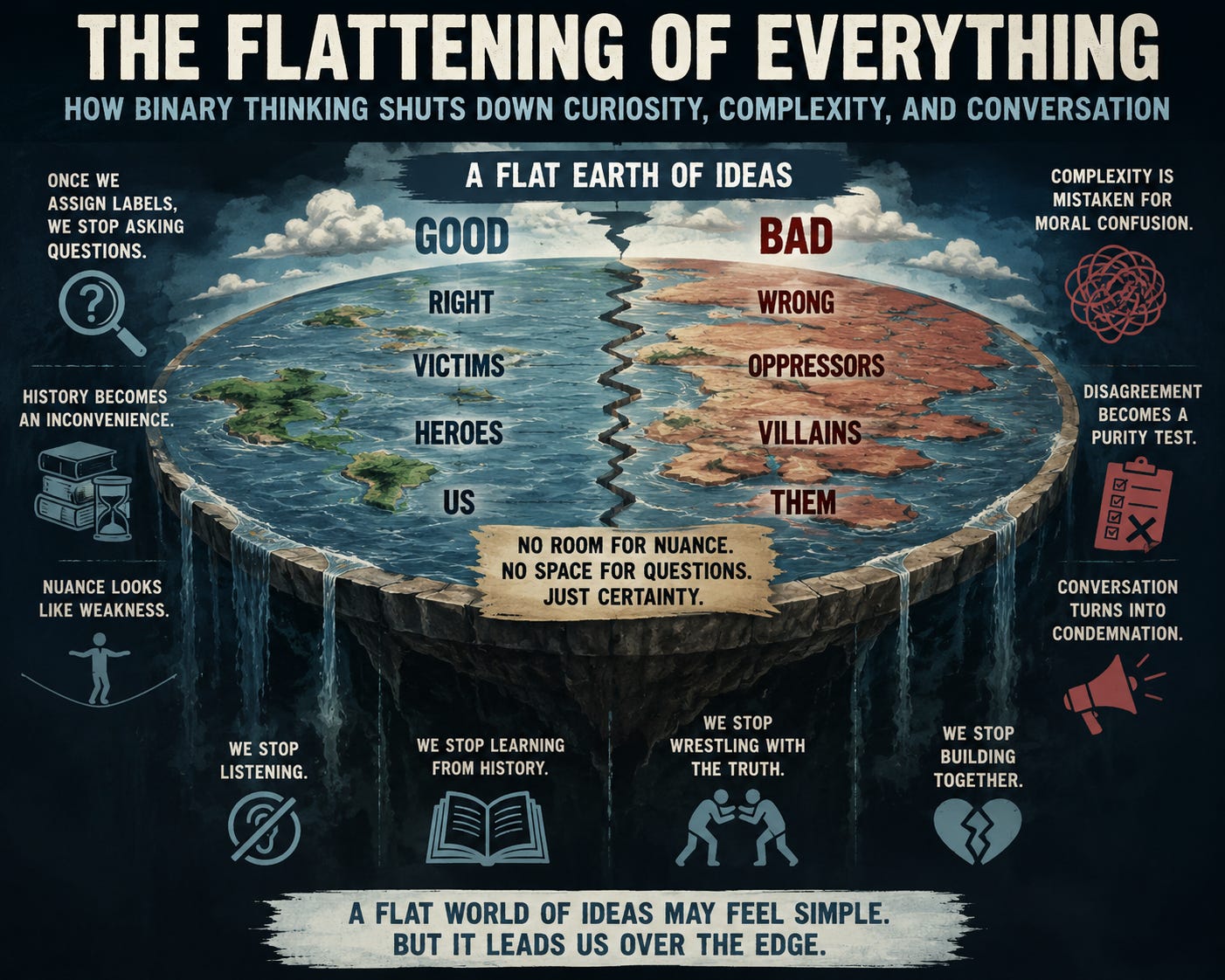
Nowhere is this more apparent than in the way we increasingly talk about the Israeli-Palestinian conflict.
There is a framework that has become particularly powerful in contemporary political discourse, especially in the West. It begins with questions of power: Who has it? Who does not? Who has historically been marginalized? Who has benefited from political, economic, or social structures?
These are important questions.
Power matters. History matters. Discrimination matters. Identity matters. And none of them exists independently of the others. Human beings inhabit multiple identities simultaneously, and those identities inevitably shape both how we move through the world and how the world responds to us.
The problem begins when asking who has power becomes a substitute for asking almost everything else.
Applied to Israel and the Palestinians, the logic goes something like this.
Israel has considerably more military, economic, and political power than the Palestinians. Israel therefore occupies the category of oppressor. Palestinians possess considerably less power and therefore occupy the category of oppressed.
Then American racial categories are layered onto the conflict.
Israelis, despite the extraordinary ethnic diversity of Israeli society, and despite the fact that a large portion of Israeli Jews descend from communities in the Middle East, North Africa, Ethiopia, and elsewhere, are frequently described simply as “white” or “European.” Palestinians, meanwhile, are placed in the category of people of color.
Once that happens, the Israeli-Palestinian conflict becomes strangely familiar to an American audience. It begins to look less like a conflict between two peoples with competing national movements, overlapping histories, legitimate attachments, terrible traumas, and profound claims to the same small piece of land, and more like another chapter in America’s own racial history.
There is, of course, a real conversation to be had about race and ethnicity inside Israel itself. I remember that from my earliest visits here in the 1970s, when the divide between Ashkenazi and Sephardi or Mizrahi Jews was far more pronounced than it is today. Years later, during my college days in Jerusalem, I stood outside the Great Synagogue protesting the treatment of Ethiopian Jews and the obstacles being placed in the way of their immigration.
Israel has changed enormously since then. Some of those divisions have faded. Others have not disappeared entirely. Pretending that Israeli society has solved every problem of race, ethnicity, discrimination, or inequality would simply be dishonest.
But acknowledging complexity is precisely the point.
Because then comes another category: colonialism.
Once Israelis have been defined as white and Palestinians as people of color, Zionism can be placed into another progressive framework - the European colonial project. Jews become settlers; Palestinians become the indigenous population; and the conflict becomes a story of white outsiders dispossessing a darker-skinned native people.
It is a remarkably clean story.
It is also one that requires an extraordinary amount of history to be flattened in order to work.
A significant portion of Israeli Jews today trace their recent ancestry not to Berlin, Warsaw, or Paris, but to Baghdad, Casablanca, Tehran, Sana’a, Aleppo, Alexandria, Tunis, and communities throughout the Middle East and North Africa. Ethiopian Jews came from an entirely different history. Many arrived in Israel after generations-old Jewish communities throughout the region were increasingly persecuted and, oftentimes, ultimately expelled. Other Jewish families have lived in this land for generations.
And beneath all of that lies an even older truth: Jewish civilization was born here.
Jerusalem was not introduced into Jewish consciousness by nineteenth-century Zionism. Jews did not begin praying toward Jerusalem after the Holocaust. Hebrew was not imported from Europe. The land of Israel sits at the center of Jewish text, ritual, calendar, language, memory, and longing across thousands of years of Jewish history.
None of that negates Palestinian history.
That sentence matters.
Palestinians have history here. They have families, villages, memories, attachments, traumas, and a national identity that cannot simply be wished away because Jewish history is ancient and real.
Recognizing one does not require erasing the other.
And that is precisely where the neatness of the framework begins to break down.
What happens when two peoples have attachments to the same land?
What happens when one people has considerably greater power today but spent much of its history profoundly powerless?
What happens when the supposedly “white” population includes Jews whose families came from literally every corner of the region?
What happens when the categories of indigenous and settler, powerful and powerless, victim and perpetrator refuse to remain fixed?
The answer should be: we study more.
The answer should be: we become more curious.
The answer should be: we ask harder questions.
But instead, too often, the categories become the conclusion.
Once this part of the world has been flattened, Israel has been assigned the role of oppressor and Palestinians have taken on the role of the innocent oppressed, remarkably little remains to be learned. Why study Jewish history? Why study Palestinian history?
When the answers are already “known” thanks to this simplistic lens, wrestling seriously with 1948 or 1967, with the occupation, the failures of Oslo, the withdrawal from Gaza, the rise of Hamas, settlements, terrorism, October 7, or the devastation that followed is irrelevant. Because the framework has already told us what those facts mean before we encounter them.
That is the moment when a lens designed to help us better understand reality begins to do the opposite.
Instead of forcing us to wrestle with contradictions, it resolves them for us.
Instead of making us more curious, it makes curiosity unnecessary.
Instead of allowing facts to challenge our assumptions, it demands that the facts conform to them.
Living in Israel has made this increasingly difficult for me to ignore. In only two months here, what becomes impossible to miss is how poorly the neat categories describe the human beings who actually inhabit this place.
That does not mean there is symmetry in every respect. There isn’t.
Israel possesses vastly greater military and economic power. Palestinians live with realities that Israelis do not. Occupation is real. Settlement expansion is real. Palestinian suffering is real. So are Israeli fear, Jewish historical vulnerability, terrorism, the trauma of October 7, and the continuing reality of movements, regimes and an Islamist ideology that claim to oppose Israeli policies but ultimately reject the legitimacy of Jewish sovereignty itself.
Holding all of that at once is difficult.
But difficulty is not an intellectual defect. In fact, it is often the beginning of understanding.
And, in the process, one foundational fact is lost and never enters the conversation- the fact that both Israelis AND Palestinians possess moral agency. Neither people is merely an abstraction called “oppressor” or “oppressed.” Both make choices. Both produce political movements and leaders. Both are capable of courage and cruelty, compromise and rejectionism, generosity and hatred.
Power matters enormously when judging those choices. But power does not eliminate agency, and suffering does not confer moral infallibility.
That may be the greatest danger of the binary itself.
For if one side is understood primarily as the oppressed, its actions are too easily explained as consequences of oppression rather than choices requiring moral judgment. If the other is understood primarily as the oppressor, its fears, history, internal diversity, and legitimate claims become morally suspect before they are even examined.
Human beings disappear behind the categories.
And that brings me back to the larger argument of this series: the flattening of everything.
The problem is not that frameworks are useless. We need them. None of us approaches history or politics without assumptions about power, justice, identity, and responsibility.
The danger comes when the framework becomes so complete that inconvenient facts can no longer challenge it.
Reality is messier than that.
Israelis are not one thing. Palestinians are not one thing. Jews are not one thing. Muslims are not one thing. Power is not one thing. History does not move in a straight line, and victimhood and moral responsibility are not mutually exclusive categories.
We should be deeply suspicious of any way of thinking that makes a conflict this old, this painful, and this complicated seem simple.
Because when understanding requires us to flatten history, identity, agency, and ultimately human beings themselves in order to preserve the categories we have created, perhaps reality isn’t the problem.
Perhaps the categories are.
No posts
Comments
Nothing yet. Say the first thing.
Sign in to join the conversation.