
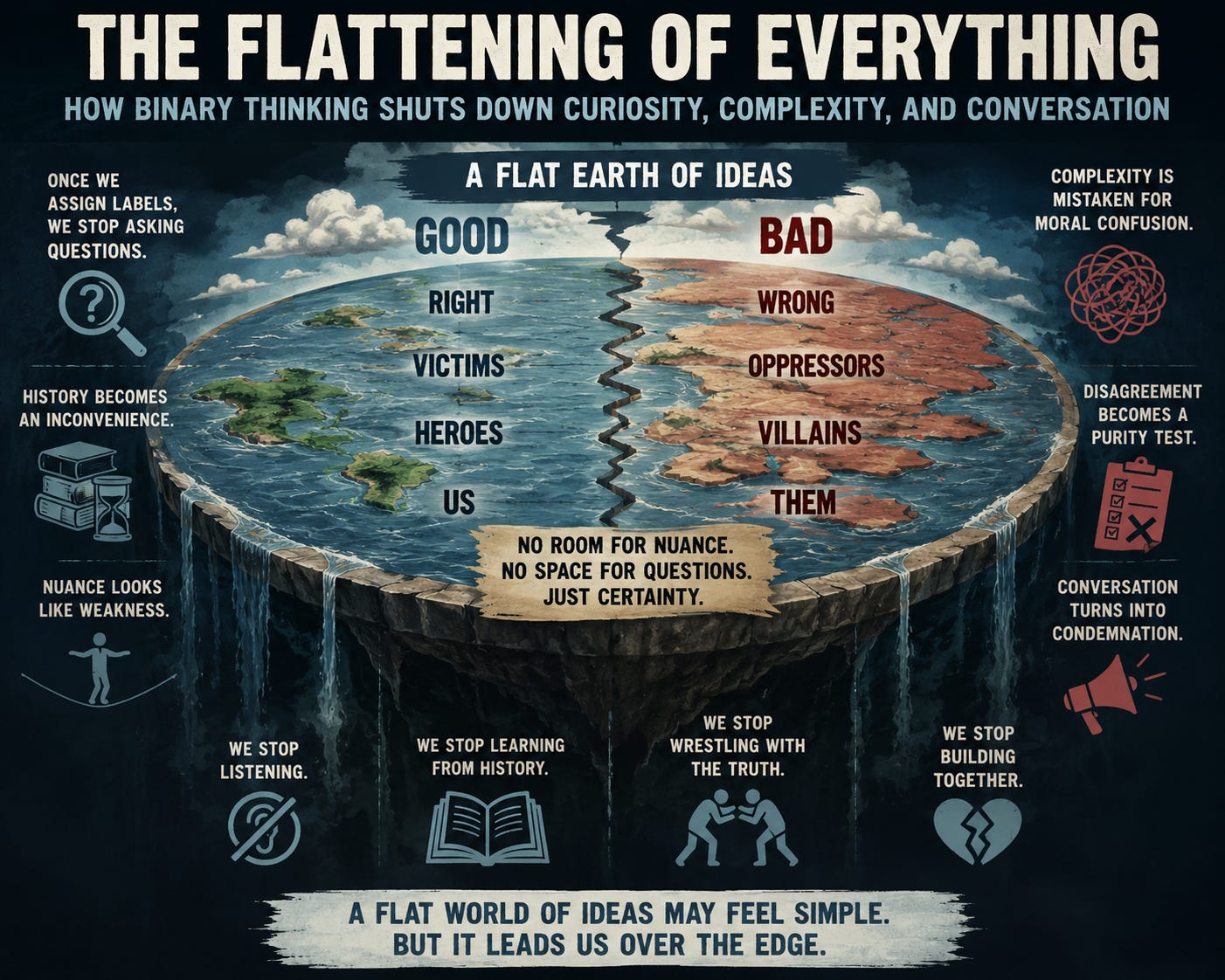
One of the things that has long perplexed me is the flat-earth movement. How, in a modern age, is it possible that there are still people who believe the world is flat? And how is it that, despite the abundance of observable scientific evidence, they hold fast to their belief?
The mental gymnastics otherwise educated people need to employ in order to hold such a position are beyond my comprehension. But they do it nonetheless, and no amount of arguing or evidence seems capable of getting them to reconsider their position. They KNOW they are right… facts be damned.
Increasingly, it seems that today’s progressives are the new “flat earthers.” Sure, if asked, they’ll readily admit that the earth is a spinning globe in the vastness of space. They don’t flatten the planet. But they flatten everything else by attempting to force everything into neat, binary categories. To them, the world is either good or bad. Opinions are either right or wrong. People are either victims or oppressors, heroes or villains.
They simplify life’s complexities into easy-to-understand binaries and, in so doing, lose the ability, or perhaps the willingness, to hold complexity. (Or perhaps they never had it, and that is WHY they embraced this flattening.)
Here’s the problem with that approach…
Once we’ve assigned the labels, we stop asking questions. History - messy, confusing and often contradictory - becomes an inconvenience. Embracing nuance and being willing to shift positions looks like weakness, and struggling with complexity is mistaken for moral confusion.
We see it everywhere. In politics, on social media and inside religious communities. And we see it in conversations among people who once prided themselves on curiosity and intellectual honesty.
People enter into conversations armed with one of the most effective ways of shutting down conversation: moral certainty.
But that certainty comes with a cost. Because once we flatten people into categories, we no longer have to listen, let alone wrestle with their stories. Once we flatten history into slogans, we no longer have to learn from it. And once we flatten disagreements into moral purity tests, we no longer have to engage, since anyone who disagrees with our position fails the test and is therefore immoral.
For today’s flat earthers, everything needs to fit into a tidy categorical box. It certainly makes the world easier to understand, but in a world as complex as ours, it is not only intellectually disingenuous; it ends conversation before it even begins.
Living in Israel has only reinforced my conviction that the process of flattening everything is destroying Western society. Because it is all but impossible to flatten life here. Here I see things that make me proud and things that make me furious. Sometimes on the same walk.
Here I meet people whose politics make absolutely no sense according to American categories. I meet people who are deeply progressive on one issue and deeply conservative on another. I meet religious Jews who support policies I oppose and secular Israelis who hold views that would bewilder American liberals and conservatives alike. (That is Part Three of this Stack.)
In Israel, reality refuses to cooperate with clean, simple boxes. And I truly believe that is the most intellectually honest approach. After all, human beings are messy. Countries are messy. History is messy. And human beings living in countries with long histories are MESSY!!!!!!
The flattening of everything doesn’t simply produce bad analysis. It shuts down discussion and debate and fuels bias and hate.
After October 7, I experienced that personally. There were people who knew me for years who heard me speak about murdered Israelis, hostages or frightened families and somehow translated that into a single question: “So you’re okay with dead Palestinian babies?”
Think about what happens when an interaction reaches a point of disconnect like that.
There is no conversation to be had.
There is no moral struggle with which to grapple.
There is simply judgement.
The 1200 people brutally slaughtered and over 200 kidnapped become irrelevant because Israelis are “bloodthirsty” and Palestinians are innocent victims. Those addressing me accused me of being a moral failure because I didn’t explicitly state my heartbreak at the loss of innocent lives. That, despite the fact that, through their silence, they were doing exactly what they accused me of when it came to Israelis.
It’s morally repugnant.
I refuse to believe that compassion for one people requires indifference to another. I refuse to believe that acknowledging complexity is moral weakness. And I refuse to believe that certainty is the same thing as courage.
The older I get, the more convinced I become that maturity is not about finding simpler answers. Maturity is about becoming capable of holding more complicated, often competing, truths at the same time.
Sadly, it seems we are living in an increasingly regressive era. And it is coming from the corners of society that I always admired for their intellectual prowess.
And that benefits no one.
No posts
Comments
Nothing yet. Say the first thing.
Sign in to join the conversation.