

I’ve been using GitHub Copilot for AI-assisted programming for more than a year now; for the last 9 months or so, I’ve used Anthropic’s Claude Sonnet 3.7 to do most of the work.
While the rest of the world argues with ChatGPT and gets annoyed with its confident sounding hallucinations, or fiddles with creating cool looking images...those of us that use AI for coding on a daily basis see an entirely different future taking place right in front of us.
In this domain...AI is dominant. Even the experts now say so; in fact, the team that is creating the software for “Claude Code” at Anthropic now uses Claude Code to write 100% of the new code for Claude.
Claude Code...is writing itself.
And man… it’s scary good.
Claude Sonnet 3.7, which I used for six months, was already impressively good, but at times I had to force it to redo work that it did poorly, or coach it with suggestions about how to solve certain problems that it got stuck on (”use this tool, look here for the data, write the code like this, use that as an example”)
Interestingly, it still did excellent work and interacted with me conversationally and jovially (as a junior programmer would have), while giving me compliments for my brilliant approaches to problem solutions at times. Sometimes even replying to me in Portuguese, for some reason.
One time, after a few hours of going round and round on a problem that it couldn’t solve, I got frustrated and wrote “fix the damn code!” which somehow made it choose an alternate approach that led to an eventual solution.
But while it was replying to me it said “OK, I fixed the DAMN CODE!” and I laughed at how human it sounded; it was just like a frustrated programmer dishing it back at me after I yelled at it.
But what I did over the past two days with its successor...was unbelievably better.
Coding is now dead as a profession; at least in the way it was understood up until about 2023. If traditional coding was analogous to hunting with clubs and arrows, modern coding is like hunting with laser-cannons mounted on a fleet of B2-stealth bombers all flying on autopilot.
When Claude Opus 4.5 arrived as an option in GitHub Copilot last month, I switched to using it—even though it costs more to use (it has a 3X multiplier vs. other models.)
I gave it a try anyway, and it was breathtaking. It is in an entirely different league than anything I’d used before. And I’m not the only one.
No less than Andrej Karpathy agreed:
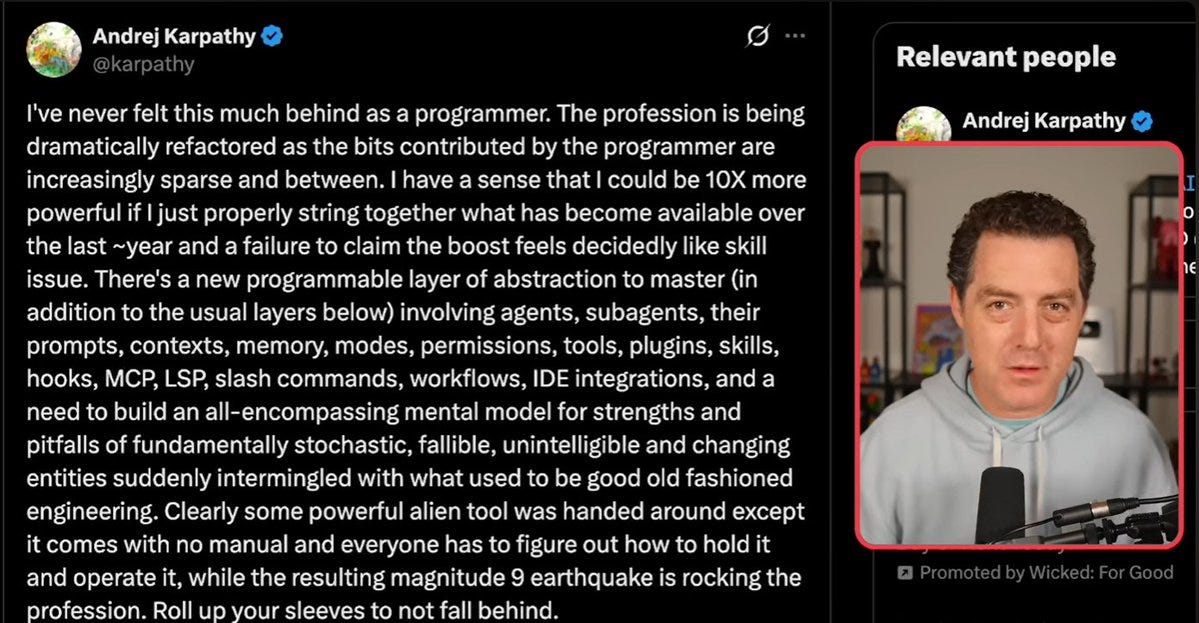
Here’s the video that describes what is going on:
I’ve written many times about my experience with AI-assisted programming over the past 18 months; at one point I estimated that on some tasks AI gave me a 100X improvement in time to completion.
Two days ago, I asked GitHub copilot (using Claude Opus 4.5) to build a new tool for my colleague at work. The tool is like a web-based spreadsheet that pulls data from a variety of sources and lets the user quickly contact customers while creating a data-populated rich text email template.
Something like this would have taken me and my team about two weeks to build, in the past; it required a new front-end component for the web, new APIs to handle data operations, new interactivity with existing modules like my email component, and a new database model.
From the time I asked Claude to start work on the component until the time it was done was about 15 minutes. It actually took longer for me to describe in a text file what I wanted it to build than it took Claude Opus 4.5 to build it.
And it just worked.
I had to go through a few iterations afterward to add features that I hadn’t thought through well enough initially and add some functionality; this it did in mere minutes each time. In other cases, it anticipated what the tool should have done, and it just designed the tool to do that without me even asking. It made smart choices.
It also understands the business side of what the tool is built for (a property management company) and it understands the accounting and analytics processes relevant to that kind of business.
Today, my colleague started using the new tool to do an annual process that used to take her the better part of a week to accomplish; with my new tool, she got it done in a few hours.
But here’s the crazy part.
While she’s using the new tool (working from home) I’m watching the same new component on my screen; I designed it to auto-update as she makes changes on her side (no page refresh required), so I can follow along with her.
As I examined her work, I saw opportunities to make the tool even better and make it easier still to use; I added some more automated data lookups into the email templates she was using, even changing the content of the email body dynamically based on which options she chose.
So, while she’s actively working with the tool to complete her annual task, I’m improving it in parallel, in real time. Then I told her: “Hey, take a lunch break; when you’re back, these new features will be live on the production system.”
Before she left for lunch, I went over the changes I had just made in my development environment to get any last-minute feedback from her; and while both of us were at lunch, I had the AI check in the code and publish it to production.
That sort of thing wasn’t even conceivable a few years ago, when I did web-app development with a small team. I built a functioning tool now in hours instead of weeks.
I also made meaningful user-experience improvements in real time, tested them and pushed them to a multi-server load balanced Linux production system, all as I watched my colleague use the tool.
There has never been a time like this in my career (and I used to build supercomputers, back in the day.)
Because I gave Claude Opus 4.5 agent access to my database as I’ve been developing code with it, I was even able to ask it to do data analysis for me; things that I would have been tasked to do, like “find me the payment history for this client, and look for missing payments and patterns.”
I literally asked the Agent to do this in English, without telling it what tables or code to use. I just gave it a name: “find me the payment history for John Smith from the electronic payment system and also from the internal ledger” and it knew enough about the structure of my system to just figure out how to get the answer.
Then it gave me a nicely formatted table showing me the analysis. Next I said: “cool...but can you convert that to a PDF?” and in seconds, it did.
Then I said “this is great. Can you turn that process you just went through for John Smith into a new command line tool that I can run at any time, just by giving you an arbitrary customer name or address?” And viola: now I have a script that I can use to generate a PDF with an analyzed payment history just by asking for a client’s name.
These AI tools are now like having a few software PhDs teamed up with an expert accountant and a data analyst all in one.
Like Inigo Montoya in the Princess Bride, I now have to say “I admit it. You are better than me.”

But I don’t get to say: “I have a secret though; I’m not left-handed, either.”
The AI can beat me with either hand, now. Easily.
Not only can it code much better and faster than I can; it can now also do the data analytics that I would routinely do using the tool that I built to help me do that analysis—but it can get the result ten or twenty or a hundred times faster.
This year I will extend the business application to allow voice-controlled agent access, so that office users can just say something like “give me the payment history for Jack Smith” without even opening the web app or searching or typing anything.
And then...I don’t know what I’ll do next. Seriously don’t know.

CognitiveCarbon’s Content is a reader-supported publication. To support my writing and research work and make it so that I can afford to buy a pack of steaks at Costco again, please consider becoming a paid subscriber: at just $5 per month, it helps me support a family.
You can also buy me a coffee here. Thank you for reading!
No posts
Comments
Nothing yet. Say the first thing.
Sign in to join the conversation.