
“Can you tell me where the time and motivation come from to get students to improve their English proficiency in 4 years of university?” The teacher’s question—not accusatory, just slightly exasperated—was directed to the panelists at the end of a recent conference on English language learning and testing in Taiwan universities.
Perhaps thankfully for the Panel of distinguished professors and researchers on stage, her question too big for the 5 minutes remaining in the Q&A.
But it hung over venue like a dark cloud on an otherwise clear skies day of careful, logical, well-supported and well-intended research on efforts to pave the way for more English as a Medium of Instruction (EMI) courses in Taiwan universities to help realize the government’s Bilingual Nation 2030 policy.
This dark cloud also pre-empted one of my own—a half formed nagging question: what does language learning and testing really mean in an age of always on-demand Artificial Intelligence?
After all, AI can read and write in any language faster and better than any human, and now with Apple air pods, AI glasses and even ChatGPT on your phone in voice mode, can translate written and spoken language in real time.
All four language skills in any language at your finger tips. Just think about this for a moment.
It means an 85-year old Taiwanese great grandma, who has never formally studied English in her life, can use ChatGPT on her phone to have a better conversation with an English speaker than a university student in Taiwan who has “studied” English for over 1000 hours since elementary school.
I think about this a lot.
For every Taiwanese who reaches an intermediate stage of being able to read and speak English, there are probably 10 who never make it past the elementary level of communication. This is not just inefficient learning, it is a form of childhood theft. My bilingual daughter had to sit through hundreds of hours of English classes full of Chinese explanations she could not understand.
The conference day of research, policy, and lesson plan sharing did not raise this issue of AI at all. It was like a conference held before 2022, before ChatGPT was unleashed on the world.
The bilingual nation policy (instigated by current President Lai Ching-te in 2018) aims to make the population more bilingual in professional, government, and academic settings to enhance international competitiveness for the country as a whole and for individuals, as well as attract more professional talent, corporations, and students to Taiwan.
And like so many political initiatives, especially in education, it’s become a speeding train with unstoppable momentum.
Many educators, including myself, have been thinking and writing about these issues for the last few years, and one thing is clear: while many are ignoring the revolution (devolution?) in learning that AI has wrought, even the many who recognize the impact on learning and learning institutions are trying to work things out as they go. Like non-engineers on a ship in tropical seas who are trying to rebuild it for passage through an unexplored Arctic.
These unfamiliar cooling temperatures and pressure systems are turning my thoughts on AI, education and language learning into clouds of questions that resist clear answers.
So, let’s get started with my first question, …
At the very least, we should encourage both teachers and students to use AI to learn languages.
With a little thoughtful prompting, AI can help us practice all four skills:
AI can create level-specific language lessons for reading, grammar, and vocabulary
it can write, but it can also evaluate a student’s writing
it can read aloud texts for listening practice
and AI tools like ChatGPT and Gemini have impressive voice modes that can interact with learners in real time conversations in most languages, and even code-switch between languages. This practices both speaking and listening skills.
In short, AI can be a learning intensifier, the likes of which have never been seen in language learning.
My second question is more problematic:
The most widely-used international scale for language proficiency is called the Common European Framework of Reference (CEFR) and has six levels: two levels for elementary (A1-2), two for Intermediate (B1-2), and two for Advanced (C1-2), with each levelling up taking over 200 hours.
However, outside of the classroom or testing center in today’s real AI-saturated world, everybody is already functionally bilingual. However, what tips the scales in terms of better AI-assisted proficiency is how capable you are at evaluating the appropriateness of the language output for your specific context.
This why in my post-ChatGPT classroom for business people or researchers, I focus more on communicative strategies to guide and evaluate AI language outputs. My students don’t have—or don’t want to spend—the hundreds of hours to raise their proficiency from B1 to B2. Here I see AI as a career skill, an amplifier of human language ability.
Reading and writing are the easiest to “functionally” master with AI. A text in another language, or even a long one in your own, can be run through AI to summarize it and explain. And writing, traditionally the hardest skill to master, is now generated flawlessly at whim, albeit often abstract and bland in style.
That leaves listening and speaking. These are the first language skills we learn first as toddlers and the most important for authentic face-to-face interaction and communication. For certain situations, real and unmediated human interaction will be crucial for creating, developing, and maintaining important relationships, such as with clients, collaborators, colleagues, and superiors.
Nowadays, AI tools can be used for on-demand listening and speaking practice. Before, this was the crucial missing link and major obstacle for developing real-time communication ability. Perhaps we are entering a return to prestige of oral communication ability that was the gold standard for wisdom and communication ability in the oral cultures that predated book cultures hundreds of years ago.
This leads me to my third question:
If speaking skills become the new gold standard for real-world communication, who really needs to spend the hundreds of hours to learn them?
Answer?- Certain service industry providers and professionals whose job is to build trust, persuade, and enter into relationships, such as nurses, salespeople, and teachers.
This begs a further question relating to the education system itself and its purpose: does everyone need to be put into the same factory assembly line of English school classes from elementary school to college?
Finally, my last final question …
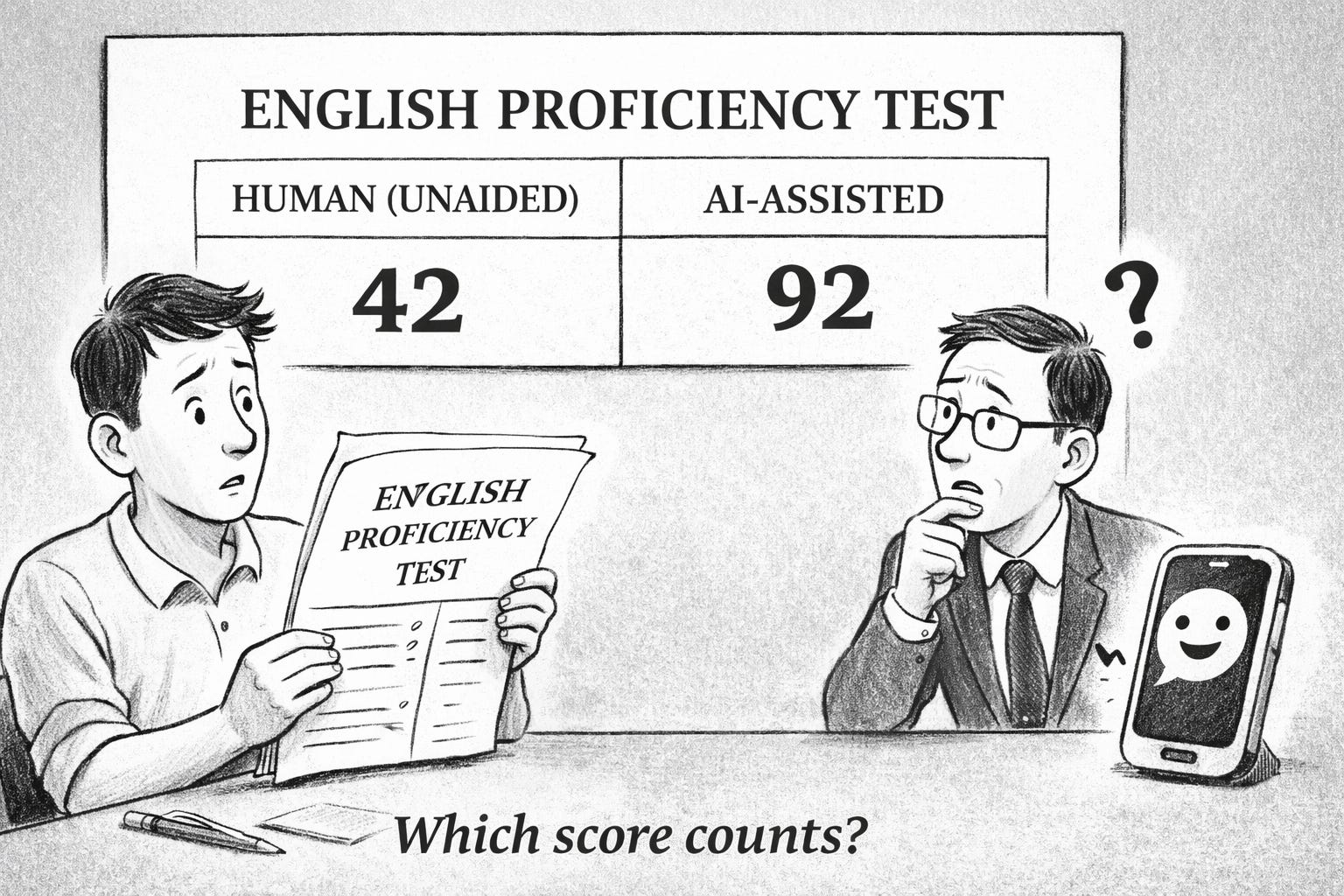
If AI collapses traditional language proficiency constructs, should language testing split into two domains, human proficiency and AI-mediated proficiency? One measuring what you can do alone in face-to-face situations, the other measuring what you can do with the tools you actually use?
After all, most industries already assume AI-mediated communication for reading and writing. And really, how many roles in Taiwan really require unfiltered human interaction? Some, but not many.
Maybe testing should reflect that divergence—a future of language testing where the score is not one set, but two: how well you use language yourself, and how well you use it with the machines now speaking beside you?
If we end up with two kinds of proficiency—human and AI-mediated—then the teacher’s question from the start returns with even more weight: Indeed, where will the time and motivation come from to raise human proficiency when the world no longer demands it?
Many students have undoubtedly come to the same conclusion. And if most learners already rely on machines anyway, how should universities spend the limited hours their teachers and students do have?
Maybe the future of language education lies not in insisting everyone climb the same ladder, but in being honest about which ladder matters for which learner. And why.
No posts
Comments
Nothing yet. Say the first thing.
Sign in to join the conversation.