
What do cocky gods, ghosts, hell contracts, temple charms and bubble tea have to do with young adulthood in Taiwan?
Quite a lot, if Netflix’s Agent from Above (Jishen, 乩身) is any guide. Released on April 2, 2026, the Taiwanese supernatural drama rose to No. 1 on Netflix in Taiwan and Hong Kong within 48 hours and climbed to No. 6 on the platform’s global non-English TV ranking [1].
At its center is Han Jie, a young man locked into service as the spirit medium, or jishen, of the god San Taizi (三太子) after a tragic mistake [2]. He must fight, repay and atone in a world where power comes with obligation.
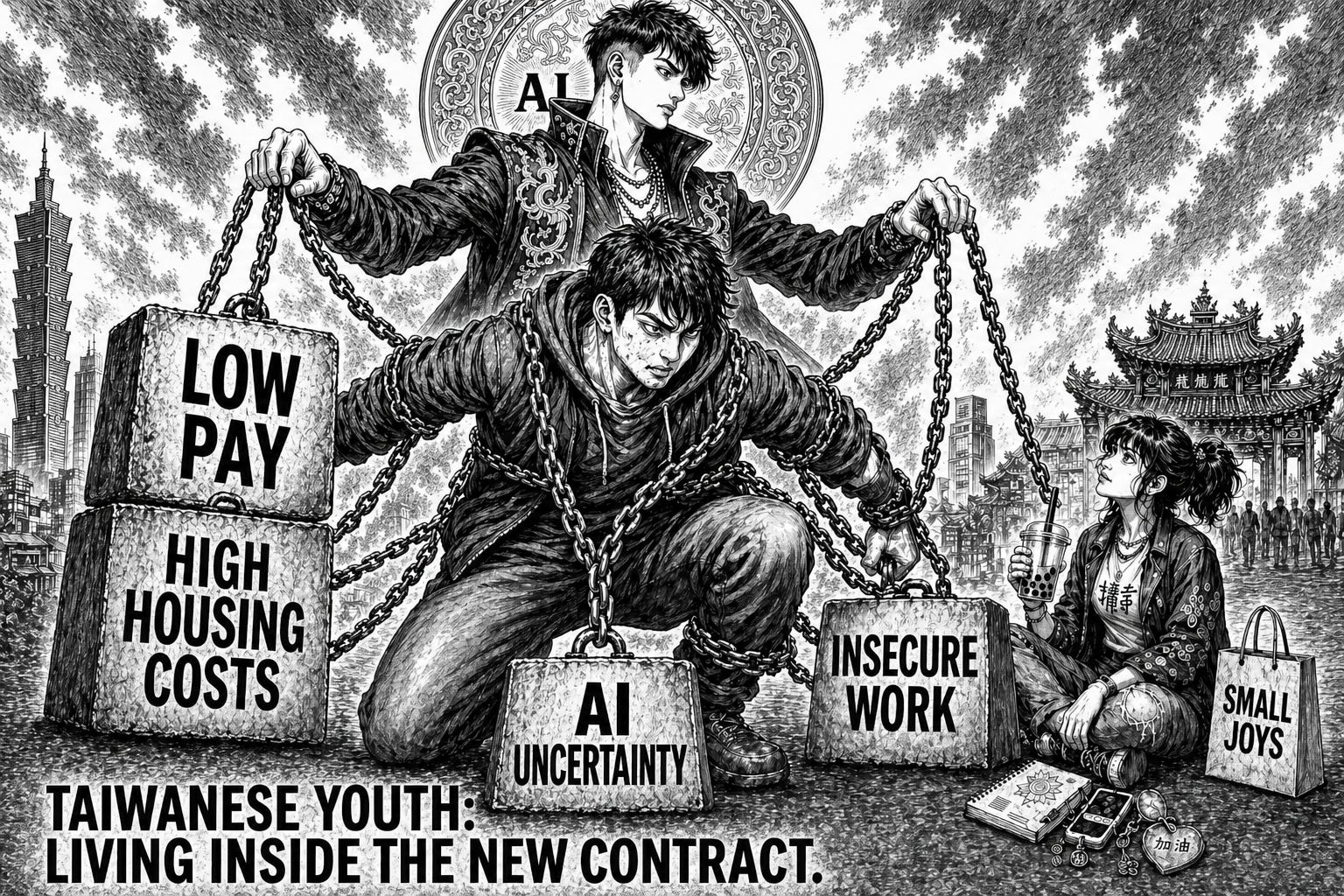
That premise is familiar to many younger Taiwanese. Adulthood now looks like a contract with unstable terms, where inherited social burdens remain, AI is rewriting the job market, and the future is harder to read.
Old social burdens
Even before AI enters the picture, young people in Taiwan already face a hard start. In 2025, Taiwan’s overall unemployment rate was 3.35 percent, but unemployment was 11.60 percent for people aged 20 to 24 and 5.77 percent for those aged 25 to 29 [3]. University graduates had the highest unemployment rate by education level, at 4.53 percent [3].
Starting pay remains modest. Labor Ministry data for 2025 show that first-job monthly salaries for university graduates averaged only NT$36,000 [4].
Housing is bleaker still. In the first quarter of 2025, Taiwan’s national house-price-to-income ratio reached 9.68, while Taipei’s reached 15.57 [5]. For residents of Taipei, that means they would have to save their entire salary for more than 15 years—without spending a single dollar on food, clothes, or rent—to afford a modest home.
While traditional pressures to study hard, find a stable job, buy a home, marry and raise children haven’t changed, for many younger adults, that sequence feels out of reach.
This helps explain why small pleasures have become so important. Taiwanese youth seek small but certain joys (小確幸 xiǎo què xìng) and chase the best happiness-to-price ratio (幸價比 xìng jià bǐ), in small purchases like Starbucks lattes and bubble tea to make pressure briefly bearable [6].
AI anxieties
AI adds a new layer to this pressure. The old education-to-career pipeline is already weakening. A 2026 report citing 1111 Job Bank found that 48.6 percent of fresh graduates chose jobs unrelated to what they studied [7].
AI-related work is also growing quickly. A 104 Job Bank report found 67,000 AI-related jobs open to fresh graduates in the first quarter of 2026, with 62 percent not limited by major [8]. The report said more than 70,000 fresh graduates applied for AI-related jobs in 2025, up 46 percent from the previous year [8].
And while that sounds like opportunity, it also changes the rules. Young people are being told to enter fields that are new and unstable. They are also being told to use tools that may remove the entry-level tasks that once helped people learn.
A 2025 1111 Job Bank survey found that 78.7 percent of workers felt anxious about their career future, while 61.5 percent worried their jobs might be replaced by AI [9]. Alarmingly, 49.4 percent feared their own professional expertise would be displaced by AI [9].
For young workers, AI is more than a tool. It is a moving target. Learn it quickly and it may help. Fall behind and it may become another gate closing in front of you.
AI opportunities
The government sees this too, especially in its plan to make Taiwan an AI island. The Ten AI Initiatives Promotion Plan by the National Development Council (NDC) frames AI as central to national security, national power and economic prospects [10].
A related NDC talent plan aims to cultivate 450,000 AI, green-collar and cross-disciplinary digital talents by 2028 [11].
Higher education is being pulled into this agenda. The Ministry of Education’s Taiwan Artificial Intelligence College Alliance includes 55 colleges and universities and offers cross-university AI credit programs [12].
At the school level, the ministry has also issued generative-AI guidance and student manuals for elementary, junior-high and senior-high students [13]. The message is clear: AI is unavoidable and must be learned. AI is becoming less like an optional tool and more like a new social contract.
AI skills?
Many Taiwanese students and workers have already signed that contract in practice.
A 2025 1111 survey found that 89.8 percent of workers had used AI tools such as ChatGPT or Midjourney, while 30.3 percent said they used them often [9]. The same survey found that 54.4 percent had already taken AI or digital-skills courses, while 92.8 percent said they were willing to spend time on AI workplace-transition training [9].
But AI use is not the same as AI skills. The 2025 Taiwan Internet Report from the Taiwan Network Information Center found that among AI users, 79.25 percent believed they could evaluate AI’s strengths and weaknesses, but only 66.23 percent believed they could use AI effectively to achieve what they wanted [14].
The problem is sharper among students.
A 2025 Child Welfare League Foundation survey found that 62.5 percent of Taiwanese adolescents used generative AI at least once a week, and 20.9 percent used it daily [15]. The same survey found that only 39.4 percent verified the accuracy of AI-generated information, while 40 percent rarely or never paid attention to avoiding uploads of personal data [15].
Like San Taizi, AI can look protective. It offers power, guidance, shortcuts and even comfort. But it can also mislead, distort judgment and quietly bind users into dependence.
Everyone, but especially young people, need to know its strengths and limits. They need to use it to sharpen judgment, communication, creativity, empathy and learning.
Younger generations cannot afford to let AI flatten those human qualities into automated output. To do so guarantees replacement and redundancy in an AI future. That may be why Agent from Above has struck such a nerve. Beneath its gods, ghosts, temple battles and bubble tea, it captures a dark mood many younger Taiwanese know well.
Old burdens are being intensified by AI anxieties, and the terms of adulthood keep changing.
There is no simple release. Only the need to keep moving, keep learning and keep enough of the human self intact to live and compete inside the new contract.
References
[1] About Netflix. (2026, April 8). Netflix《乩身》48小時空降台灣、香港排行榜冠軍 榮登全球非英語影集排行榜第6名!
https://about.netflix.com/zh_tw/news/agent-from-above-celebrates-divine-ascent-to-global-ranking
[2] About Netflix. (2026, February 26). 人間與靈界的宿命之戰一觸即發!Netflix原創奇幻民俗動作影集《乩身》4月2日全球獨家登場.
https://about.netflix.com/zh_tw/news/agent-from-above-premieres-april-2
[3] 公視新聞網. (2026, February 5). 2025全台失業率微減0.03% 待業碩博士比例創近5年新高.
https://news.pts.org.tw/article/794010
[4] 勞動部. (2026, April 24). 114年初任人員薪資統計結果.
https://www.mol.gov.tw/1607/1632/1633/90149/
[5] 經濟日報. (2025, September 4). 買房痛苦指數仍高!2025年第1季房價所得比達9.68倍.
https://money.udn.com/money/story/5621/8984160
[6] TVBS Health. (2026, February 6). 抗通膨!沒CP值別想賺年輕人的錢「新節儉主義」正流行.
https://health.tvbs.com.tw/life/357240
[7] 經濟日報. (2026, March 6). 不再糾結學以致用 人力銀行:近半數新鮮人選擇就業與所學無關.
https://money.udn.com/money/story/5612/9363495
[8] 104人力銀行. (2026, April 7). 搶當AI新貴!6.7萬個AI工作機會 62%不限科系 歡迎新鮮人.
https://corp.104.com.tw/archive/storage/news/filename_1604.pdf
[9] 1111人力銀行. (2025, July 4). AI世代求職焦慮調查:月花5000元投資進修.
https://www.1111.com.tw/news/jobns/161433
[10] National Development Council. (2026). Ten AI Initiatives Promotion Plan (2025–2028).
https://www.ndc.gov.tw/en/Content_List.aspx?n=E738D6D7DD31163F
[11] National Development Council. (n.d.). National Talent Competitiveness Jumpstart Program (2024–2027).
https://www.ndc.gov.tw/en/Content_List.aspx?n=14A9F8185CBA2C03
[12] Taiwan Artificial Intelligence College Alliance. (n.d.). 計畫緣起 / Origin of the Project. https://taicatw.net/
[13] Ministry of Education. (n.d.). 推動中小學數位學習精進方案入口網:資料下載.
https://pads.moe.edu.tw/download.php
[14] Taiwan Network Information Center. (2025). 2025 Taiwan Internet Report.
https://report.twnic.tw/2025/assets/download/TWNIC_TaiwanInternetReport_2025_CH_summary.pdf
[15] Child Welfare League Foundation. (2025, September 24). CWLF Survey: 63% of Teens Use AI for Schoolwork, but 60% Rarely Verify Accuracy or Safeguard Privacy.
https://www.children.org.tw/english/news_detail/2025-survey-online-safety
No posts
Comments
Nothing yet. Say the first thing.
Sign in to join the conversation.