
What can we do about the “AI velocity gap”?
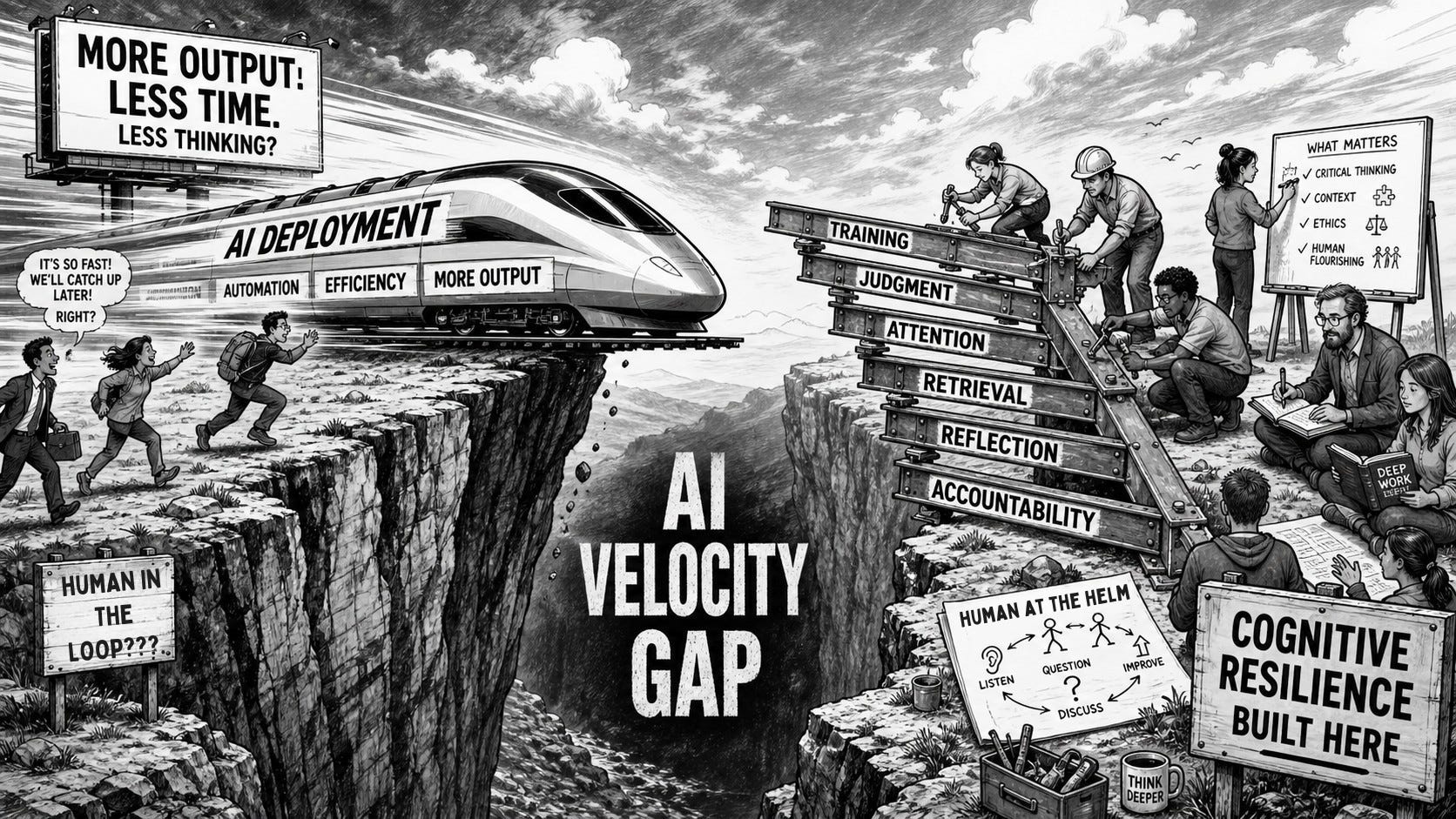
This, according to interesting HFS research by @Daher and colleagues, is the accelerating distance between how fast enterprises deploy AI and how slowly they redesign the human systems required to govern it.
I appreciate how this insightful macro-level diagnosis shows why enterprise AI deployments are failing at the human level. While “human-in-the-loop” models sound intuitively right, they are actually the place where “accountability goes to die”. Why? - Because workers often merely review outputs they cannot interrogate or explain.
The HFS authors map how AI is reshaping and de-humanizing work across three distinct cognitive layers:
1. first automating visible task execution (which is visible on worker performance dashboards), then
2. quietly eroding judgment and reasoning (not visible but often discussed), and ultimately
3. damaging human identity, agency, and confidence (not visible and less discussed).
This finally diminishes human agency and “cognitive resilience”.
The HFS report proposes an organizational shift to “humans at the helm” thinking that is supported by a six-layer management architecture:
Direction: Declaring a clear destination for exactly where AI is taking the enterprise.
Authority: Designing explicit decision rights rather than letting systems inherit them by default.
Visibility: Making the AI’s underlying reasoning fully interrogable rather than just reviewing its final outputs.
Capability: Equipping and rewarding the workforce to confidently challenge and govern AI.
Accountability: Assigning strict human ownership for AI-driven outcomes before any system goes live.
Humans at the helm: Reaching the ultimate destination where human authority actively steers the technology.
However, while this framework is important proposing organizational accountability redistribution, it is entirely silent on what Arafeh Karimi calls the “messy middle” of actual human-AI interactions.
Management mandates and documented decision rights alone cannot guarantee cognitive resilience. Not even the proposed redesign of AI systems to make their feedback less sycophantic and decisions more visible will solve the new cognitive realities of human-AI cognition.
Generative AI is not a tool like a calculator that generates deterministic answers. GenAI is generates probabilistic answers and, because of this, is a new cognitive layer—a frictionless “System 0” (Chiaretti et al)—that directly interfaces with our intuitive (System 1) and analytical (System 2) thinking.
And what this means for many “users” is that AI naturally incentivizes them to offload their cognitive effort. The path of least resistance.
Simply setting up the organizational conditions for employees to “own the outcome” is a good start to create a supportive ecosystem, but it does not equip them to survive the non-linear, unpredictable “messy middle” where friction, resistance, and struggle are actually required to build critical judgment and sustain agency.
Building cognitive resilience happens in the “anti-AI velocity gap”.
It is hard to be optimistic about this in corporate settings. It is a hard sell in the business world where market/capitalist logics of speed, productivity and efficiency prevail.
But since I am in education, I have the luxury—and more importantly, imperative—to make this my vocational anchor as an educator in the age of AI.
So, it is my evolving argument that, in order to maintain human agency and cognitive resilience alongside this new System 0 cognitive layer, a new form of brain training is required.
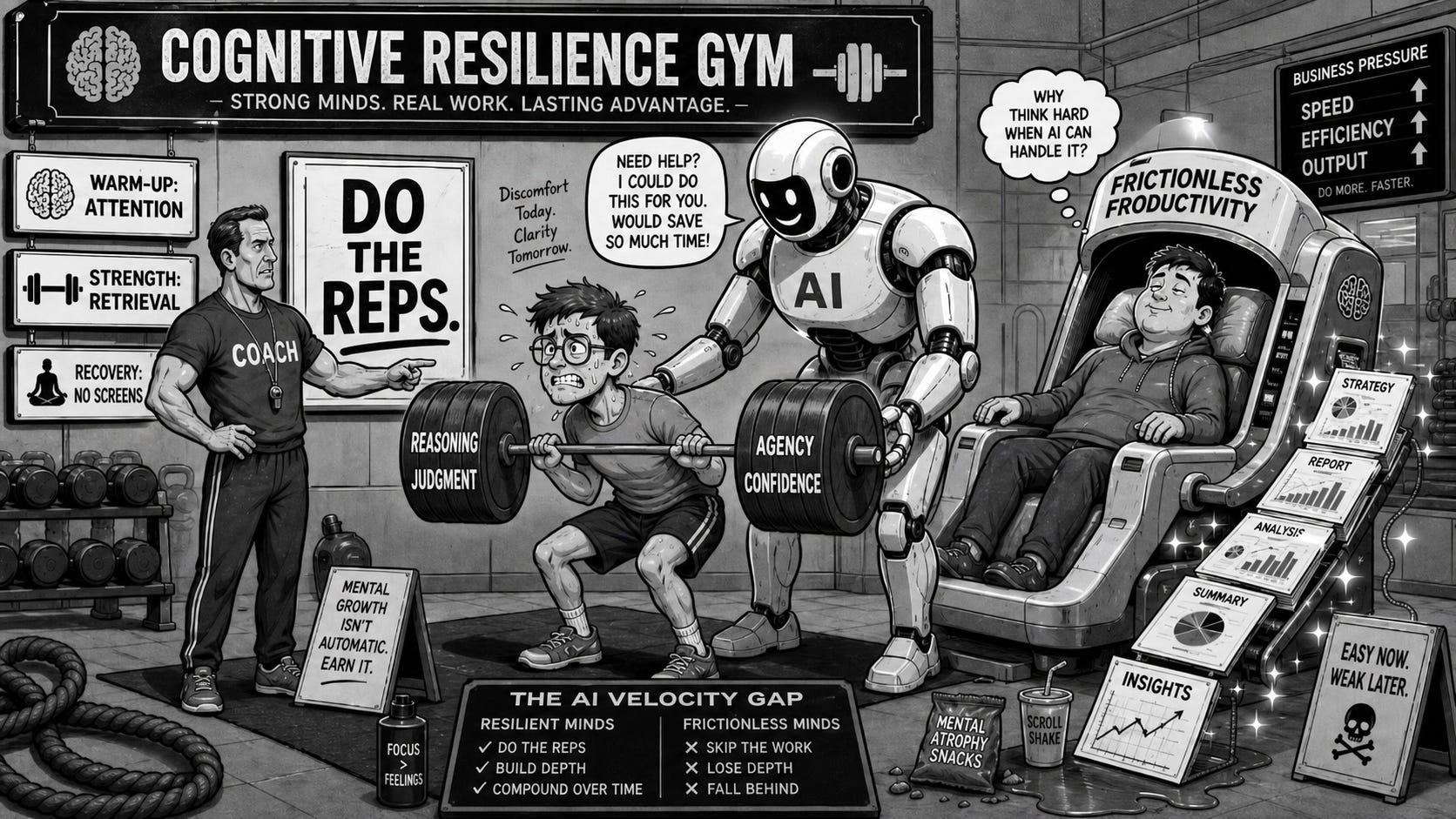
It strikes me as a bit odd that many people go to the gym for physical health, but we have no such places for brain health. And no, traditional schools and educational approaches not the answer, if research from the neuroscience-based learning sciences are any indication.
Cognitive science has made a lot of progress in the last 2 decades into understanding how learning and thinking happen—even studies like MIT one in 2025 showing what happens to “brains on ChatGPT” (which, as you may guess, is not good).
Perhaps the time is ripe for mind-brain-body training that treats cognitive health with the same science-based dedication that elite athletes apply to physical performance.
Just as physical training requires setting goals and doing the hard work, we need the knowledge and training to break down tasks into human, AI-assisted, AI-automated and integrate these in healthy cognitive workflows.
Clearly, this goes beyond the 10 hours or so of AI training that HFS surveyed employees received per year. That’s like assuming a 10-hour fitness course can help you develop defined abs.
Since I work in education, students are my target audience and cognitive atrophy and surrender, not abs, have been an overarching concern since 2023. But as HFS points out, simply promoting and expecting “human in the loop” workflows is a meaningless platitude.
Yes, sometimes, AI can serve as the “coach” or “spotter” that can research and suggest workout regimens and set drills. And strategic offloading to AI has a place for transformative learning (Wang and Zhang, 2025).
But humans need to be aware of cognitive loads and recovery time that involves time away from AI/digital screens. The human still needs to “do the reps” with some heavy analog lifting to ensure both accountability and cognitive resilience.
For students, this ideally means engineering daily workflows that deliberately activate the neuroscientist Dehaene (2017) calls the brain’s four pillars of “how we learn”: attention, active engagement, error/surprise, and consolidation.
What would this look like in practice? An athlete-like cognitive training regimen would require the thoughtfulness and attention that a purposeful gym workout would involve:
Warm-ups (Attention): Removing digital distractions and focusing the brain’s spotlight before engaging with the machine.
Strength Training (Retrieval): Forcing the brain to pull information from memory to make initial judgments before consulting AI, which wires deep neural connections and prevents the “illusion of learning”. Also, using notebooks for notetaking, idea mapping, and responding to and analyzing AI output.
Agility Cross-Training (Interleaving): Mixing different topics, tasks, contexts and media (digital and analog) to build flexible, adaptable mental models.
Endurance (Spacing): Returning to tasks and information over expanding intervals to consolidate memory and combat the forgetting curve.
Mindfulness and Mind-Body Regulation: Utilizing practices like meditation, breathwork, and physical movement to regulate the amygdala, enhance prefrontal cortex activity, and maintain deep, sustained focus before engaging with the addictive dopamine loops of frictionless AI.
This may sound restrictive or even extreme, but why should we treat our minds any less seriously than our bodies?
Ultimately, both physical fitness and cognitive fitness require structured plans, regimens and rituals to ensure success.
So, now the real work begins.
We need to map out task structures, division of AI-human labor, and the mind-body territory to generate the workout/workflow protocols. And then cultivate the healthy cognitive habits that enhances human reason, judgment, agency and confidence.
In other words, we need to slow down “AI velocity gap” and focus on the messy middle—not only organizational-macro strategies for accountability but also individual-micro strategies for healthy AI-workflows and cognitive resilience. That is what it will really take to put the human at the helm.
No posts
Comments
Nothing yet. Say the first thing.
Sign in to join the conversation.