
Hello,
Happy Friday! This week I’m writing from the road. Well, technically, from the airport. Staring out of the window is much too much fun on the roads into Chennai to try writing anything! The next few weeks I’ll be travelling quite a bit and my first stop, a few hours after this goes out, will be Catalonia for some historic touristing. There will be photos. Then I’m off to very big conference. For now, though, I’ve been searched and stamped and am sitting in the strange limbo that is airside at an international airport.
I had threatened some weeks ago to write something on passports and this seems like a good time. It is far from definitive. There is a lot of work out there on the subject! And I could do no better, if you want to read something longer and more contemporary than this, to recommend the work of my friend and former Birkbeck colleague, Jessica Reinisch.
While searching through my own database of things I’ve read or mean to read or just want to know exist for ‘passport’, though, I came across this quote and it confirmed to me that today is passport time. It is by the poet, W. H. Auden, and I have it in notes from a published lecture by a now sadly departed but very famous medieval historian.1
“On my own passport I am described as a ‘Writer’; this is not embarrassing for me in dealing with the authorities, because immigration and customs officials know that some kinds of writers make lots of money. But if a stranger in the train asks me my occupation I never answer ‘writer’ for fear that he may go on to ask me what I write, and to answer ‘poetry’ would embarrass us both, for we both know that nobody can earn a living simply by writing poetry. The most satisfactory answer I have discovered, satisfactory because it withers curiosity, is to say ‘Medieval Historian’.”
These days, British passports do not ask for profession, which is probably a shame for future historians but obviates Auden’s dilemma. I think I might quite have enjoyed being labelled ‘Medieval Historians’ on the only identity document I have nightmares about losing. It doesn’t seem to matter though: reliably when entering or leaving India I get asked at least once what I’m here for or what I was here for. As soon as I say I work at a university, the next question is logically, doing what. I tend to stick with ‘Historian’ but more than once I’ve ended up in conversations over immigration counters anyway about how wonderful the ancient and medieval heritage of India in general and Tamil Nadu or Andhra Pradesh specifically is.
I enjoy any opportunity to talk about the past, so I usually enjoy these chats, unless I happen to be coming off a red-eye flight and haven’t slept in 36 hours. They have their own particular flavour though because everything about the extremely explicit interaction with big bureaucratic power structures at border control points is a bit fraught. (I should say, this isn’t specific to India. I’ve also had similar conversations at border control points across Europe and once got pulled aside for a longer talk with immigration officers in the US, who were curious about the fact that I had a visa for a 9 month stay in Washington D.C. to study Byzantine coins found in India.) Behind the conversation lurk all of the questions that the border poses: am I smiling too much? Am I smiling too little? Do I look suspicious? And if so, suspicious of what? And if I don’t know, how can I avoid looking suspicious? Is there a right answer or a correctly general answer? Or might generality seem evasive? Does this person actually care about anything specific I’m saying or are specific questions designed to check whether I have convincing-sounding answers?
My instinct is to see the human in any system. I hope that at least once or twice I’ve provided a few seconds of diversion or shared enthusiasm for the beauties of (South) Indian history for somebody who has also been awake for many hours doing their job. But there’s no escaping the context of those border-crossing conversations. And rather like the statement of profession that challenged Auden and is now redundant, those chit-chats always raise the bigger question: what is it important to know about somebody?
When it comes to border control, there are a pretty consistent set of broad answers:
Who are you?
Where are you from?
Where are you going?
What are you doing?
The particular details that different times and places have demanded all seem to be attempts to answer these questions and to establish whether, at this time and in this place, you have whatever permission is required. That doesn’t make the questions or the answers simple though.
I’ve written here before about considering the question ‘who are you’, in terms of professional identity but from a border-control point of view, what does it mean to say somebody is somebody? Pretty much every form I’ve had to fill in since arriving in India has required the names of my parents. This is something rarely asked for in the UK, and only once when I was living in Istanbul. (That information was then left off the form and I was told it didn’t matter when inquired.) My husband has occasionally found it challenging to buy things in Spain that require the buyer to specify their individual tax number because we don’t have one of those in the UK. We do have a National Insurance number but that has letters in it, so often isn’t accepted by forms requiring numerical data only. In the UK, I guess date of birth and address are probably the things the state is most keen to use to pin people down but where you were born (at the level of town or city) also comes up when more information is required.
Clearly, whichever of these systems you grow up with is also likely to seem most ‘usual’. I had to think harder about what information I more often get asked for in the UK than anywhere else because I’ve been answering those questions all my life and, until you encounter different questions it is easy to take them for granted.
However a system establishes who somebody is, at a border control, the purpose of that is, really, o to fix the person in the wider framework of what is and isn’t allowed: are you allowed to enter or to leave or to do or carry particular things? In the Roman Empire of the fourth to sixth centuries, laws regarding crossing the border with the Persian Empire seem much more concerned with people not taking valuable resources like weapons or gold across the border, and thus out of the Roman Empire, and with people not crossing the border except in places where they could be charged whatever taxes they owed on anything they brought with them, much more than about who was actually doing the crossing. The laws also show a concern with spying, so presumably you could end up under suspicion about who you were, but even then, the concern was really with what you were doing.
Under Mongol rule, in medieval East and Central Asia, passports were required for moving around within the state as well as crossing its borders. The early Roman Empire, too, had mechanisms for monitoring people inside the empire. In both cases, this was in part about keeping people in places where they were useful. The ancient Roman Empire very much wanted enslaved people not to flee and lose their enslaved status by losing their identity in some new place. Mongol authorities did not want farmers leaving their land in search of new opportunities that would nevertheless leave the state with the problem of who was going to farm the land. In the Mongol case, though, it was also about giving people different rights to use the facilities of the imperial postal system (including things like inns and access to horses), which enabled trade and the movement of information across a massive area. So ubiquitous were these passports for movement that the gravestone of a woman from Italy, who died while living in what is now China in the 14th century, has been interpreted as a monumental, spiritual ‘passport’, mirroring the official documents of mobility but in the form of pleas and permission to enter heaven!2
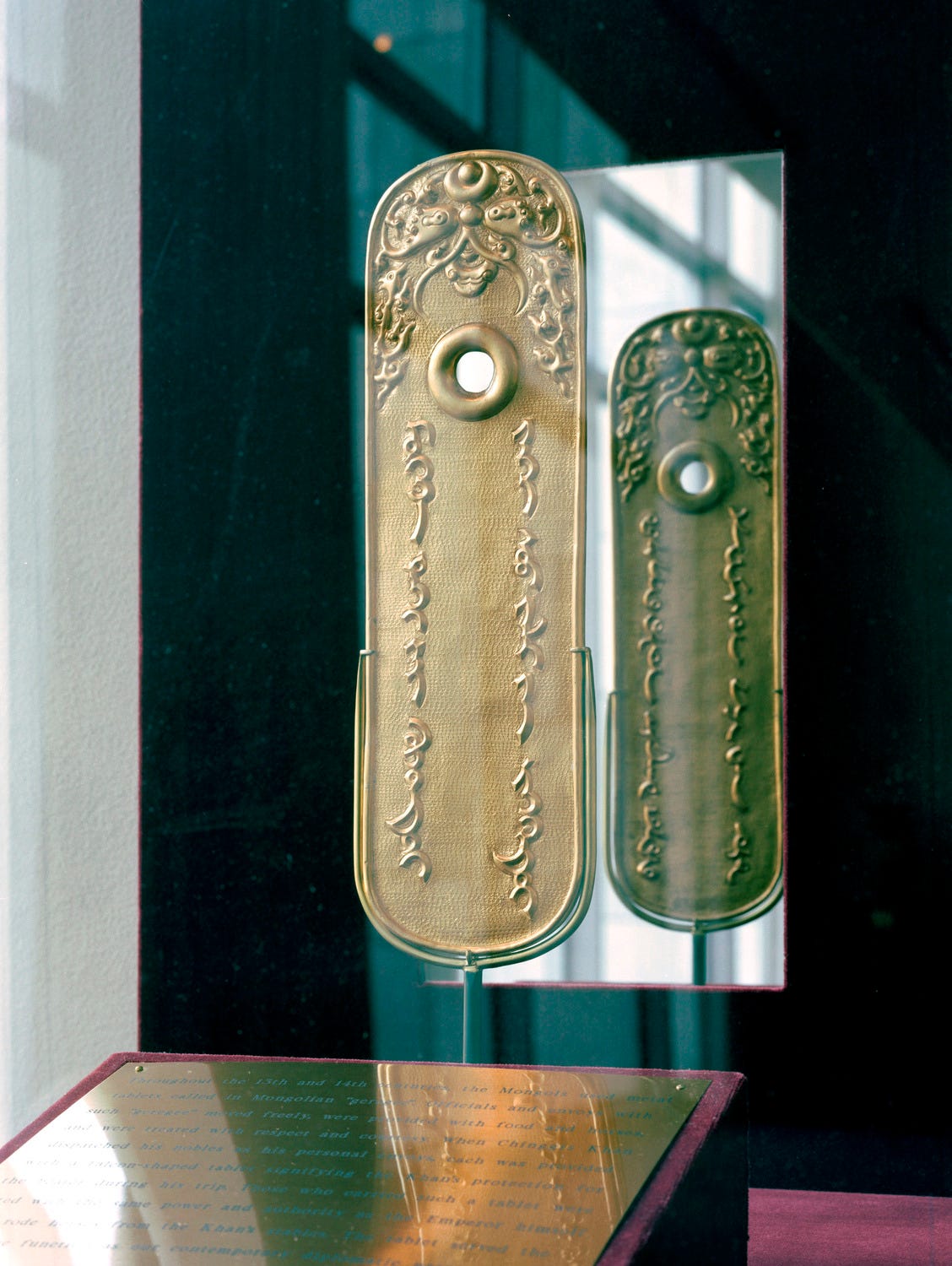
In fact, for most ancient and medieval states, ‘who are you?’ was much more of a concern inside the state than at its borders. A lot of this was because ‘who are you?’ was directly connected to ‘how much tax do you owe?’ The regional censuses, like the one described in the Christian Nativity story, where Joseph has to take his pregnant wife to his father’s town to be registered, were all about keeping track of people’s tax liabilities. But unlike the modern world in which everywhere is somewhere, the world divided up into contiguous somewheres, each with their own ways of defining and determining who is who and where they can and can’t go and what they should and shouldn’t do, the world up to a few hundred years ago was more often described by the people in it as a patchwork of ‘somewheres’ and ‘nowheres’. This was often described in terms of contrasts: ‘civilisation/barbarism’, ‘city/wilderness’, ‘fertile land/forest’. It could also be expressed in terms of a familiar unit, ‘us’, in a world full of people but people who remained unknown (at least rhetorically). Perhaps this was why exile was a common punishment because being cast out of your society, being prevented from staying where you were who you were, defined by your social connections, was considered one of the most serious sanctions available.
Controlling coming in and going out could, in this other world of somewheres and nowheres (each subjectively defined, of course: nobody ever thought they came from ‘nowhere’!) , be much of apparently minimal concern. Inscriptions placed by Kushan rulers in northern South Asia around the turn of the first millennium CE have been argued to show people entering the empire that that was what they were doing, but this may have been as much about welcome or at least provision of useful information for travellers as for control. There is no evidence for checkpoints at these spots, though I’m not sure, except for stone buildings, what that would be and how well it would survive archaeologically. But if the inscriptions were unmanned ‘announcements’ then they told travellers whose laws they now operated under and perhaps worked as useful way markers. In a world in which fairly few people moved long distances between empires and often did so carrying valuable goods desired by rulers, stopping people getting out of your own state, or even leaving their household or village was more important than stopping people coming in from outside.
What stands out across time, though, is that the rules and definitions have always been in negotiation with the messy, complex ways people actually live. One of the most famous legal speeches in the corpus of ancient Greek literature concerned the case of a woman accused of passing herself off as a citizen of Athens when she wasn’t. This truth had to be established which meant also establishing how such a thing could be proved or disproved. We don’t, unfortunately, have the outcome of the case, only the arguments made by one side. It is still a rich insight into how much people might move and what a mess that might make of carefully theorised notions of orderly identity.
I feel very fortunate to be travelling within the permitted routes of orderly identity. I am grateful each time I hear the stamp come down in my passport - another border crossed, another confirmation that I am who I am and it is okay that today I can come or go wherever I happen to be. But in those conversations about what exactly it is that I am doing, I can still feel the vague anxiety that the answer I am about to give is going to sound messy and complicated and not at all what was expected.
Ilko, Krisztina, ‘Yangzhou, 1342: Caterina Vilioni’s Passport to the Afterlife’, Transactions of the Royal Historical Society, 7, 2 (2024), pp. 3–38, doi:10.1017/S0080440124000136
Comments
Nothing yet. Say the first thing.
Sign in to join the conversation.