
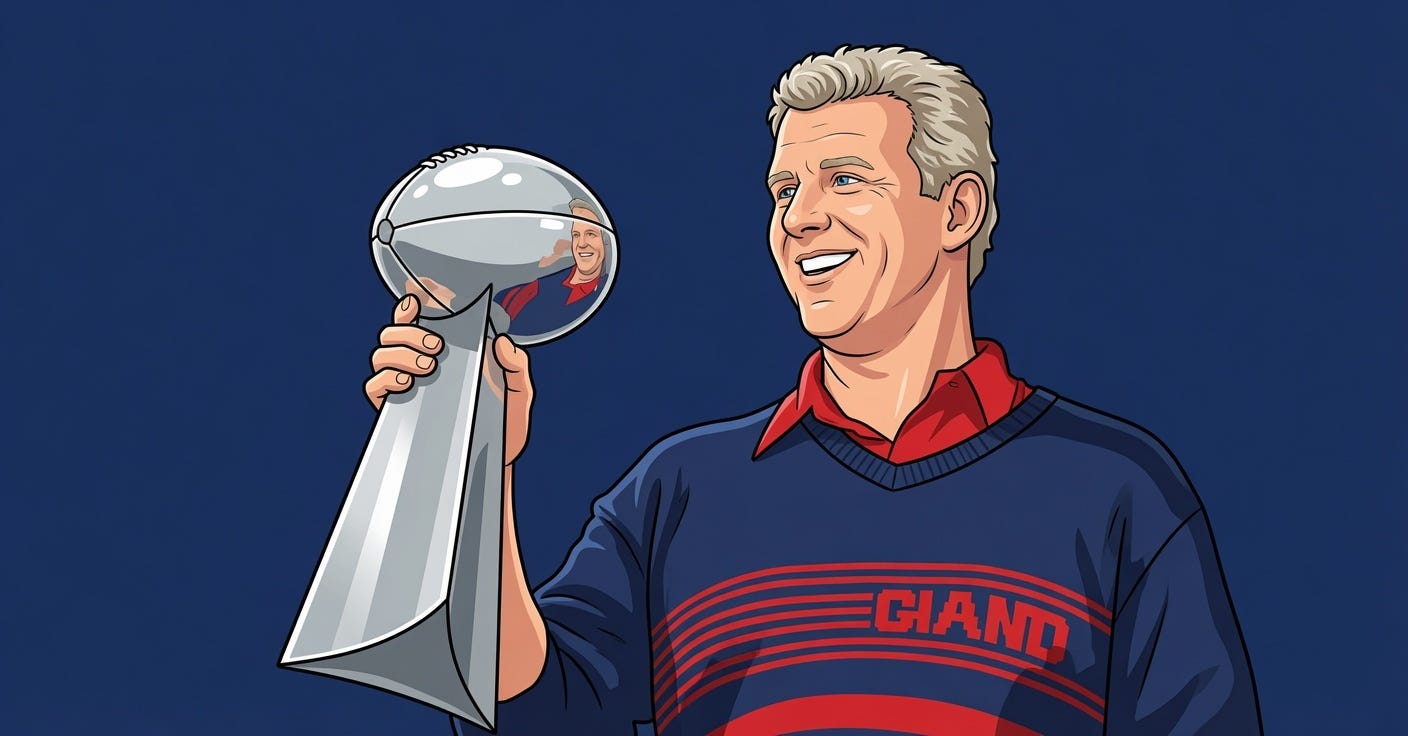
After a disastrous first season as head coach of the New York Giants, Bill Parcells’ NFL career was almost one-and-done.
After a Week 14 loss to the Cardinals in 1983, the Giants’ record stood at 3-10-1 and it’s public knowledge that ownership tried to replace Parcells with University of Miami head coach Howard Schnellenberger.
In one of the great sliding doors moments in coaching history, Schnellenberger declined, and the Giants ended up deciding to keep Parcells in the role.
That decision had implications not just for Parcells’ fledgling career, but young Giants staff members Bill Belichick, Romeo Crennel, and Ernie Adams as well. The group would go on to win two Super Bowls together with the Giants, and become one of the era-defining teams in the NFL.
It raises the question — how do we judge if a coach is good or bad? Is win-loss record all we can look at? Or is there more to it?
Recently, my mentor asked me how I think a head coach should be judged. It’s a great question, and it made me think of Parcells’ early stumbles.
In fact, Parcells outlines how he thinks coaches should be judged in his book.
“A team reflects its coaching staff,” Parcells writes, “and in particular its head coach — their personality, behaviour, what they view as fundamental to the game.”
As a result, Parcells says he believes coaches should be judged on three things:
Do the players have a design that allows them to function on game day?
Are they prepared to deal with contingencies that may confront them?
Do they behave the way the coach wants them to?
“Any competent coach can field a team that is strategically sound, that plays with discipline, that doesn’t beat itself,” Parcells offers, suggesting that if those elements are missing, it is the head coach who must be held accountable.
Since Parcells wrote that passage in 1995, professional sports has undergone a significant boom that has led to rapid organizational growth and economic conditions that would have been unimaginable thirty years ago.
To recognize that shift and the changing realities of the head coaching position, I’ve built on top of Parcells’ list to form my own responses to how a coach should be judged.
You (probably) won’t be shocked to find that I’ve also sorted my 12 criteria by the four crafts of head coaching:
Personal Craft
Is the coach continuing to develop themselves and increasingly show leadership maturity over time?
Is high skill visible in the coaching behaviours displayed by the coach?
Is the coach looking after themselves to the degree that we would expect of anyone in an elite leadership position?
Organizational Craft
Is the coach showing clear and effective leadership across all departments in the organization?
Has the coach hired a staff capable of delivering the goals of the organization?
Does the coach frequently and willingly communicate with the front office and ownership?
Locker Room Craft
Is the coach facilitating a culture that enables and encourages the values of the club to shine through on-field and off-field?
Is the coach spending sufficient time around the players to ensure they have a reliable read on the tone of the group?
Is the coach proactively developing current (and future) leaders within the group?
Game Craft
Is the team making discernible progress towards their goals?
Does the team have a clear design that is maximizing the gifts of a majority of the players?
Are the players developing the necessary skills to navigate the next level of challenge in the competition?
No posts
Comments
Nothing yet. Say the first thing.
Sign in to join the conversation.