
Early on 22 June 2025, the US conducted strikes against three of Iran’s nuclear sites. Fordow and Natanz are Iran’s major uranium enrichment facilities, and the Isfahan site stores near-bomb-grade enriched uranium. US forces dropped multiple 30,000lb bunker bombs, known as Massive Ordnance Penetrators (MOPs), on Fordow.
Although The Code Wars tends to focus on software based tech that is changing the face of global security, the Bunker Buster is worthy of some commentary as this is the first time it known that the MOP has been used on a real-time operation.
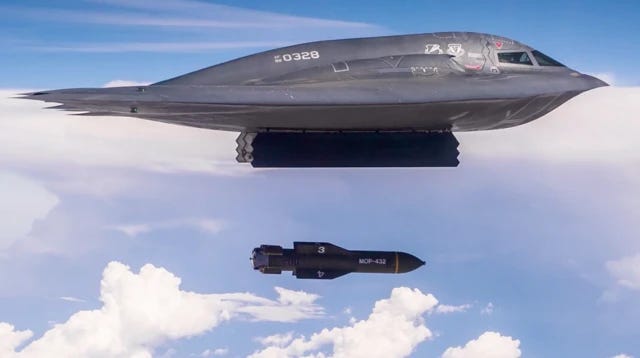
The GBU-57A/B Massive Ordnance Penetrator, or MOP, is a precision-guided 'bunker buster' bomb. At 30,000lb (approximately 13,600kg), it is the world's largest non-nuclear bomb, designed to destroy deeply buried, hardened targets. Development efforts, spearheaded by the Air Force Research Laboratory and Boeing, intensified after 2003, when existing bunker busters proved insufficient against sites attacked in Iraq. The MOP was first tested in 2007, and by September 2011, the Air Force received 20 of these bombs.
Experts with Janes, an open-source intelligence company, report that the weapon can penetrate about 60 metres (200ft) of earth or 18 metres (59ft) of concrete. Examining the weapon’s details, the MOP is 6.2 metres (20.5ft) long and 0.8 metres (31.5in) in diameter, weighing almost 13,600kg (30,000lb). Its explosive component is a BLU-127 series bomb, which features a modular design. The MOP uses a combination of Global Positioning System (GPS) and Inertial Navigation System (INS) for precise targeting. Grid fins help keep the bomb stable in flight for mid-course adjustments. A delayed fuze allows the bomb to explode after it has penetrated the target. As of 2012, the MOP detonated only after it stopped, lacking a void-sensing fuze.
One bomb may not burrow deep enough to reach their targets as the Fordow facility itself is hidden in the mountains and is believed to be buried up to 295 feet [approximately 90 metres] below ground level. Additional ordnance may certainly be required with the first MOP driving an initial wedge and as it expands with additional bombs driving deeper. In a sense, you're trying to create an earthquake, you're trying to crack the mountain and to channel that seismic energy down to make whatever is under there, whatever facility is under there, shake around a lot.
The B-2 Spirit strategic bomber is the only US aircraft in service able to carry and use the GBU-57 MOP. A B-2 can carry two of these heavy bombs. The B-21 Raider is also set to carry it in the future. While B-52s were used for testing, operational B-52s do not carry the MOP.
The B-2 is a long-range, stealth bomber. Its design, including composite materials, special coatings, and wing shape, makes it hard for advanced defence systems to detect. The B-2 has a range of about 6,000 nautical miles without refuelling. Israel lacks both the MOP bombs and the heavy bombers needed to strike deeply buried targets like Fordow.
These US strikes are a serious challenge to international law and the rules-based order we in the West have strived to uphold since the end of the Second World War. The idea that pre-emption is a just cause for war is a dangerous precedent. The 2003 Coalition of the Willing used pre-emption to justify the war in Iraq to uncover non-existent weapons of mass destruction. Russia used pre-emption as one of its justifications for its full-scale invasion of Ukraine in 2022.
At this time, it is worth recalling a quote by President Eisenhower about the Suez Crisis:
“The real point is that Britain, France and Israel had come to believe—probably correctly—that Nasser was their worst enemy in the Middle East and that until he was removed or deflated, they would have no peace. I do not quarrel with the idea that there is justification for such fears, but I have insisted long and earnestly that you cannot resort to force in international relationships because of your fear of what might happen in the future. In short, I think the British and French seized upon a very poor vehicle to use in bringing Nasser to terms.”
One could easily substitute Britain and France for the US and Nasser for the Iranian Ayatollahs. Believing that international law applies to your enemies but not to yourself is a slippery slope towards a world where 'might is right'. President Eisenhower again emphasised that international law must be applied to all during an address to the United Nations General Assembly on 16 August 1956.
"We must be equally clear that the rule of law applies to all, great and small, strong and weak alike."
Eric Schmitt in The New York Times reported that a US official, speaking on condition of anonymity, stated the Fordow facility has been 'taken off the table'. This may lead Iran to broaden its missile strikes and proxy operations into the Middle East, Europe, and possibly America. While Iran’s ballistic missile launches have lessened recently, they may hold reserves for a response. Therefore the threat of missile attacks in the Middle East will remain high in the short term.
Overall, the trajectory of the Middle East conflict is now far more uncertain. The recent US attack on Iran’s nuclear facilities has broad implications for the future of warfare and regional stability. This shift changes the war’s character, especially were the US to directly enter the conflict beyond these strikes.
For key partners, this poses new questions.
Russia may view the US distraction in the Middle East as favourable, potentially diverting munitions from Ukraine and fuelling its global misinformation campaigns. However, China may also tolerate US entanglement in the Middle East, as it could reduce American deterrence in the Western Pacific, particularly concerning Taiwan. China’s increased military activity around Taiwan during the US carrier group’s movement to the Gulf highlights this strategic calculation, suggesting a need for American strategists to limit Middle East involvement.
International bodies like the EU and NATO have yet to issue statements (as at morning of 22 June). Evacuation efforts for citizens and diplomats from Iran will also become more difficult, as Iran may suspect foreigners of collecting intelligence.
The deployment of a massive, precision-guided conventional weapon like the MOP by stealth bombers underscores that, even in an evolving landscape of military technology, powerful, targeted conventional munitions delivered by manned aircraft retain a critical role in addressing hardened, deeply buried threats.
For more on the military implications, Mick Ryan's Substack, Futura Doctrina, is highly recommended.
Comments
Nothing yet. Say the first thing.
Sign in to join the conversation.