
A notable difference between homeschool and the more typical academic life of an in-person school is the fact that at a school, students are in classes for 6 to 8 hours per day and then complete homework when they get home. Most students and some parents tend to be reticent to welcome the idea of homework. Some homeschooling families even brag about how they’re able to complete a whole school day in just 2-3 hours without additional homework. That sort of plan makes me a little skeptical about how much learning is actually happening, though maybe it’s not impossible. On the other hand, some teachers and parents think that egregious amounts of homework is acceptable or ideal (more=better).
As with all things, virtue is in the mean, and not all homework is created equal. Some homework truly is a waste of time. I think its pretty easy for all of us—students, parents, teachers, administrators—to agree that there is homework (“busywork”) that does not contribute to a student’s formation sufficiently to justify its encroachment upon their evening after school. Yet, we sometimes find disagreement between teachers, parents, and students about what constitutes worthwhile homework.
Outside of independent study time, there are two different types of fruitful homework:
preparation for new knowledge or skills in an upcoming class
repeating skills and rehearsing truths learned in the classroom
Pre-reading is of course necessary for seminar-discussion classes. If students are to encounter the true, good, and beautiful in great texts like Aristotle’s Nicomachean Ethics, or Dante’s Purgatorio, they must have already read the text. The teacher in a good seminar will limit their contributions to providing fruitful and guiding questions for students to ponder out loud in group discussion.
Ideally, students have done an initial pre-read of the text for homework. Contrary to popular belief, this initial homework reading does not need to result in perfect comprehension. It should be the student’s first encounter with the text and ideas. This is especially true with regard to complex or poetic texts. Fuller understanding is the point of our coming discussion.
Take for example, Canto 17 of Dante’s Purgatorio, a text I taught in the classroom recently. Reading a full canto is easily completed for homework the night before without any pressure on students to totally understand everything they’ve read. In discussion the following day, the class can begin by re-reading aloud a selection. Here are 36 lines from the end of the canto:
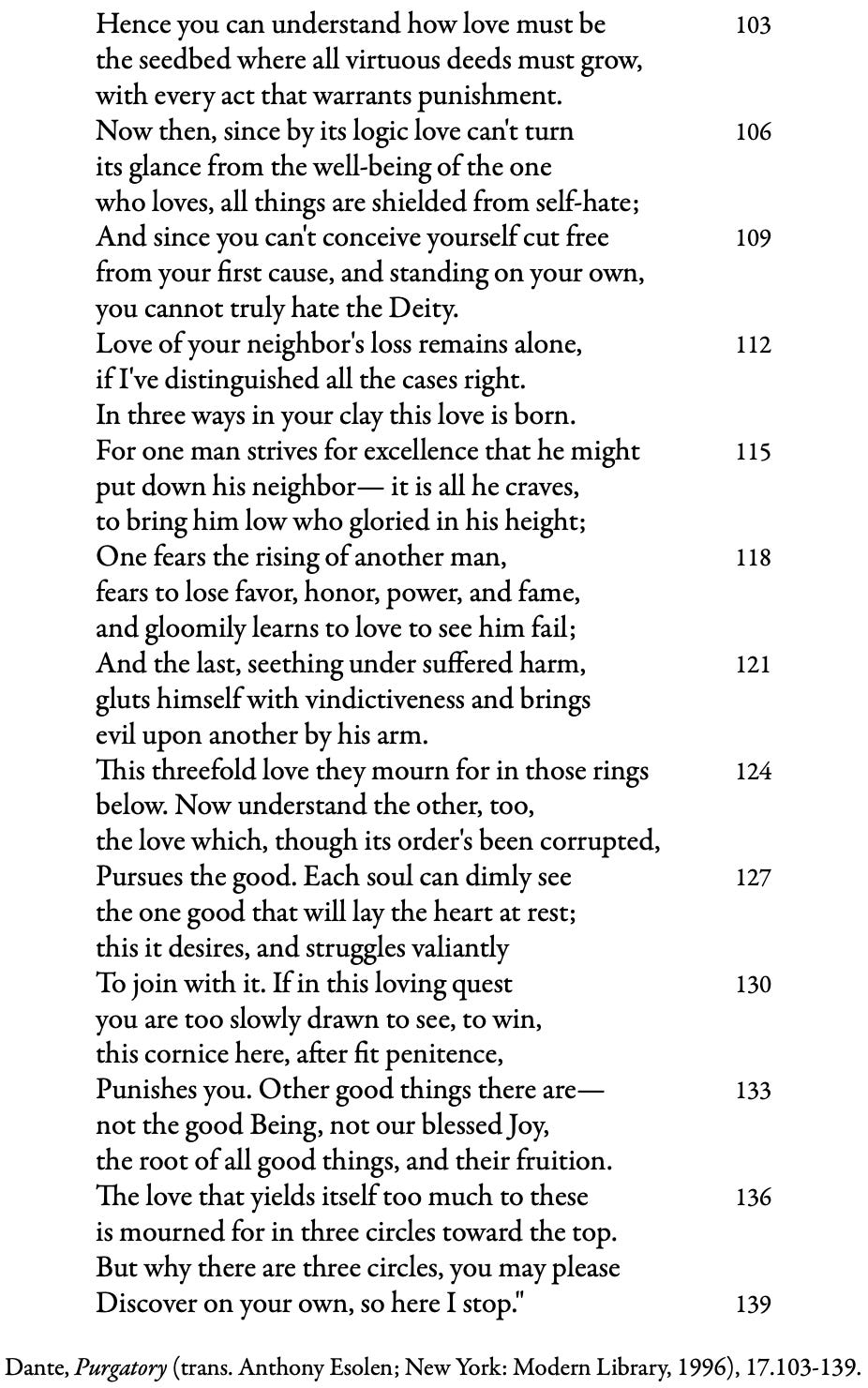
The teacher might begin the conversation with a question that calls to the students’ minds some review: Where are we in purgatory, what have we seen and what do we expect to see in purgatory as we ascend the mountain? Students respond by reviewing the first 16 cantos:
After entering into the gates of purgatory, we have seen sinners punished and purified of the vices of pride, envy, and wrath. We are currently exploring the punishment and purification of sloth or acedia.
We might ask further questions such as how were those vices punished? How can we apply Dante to our own souls in finding freedom from these vices? This review at the outset is important. Notice the kinds of review we’ve done:
First, we re-read a select passage that was part of the homework assignment.
Second, we reviewed content from previous classes and homework assignments.
As students orally offer this review, they’re rehearsing the ideas in their own minds. If the teacher cold-calls these review questions, then all attentive students are doing the review actively. In either case, even hearing the questions and answers provides an opportunity for review for those that are less engaged.
From this review, we can begin to ask more questions about the text at hand, offering students an opportunity to deep-read the text together in discussion. Some questions about this passage that my students have spent whole class periods discussing:
What do we learn about the structure of Mt. Purgatory from Virgil’s explanation here in these lines?
What is the role of love in human decision-making? What kind(s) of love are at stake here?
Is it true that sins and vices come from love? How can this be?
Based on this account of love, how can we be intentional about building virtue?
From this discussion, students learn much about how human actions are motivated, how our affections can be disordered or disproportionate, and how we can purify our hearts in our walk with Christ. Discussing these 300 words from Dante in under an hour offers my students a window into the human soul and the moral life that would otherwise require years of life-experience to understand. Later, they’ll incorporate these ideas into a hand-written essay to reinforce and apply them.
Not every class session focuses on seminar discussion. Very often, there are specific truths that must be committed to memory, or skills and procedures that must be known. For this, students get homework assignments that help to train their memories to retain specific knowledge.
Contemporary cognitive science has achieved a great deal in researching how we can make long-term changes to our memory (clearly an important part of learning). The Catholic intellectual tradition also has much to contribute to this topic.
Our vision of education is one that results in students developing virtue; we aren’t limited to developing professional and practical competencies. The foundational moral virtue requisite for attaining the others is prudence. St. Thomas Aquinas articulates several “parts” of prudence. Just as wall, roof, and window are parts of a house, so too is memory a part of prudence (he calls it a quasi-integral part).
In order to build and exercise the virtue of prudence, so argues St. Thomas, we need to contextualize the present with the past. For this, we need a long and full memory. Part of education is filling the memory with the culture and heritage of the Catholic intellectual tradition so that our students can use the wisdom of the past in their own decision making. Indeed, as far as academics are concerned, this is one of the primary ways that education forms the soul.
St. Thomas offers several ways to develop the soul’s power of memory:
Imagine. Associate the truth to be memorized with some striking image. Concepts alone fade from memory quickly, but associating them with zany images helps with retention.
Organize. That which we want to remember we should “carefully consider and set in order” so that we may “pass easily from one memory to another.” Mnemonics often do this, especially acronyms. Teachers should give their students mental models and structures within which to place new truths in their proper order. Truths organized are that much closer to being memorized.
Repeat. St. Thomas says that when we’re anxious about some truth, then we will remember it better because we’ll return to it often. Frequent study, rehearsal, and practice must be the cornerstone of our attempts to commit something to memory. Understanding is wholly insufficient, we must review, rehearse, and practice.
Reflect. While step 3 helps information move from working memory (understanding) to long-term memory, reflection often pulls truths from long-term memory in order to solidify its place there.
Dr. Kevin Vost has several wonderful books in which he uses these steps to help Catholics memorize important aspects of the faith.1 While all of these steps can be done with homework exercises, it is the repetition step that holds the most natural relationship with homework. Using homework to repeat and reinforce what was understood in the classroom is both essential and fruitful for learning.
Doug Lemov’s Teach Like a Champion 3.0 helps us understand some of the cognitive science behind memory (and it integrates well with St. Thomas’ comments). I’ve adapted some of that information here:
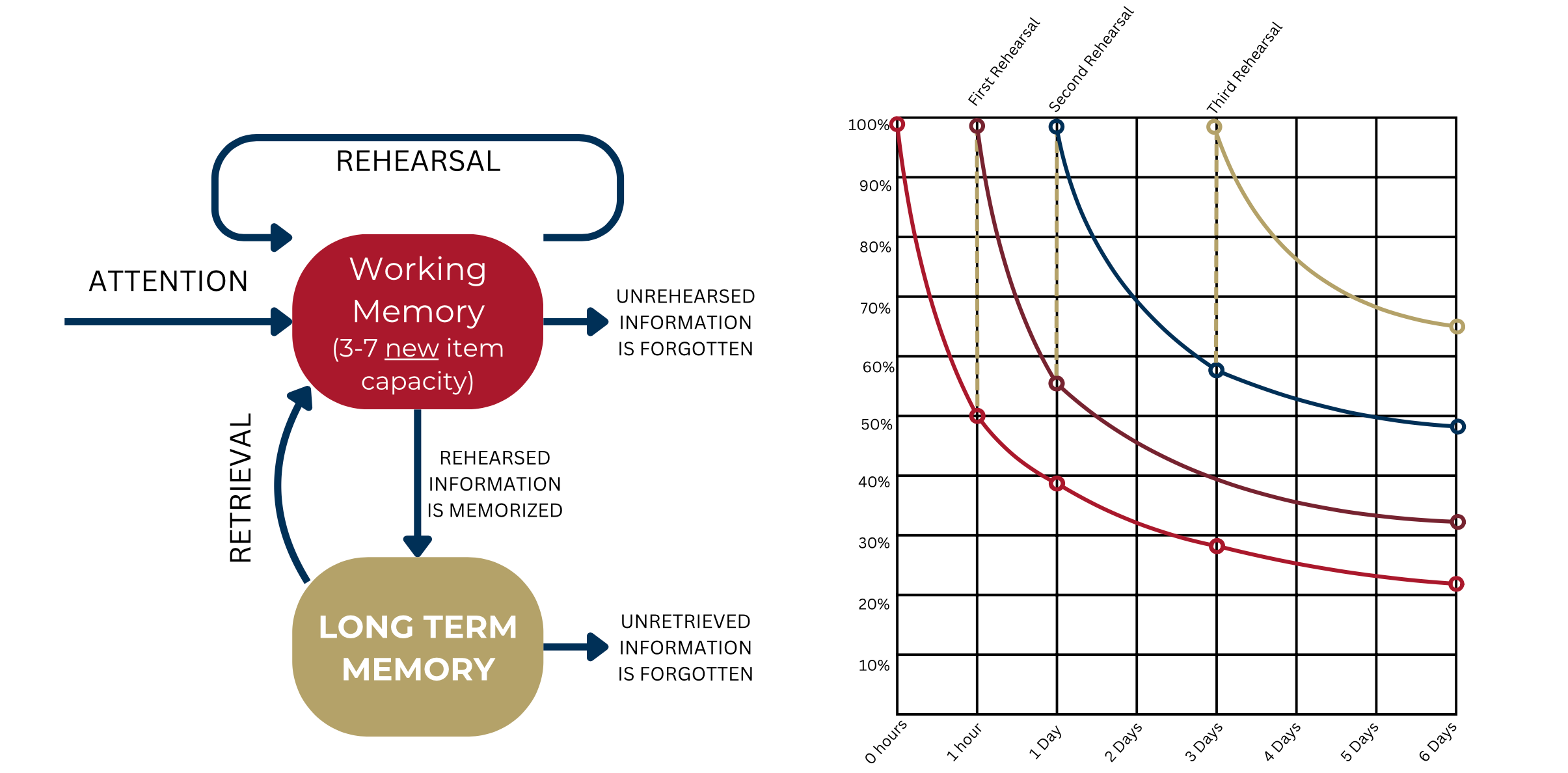
On the left is the cognitive structure of learning. As we give something our attention, it enters into working memory, by which we understand and explore new information. If we rehearse that information a few times (think repetition from St. Thomas), it is loosely transferred to long-term memory. In order to truly solidify information in our long-term memory, we must retrieve it every so often (think reflection from St. Thomas).
On the right is a forgetting curve. On the top-right of that graph is the moment of understanding new information (e.g., in class). Memory experiments seem to indicate that spacing out our repetition and reflection over time (one hour, one day, two days, etc.) helps students learn. If we think of memorization and learning as “interrupting” the process of forgetting, we can teach and learn more effectively. Interrupting forgetting is more effective than constant attention for learning (which is why I try so hard to discourage my students from cramming before an exam, or spending study time simply re-reading).
Homework is essential as interrupting the process of forgetting. It is essential as repetition and rehearsal of truths that we want our students to learn.
We’ve seen the wonderful fruit that can come from homework in preparing students for the truth or reinforcing truths they’ve learned. The question remains: how do we identify busywork?
Here are some diagnostic questions that we can use to identify whether our homework is truly worthwhile or if it needs to be improved (or perhaps just not assigned).
What are the essential truths that I want students to learn?
How does the homework assignment either prepare them to learn this truth or repeat and reinforce the truth?
Does the assignment suitably interrupt forgetting from previous material?
Does the assignment use time efficiently? For example, rereading is less efficient than working flashcards or completing Cornel-style notes (built around reviewing in-class material).
Does the homework teach the student how to study and what is important to learn?
In all these considerations, teachers must remember that when assigning homework, they must form their students to be well-rounded. It is important for each teacher to recall that theirs isn’t the only course students take and have homework assigned. Further, we want them to have time for their families, athletics, and other extracurriculars. At my high school, my teachers and I shoot for approximately 15 minutes of homework per night per course. For the typical student, that works out to about 90 minutes of homework a night. We find this to be an appropriate balance.
If this piece made you think of someone — a teacher, a principal, a parent wrestling with these questions — would you forward it to them? One attentive reader is worth a hundred passive followers, and you probably know exactly who I’m describing.

Comments
Nothing yet. Say the first thing.
Sign in to join the conversation.