
When it come to AI, most founders are barely scratching the surface. Not because they’re lazy or behind the curve. Most of them are actually using it constantly. They’re generating emails, summarizing calls, writing code, and brainstorming taglines. They look like power users.
But they’re playing checkers on a chessboard.
Here’s what I mean.
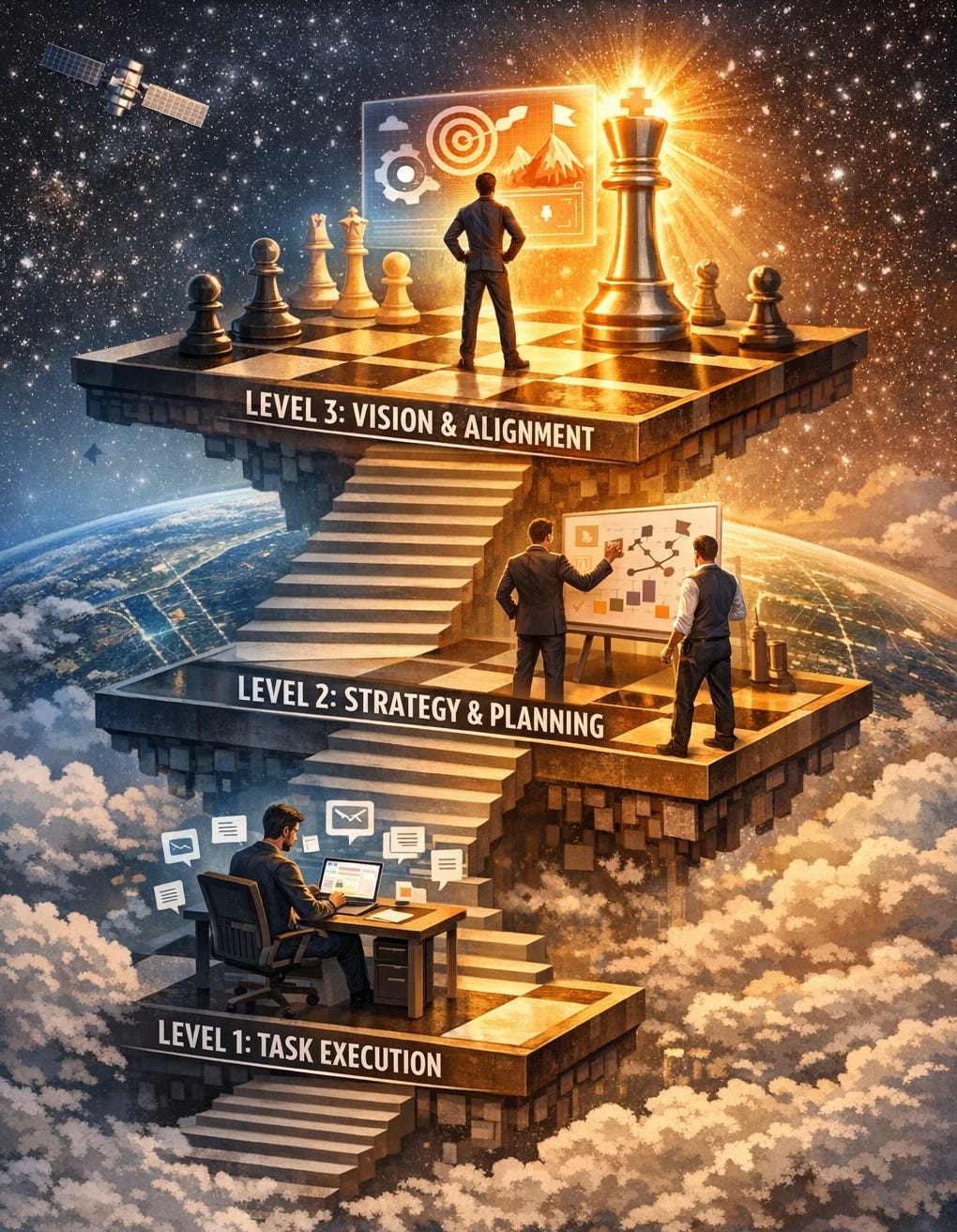
There’s a hierarchy to how people use AI, and almost everyone is stuck on the bottom floor.
Level one is task execution. You use AI to do things. Write this email. Summarize this doc. Fix this code. It’s useful. It saves time. And it’s where 95% of founders live.
Level two is planning and decision-making. You use AI to think through strategy. Map out scenarios. Pressure-test an idea before you burn three months on it. Fewer people operate here, but it’s where things start to get interesting.
Level three is where it gets powerful, and almost nobody is doing it. At this level, AI becomes a context holder. A strategic mirror. It doesn’t just help you do things or plan things. It holds you accountable for what you said matters.
Your vision. Your mission. Your values.
It checks whether the thing you’re about to spend your Tuesday on actually aligns with the thing you said you’re building your life around.
That’s a different animal entirely.
Here’s the dirty secret: most founders don’t have a clear vision. They have a vague sense of direction. They have ambition. They have goals, usually revenue targets or headcount milestones. But vision? Mission? Values they’ve actually defined and pressure-tested?
It’s fuzzy. Conceptual at best.
And that means they can’t use AI at level three even if they wanted to. You can’t ask AI to hold you accountable to something you haven’t articulated. You can’t build a feedback loop around a destination you haven’t defined.
This is the real divide.
It’s not between people who use AI and people who don’t. It’s between people who have done the inner work, who know what they’re building, why they’re building it, and what principles they refuse to compromise, and people who haven’t.
The first group can hand AI something profound to work with. The second group can only hand it tasks.
I’ll make it concrete with my own stack.
My vision is a world where consciousness is acknowledged as the ultimate tool in business. For creating value, driving growth, and building companies that matter. Not as a fringe idea. Not as something you whisper about after the board meeting. As an acknowledged principle. The thing that actually moves the needle more than any strategy deck or growth hack ever will.
My mission is to create ten $100 million companies in the next ten years. One of those is a network of 100 transformational coaches, each building a $1 million business, which is just another $100 million company built through consciousness rather than conventional playbooks.
My values are peace, freedom, and connection. Non-negotiable. Not aspirational, operational. They’re the filter for every decision, every partnership, every opportunity.
That’s a complete stack. And when I hand that stack to AI, something fundamentally different happens.
When I’m mapping out a new initiative, I don’t just ask AI to help me plan it. I ask it to challenge whether this initiative actually advances the thesis that consciousness creates business value. When I’m designing a coaching program, I don’t just ask AI to structure the curriculum. I ask whether the structure honors peace, freedom, and connection, or whether I’m unconsciously building something that will drain me and everyone in it.
AI becomes the thing that holds the context I’d otherwise lose in the noise of daily execution.
Think about that for a second. How much of your week is spent on things that feel urgent but don’t actually connect to anything you care about at the deepest level? AI can’t fix that if you haven’t defined what you care about. But if you have? It becomes the most relentless accountability partner you’ve ever had. It doesn’t forget. It doesn’t get caught up in the emotion of the moment. It just asks: Does this align?
Imagine two founders driving cross-country.
One has a destination, a route, and a reason for the trip. When they hit a detour, they reroute. When someone suggests a “quick stop” that’s four hours off course, they can evaluate it against their actual destination.
The other founder is just... driving. They’re moving fast. They’ve got a great car. They’re making excellent time. But toward what? Every suggestion sounds interesting because there’s no filter. Every detour is plausible because there’s no destination to measure it against.
AI is the GPS. But GPS is useless if you never enter an address.
Most people are using AI like a foot soldier with binoculars. They can see a little further ahead. They’re slightly more effective in their immediate surroundings. But they’re still on the ground, reacting to what’s right in front of them.
Level three is the satellite view. It’s not about seeing further. It’s about seeing the whole map. Your position relative to where you said you wanted to be. The gap between your daily actions and your declared purpose. That’s strategic. That’s transformational. And that’s available to anyone willing to do the real work first.
And that’s the uncomfortable part of this conversation. Because the real work isn’t learning a new AI tool. It’s not getting better at prompting. It’s not subscribing to another newsletter about the latest model.
The real work is sitting down and answering questions most founders avoid:
What’s your vision? Not your revenue target, but the world you’re trying to create. What do you believe about how value actually gets created, and are you willing to build around that belief?
What’s your mission? The concrete, measurable proof that your vision is real. Not a vague purpose statement. A scoreboard.
And what are your values? Not the ones that sound good on a website, but the ones you refuse to violate even when it’s expensive. The ones that dictate how you build, not just what you build.
Most people don’t have clear answers. That’s not a character flaw. It’s just the truth. We’re not taught to think this way. Business culture rewards execution and speed, not reflection and clarity.
But here’s what I’ve found: the founders who do this work, who get ruthlessly specific about vision, mission, and values, unlock a version of AI that everyone else doesn’t even know exists.
This is what keeps me up at night. Not in a doom-and-gloom way, but in a “this matters and nobody’s saying it” way.
The gap between founders using AI for tasks and those using it as a strategic partner is widening every day. And it’s not a technology gap. Everyone has access to the same tools. It’s a clarity gap.
The founders who’ve done the inner work are compounding. Every interaction with AI reinforces their vision, sharpens their decisions, and keeps them aligned. They’re not just moving faster. They’re moving faster in the right direction.
The founders who haven’t done the work are also compounding, but they’re compounding busywork. More output. More content. More activity. All of it unanchored.
Same tools. Radically different outcomes.
If you’ve read this far, you’re probably in one of two places.
Either you’ve done this work and you’re nodding along, recognizing what you already know. In which case, go deeper. Feed your vision, mission, and values into every AI interaction. Make it the operating system, not an app you open sometimes.
Or you haven’t done this work yet. You know your vision is vague. Your values are more vibes than principles. Your mission is something you’d struggle to articulate in a sentence.
That’s fine. But don’t pretend the next AI tool is going to change things for you. The tool isn’t the bottleneck. You are.
And I say that with love. Because the moment you get clear? Everything changes. AI goes from being a slightly faster version of Google to being the strategic partner you’ve been looking for your entire career.
The one that never forgets what you’re building. The one that calls you out when you drift. The one that holds the context you can’t hold alone.
That’s the real power of AI. And it’s waiting for you on the other side of the hardest, most important work you’ll ever do.
Define the vision. Clarify the mission. Name the values. Then hand AI something worth holding.
All my best,
~ Townsend
No posts
Comments
Nothing yet. Say the first thing.
Sign in to join the conversation.