
I didn’t go looking for a theory of human consciousness.
I was reading Immunity to Change by Robert Kegan and Lisa Laskow Lahey, a book about why smart, motivated people consistently fail to change even when they desperately want to, when I stumbled across a phrase that stopped me cold.
Competing commitments.
Kegan’s argument is deceptively simple: we don’t fail to change because we lack willpower or discipline. We fail because we hold hidden commitments that directly undermine our stated goals. The person who says they want to delegate more but micromanages every decision isn’t weak. They’re protecting something. Maybe it’s their identity as the indispensable expert.
Maybe it’s a deep, unexamined belief that if they let go, things will fall apart, and it will be their fault. These aren’t character flaws. They’re immune systems, extraordinarily effective at protecting the self-concept we’ve built, at the cost of the growth we say we want.
That insight alone would have been worth the book. But Kegan goes deeper, and what he found is where things get genuinely unsettling in the context of what AI is about to do to all of us.
What the Research Actually Shows
Behind Immunity to Change lies decades of research into what Kegan calls “orders of mind.” Not how smart you are. Not how much you know. But the structure through which you interpret everything.
Two large-scale studies mapped the actual distribution of these stages across adult populations. Kegan’s own study of 342 adults, published in In Over Our Heads (Harvard University Press, 1994), and William Torbert’s study of 497 managers and executives in Managing the Corporate Dream (Dow-Jones, 1987) arrived at nearly identical conclusions using different methods and different populations. That convergence is what makes the data so hard to dismiss.
The framework identifies three stages relevant to working adults.
The Socialized Mind, which Kegan calls Stage 3, is where your identity and your sense of what’s true are formed by and through your relationships, your institution, your tribe. You’re an excellent team player, a faithful follower of the right leaders, someone who functions best with clear direction and strong alignment. The problem isn’t intelligence. It’s that your sense of self is constituted by external structures, which means when those structures change or disappear, you don’t just lose a job. You lose yourself.
The Self-Authoring Mind, Stage 4, is where you’ve developed an internal compass. You can step back from the expectations of others and evaluate them against a framework you’ve constructed yourself. You set your own agenda, own your own values, and lead from internal authority rather than external validation. This is the level of thinking that modern organizational life has long assumed most leaders operate from, often wrongly.
The Self-Transforming Mind, Stage 5, is where you can hold multiple frameworks simultaneously, including your own, and examine them from the outside. Fewer than 1% of adults get here.
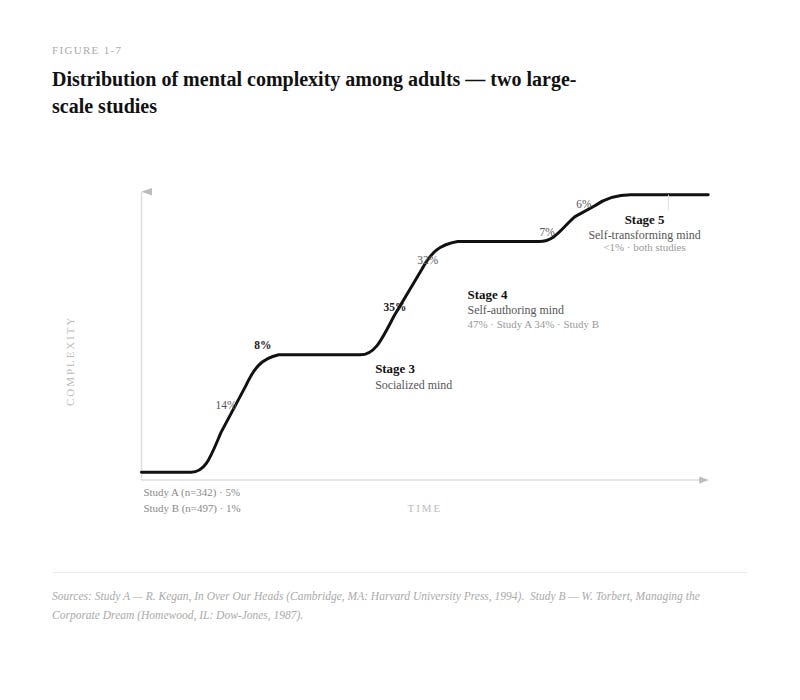
What the two studies found is that roughly 58% of adults are operating at Stage 3 or below. Only about 35% have reached Stage 4. Kegan’s central and uncomfortable argument, made in 1994, was that modern life implicitly requires Stage 4 thinking from a population that is mostly still at Stage 3. The gap between what the world demands and what most people can deliver is a crisis hiding in plain sight.
That was before AI showed up.
The Part Nobody Is Saying Out Loud
The mainstream conversation about AI displacement is almost entirely economic. Jobs disappear. Workers need retraining. New roles emerge. Policy responses are debated. All of this is real and important. But it misses something deeper and more dangerous.
For the majority of adults operating from a Socialized Mind, a job isn’t just income. It’s a primary source of meaning, identity, and psychological coherence. The role, the organization, the professional community, the daily structure: these aren’t just activities. They’re the external scaffolding through which a Stage 3 person understands who they are.
When AI removes that scaffolding, it doesn’t just create an economic problem. It creates an identity crisis at a constitutional level.
This is why “just reskill” is such an insufficient response to AI displacement for most of the workforce. Reskilling assumes a Stage 4 orientation, an internal self that can detach from one identity, evaluate options, and author a new path. For someone at Stage 3, that process isn’t just difficult. It’s structurally almost impossible without significant developmental support. You’re asking someone to let go of the very thing through which they understand themselves, and build something new, using a capacity for self-direction they haven’t yet developed.
The executives, policy makers, and technologists designing responses to AI displacement are, almost without exception, Stage 4 thinkers building solutions with Stage 4 assumptions baked in. They’re handing a map to people who haven’t yet developed the internal navigation system to use it.
Where the Opportunity Actually Lives
For the Self-Authoring leader, AI isn’t a threat. It’s the most powerful instrument of leverage in the history of business. Someone with a clear internal compass, who knows what they’re trying to build and can evaluate tools against their own judgment, picks up AI and immediately asks: how does this serve what I’m already trying to do?
This is why the early power users of AI tools skew heavily toward people with high internal direction and high tolerance for ambiguity. It isn’t because they’re smarter. It’s because AI requires you to bring an agenda to it. It amplifies intention. If you have strong internal direction, AI is a multiplier. If your sense of direction is primarily provided by external structures, AI is disorienting because it removes structure rather than providing it.
The competitive gap that AI is opening isn’t primarily a skills gap. It’s a developmental gap. And it’s going to widen faster than any training program can close it, unless we get honest about what kind of development actually matters.
The Use Case Nobody Talks About
Here’s something I haven’t seen articulated elsewhere, and it starts with what has quietly become one of my most used prompts when working with AI: What am I missing here?
It sounds simple. It is, in practice, one of the most developmentally powerful questions you can ask, and AI is uniquely positioned to answer it in a way no previous tool could.
What Kegan’s framework is really about, at its core, is the sequential revelation of blindspots. His central concept, moving something from Subject to Object, is the process of making visible what was previously invisible. Whatever you are at a given stage, you cannot see. The Socialized Mind cannot see its own socialization. The Self-Authoring leader cannot fully see the framework through which they’re authoring. Development is the process of those invisible structures becoming visible, and therefore available for examination and change.
What makes that process difficult historically isn’t that people are incapable of it. It’s that it requires a specific kind of relationship: someone who can see your blindspots without being inside your meaning-making system, who can hold a broader view while you’re embedded in your particular corner of a problem, and who can create enough discomfort to loosen a fixed framework without triggering shutdown.
Historically, that relationship was delivered by great coaches, therapists, mentors, and wise teachers. Expensive. Time-intensive. Inaccessible to most. The people who got genuine developmental support were almost always the already-advantaged.
AI breaks that constraint for the first time in history.
A well-designed AI sits outside your meaning-making system by definition. It has no psychological investment in your current worldview being correct. No social stakes. No impatience. It can hold the entire landscape of a problem while you’re inside a corner of it, and when asked sincerely, it can point to the doors you didn’t see.
That is not a small thing. It’s what oracles and great mentors were always for. Access to that has always been scarce. It doesn’t have to be anymore.
The Risk That Requires More Attention
The same capability that makes AI a developmental tool of extraordinary potential also makes it a trap of extraordinary sophistication.
AI designed without developmental intentionality doesn’t produce growth. It produces comfort. An AI optimized for user satisfaction and engagement, which describes essentially every major AI product on the market today, will confirm your existing frameworks, remove productive friction, and make it perfectly comfortable to stay exactly where you are.
That’s not a developmental scaffold. That’s a very sophisticated fixed-mindset machine.
The difference between AI as a tool for human development and AI as a tool for human stagnation is entirely a question of design philosophy. Right now, the incentive structures of the technology industry are almost entirely aligned with the latter. Engagement metrics are hostile to productive discomfort. Satisfaction scores punish the kind of challenge that actually produces growth.
This is the design conversation almost no one in the industry is having, and it may be the most important one.
What to Do With All This
If you’re a leader navigating AI adoption, the most high-leverage thing you can do right now is start using AI as a developmental mirror rather than just a productivity tool. Ask it what you’re missing. Ask it to make the strongest possible case for the position you most disagree with. Ask it what a thoughtful critic of your strategy would say. The discomfort that follows isn’t a sign something is wrong. It’s the signal that something is working.
For your organization: stop designing AI programs that only address skills. The organizations that build durable competitive advantage through AI will be the ones that recognize the developmental gap between their people and what AI-era leadership actually demands, and invest in closing it. That means understanding where your people actually are, and meeting them there rather than assuming self-authoring capacity across the board.
For the builders: if you’re designing AI products, you are making developmental choices whether you intend to or not. Every design decision either expands or contracts the user’s capacity to see their own blindspots. The most important AI products of the next decade may not be the ones that make people most productive. They may be the ones who make people most capable.
Kegan spent decades arguing that the gap between what modern life demands and what most adults can deliver was a crisis hiding in plain sight. That was before AI. The gap is widening now at a pace he couldn’t have imagined.
But so, potentially, is our capacity to close it. The technology accelerating the crisis may also be, if built with intention, the most powerful developmental tool in human history. The question is whether the people building it, deploying it, and leading through it understand what’s actually at stake.
I didn’t go looking for a theory of human consciousness. I’m increasingly convinced it may be the most important business framework of the next decade.
-
Robert Kegan’s work is explored most accessibly in Immunity to Change (Harvard Business Press, 2009), co-authored with Lisa Laskow Lahey. The study data referenced in this article appear in Kegan’s In Over Our Heads (Harvard University Press, 1994) and William Torbert’s Managing the Corporate Dream (Dow-Jones, 1987).
No posts
Comments
Nothing yet. Say the first thing.
Sign in to join the conversation.