
Hey coaches, hey.
Every once in a while I read a sentence that jolts me when I realize, immediately, this is about to change my mind.
I look away for a moment to remind myself of my previous beliefs, as though preparing to say goodbye to them. I take a minute to wonder what is going to change them.
And then I dive in — knowing, trusting, that something will.
Convince me, baby!
That’s what I felt when I saw the title of Pooja Venkatraman’s upcoming workshop.
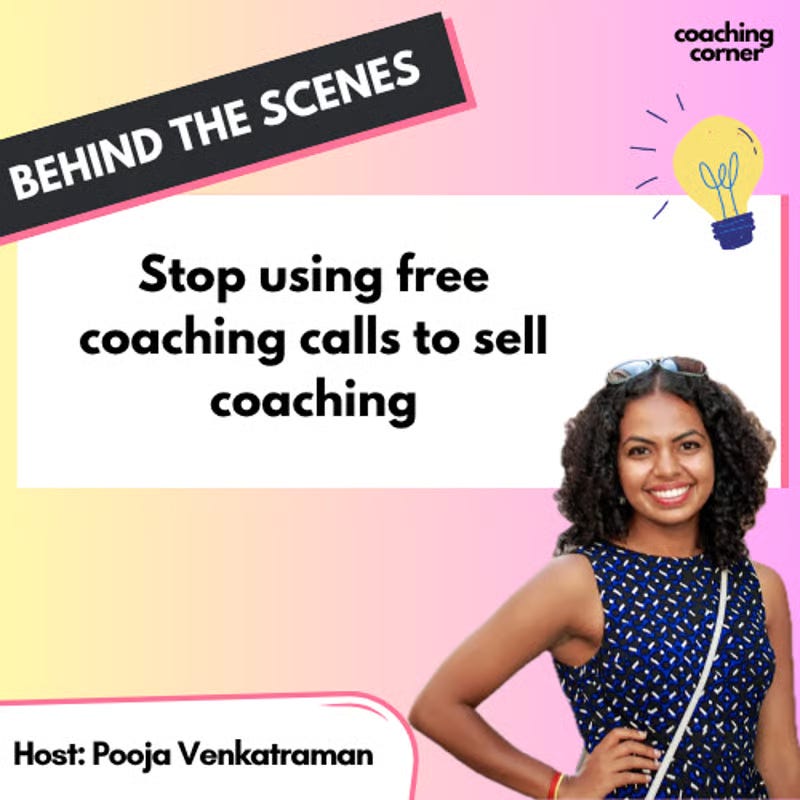
It sizzled. Oh boy, I really thought I should be doing way more free coaching calls.
I kinda wanted to save the mind-change experience for the workshop itself, but youknowwhat I love spoilers and couldn’t resist the chance to do some pseudo-journalistic-voice-memo-ing with Pooja ahead of time.
Spoiler alert: I’m convinced. Converted. Signed, sealed, delivered.
Don’t worry: there’s still a place for free coaching calls in this philosophy! And I think there’s a case to be made for “marrying” it with Kelly Liu’s 100 Free Coaching Calls approach.
The following dialogue is a reinterpretation of voice memos that Pooja and I exchanged, edited for focus, flow, length:
MJ Halberstadt: I heard the idea for this workshop came up during a CC workshop. What’s the backstory?
Pooja Venkatraman: In a Coaching Corner Slack thread, someone was offering free coaching calls and expressed feeling frustrated about no‑shows. They were asking things like, “Should I take a deposit?” “How do people handle this?”
My take was: if my top priority is getting as many clients as possible, I’d rather have as few barriers as possible to booking a call. I’m okay with more no’s and more no‑shows if it also means more yeses.
But for that specific person, we realized getting more clients actually wasn’t their top priority right then, so the “right” advice flipped: add more barriers, create more friction.
I also said, “By the way, I have a lot of thoughts about using free coaching calls to sell coaching, and I actually don’t think that’s the most effective strategy.” A few people jumped in like, “Wait, we’re very interested in that topic—please say more.” Someone suggested a BTS talk, and that’s how this workshop idea was born.
MH: The workshop is going to look at the difference between a free coaching call and a consult call. How do you describe what those two kinds of calls are?
PV: The simplest way to think about it is:
A free coaching call is one where the client decides what we talk about: overwhelm, a tough boss, a difficult project, whatever is on their mind.
During a consult call the topic is pre-decided: should they work with you as their coach?
It’s still coaching, but the “thing we’re coaching on” is that decision.
MH: Oh gosh, I’m afraid that’d feel salesy!
PV: On a consult call, there can feel like there’s a conflict of interest – for both coach and client – even though most coaches I meet are not actually pushy or salesy. The fear of looking salesy makes them act weird on consults.
What makes consults work is when you treat them as “The first act of coaching I’m doing for you is coaching you through the decision of whether you should work with a coach at all, and whether that coach should be me.”
The coach’s goal should be to achieve the same level of neutrality as though they were helping the client make a decision about whether or not to hire a personal trainer versus a workout app versus just doing push-ups for free in their bedroom, right?

MH: Okay, that’s helpful. I get what the theoretical difference is, but how do free coaching calls and consult calls feel different from each other?
PV: A free coaching call feels like a normal coaching session. You’re in neutral coach energy, helping them with a spot problem. There’s no explicit decision about investing in coaching on the table.
With a consult call, you’re helping them think about whether or not they should work with you. And yeah, that has an implication on you, but it’s actually a great opportunity to show them you can be objective. You can hold neutral space.
Besides, it’s not fun for either of you to work with someone who’s not a good fit, so your incentives are actually tremendously aligned, even from a business perspective.
MH: Can you remind us of your coaching backstory?
PV: From ages 9 through 20, I was like: “I’m a writer.” I wrote fiction, did newspaper and mock trial, then discovered screenwriting and comedy in college and decided I was going to be a comedy screenwriter in LA, but I quickly realized this industry isn’t actually the right fit for me.
So I pivoted to business. I literally bought a blazer, went to on-campus recruiting, and said, “Hello, I would like a job in business, please.” I ended up in the corporate strategy group at Capital One, which was an incredible fit. I realized it was secretly a writing job: take ambiguous problems, structure them, gather and synthesize information, build a point of view, and then communicate and operationalize that across an organization.
From there I went to business school, did a research fellowship with Clay Christensen, did management consulting at BCG, and had a chief‑of‑staff role. I kept trying to find a home for “writer + advisor + teacher” inside corporate and academia, and it never quite fit. By 2020, I was out of ideas for how to make that work long‑term.
That’s when I stumbled into coaching by working with a couple of coaches. It was so effective, so simple, such good root‑cause problem‑solving that I was like: “This is the answer to life, the universe, and everything.”
I could see a huge gap: my friends were high-achieving, they had therapy, personal trainers, maybe ayahuasca retreats—but this particular style of structured, non‑pathologizing, forward‑looking coaching wasn’t really in their toolkit yet. I could see the business opportunity, I loved the customer (because… it’s me and my friends), and I enjoyed both the craft of coaching and the entrepreneurship of building the business.
I started my coaching practice a bit over four years ago, have been full‑time, and it’s supported my living from the start. I’ve been making six figures since I began, and my longer‑term vision is to build out more scalable products and a multi‑million‑dollar business. But the main thing is: it’s deeply aligned with my strengths, values, and how I want to live.
MH: Did you ever use free coaching calls while you were figuring out your approach? What was that like?
PV: Yes, quite a lot, in a couple of distinct ways.
At the very beginning, I did six‑week free packages with 10 people. My intention there was purely to practice three things:
Doing consult calls
Coaching “civilians” instead of other coaches
Coaching over an arc of sessions, not just one‑offs
That was phenomenal practice, and I recommend something like that to new coaches. None of those people became paid clients, and I wasn’t aiming for that.
Later on, I offered a lot of “coffee chats”, and people sometimes asked at the end, “How would I work with you?”, but it didn’t translate into many clients. My conversion rate from generic free calls was essentially zero, versus 40% from consult calls.
So: free calls were great for skill-building early on; they were not effective for sales, in my experience.

MH: That’s stunning. Why are free coaching calls less effective for sales purposes? Why are they less helpful to the client?
PV: A few reasons.
They attract a different kind of situation. If you frame the call as, “Here’s an hour of free one-off coaching,” you’re gonna get someone who’s like, “Great, I have a singular problem that I would like some spot support on.”
You’re not explicitly coaching on actual goals, big urgent problems, or the investment required to solve a big problem – let alone the role coaching plays.
And it leaves the client alone with a complex decision they’re not well equipped to make. Even if they would benefit from a full package, just experiencing “a bunch of free coaching” doesn’t magically help them think through the investment of coaching. Clients don’t usually know what questions to ask themselves to accurately assess how much coaching could actually help.
MH: I see, and consult calls are structured to help them think through whether coaching (with you) is compatible with their needs.
PV: Exactly. It puts you in the position to help assess their problem, clarify what they actually want, address their concerns, and share your honest diagnosis on the spot. Whether it’s a yes or no to working with you, the goal is to get you to a really good answer that you feel good about and is as accurate as possible – just like you’d coach them through deciding whether to take a job or hire a personal trainer.
MH: How has your strategy of using consult calls shaped your practice?
PV: It’s given me a very clear view of my customer journey and made my business feel much more intentional. It’s much easier for me to design my content so that the natural next step is, “I’d like to have that decision-making conversation with you.” It also informs how I introduce myself and talk about what I do, so people see the value of a consult as a career or life “audit,” not just a sales call.
In fact, I’ve even started calling my consult a “free career audit” because a lot of my work is career and executive coaching. I say to prospective clients, “We’ll step back, look at what’s working and not working in your career, identify the gaps, and build a plan to close them.”
That’s valuable whether or not you ever hire me.
MH: Well, it’s been valuable for me, and I’m sure it will be for Coaching Corner, too!
Need more convincing? Want to learn more about how to approach consult calls? Join Pooja at Stop Using Free Coaching Calls to Sell Coaching on Tuesday, May 12.
🫙 The Scary Jar: Come Get Shit Done | Thursday, May 7 | Hosted by Kelly Liu
💸 BTS Talk: Stop Using Free Coaching Calls to Sell Coaching | Tuesday, May 12 | Hosted by Pooja Venkatraman
🦎 What Makes CC Sticky? A Community Discussion on How We Built This Thing + What’s Next | Thursday, May 14 | Hosted by Connie Liu & Kelly Liu
🍑 Real Talk: Practice the Art of Revealing | Tuesday, May 19 | Hosted by Kelly Liu
🤝 Not Your Average Speed Friending | Wednesday, May 20 | Hosted by Kaylin Aarts
Subscribe to our calendar here to stay up-to-date on all our upcoming events.
No posts
Comments
Nothing yet. Say the first thing.
Sign in to join the conversation.