
In December of 2025, I decided that I did not read enough, and that I collect an insane amount of books. The former was not always the case, but the latter has unfortunately been the case for a while (so much so that I ended up with a bookstore full of my own books). Earning a philosophy degree in 2008 had murdered most of the early ambition I had for reading, but graduate school in technical and professional writing really closed a very, very solid lid on that coffin.
Reading: A Personal History
As a teenager, reading was an escape, and I escaped lavishly into the classics. I read Jane Eyre and the complete works of Austen for fun. I dug into The Idiot and The House of the Dead because I wanted to read more after Crime and Punishment. I delighted in mid-century novels that were already vintage, and in weird little miscellanies in which I could collect facts and stories. I created a wonderful life for myself through books.
But majoring in English and starting an education in philosophy ended these escapes to other worlds, the peeks into the lives of others much cleverer and more beautiful than I. I was told by a haughty professor that one had to “get worldly experience” to truly understand The Scarlet Letter, the same man who made me (and others) cry on more than one occasion, and seemed to rejoice in it.
Add to this the kind of reading where you need to read everything twice to perfectly understand every nuance, and I slowly found myself reading less and less until I just. stopped.
In those strange in between years, I spent what money I had collecting books: strange books, clever books, worldly books, lifechanging books. I collected everything from Latin to French poems to books on 19th century sex work to books on Catholic theology to books about the history of China. If it looked weird or wonderful, I added it to my growing shelves.
These ended up in a storage unit for years and years, though, as my reading dreams dried into a raisin, shriveled and tiny. And grad school in the midst of homelessness entombed those dreams, swept away that raisin, pushing it into the trash heap along with so many hopes and dreams.
So, I’ve gotten my MA and am finally living in a place where I do not constantly fear for my life. Perhaps it’s another time to give reading a try.
Since grad school, I’ve subsisted off manga, graphic novels, and nonfiction I read for projects. I rarely read nonfiction cover to cover, but struggle even worse with fiction. I decided to give myself a challenge, then: read one novel, one nonfiction book, and one book I’ve hoarded on the subject of writing. Three books per month. Twelve months per year.
The Contenders for January
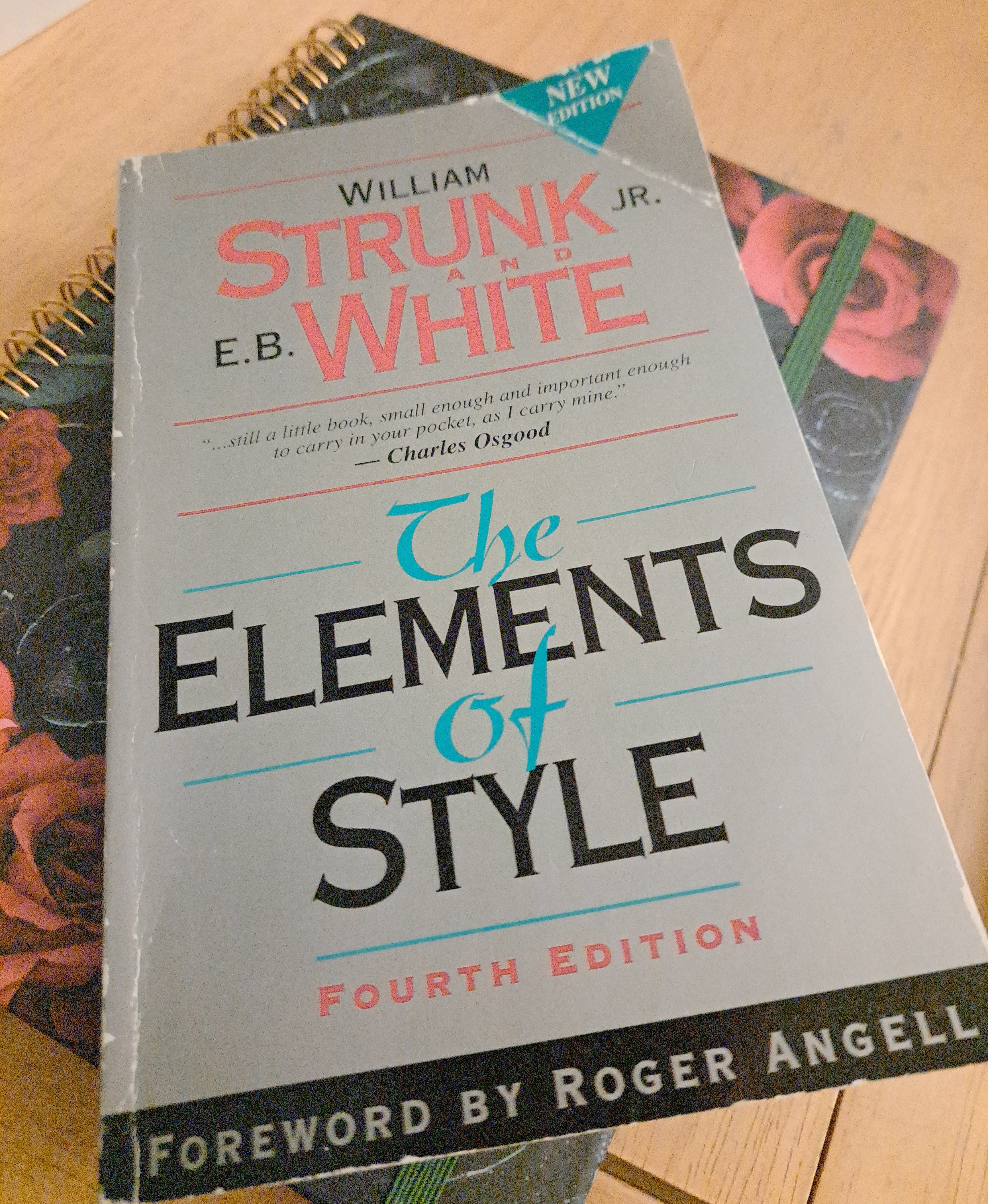
For January, I pledged to read the novel Seance in Apartment 10 by Ambrose Ibsen, the nonfiction book Forbidden Knowledge: From Prometheus to Pornography by Roger Shattuck, and The Elements of Style (Fourth Edition) by William Strunk and E. B. White.
I found little pleasure in Ibsen’s error-riddled horror novel besmirched by a main character who resembled a cardboard cutout more than a person, so I never managed to finish it. Shattuck’s book, while promising to be an interesting history of ideas, really failed to make it out of the gate as the author very clearly imposed his own opinion upon the work at the outset, poisoning the well for something that had the potential to be very interesting indeed. I did not finish it either. The third nonfiction book was a bonus anyway. . .
Ah, but Strunk & White! I knew this little book from the time I was a baby in high school, though it wasn’t preached through the teachers by name. It was offered me via PDF by a professor in my editing and style class in grad school. A stickler for grammar (though no longer sporting the iron corset of a pedant), I read snippets of this wee book over the years. But as someone who ekes out a living as a professional writer (and erstwhile editor), I decided this small (fewer than 100 pages!) tome would be a great start to a year of reading writing books.
Reader, I finished it!
The Elements of The Elements of Style: Meet Strunk & White
William Strunk and E. B. White. A few of us know the latter, but I think most of us only know the former for this work. William Strunk was a writing professor known for his skillful teaching of the art, and who had written a small book for his students (their textbook for his class), to share with them the dos and don’ts of clear and effective prose.
In the early 20th century, White takes Strunk’s class. In the Introduction to the book, E. B. White writes fondly of his former professor, with the task of editing and adding to the original text given to him years after the professor passed away. White, best known for the beloved children’s classic, Charlotte’s Web, was happy to take on this task.
The book itself, originally published in 1959, has four editions, as well as a fiftieth anniversary edition. It consists of 85 pages of rules, guidelines, grammar facts, and an essay on the philosophy of style that is poetic and pragmatic at the same time. Well received for many decades, Strunk & White, as the book is often affectionately called, has become a style bible and jumping off point for many prominent writers.
In a class on editing, I recall the mention of Strunk & White, the idea slipping into my head that these two glorious men must be mirrors of the Muppets’ Statler & Waldorf, sitting in the balcony, throwing out barbs for those who dared write without clarity and concision. But why write opaquely when you can write with your audience in mind?
The Most Bang for Your Buck
I will not lie to you and tell you that The Elements of Style was the first book I read on style, or the only book. For that same class, us aspiring editors dealt with Style: Lessons in Clarity and Grace by Joseph M. Williams and Joseph Bizup. That book, half editorial workbook, half college textbook, while unexpectedly engaging, certainly borrowed heavily from the concepts from which Strunk and later White laid down the foundations.
I will have to say that Strunk & White does not play. It is often straightforward, sometimes brash, and even occasionally brutal. As White mentions in the Introduction, Strunk was a man who did not mince words. Why do something in ten words when it can be easily (and more clearly) done in five?
The book boasts five sections, as follows:
I. Elementary Rules of Usage
II. Elementary Principles of Composition
III. A Few Matters of Form
IV. Words and Expressions Commonly Misused
V. An Approach to Style
The first two sections are completely essential and you will get your most bang for your buck. Usage explains the way we appropriately form sentences in English. Where you punctuate, where you do not. How to form a sentence that is complex, compelling, and correct. This section is essential for anyone who wants to begin to understand how English is used in written communication, and how to do the communicating in a way that is understandable via common consensus.
The Principles of Composition assume you’ve put some mastery into the first chapter, then explain the art of putting together any bit of writing. How to write with clarity and concision so that the reader can understand. The writer must always be mindful that there is a reader. If not, the writer could write something that comes off as nonsensical to the reader and fail at their job of communication.
As a writer of some years, I would have to say that I nodded along emphatically to most of these commandments. “Omit needless words,” for instance, becomes even more necessary as we write for the digital audience. No one really wants to read what older folk used to call “purple prose.” Additionally, firm instructions that “the number of the subject determines the number of the verb” are helpful reminders when we forget where we are going.
Strunk & White explain each instruction with precision, if not sometimes with snark and pomposity, but always with examples.
Matters of Form describes what we generally do to coined words or other expressions, as a bunch of people who accept certain rules about writing in English. This section explains everything from when to use a hyphen in those two-words words, to how to format the margins of your document, to rules about parentheses and quotations. While useful, some of these particular rules are either out of mode or a nonissue altogether. I’ve never seen anyone call wildlife “wild-life,” for instance. At least not in the past century.
But the wildest of Strunk & White lies in the Misused Words section. Here, the two go through a lengthy list of words that were most commonly misused in the English language at the time. In typical Strunk & White style, they tell you why and why you should not. In this section, the two take umbrage with business speak, decrying the turning of a noun into a verb. Those of you who would like to gift something to someone might feel a little sad.
Misused Words and Phrases does show its age, however, as someone newly learning English would take well to know. All you need to do is see the little passage on the word “literally.” Its modern usage is literally something that would have the two writing giants spinning in their graves.
Ending with an essay on what style is, what it isn’t, and how to grasp it, the short book concludes on a high note. Style is not something you can just get from following grammatical rules. It is not something you can take from someone else and it be your own. It is something that you find, well after having acquainted yourself with the rules in the other little sections.
Style, the two argue, is your own personal growth as a writer. It is not dependent on lists or fancy words or the trappings of pedantry. It is you. It is you on the page. And a little book like The Elements of Style can help you remember how to get there.
I ended the little book with a fond smile.
Problematic Elements for the Modern Reader of the Elements
While I would still argue that this book is essential and a helpful tool for writers of all sorts, I would like to add a little note that, because of its age (E. B. White died a few months after C. M. Black was born), there are some aspects of it that do not quite hold water anymore.
For instance, while I appreciate the rigorous enthusiasm of the two authors, some of their notions on proper speaking are a little too rigid for the (20)20s. Like many of their academic ilk, the two seem to have a disdain for slang, as an example. While there is a small section on writing in a dialect (avoid it unless you can do it well, and stick to one spelling of a dialect word), I am inclined to discomfort around some of the rigidity of the rules the two profess.
It is this pedantry that can lend itself to closemindedness and an ignorance of the progression of language. Many of us often see or use -wise in words, for instance. We can probably give up on their idea of “transpire.” And unfortunately, in advance of “thanks in advance,” they didn’t get their way there either. If Strunk & White were now living, would they have mocked us from their balcony seats?
Additionally, I personally think we should use this small tome as a jumping off point. Sticking religiously to the Elements can make us sound like crusty Victorians, but taking the ideas from the work, especially in the first two and the last sections, can help enrich our own writing, even if the authors were stuffy academics.
Strunk & White: A Good First Book
Strunk & White remains overall a healthy book for starting off as a writer. Like any good recipe, it shows you the ingredients to make the dish. It’s up to you to expand or substitute these ingredients if you want to become a chef.
The former pedant in me delights in the scolds of William Strunk and E. B. White, but the older writer in me appreciates the advice and friendly reminders. In the end, you create your own style. Let that style be you, the writer.
PS: Three Books for February
February, the month of love. According to my list, I am bound to:
The Beautiful by Renee Ahdieh (some vampire novel?)
Yours Cruelly, Elvira by Cassandra Peterson
Bird by Bird by Anne Lamott, who wrote the best chapter on “Shitty First Drafts”
Have you read The Elements of Style? I’d like to hear your impressions on the work!
If you appreciate what you’ve seen here, I thank you for your support in any way, but consider a Ko-Fi tip for someone who needs to pay insurance premiums. It also helps keep this blog free.
No posts
Comments
Nothing yet. Say the first thing.
Sign in to join the conversation.