
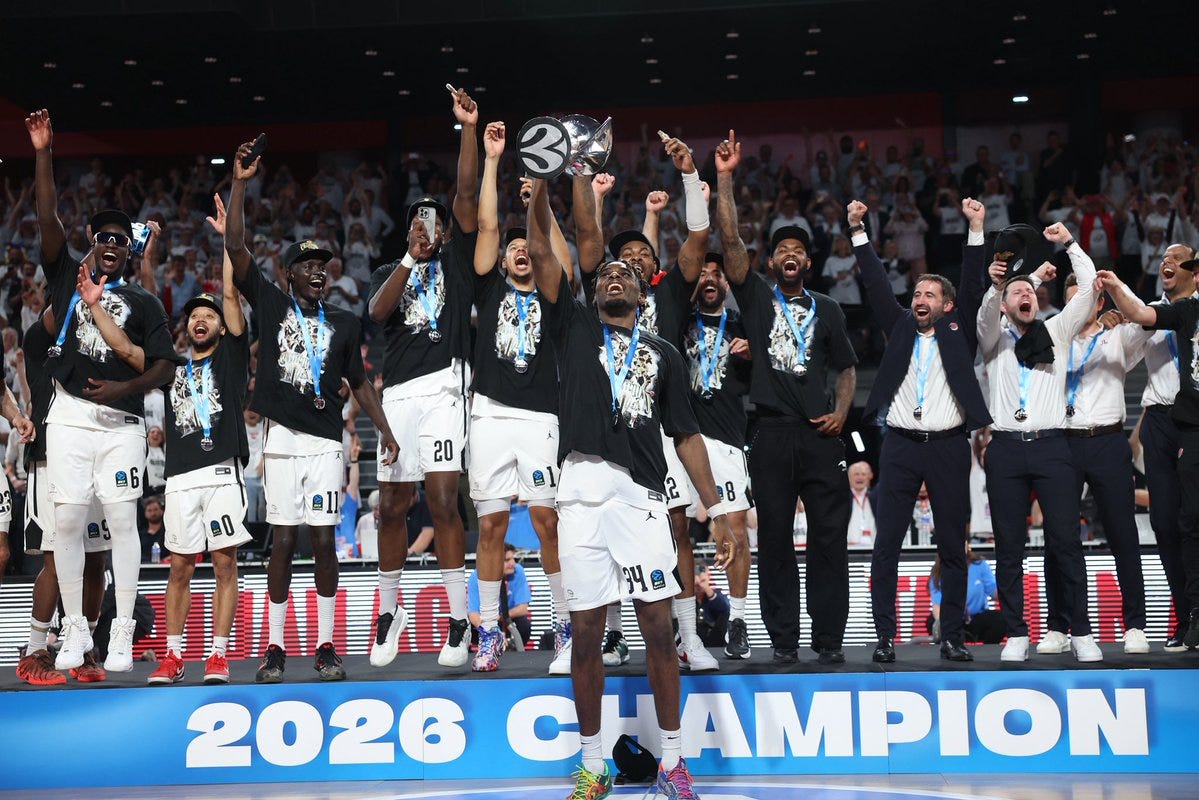
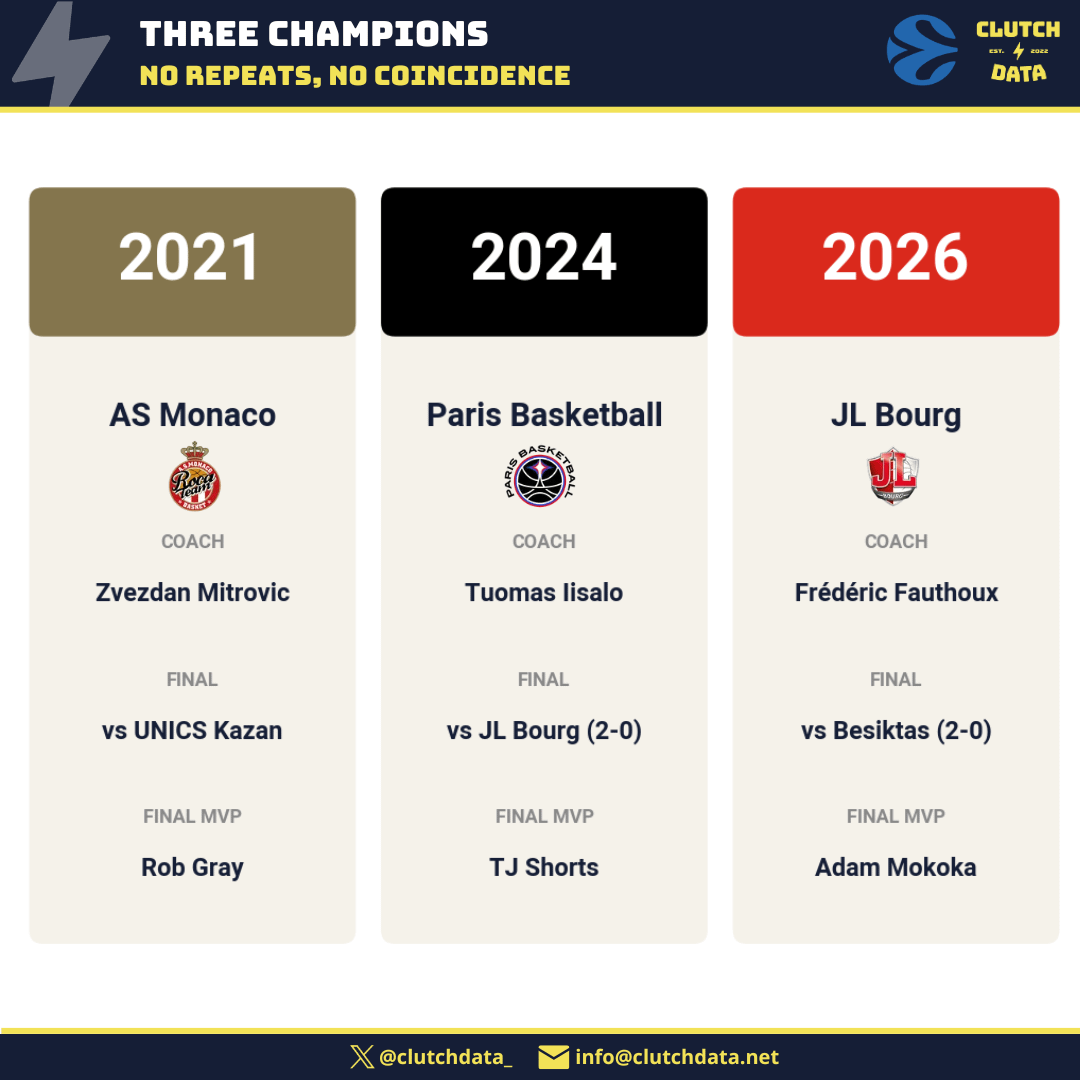
In the last five editions of the EuroCup, three trophies have stayed in France. Before Monaco in 2021, no French club had ever lifted the title in the modern era of the competition. Today, France is the only country that has won three different editions in this cycle, with three different teams, three different coaches and three different cities.
And the three champions have one more thing in common: none of them were favorites at the beginning of the season.
Three champions, no repeats. That alone is a sign of something bigger than one-season luck. And once you dig into the data, a very specific pattern emerges.
The first thing worth getting out of the way is the idea that the three champions played the same way. They didn’t. Each one had a completely different EuroCup.
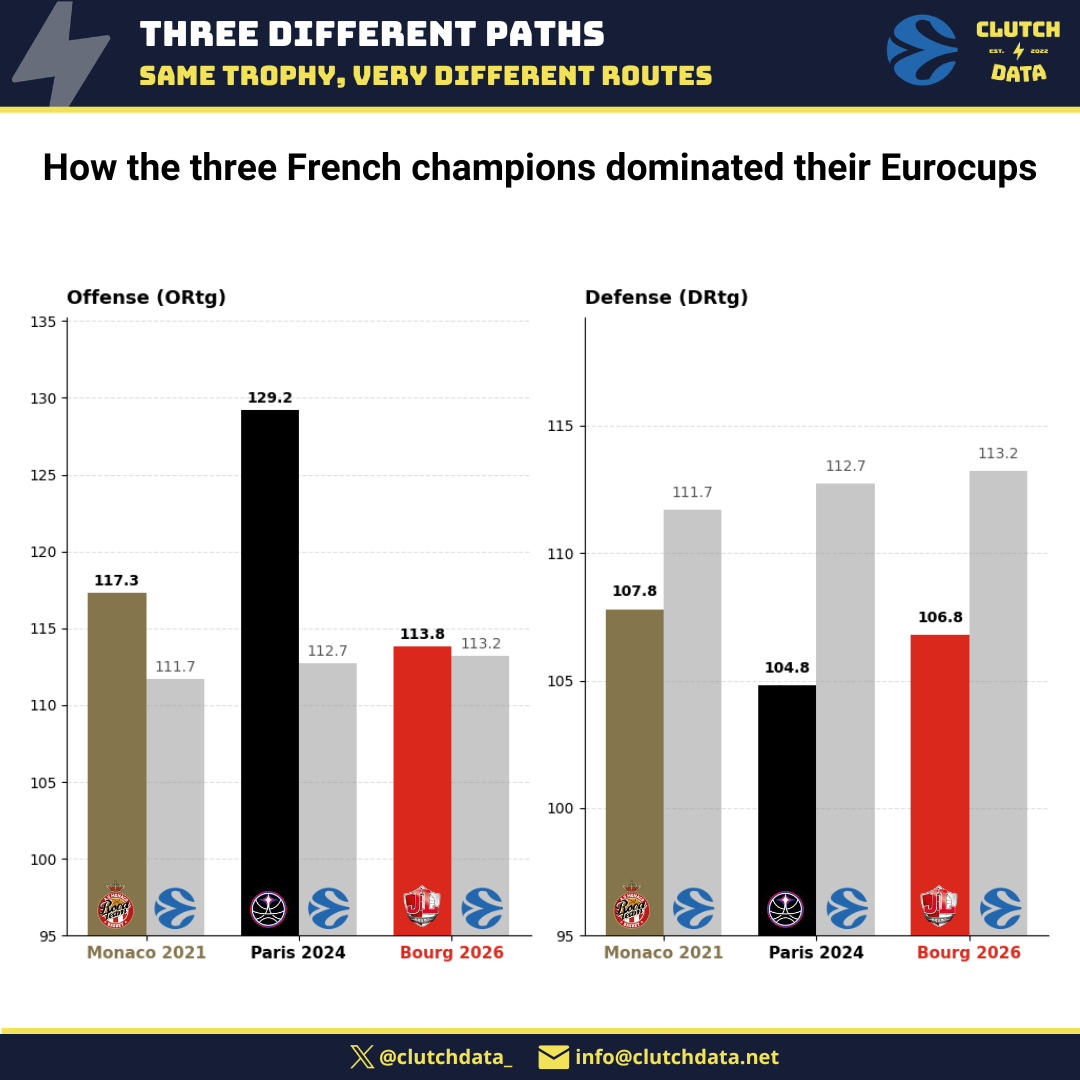
Monaco 2021 was a balanced team: ORtg #6/24, DRtg #7/24, Net Rating #2/24. Good offense, good defense, top-1 at nothing. For context: Monaco was a club that in 2014 was still in the French third division. Seven years later, they lifted the EuroCup.
Paris 2024 was a steamroller. ORtg #1/20 (129.2, almost 17 points above the league average), DRtg #2/20, Net Rating of +24.4. They closed the EuroCup with a historic record: 22 wins and 1 loss in the competition, the last 15 in a row. By far the most dominant of the three champions.
Bourg 2026 arrived with a very modest offense: ORtg ranked only #10/20, barely a point above the league average. Their Net Rating of +7.0 was one of the lowest for any recent European champion. And they still won.
If you stop at the offensive averages, you understand nothing. To get the pattern, you have to flip to the other side of the court.
When you look at the defensive numbers in detail, the pattern becomes transparent.
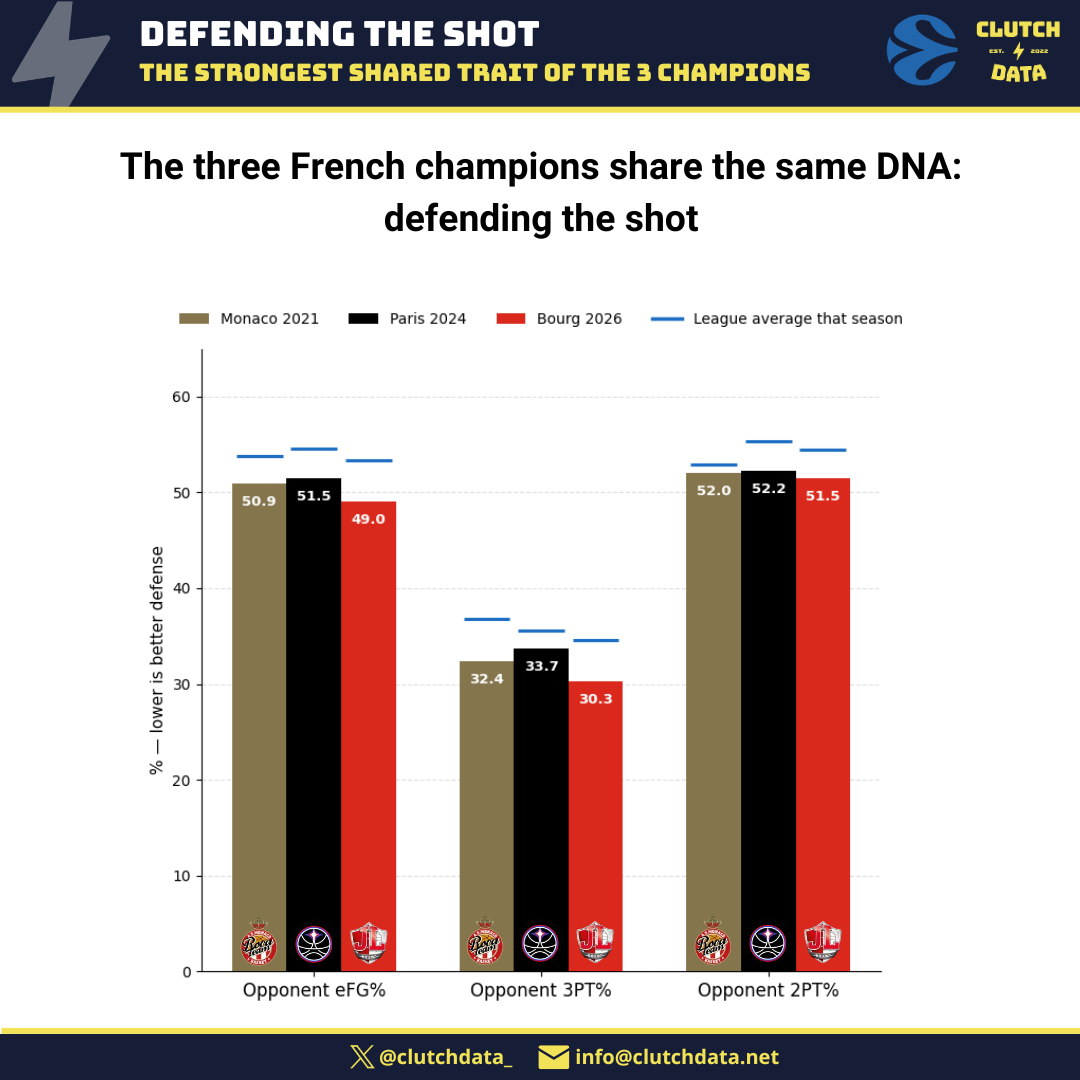
The three champions were all top-4 in opponent eFG% in their respective EuroCup:
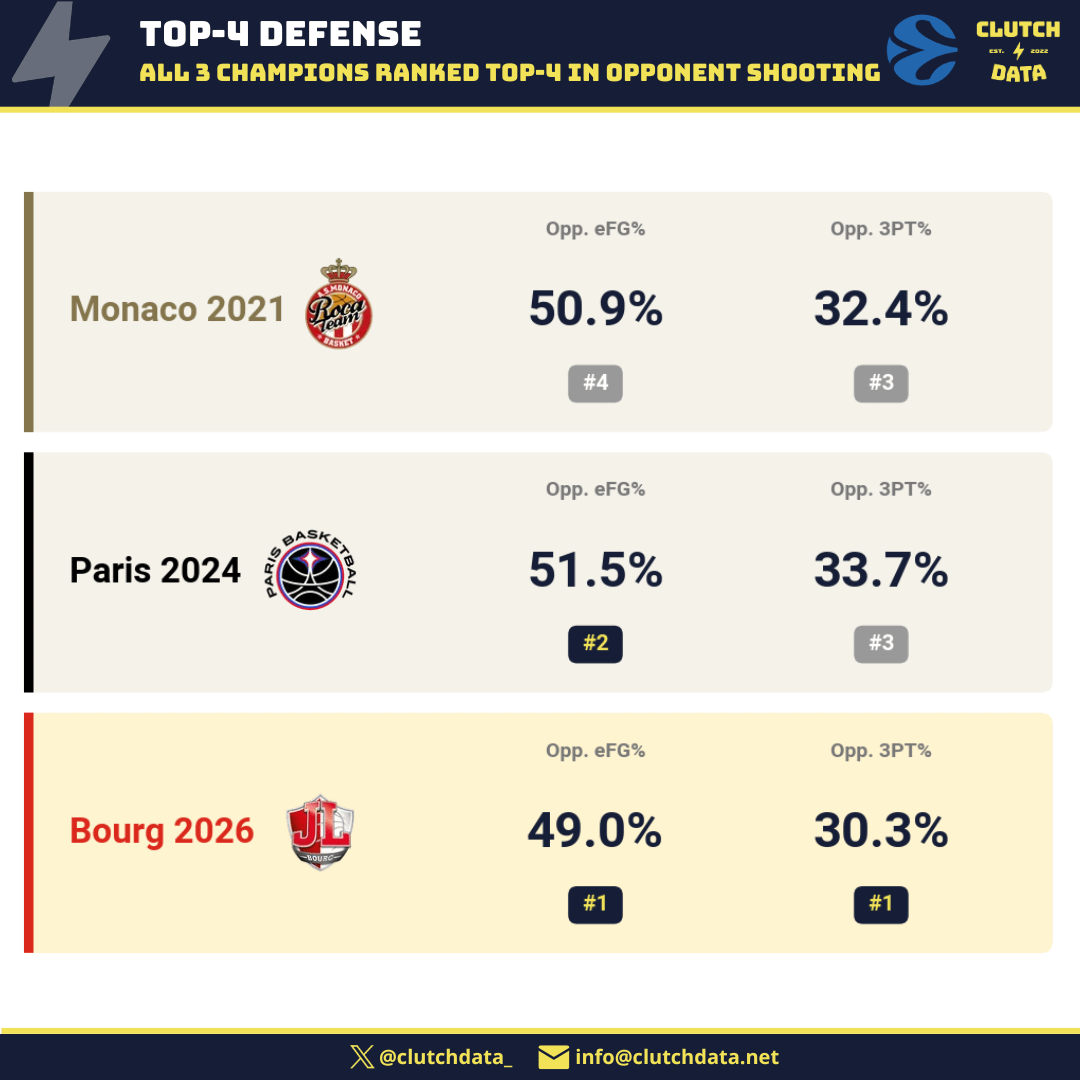
This isn’t a small detail: it’s the strongest and most consistent shared trait of the group. All three teams limited opponent shooting percentages far more than the league average, and all three did it especially well on the three-point line. Bourg 2026 was literally the best shot-defending team in the entire EuroCup that season.
The French championship model isn’t built on offense. It’s built on defense. And specifically, on defending the shot better than almost anyone.
Season averages confirm the pattern. But the real proof comes from going down to the lineup level: what happened when each team’s starting five was on the floor?
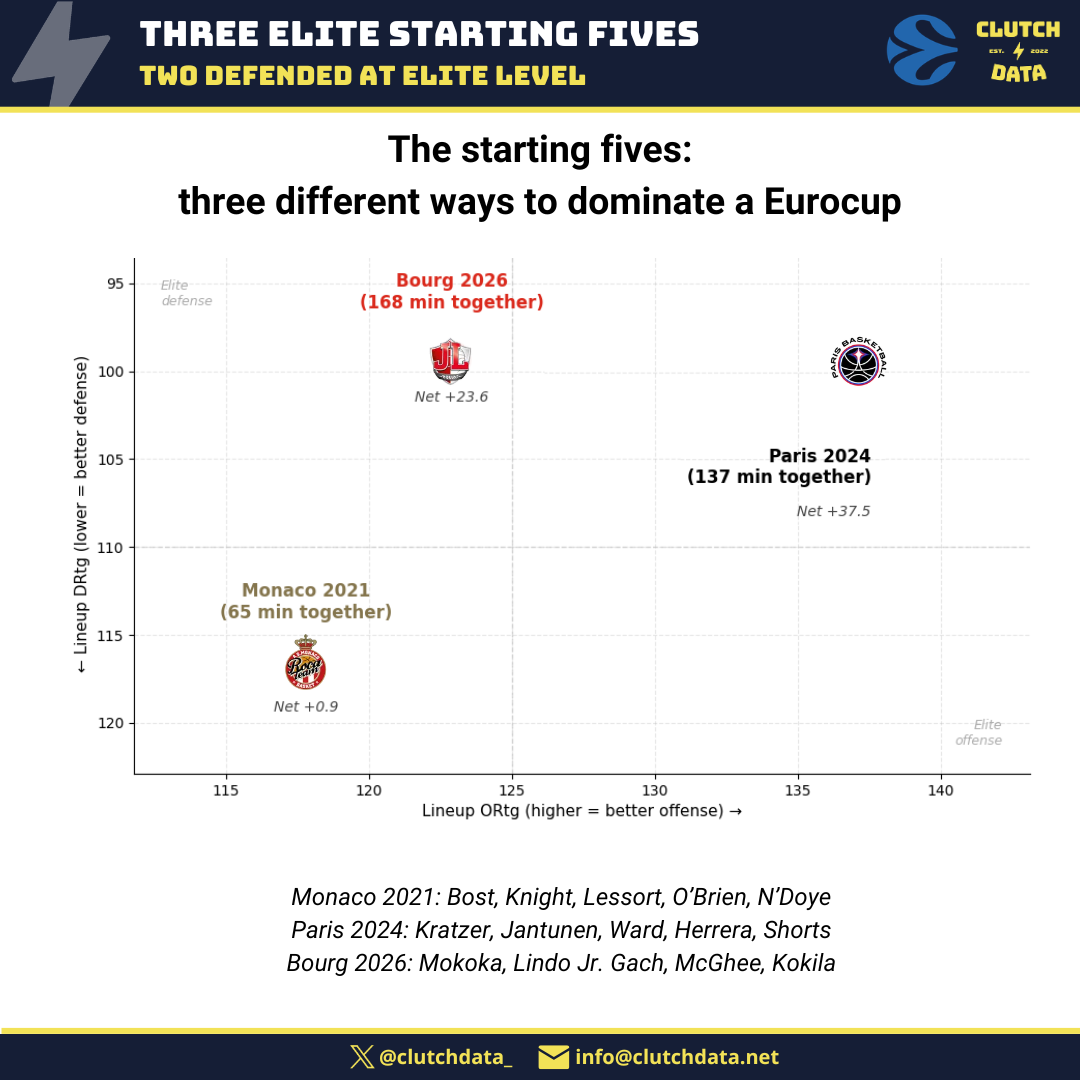
Paris’ and Bourg’s starting fives defended at roughly 100 points per 100 possessions — elite. But Monaco’s most-used five was mediocre (+0.9 in 65 min). Mitrovic rotated heavily, and that opens an interesting question: where was each team’s real engine if it wasn’t in the starting lineup? To answer that, you need to drop another level — to the trios.
Trios are more revealing than starting fives for two reasons: there are more combinations, and each one accumulates more minutes, which gives statistically stronger samples. This is where you can see which subsets of players actually moved the needle.
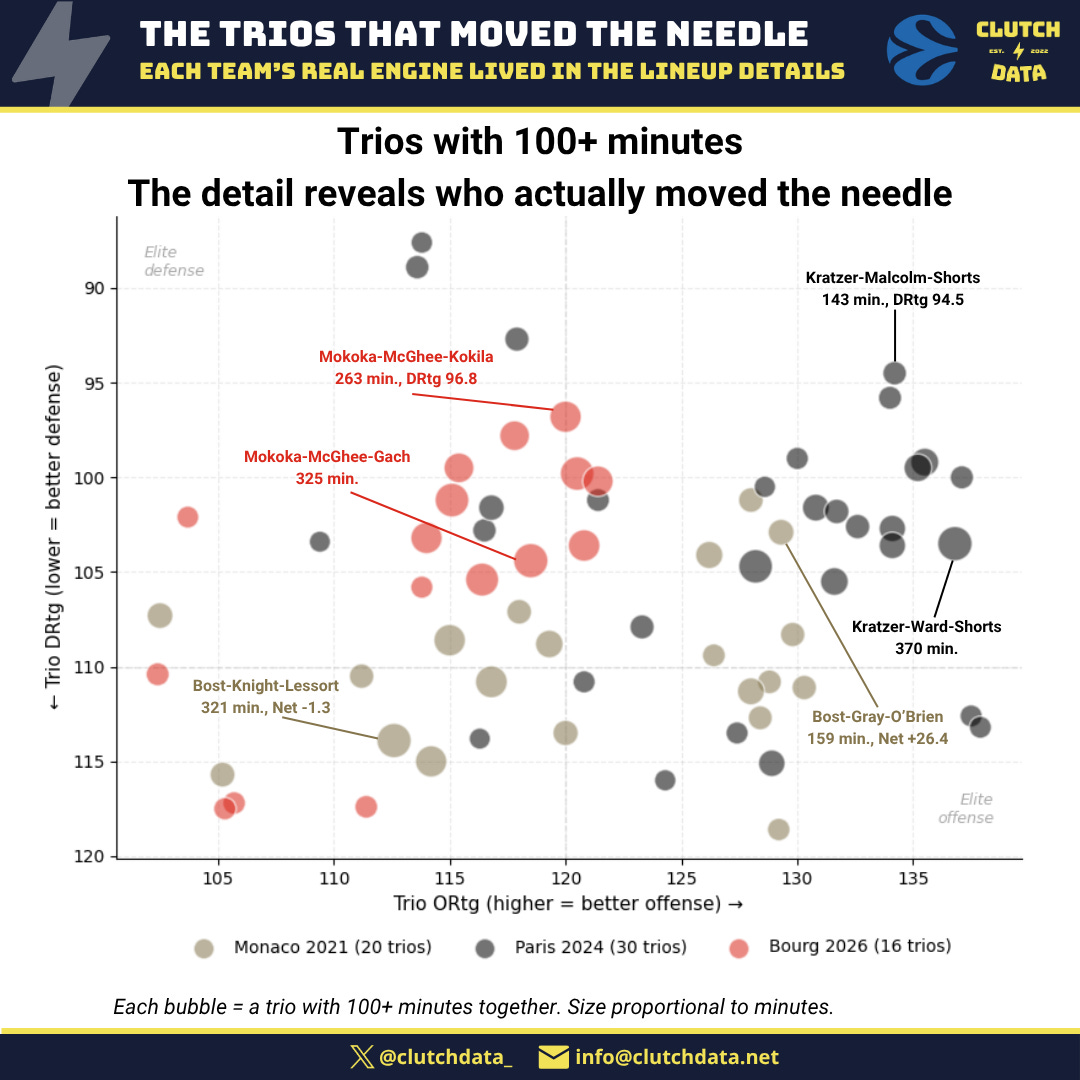
The first thing the chart shows is the cloud of points — each team’s footprint in the ORtg/DRtg plane.
Paris (black) has the cloud furthest to the right and highest up: 30 trios with 100+ min, average ORtg 127.3, average DRtg 103.2. Almost any combination worked.
Bourg (red) lives in the upper-middle zone: 16 trios with 100+ min, average ORtg 113.9 (modest) but average DRtg 105.1 (solid). Less variety, but every trio was competitive.
Monaco (beige) occupies the middle-lower band: 20 trios with 100+ min, average ORtg 121.0 but average DRtg 110.1. Higher variance: some trios shone, others were weak.
And then there’s the detail.
Bourg’s best trio by Net Rating is Mokoka-McGhee-Kokila: +23.2 in 263 minutes, DRtg 96.8, opponent 3PT 27.9%. And when trios are ranked by best DRtg, Kokila appears in five of the top six. The center who came over from N1 three summers ago, the only survivor of the previous season’s roster, became the defensive anchor of the entire campaign.
The team’s most-used trio (Mokoka-Gach-McGhee, 325 min, Net +14.1) was the “offensive trio”: creation and shooting. But the trio that most tilted the season in terms of net efficiency was the “defensive trio” built around Kokila. Fauthoux managed two complementary trios, not one.
Most-used trio: Kratzer-Ward-Shorts II, 370 minutes, Net +33.3. A championship season on its own.
Best trio by Net Rating: Kratzer-Malcolm-Shorts II, 143 min, Net +39.7. The tier above when Malcolm came in for Ward.
Best defensive trio with a real sample: Kratzer-Malcolm-Shorts II again. DRtg 94.5, opponent eFG% 44.0%, opponent 3PT 30.8% in 143 minutes.
When Caleb Malcolm shared the floor with the Kratzer-Shorts core, Paris lost nothing offensively (ORtg 134.2) and gained significantly defensively. This is exactly the kind of finding that only appears once you go down to lineups instead of season averages: Malcolm’s individual numbers were modest, but his on-court presence lifted the entire team. The three best defensive trios with 100+ minutes all have him in them.
Monaco’s pattern is the opposite. The most-used trio was Bost-Knight-Lessort: 321 min, Net -1.3. The team’s de facto starting trio was, in fact, mediocre. What actually won Monaco the EuroCup was Rob Gray, who joined the club mid-season and only played 13 EuroCup games.
Monaco’s three best trios by Net Rating all have Gray in them:
Gray-O’Brien-N’Doye: Net +26.8 in 141 min, DRtg 101.2 (the team’s best defensive trio)
Bost-Gray-O’Brien: Net +26.4 in 159 min
Bost-O’Brien-N’Doye: Net +22.1 in 182 min (without Gray but with the rest of the core)
In barely half a season, Gray transformed the team. When he stepped on the floor, Monaco became a different unit, better both offensively and defensively. Mitrovic found that configuration in the second half of the season, and Gray didn’t win Final MVP by accident: he was the player who unlocked the entire team, arriving just in time for the games that decided the title.
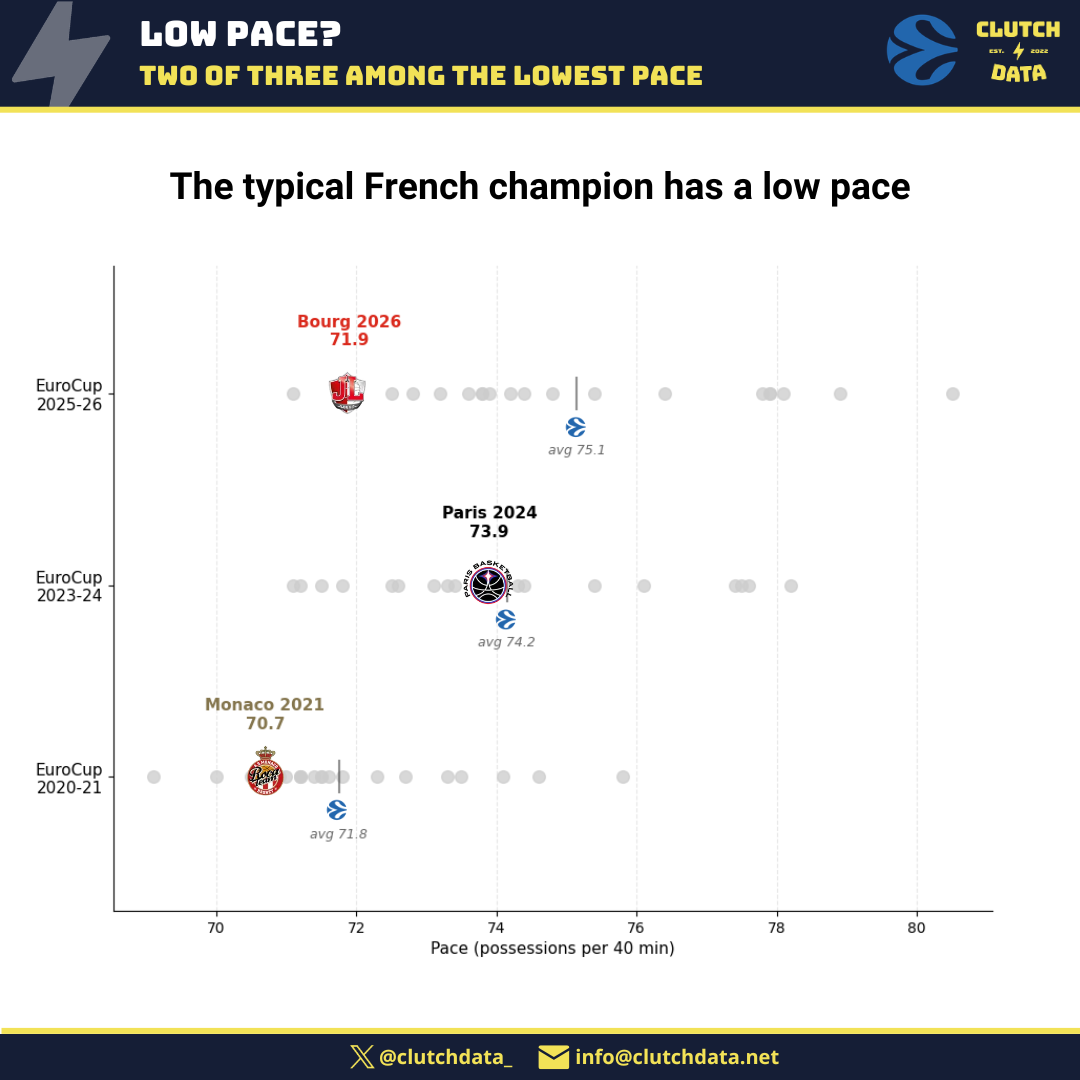
Monaco (#20/24) and Bourg (#19/20) were among the lowest-pace teams in their respective EuroCups. Paris was the exception (#10/20), but their pace wasn’t high either: barely 0.25 possessions below league average (Paris ranked in the top 3 in offensive rebound percentage, which meant more second-chance opportunities on the same possession, extending it).
Elite defense and controlled pace are two sides of the same coin: fewer possessions mean less variance, fewer chances for the opponent to get hot from the perimeter.
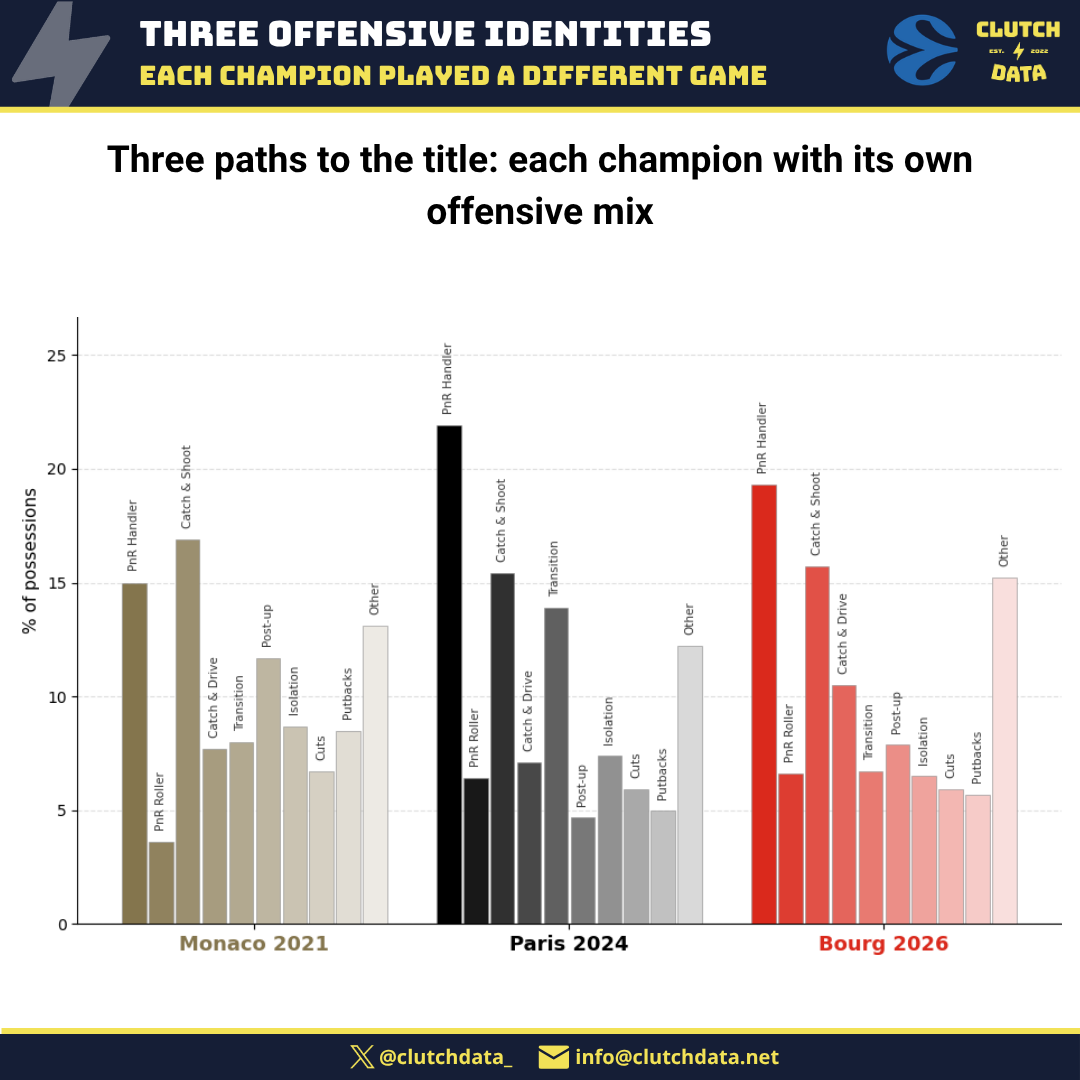

Monaco 2021 was the most conservative. 11.7% of their possessions ended in post-ups — the highest share of the three — at a PPP of 0.73 (#2/24 in post-up efficiency). Mathias Lessort was the engine: PER 24.1, top 4% in the entire EuroCup. Post and mid-range basketball.
Paris 2024 was the most modern. 21.9% of their possessions in PnR Handler (TJ Shorts), 13.9% in Transition (#1/20 in the league). Shorts had the best PER of the entire EuroCup that season (30.6), and Paris was #1/20 in PnR Handler PPP at 0.89. The whole system revolved around the point guard’s game, with Kratzer spacing the floor from the 5.
Bourg 2026 was the most distributed. 62.9% of made baskets came off an assist (one of the highest rates in the league), with no single dominant creator. McGhee, Mokoka, McDowell-White, Gach — everyone passes, everyone creates. And their catch-and-shoot efficiency was #3/20 (PPP 1.18) — the system was designed to free up shooters, not to monopolize the ball.
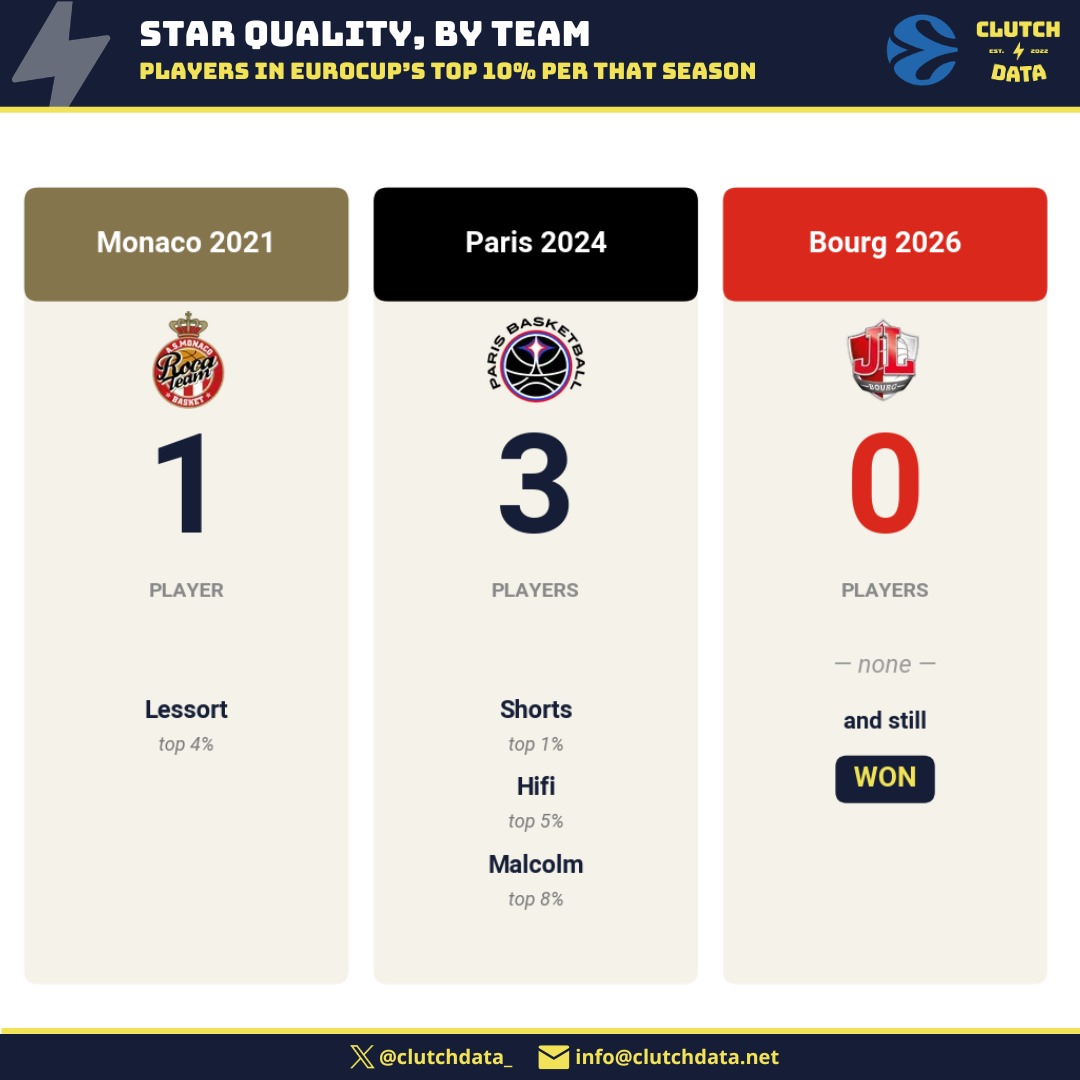
Paris was the only one with a clear-cut star — Shorts top 1% in PER and in Usage Rate. But it also had 3 players in the top 10% of the entire EuroCup. It was a team with a clear hierarchy of quality.
Bourg 2026 is the extreme opposite case: no player made it into the top 25% of the league in PER. Both Gach, the most-used player, sits in the top 30%. And they still won. Because, as the trios showed, the team worked as a collective: Mokoka + Kokila as the defensive core duo, McGhee and Gach providing creation and shooting, Lindo adding versatility. No star, but five pieces fitting together perfectly.
There are three more, more qualitative traits that close the pattern:
1. Undervalued coaching staffs that take the next step right after. Mitrovic, Iisalo, Fauthoux. None of them were top-tier coaches when they arrived. Iisalo later joined the Memphis Grizzlies. Mitrovic was replaced by Obradovic, who took Monaco to the EuroLeague Final Four. Fauthoux doubles as head coach of the French senior national team. French clubs are picking the right profiles just before they explode — not the already-established ones.
2. Undersized American point guards as the system’s engine. Rob Gray (1.85m, 2021 Final MVP). TJ Shorts (1.75m, double MVP 2024). Darius McGhee (1.75m, Bourg 2026’s top Usage scorer). It’s not aesthetics — it’s market arbitrage. Elite point guards below average height are systematically undervalued in the European market because traditional EuroLeague clubs look for other profiles.
3. The champion comes out revalued. Lessort went from Monaco to Partizan, where he played one EuroCup season and then reached the EuroLeague playoffs the next one, before winning the EuroLeague with Panathinaikos in his first year in Athens. Shorts and the Paris core stayed together for a first EuroLeague season that ended in the playoffs, with TJ Shorts among the best players of the 2024-25 edition, before he signed for Panathinaikos. Iisalo made the jump to the NBA. Mokoka, 2026 EuroCup Final MVP, is rumored to be a target for several EuroLeague clubs. The French championship club works as a revaluation platform, not as a final destination.
The bigger picture: why France, why now
This isn’t just about clubs. What’s happening in the EuroCup connects to something much larger.
In 2023, Victor Wembanyama was the #1 pick of the NBA Draft. In 2024, Zaccharie Risacher and Alex Sarr went #1 and #2 — the first time in draft history that the top two picks came from the same European country. In 2025, three more Frenchmen went in the first round (Nolan Traoré, Noa Essengue, Joan Beringer) and three in the second round (Noah Penda, Maxime Raynaud, Mohamed Diawara).
What matters for the EuroCup is that the ecosystem producing that NBA talent is the same one sustaining the championship clubs: INSEP, the academies of Cholet, ASVEL, Bourg, Le Mans, the Pôles Espoirs. Risacher actually played for Bourg the season they lost the EuroCup final to Paris (2023-24) before being the #1 pick.
Over the past ten years, France has built an infrastructure that produces both NBA/Euroleague talent and clubs capable of competing in Europe. One feeds the other. The ecosystem, not the individual team.
At the club level, France had three teams in the EuroLeague last 2 seasons (Paris, Monaco, ASVEL). If Bourg confirms its entry, it could come at the cost of another French club losing its spot. But the qualitative read doesn’t change: France has gone from having no stable EuroLeague presence to being, alongside Turkey and Spain, the continent’s third major club power.
JL Bourg has secured a spot for EuroLeague 2026-27 although, as Maxi Basket puts it, “playing it could prove suicidal” without a budgetary jump. The club has doubled its budget in nine years, from €3.5M to €8.1M — but Beşiktaş, the team they just beat in the final, is estimated to have a payroll three times larger.
The most interesting question isn’t whether France will keep winning EuroCups. It’s: how far can this model scale to EuroLeague, where the context is different, the budgets are different, and the opponents are different?
Monaco gave a resounding yes: from EuroCup champion 2021 to EuroLeague finalist in 2025. Paris gave another yes: playoffs in their debut year, French champions in 2025, and an Adidas Arena that’s repositioning French basketball as a global brand. Bourg’s answer will come starting in October.
The French model works in EuroCup. What’s left to find out is whether it’s a model — or just a window.
Clutch Data analysis — May 2026.
No posts
Comments
Nothing yet. Say the first thing.
Sign in to join the conversation.