
Data through May 30, 2026.
That wasn't the plan. Sabrina Ionescu — the New York Liberty's starting point guard, the No. 1 pick of the 2020 draft and a four-time All-Star — got hurt in the team's final preseason game against Connecticut and missed the first five games of the 2026 season. The result: the Liberty opened the year with a 24-year-old French rookie, fresh off the plane from Prague and barely two weeks into the team, running the starting five.
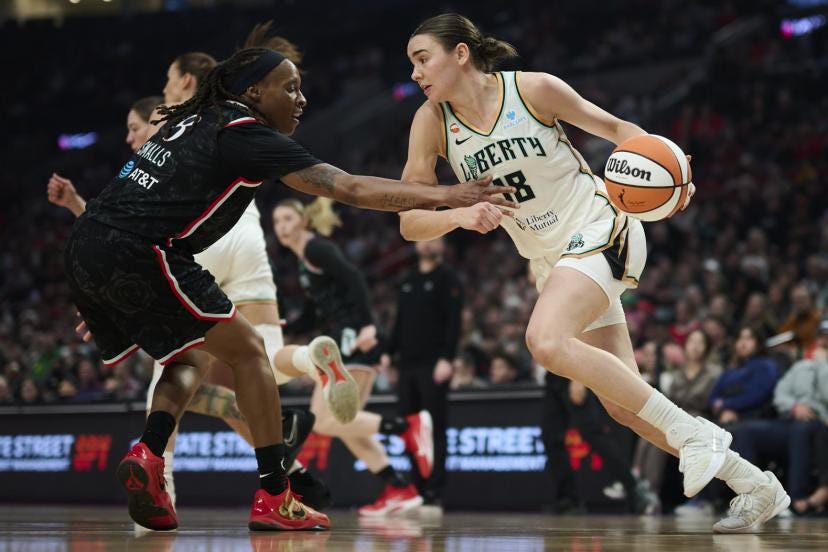
Nine games in, Pauline Astier is one of the most efficient offensive players in the entire WNBA.
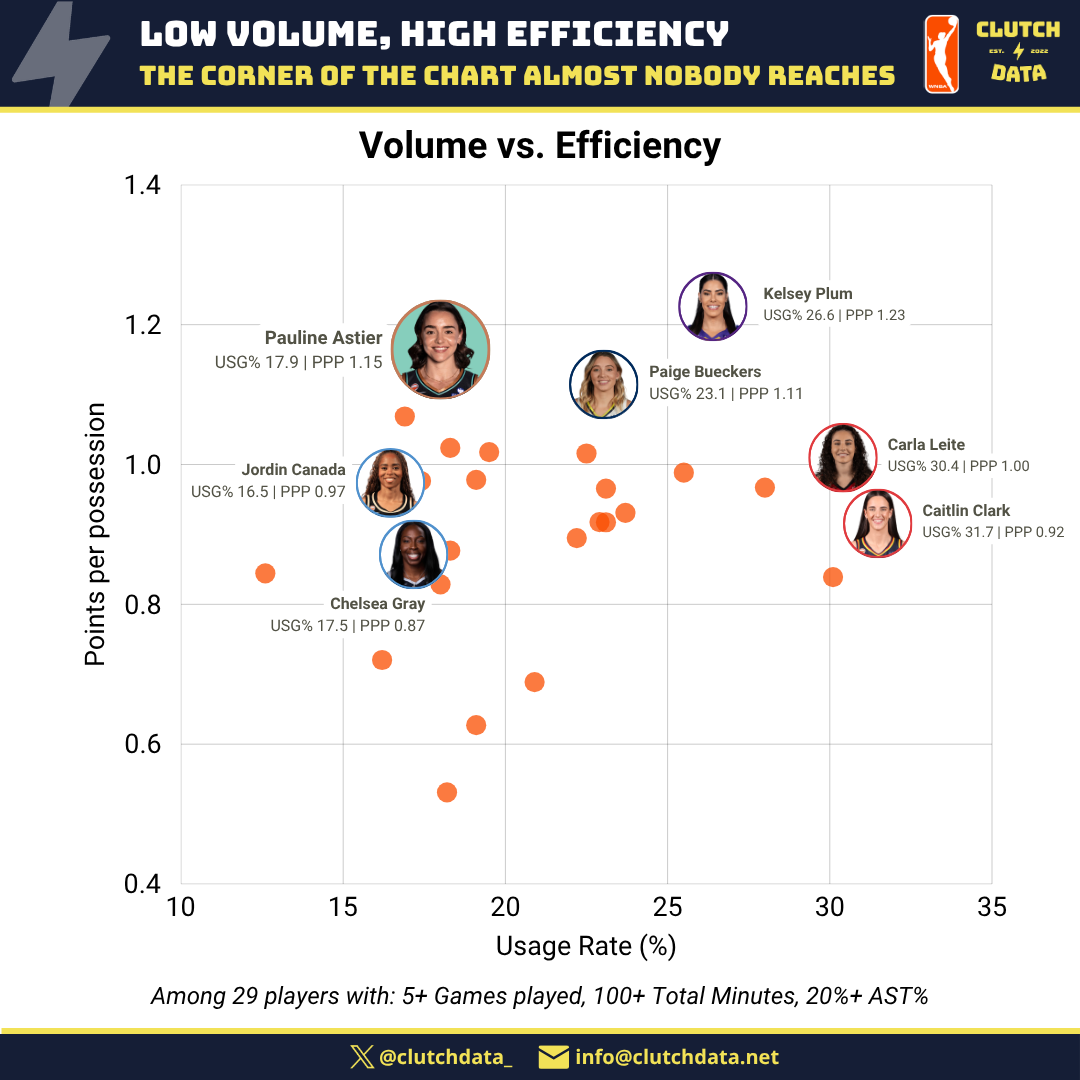
That's not hyperbole. Among the league's 29 creating guards (more than 100 minutes played and an AST% of 20% or higher), Astier ranks #2 in True Shooting Percentage (69.6%), #2 in Effective Field Goal Percentage (67.2%), #2 in field goal percentage (61.2%) and #2 in 3-point percentage (47.1%). In individual points per possession, she's #2 of 29. Only Kelsey Plum shoots more efficiently among the league's guards.
This isn't the story of a European rookie who arrived in the WNBA to learn and adapt slowly. It's the story of a European rookie who started out shooting at a rate that ranks among the best in the league.
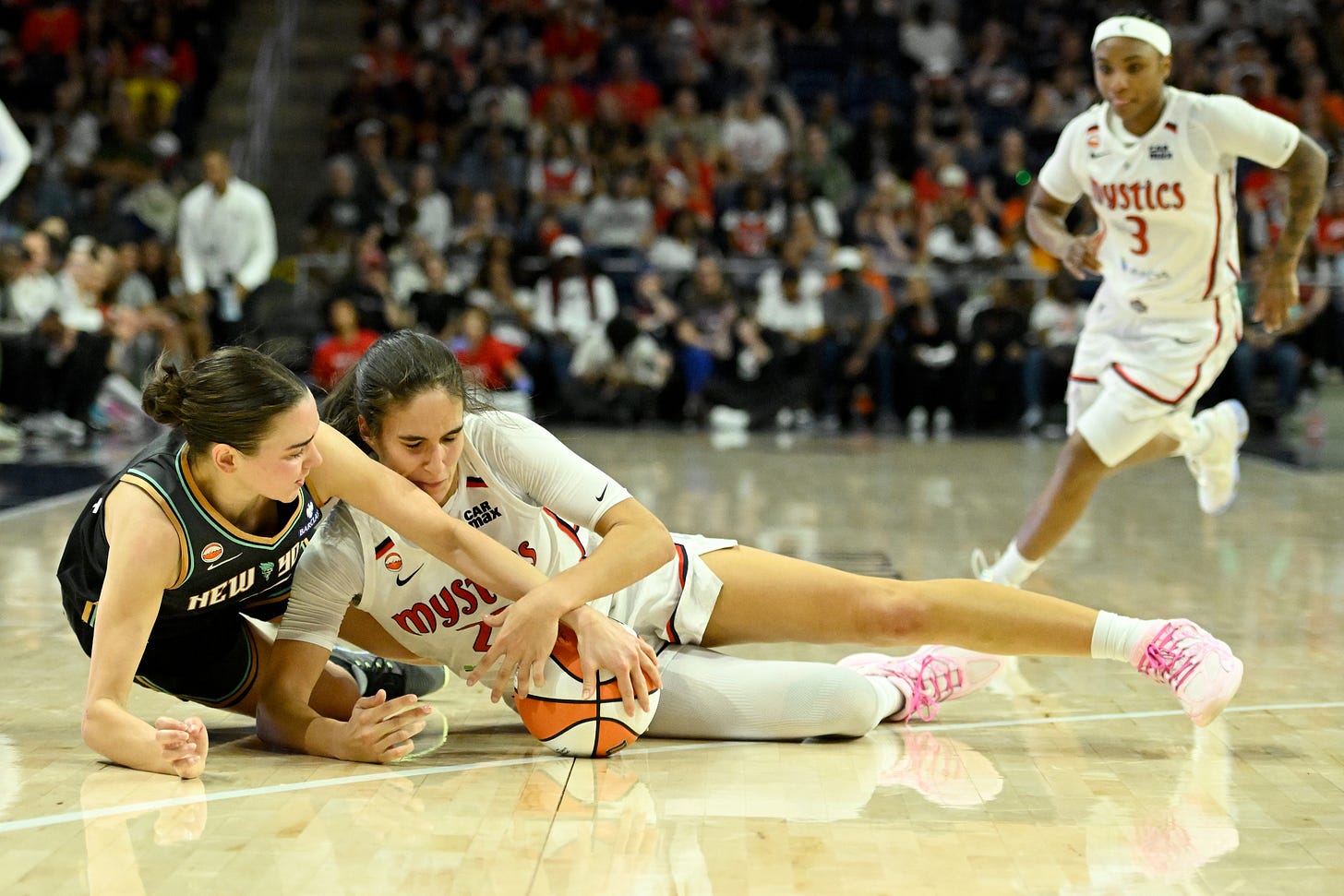
If there's one game that defines how the Liberty has looked at Astier from the very first minute, it's the second of her career: May 10, at Washington, her first start. 35 minutes on the floor, 18 points on 6-of-10 shooting, 7 assists, 5 rebounds, 2 steals. The Liberty win 98-93 in overtime, and Astier hits the two free throws with 19.3 seconds left that seal the win.
Her stat line made her one of just three rookies in WNBA history with 18+ points, 7+ assists, 5+ rebounds, 2+ steals and 60% or better from the field in a single game. The other two are Candace Parker and Paige Bueckers. Both won Rookie of the Year.
Three days later, in Portland: 24 points on 10-of-14 shooting. Two days after that, again in Portland: 20 points, 3-of-6 from three. 62 points in three straight games — the first Liberty rookie to reach that mark since Sophia Witherspoon in 1997. And with 67 points, 16 rebounds and 15 assists in her first four games, Astier joined a short list of rookies in WNBA history alongside Candace Parker, Tamika Catchings and Caitlin Clark.
New York didn't come out of nowhere. In 2025-26, Astier has played the four most demanding stops a European player of her profile can aspire to. And she delivered at every one.
October 2025 — European SuperCup in Villeneuve-d'Ascq (France). Her first official game with ZVVZ USK Praha, on French soil. Against the hosts: 17 points, 15 assists, 7 steals, 1-of-1 from three in 32 minutes. ZVVZ USK Praha wins 86-77 and Astier walks away with the MVP. It was her first official game with a non-french team after many seasons in Bourges.
October 2025 to March 2026 — EuroLeague Women. In 14 games: 24.7 minutes, 10.2 points, 5.5 assists per game (#3 in all of EuroLeague Women), 1.9 steals per game (top-8 in the entire competition), 52.3% from the field (#2 among creating guards), 92.9% from the line. ZVVZ USK Praha is +8.4 in Net Rating with her on the floor (vs +1.0 without her). Her real impact, measured in net efficiency: +7.4 points per 100 possessions.
March 2026 — 2026 World Cup Qualifying Tournament with France (Villeurbanne). Part of the national team's rotation: 14 minutes per game, 2.4 points and 3.2 assists. The team rolled — 5-0, first place, World Cup berth secured — with Astier part of a squad ranked #2 in the world.
May 2026 — WNBA with the New York Liberty. What we've already seen.
What's striking is that the role changed at every stop — featured star in the SuperCup, primary creator in EuroLeague, accidental starter in the WNBA — but the shooting numbers didn't move. These aren't small-sample figures: they hold up across five different competitions, against very different levels of defense, with very different teammates.
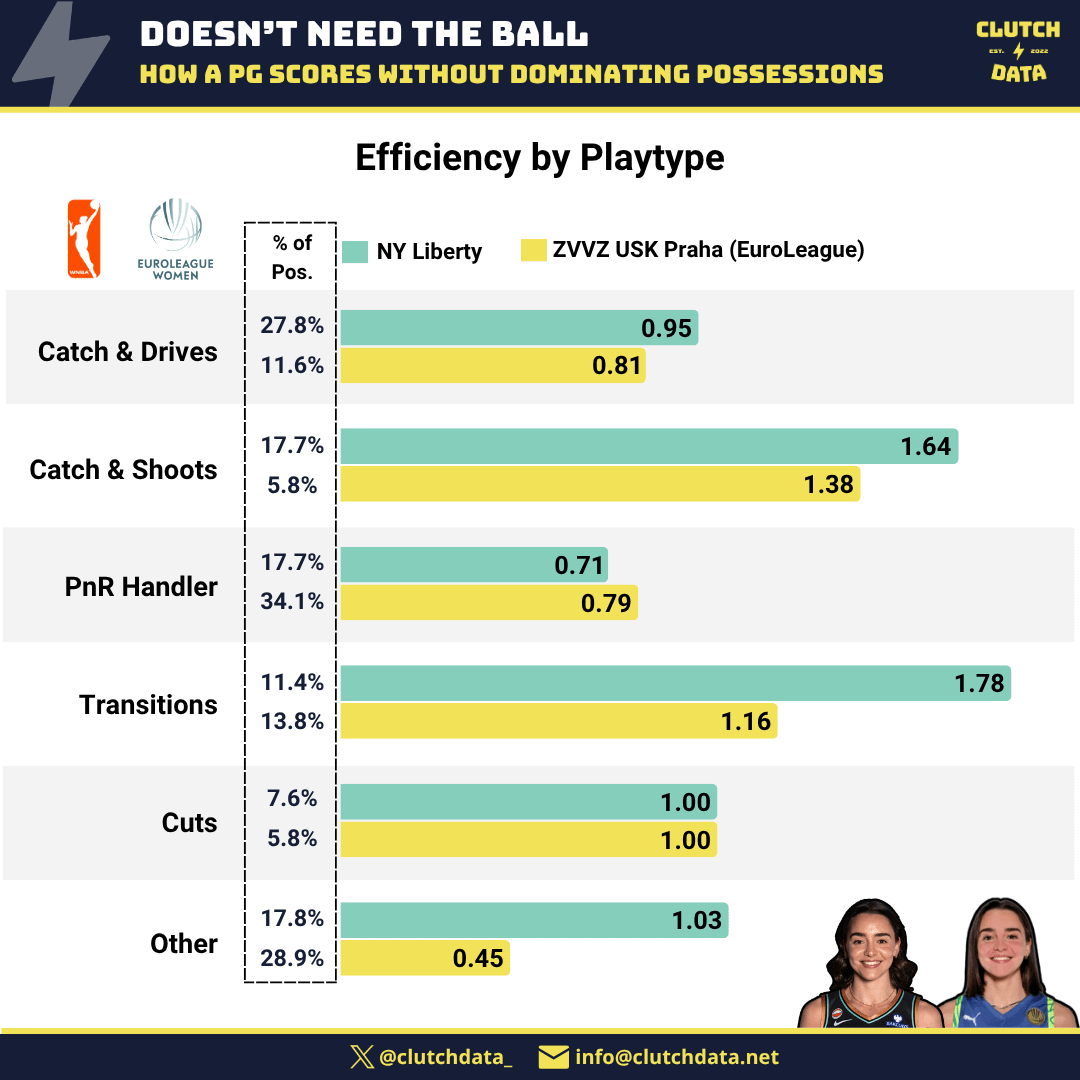
A player can have a 70% TS% for two reasons: because she takes few shots from great spots, or because she's genuinely efficient across many situations. The play-type breakdown says Astier is the second kind. But there's something even more interesting when you compare her two top competitions of the season.
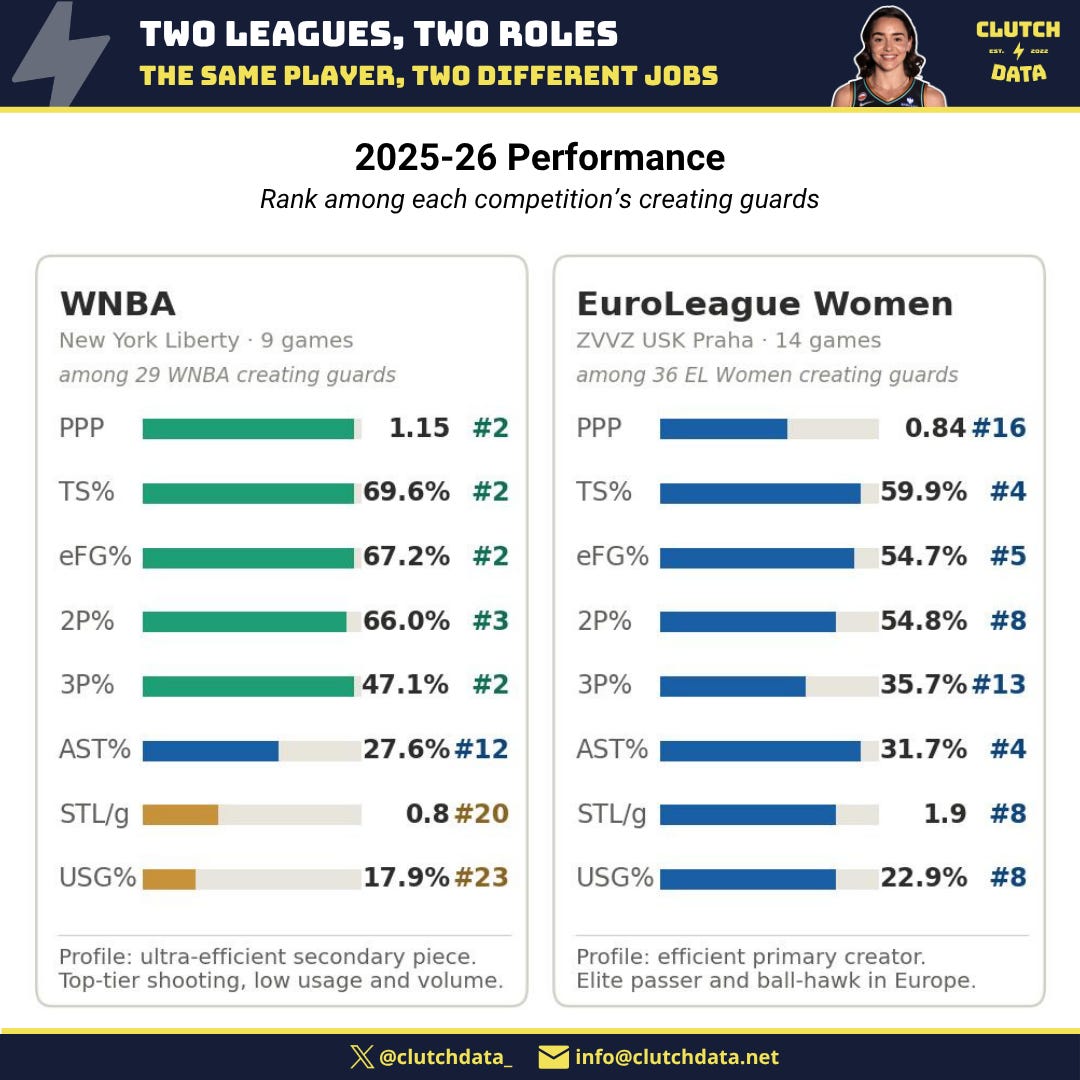
In EuroLeague Women, 34% of her offensive possessions came as the pick-and-roll handler. She was THE guard: the one who took the screen, read the defense and decided. In the WNBA, that share collapses to 13%.
In the WNBA, her most-used plays are Catch & drives (28%) and Catch & shoots (18%) — catching the ball on the move and attacking, or catching and shooting. In EuroLeague, Catch & shoots were barely 6% of her possessions.
It's the exact portrait of a role change: in Europe she created with the ball in her hands; in the WNBA she plays off the ball. And she keeps the efficiency in both contexts: 1.64 points per possession on Catch & shoots and 1.78 in transition in the WNBA, elite figures. 60% of her WNBA baskets are assisted — a very high ratio for a guard. She doesn't need to dominate the ball to be productive.
That fits perfectly with a Liberty roster that has several dominant scorers (Breanna Stewart, Jonquel Jones, Marine Johannes) and will get Ionescu back as the primary creator: Astier is exactly the secondary piece that team needed.
The most visual way to understand Astier's scoring/passing duality is to see five different metrics in a single image, with every WNBA creating guard marked as a dot.
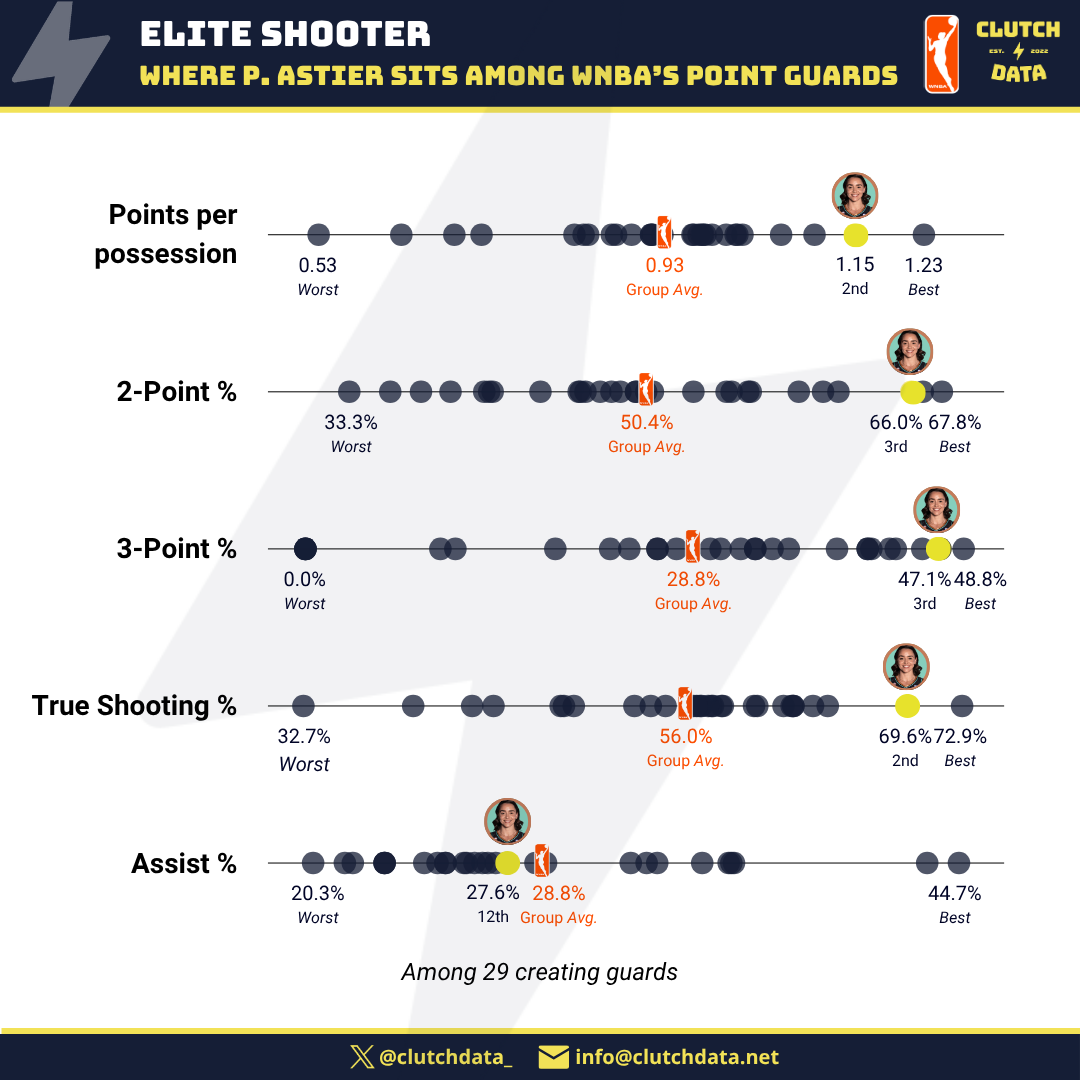
Four shooting categories, one passing category. Astier is the dot furthest to the right or close to it in every shooting category — top-3 in PPP, TS%, eFG%, 2P% and 3P%. She's the one who cashes in every time the ball is put in her hands.
In AST%, she sits right around the group mean (27.6% vs the group's 28.8%), but the trend is climbing fast: across her last three games, her AST% has jumped to 33.3%, well above the average. And her overall AST/TO ratio is 2.0 — a strong sign of decision-making for any guard, let alone a rookie still learning the league. As her minutes get more stable and the team gets healthier, her playmaking footprint is starting to catch up with her scoring.
The same chart with her EuroLeague Women season reveals just how much her role changed:
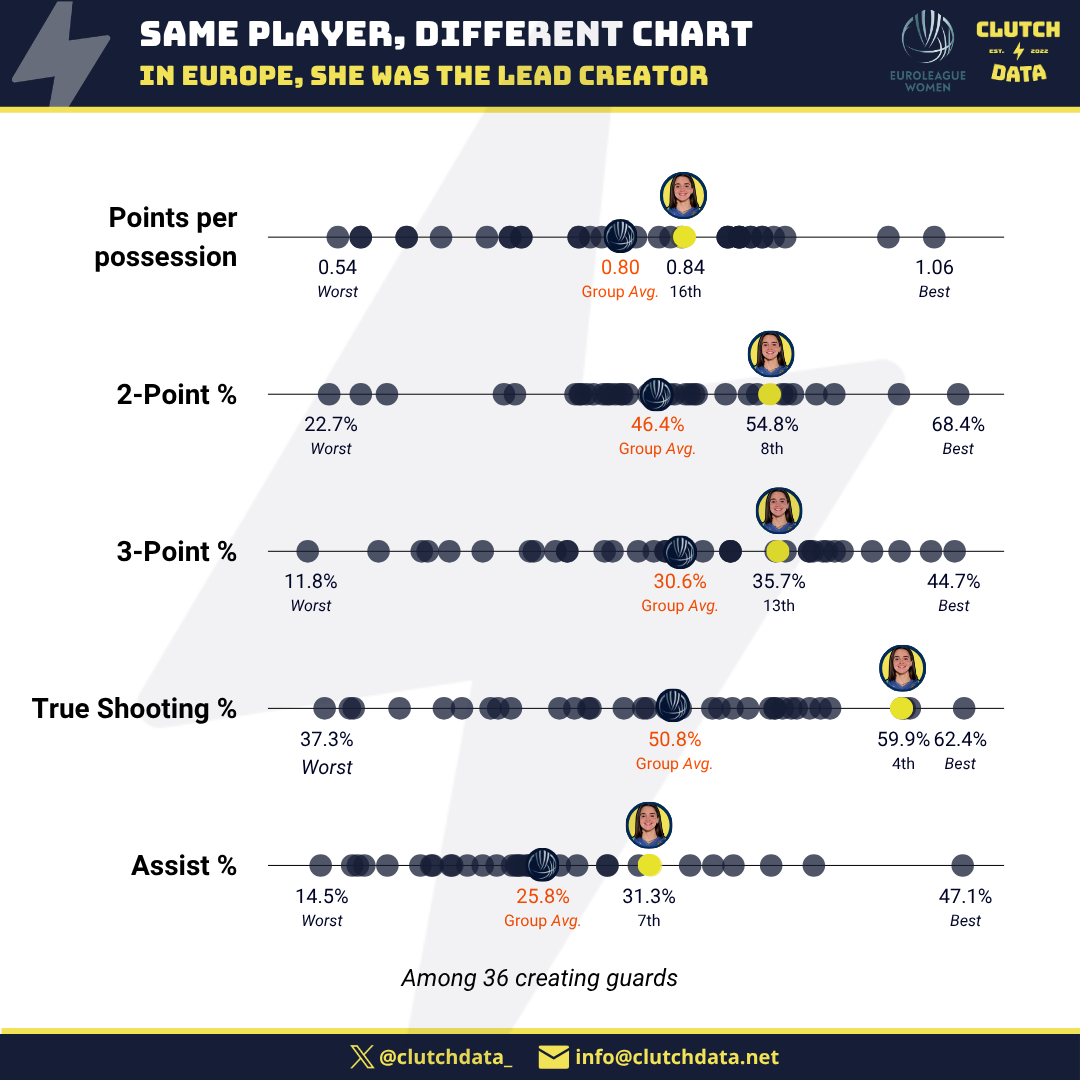
In Europe, she was the creator. In the WNBA, she fits as a secondary piece without losing efficiency — and is now slowly stepping into more on-ball responsibility.
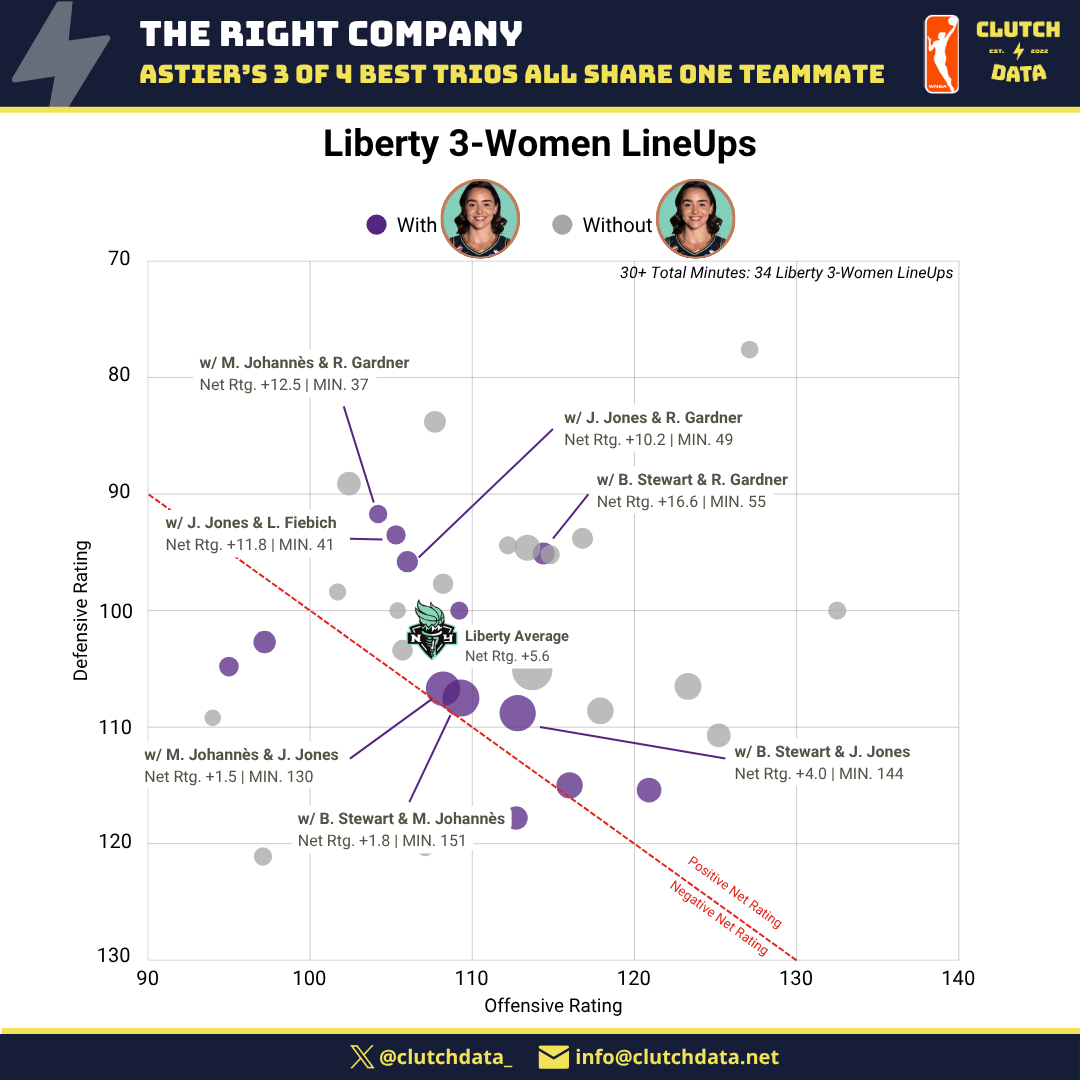
The fastest way to see a guard's real impact is to drop down to the 3-women lineup level: three-player combinations that recur on the floor. And when you look at the map of the Liberty's 3-women lineups featuring Astier, a striking pattern emerges.
Look at the top four most efficient Astier lineups with at least 30 minutes together:
Stewart + Gardner + Astier: +19.3 Net Rating in 53 minutes (114.4 offensive, 95.1 defensive)
Johannes + Gardner + Astier: +12.5 in 37 min (DRtg 91.7)
Fiebich + Jones + Astier: +11.8 in 41 min (DRtg 93.5)
Jones + Gardner + Astier: +10.2 in 49 min (DRtg 95.8)
Three of the top four share one name: Rebekah Gardner, the veteran wing signed for shooting and defense. And the fourth — pairing Astier with Fiebich and Jones — keeps the same pattern of letting Astier play next to length and shooting. In every elite Astier combination, the common denominator is the same: surround her with smart, defensively reliable veterans, and the floor opens up.
And the pattern carries up to full starting lineups: Johannes-Stewart-Jones-Gardner-Astier is +39.7 in 17.5 minutes, with a Defensive Rating of 69.7. Drop to four-player units and the top three all feature Gardner: Stewart-Jones-Gardner-Astier sits at +31.9 in 26 minutes (DRtg 85.4), Johannes-Jones-Gardner-Astier at +25.6, and Johannes-Stewart-Gardner-Astier at +24.2. For context: the WNBA's best team defense hovers around 95 points per 100 possessions.
It's a pattern that showed up in Europe too: ZVVZ USK Praha's most efficient 3-women lineups usually had Astier in them, with the team's experienced players around her. Astier isn't a guard who changes the team when she comes in. She's a guard who raises the ceiling of the good players already next to her.
There's a stat that captures how much the Liberty staff actually trusts Astier better than any rate: how much of the clutch she's playing.
The Liberty have played 22 minutes of clutch time this season (last 5 minutes of a game within 5 points). Astier has been on the floor for 21 of them. Only Breanna Stewart, the franchise's All-Star, has matched her presence on the court when games tighten up.
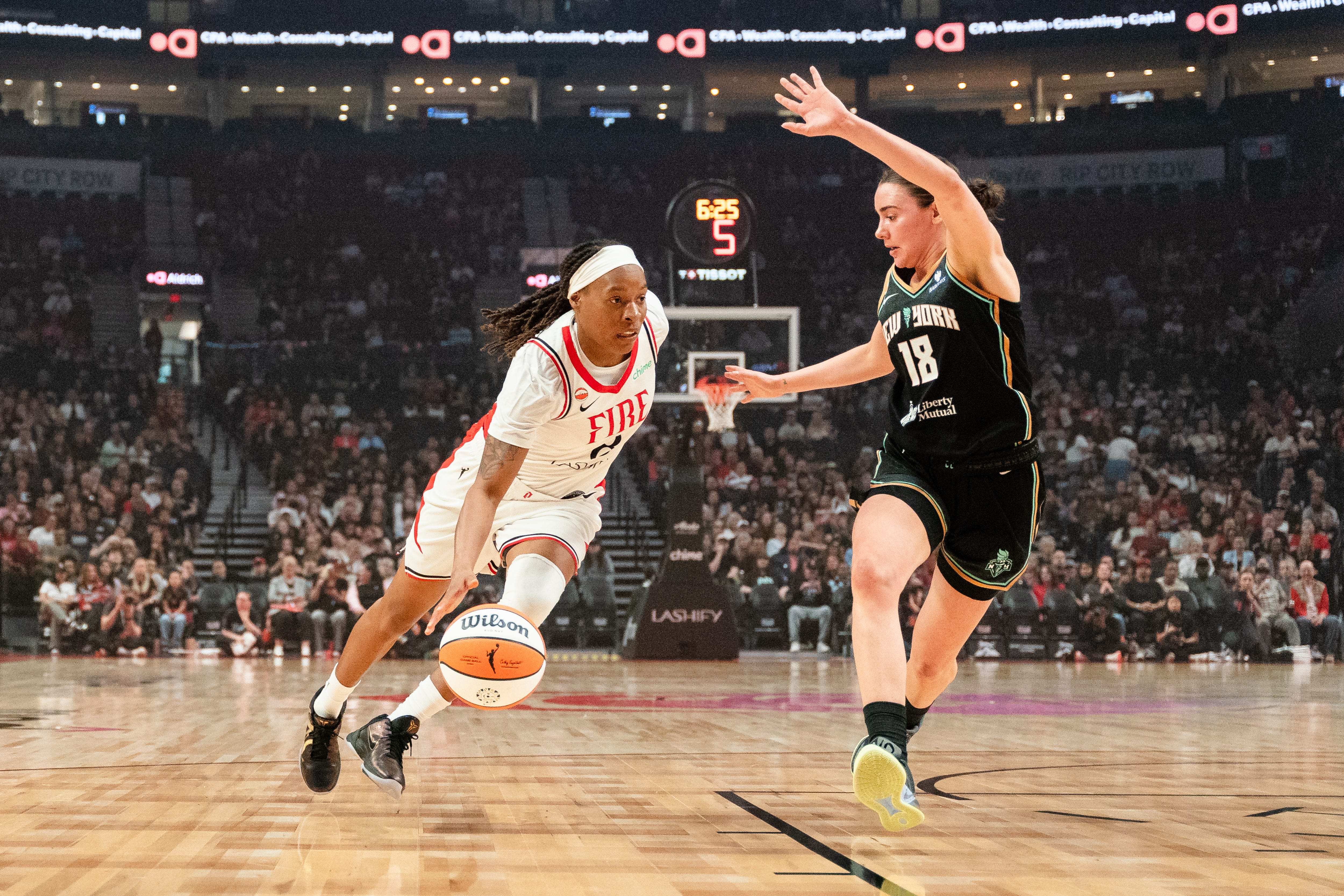
And it's not just minutes — she's actually involved. Astier's Usage Rate in clutch is 23.3%, third on the team behind Stewart (30.6%) and Jonquel Jones (25.0%). For a rookie playing her first WNBA games to be the third option in late-game possessions, ahead of veterans and former All-Stars, isn't just trust — it's confidence. The team isn't hiding her when it matters. They're using her.
Here's a pattern worth tracking, with the obvious small-sample caveat. In the Liberty's 5 wins with Astier, she averages 4.6 assists and an AST/TO ratio of 3.8 — elite playmaking efficiency. In their 4 losses, that drops to 2.2 assists and an AST/TO of 0.9. Her Usage Rate also climbs in wins (19.2% vs 16.4%) and her PPP edges higher (1.14 vs 1.08).
In other words: she's not a rookie the team hides to win. The more she creates and the more involved she is, the better the Liberty look. It's an early signal, not a law — but it points in the same direction as everything else in this article.
There's a type of player that traditional analytics underrates: the efficient guard who assists without piling up volume, who doesn't have a flashy Usage Rate (17.8% in the WNBA) but whose shots fall at a disproportionate rate. It's a profile many teams overlook because they're chasing flashier traits — and yet it delivers exactly what a roster full of scorers needs: quiet efficiency and quick decisions.
Liberty General Manager Jonathan Kolb put it this way in the official announcement of the signing, this past April: "At just 24, Pauline Astier represents exactly the type of young player we prioritize, someone with the talent to contribute right away and the upside to develop into an everyday player in this league." It's not common for that kind of statement to accompany a player arriving after seven seasons in European leagues. It usually goes with top draft picks.
Sabrina Ionescu returned on May 24 against Dallas: 11 points and 7 assists in 31 minutes. Astier moved to 19 minutes off the bench. But the star's return hasn't been linear: Ionescu rested the next night against Portland and was ruled out again on May 27 and May 29 against Phoenix with back soreness. In those two games, with the rookie back in the rotation, the Liberty went 2-0 — including a 75-68 win on May 29 in which Astier added 16 points, 6 assists and a +10 plus/minus in 31 minutes. The Liberty sit at 5-4.
The situation ahead is just that: a backcourt deep in guards (Ionescu, Astier, Johannes) with minutes split according to game context and the injury report. Astier's averages will most likely come down once Ionescu is the undisputed starter. That's already being read too quickly as "the rookie fading." But the real data point is another one: when she's been given the ball, Astier has shot 61.2% from the field and 47.1% from three. No guard in the league shoots like that by accident.
The interesting question isn't whether Astier will win Rookie of the Year. The 2026 class includes names with far more volume and media spotlight — Azzi Fudd (No. 1 pick, Dallas), Olivia Miles (No. 2, Minnesota), Awa Fam, Lauren Betts, Flau'jae Johnson. The question is a different one: what kind of player has the WNBA found?
If these first nine performances are representative — and the European games that preceded them suggest they are — the answer is: a secondary guard who moves off the ball, who knocks down shots like any of the league's specialists, who lifts the performance of the good players around her, and who is already trusted with the ball when it matters most. Not a dominant piece. A piece that fits.
In European women's basketball there are plenty of players like that, waiting for someone to see them. The difference this time is that a top WNBA franchise got there first.
No posts
Comments
Nothing yet. Say the first thing.
Sign in to join the conversation.