
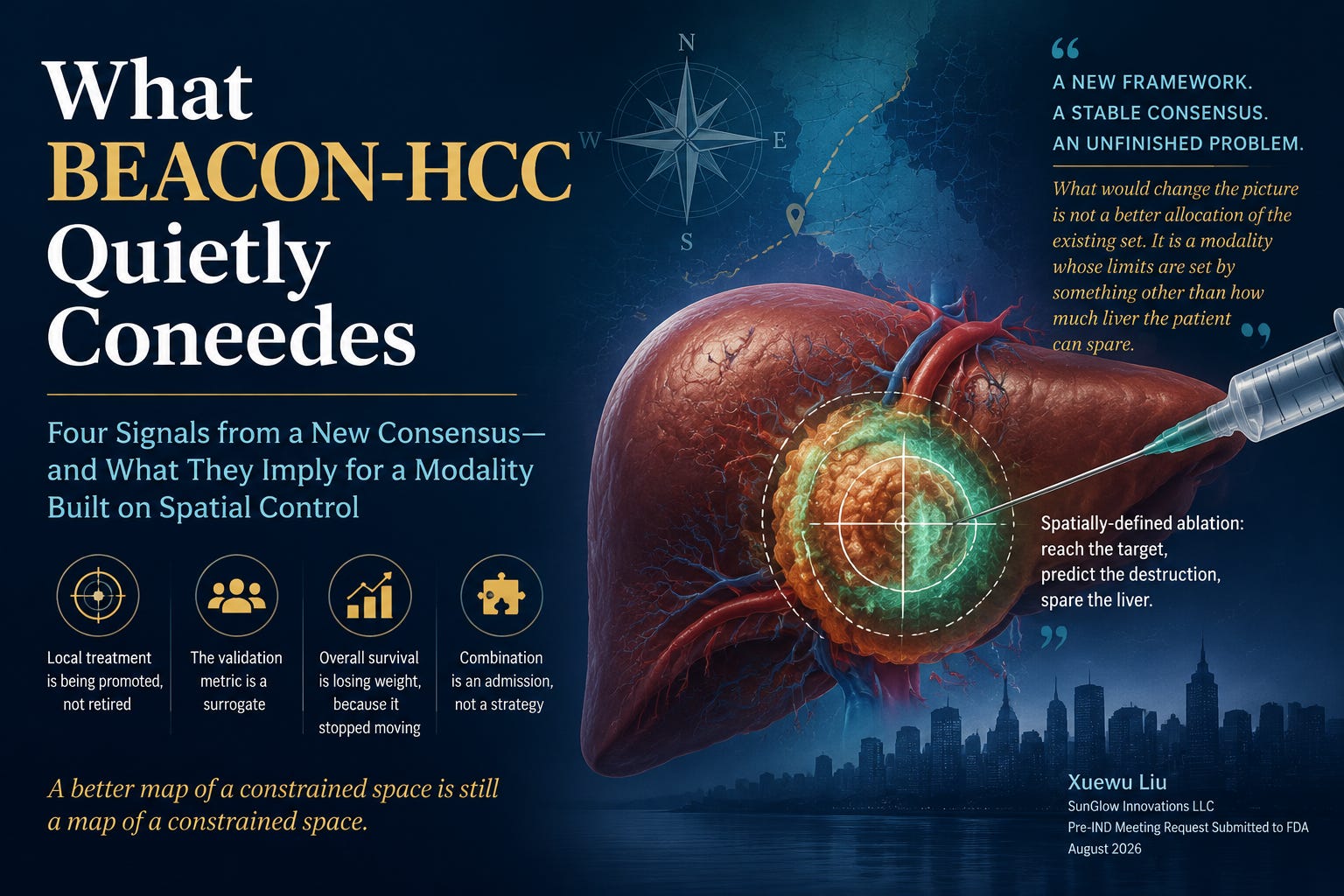
A new North American consensus on liver cancer says more about the limits of the field than about its progress. Four signals worth reading closely — and what they imply for a modality built on spatial control.
In August 2026, the American Association for the Study of Liver Diseases published BEACON-HCC in HEPATOLOGY: a consensus framework for allocating treatment in hepatocellular carcinoma, built by twenty North American experts spanning hepatology, medical oncology, surgery, radiology and radiation oncology, using a modified Delphi process and piloted against twenty-nine real-world cases.
It is a serious piece of work by serious people, and I want to read it the way I think it deserves to be read — not for what it recommends, but for what its existence concedes.
Four things stand out.
For most of the past decade the narrative in oncology has run in one direction. Systemic therapy — targeted agents, then checkpoint inhibitors, then combinations of both — was the frontier. Local treatment was what you did to small tumours in patients who were lucky enough to be caught early, or what you did palliatively when nothing else was left.
BEACON-HCC does not read that way. The framework explicitly widens the locoregional toolbox: external beam radiation therapy, transarterial radioembolization, and combinations of systemic and locoregional strategies are all incorporated as first-class options rather than as historical residue.
That is a directional statement. After ten years in which the money and the attention went to systemic agents, the framework that experts actually use is expanding on the local side.
Look at how BEACON-HCC was tested. Its headline results are concordance figures: 96.6% agreement between the framework’s recommendations and independent multidisciplinary expert decisions, against 72.4% agreement between those same expert decisions and the current Barcelona Clinic Liver Cancer recommendations.
Note what is being measured. Not survival. Not response. Agreement. The framework is validated by showing that it reproduces what good clinicians already do.
I do not say this as a criticism — it is a reasonable way to build a decision aid, and the authors are transparent that prospective validation is planned. I say it because it is a clear instance of something broader: in HCC, the field has been migrating toward endpoints that can actually be measured on a workable timescale. Time to progression. Progression-free survival. Objective response. Pathologic response. And now, concordance with expert judgement.
When a field starts validating its tools against proxies, it is telling you something about the hard endpoint.
Here is the number that should be read alongside the concordance figures. AASLD states plainly that five-year survival in HCC remains below 25%.
Below 25%, after a decade during which the therapeutic landscape “evolved dramatically” — the framework’s own characterisation of the period it was written to accommodate.
Overall survival in advanced HCC is also structurally difficult to interpret. Patients receive sequential lines of therapy; a survival difference attributed to a first-line agent is contaminated by everything that follows it. Underlying cirrhosis competes as a cause of death independent of the tumour. Crossover in trials blurs the comparison further.
So the de-emphasis of survival is partly methodological and partly, I think, something else. It is easier to demonstrate progress on a surrogate than on a number that has not moved.
The most-repeated word in modern oncology is combination. Systemic plus locoregional. Immunotherapy plus antiangiogenic. Ablation plus adjuvant systemic. BEACON-HCC incorporates combined strategies precisely because that is what practice has become.
Combination is usually presented as sophistication — the multidisciplinary team, the personalised plan, the therapy matched to the biology. And sometimes it genuinely is.
But there is a plainer reading, and I think it is the honest one. You combine because nothing you have is sufficient on its own. If any single modality reliably did the job in a defined population, it would be used alone in that population, and the framework would say so. Twenty experts convened to build an allocation map because the map has become necessary — and it has become necessary because no route through it is short.
Read together, the four signals describe a field that is expanding its local toolkit, measuring itself against proxies, quietly setting aside the endpoint that matters most, and assembling therapies in sequence because no single one closes the case.
I develop an image-guided intratumoral ablation system. Chlorine dioxide is delivered directly into the tumour under real-time imaging; it destroys tissue by immediate chemical oxidation of what it physically contacts, and is consumed in the process, so the reaction is self-limiting. In whole-blood work the reaction boundary forms within a minute and does not move over the following hour, and the extent of the reacted zone tracks the volume delivered rather than the time elapsed.
I am not going to claim outcomes here. The programme is at the pre-IND stage with FDA; the human experience behind it was collected outside GCP and I make no efficacy claim from it. What I want to put forward is a question about category, not a result.
Every modality in the BEACON-HCC toolbox is allocated by eligibility: is the patient’s stage, liver function, tumour number and vascular status compatible with this treatment? The question a spatially-defined ablative agent asks is different: can the target be reached, and can the destroyed region be predicted and bounded in advance?
Those are not the same question, and a framework built on the first does not have a natural slot for the second. That is not a complaint about BEACON-HCC. It is an observation that allocation frameworks are downstream of what the available modalities can do, and that a modality organised around spatial control rather than stage eligibility sits awkwardly in a map drawn before it existed.
There is one point specific to liver worth stating. HCC is characteristically hypervascular — this is why transarterial approaches work there at all. An agent that destroys tissue on contact also destroys the vasculature it contacts, and vascular disruption produces secondary necrosis in territory beyond the directly contacted volume, by a mechanism closer to embolization than to chemotherapy. Whether that helps or merely raises the dose required is an empirical question that data, not argument, will settle. But it is not obvious that a blood-rich lesion is the wrong target for an oxidative ablative agent. The embolization literature suggests the opposite intuition.
Now the part I think is unavoidable, and which no framework can fix.
The therapeutic options in HCC are constrained by the organ. Resection requires adequate future liver remnant, which cirrhosis often denies. Transplantation is rationed by organ supply and by criteria that exclude most patients. Thermal ablation is limited by lesion size, by proximity to vessels — where the heat sink effect defeats it — and by proximity to bile ducts and bowel. Transarterial therapies depend on arterial anatomy and on liver reserve that many patients no longer have. Systemic therapy is limited by hepatic clearance in a failing liver, and by the fact that its benefit in this disease has been real but modest.
Every one of these constraints comes from the same source: the tumour sits inside a diseased organ that the patient cannot afford to lose more of. That is why survival has not moved. It is not that the field lacks intelligence or effort — the past decade has had plenty of both. It is that each modality is bounded by the same underlying physiology, and combining bounded modalities does not remove the bound. It rearranges it.
BEACON-HCC is a better map of that territory than what came before, and better maps are worth having. But a better map of a constrained space is still a map of a constrained space. Twenty experts reaching 96.6% agreement with each other, in a disease with sub-25% five-year survival, is a description of a stable consensus — not of a solved problem.
What would change the picture is not a better allocation of the existing set. It is a modality whose limits are set by something other than how much liver the patient can spare.
Whether an intratumoral agent whose destruction is bounded by delivered volume turns out to be that — I do not know, and I am not going to pretend the question is settled by anything I have so far. FDA will have views on what has to be shown before it can be asked properly, and that is the right order.
But the question is worth asking out loud, and I notice that the frameworks are not currently structured to hear it.
Xuewu Liu is the founder of SunGlow Innovations LLC and the inventor of the intratumoral chlorine dioxide ablation system. A Type B pre-IND meeting request for Chlorine Dioxide Injection, 2% was submitted to FDA in August 2026. Nothing in this article is a claim of safety or efficacy for an investigational product.
No posts
Comments
Nothing yet. Say the first thing.
Sign in to join the conversation.