
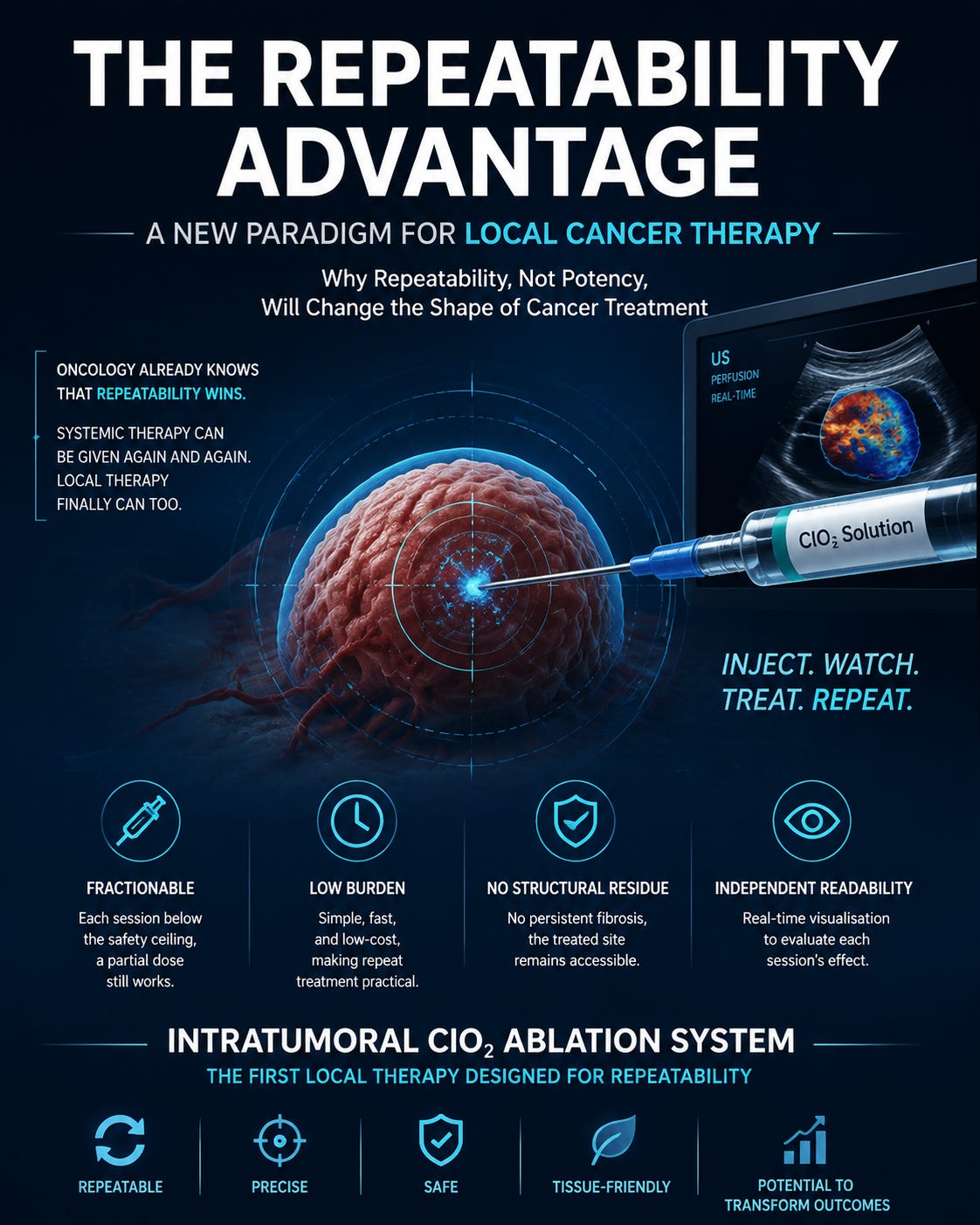
Ask an oncologist why cytotoxic chemotherapy still occupies the centre of advanced cancer care, sixty years after it was introduced, and you will not get an answer about potency. Chemotherapy is not a precise killer. It is not an efficient one. Its therapeutic index is poor by any modern standard.
It dominates because it can be given again. Every three weeks, for as long as the patient tolerates it, adjusting dose, adjusting agent, responding to what the disease does next. Cancer is not a single event. It is a process that keeps generating new problems, and only a treatment that can be re-applied can keep answering them.
Local therapy has never had a member with that property. Surgery is a once-or-twice resource. Radiation is fractionated within a course but bounded by a lifetime cumulative dose. Thermal ablation can be repeated technically, but each session leaves behind a permanent scar that makes the next one harder. So local therapy has been confined, structurally, to the beginning of the disease — the curative-intent moment, the one shot. After that, patients are handed to systemic therapy, because systemic therapy is the only thing that can keep going.
This essay argues that repeatability, not potency, is the property that would change the shape of cancer treatment — and that the intratumoral ClO₂ ablation system may be the first local modality to possess it. I will start from what has actually been observed, derive the repeatability claim from it, rank the existing modalities against a four-part definition, and then — clearly labelled as such — speculate about what a repeatable local therapy would make possible.
Everything that follows rests on four properties observed across laboratory work and a series of veterinary oncology cases in dogs with spontaneous, externally visible tumours. I state them first, separately from what I want to conclude from them.
Chlorine dioxide does not diffuse indefinitely through tissue. It is consumed by what it oxidises, and the reaction front stops where the oxidant runs out. In liquid whole blood, a droplet produces a sharply bounded discoloured disc within about one minute — and that disc does not grow measurably at fifteen minutes, thirty minutes, or sixty minutes. The reaction is over almost as soon as it starts.
The clinically important part is that the boundary is observable in real time. Under ultrasound, the perfusion front is visible within one to two seconds of injection, without contrast agent. The operator is not inferring where the agent went from a model; the operator is watching it. Self-limitation plus visualisation means the treated volume is both bounded and known.
The agent acts on tumour cells directly and on the intratumoral microvasculature. Vascular destruction matters more than it might appear, because it means the treated volume does not have to equal the tumour volume. Killing the supply kills territory downstream of it. Coverage does not have to be exhaustive to be structurally decisive.
And the result is legible immediately. Within roughly fifteen minutes, the treated region loses the appearance of living tissue — the smooth, glistening, perfused surface is replaced by something demarcated and dull. In one canine tongue tumour, the entire mass and the tongue itself had gone black before the animal recovered from anaesthesia; the tissue separated and detached on its own by day four.
One caveat I want to state myself, because it is the most common misreading of these images. The colour is a function of how much blood was in the field, not of how thoroughly the tissue was killed. Richly perfused tumours turn black; poorly perfused ones coagulate to tan or yellow-white. The invariant is not blackness. The invariant is that the appearance of living tissue disappears within a bounded region, immediately, and does not return.
The mechanism is not exotic to human biology. The innate immune system kills using oxidants, including chlorine-based ones: activated neutrophils generate hypochlorous acid through myeloperoxidase as a primary microbicidal weapon. Oxidative destruction of biological structures at a site of attack is a mechanism the body itself runs. This is an analogy, not an identity — chlorine dioxide is not an endogenous species — but it explains why the tissue response looks the way it does.
What is observed clinically is a striking absence of inflammatory oedema around the treated zone, and no persistent fibrotic conversion of the treated bed. Necrotic tissue is sloughed or resorbed rather than being organised into scar. This is a difference in kind from thermal ablation, where coagulated tissue is not cleared but is progressively replaced by fibrosis and scar — permanently.
Honest scope note: the absence-of-oedema observations come from peripheral and oral lesions, not from brain or other confined compartments, and the absence of fibrotic residue is supported by clinical observation rather than by serial histology.
Ultrasound guidance, a needle, a syringe. No generator, no probe geometry, no grounding pads, no argon, no thermal monitoring, no cryogen cycle. In a recent canine case, three separate lesions at unrelated sites — a residual tongue-base tumour and two subcutaneous masses — were treated in a single session with a 25 mL total dose, under a short general anaesthetic, with normal recovery.
Take the four properties together and something falls out of them that is larger than any one of them.
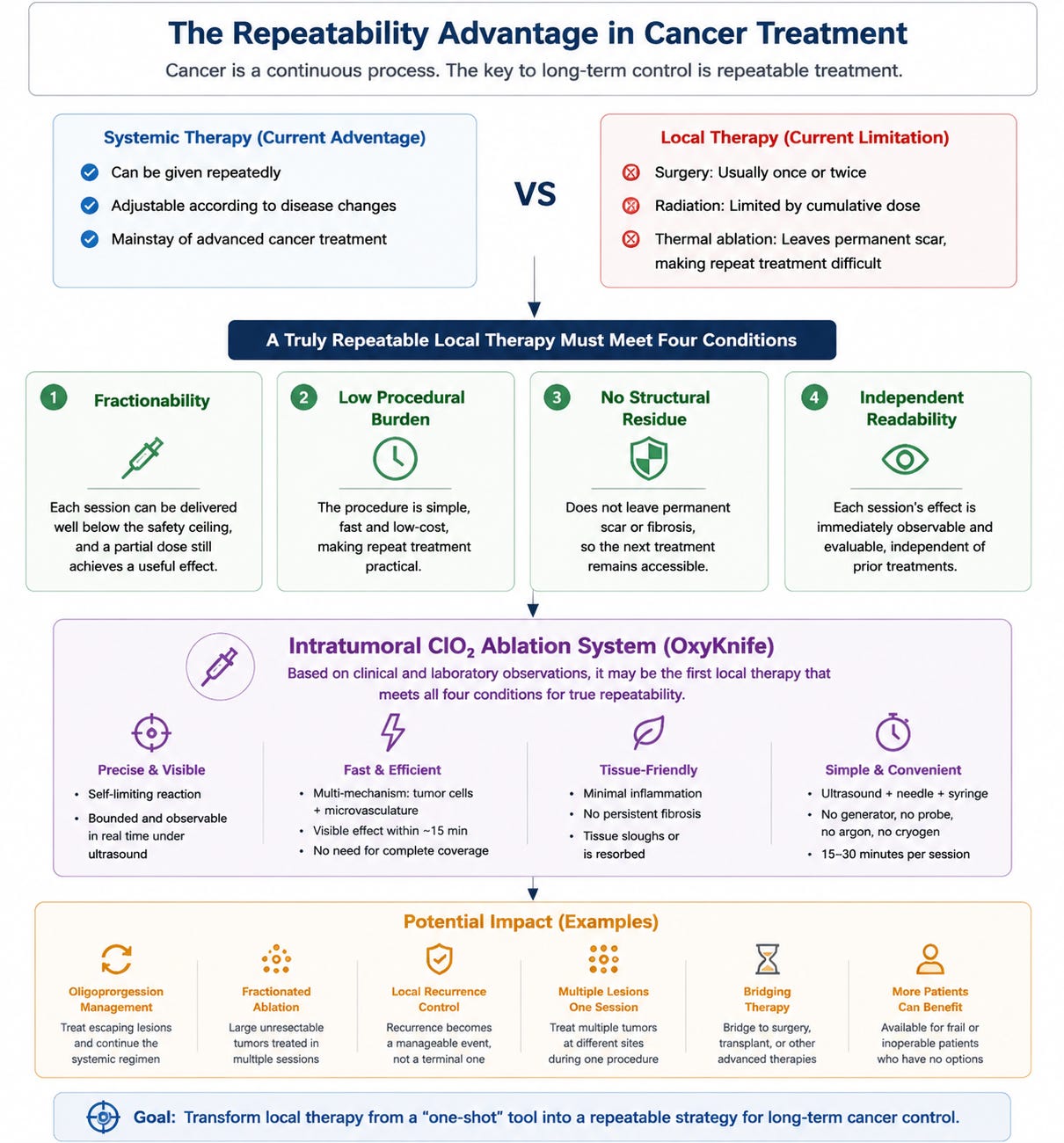
A treatment can be genuinely repeated only if four conditions hold simultaneously. Most discussions of “repeat treatment” collapse these, which is why the word has become almost meaningless in oncology marketing. Separated, they are testable.
Condition 1 — Fractionability. Each individual session can be delivered well below the safety ceiling, and a partial dose does something useful rather than something harmful.
This is a stronger requirement than it sounds. Thermal ablation is essentially all-or-nothing per session: coagulative necrosis requires tissue to exceed roughly 60 °C, and heating that falls short is not merely less effective — sublethal thermal stress at the ablation margin has been reported to promote residual tumour aggressiveness. A half-dose of heat can be worse than no heat. Thermal modalities therefore cannot be fractionated in the way radiation is; every session must go to the full margin.
Chemical ablation has no analogous mechanism. Five millilitres does five millilitres of work. Self-limitation (observation 1) is precisely what makes fractional dosing predictable rather than reckless: you know where the reaction stopped because you watched it stop.
Condition 2 — Low procedural burden. Each session must be cheap enough, in time and resource, that repeating it is actually realistic.
This is not a comfort argument. Procedural burden feeds back into fractionability: if a session occupies an interventional suite for two hours and requires a device team, no one will design a four-session protocol, whatever the biology permits. Observation 4 is what makes a fractionated schedule operationally possible.
Condition 3 — No structural residue. Each session must not leave persistent changes that impede the next one.
This is where thermal ablation fails hardest, and the failure is fourfold. Fibrous scar alters tissue impedance, so radiofrequency energy deposits differently. It alters thermal conduction. It alters needle trajectory and tissue mechanics. And it alters imaging, because post-ablation fibrosis and residual tumour are notoriously difficult to distinguish on CT or MR. Each of these compounds across sessions. Real-world data reflect it: in a large hepatocellular carcinoma cohort, three or more episodes of local progression was an independent adverse predictor of overall survival, with median survival declining stepwise with each episode.
Observation 3 is the direct answer to this condition — provided it holds up. That is a claim that needs to be tested, and I say below how.
Condition 4 — Independent readability. Each session’s effect must be assessable on its own terms, without confounding from prior sessions.
A therapy you can deliver but cannot read is not repeatable in any useful sense — you would be re-treating blind. Thermal ablation runs into exactly this: after the first session, the operator often cannot tell scar from residual disease, so the second targeting decision is made under uncertainty. Observation 2 supplies the counterpart: an intraoperative readout available within minutes, from direct visualisation rather than from inference about temperature or ice-ball geometry.
Note the structure. Self-limitation gives fractionability. Simplicity gives operational feasibility. Absence of fibrotic residue gives access for the next session. Immediate visual legibility gives the ability to judge each session. Four observed properties, four conditions, one per condition. Repeatability is not an additional claim layered on top of these observations — it is what they mean when read together.
Below, each modality is scored 0–3 on the four conditions. This is a structured judgement, not a measurement, and I have tried to score against the modalities rather than for my own.
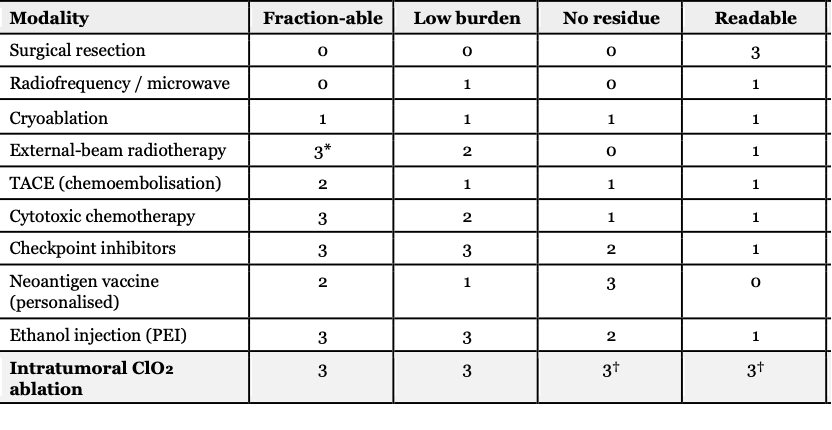
* Radiotherapy is fractionated within a course but bounded by a hard lifetime cumulative dose to normal tissue; re-irradiation is severely constrained. It is the clearest case of a modality that is fractionable but not repeatable.
† These are the scores I am claiming, not scores that are established. They rest on veterinary and laboratory observation, not on controlled human data. Section V says what would overturn them.
The systemic therapies score high. Chemotherapy and checkpoint inhibitors sit near the top not because they are precise but because they are repeatable — deliverable in cycles, indefinitely, adjustable in response to what the disease does. This is the point of the whole essay. The modalities that dominate advanced cancer care are the repeatable ones. Oncology has already run this experiment and knows the answer. It has simply never had the option of running it with a local therapy.
The best-scoring local therapy is a nearly abandoned one. Percutaneous ethanol injection scores 9. It was displaced by radiofrequency ablation in the 1990s and 2000s on grounds of efficacy — ethanol does not distribute past intratumoral septa, and struggles with larger lesions — not on grounds of repeatability. This is worth being honest about: PEI is the real precedent for what I am describing, and the field walked away from it. The relevant question for intratumoral ClO₂ is therefore not “can a chemical ablative be repeated” (PEI already showed it can) but “can a chemical ablative be repeated and do the destructive work that made the field switch to heat.” Vascular mechanism, non-exhaustive coverage, and real-time visualisation are the reasons I think the answer may be yes.
Surgery scores lowest but remains the best curative treatment. This is not a contradiction and I do not want it read as one. Repeatability is not a measure of how good a treatment is; it is a measure of what role a treatment can play. Surgery, when it can achieve a complete resection with clear margins, is the most definitive thing in oncology and nothing here changes that. Repeatability matters in the space where surgery has run out — where the tumour cannot be resected, where it has already come back, where the patient cannot survive another operation.
Comments
Nothing yet. Say the first thing.
Sign in to join the conversation.