
This is a free site! If you are asked to pledge anything, just say “No Thanks!”.
While on vacation on St. John in the US Virgin Islands, we stayed at Papaya Moon and began talking to the owners, Sue and Ron. St. John is a small island with a population of about 4500, and is accessible only by boat. About 60% of it is a national park. Hit by devastating hurricanes - Marilyn in 1995 and Irma and Maria in 2017 - much of the island infrastructure was destroyed
Some useful life lessons can be learned from people who live with limited or no access to energy sources (electricity and natural gas), to fresh water and to extensive food choices. Importing food and water to the island is expensive and unreliable. Waste disposal on this beautiful island is another challenge to life there.
Sue and Ron’s home, Papaya Moon Villa, was built in the 1980s, years before electricity was available on the steep hillside above Coral Bay. Originally from Iowa, Sue and Ron bought the villa in the early 1990s.
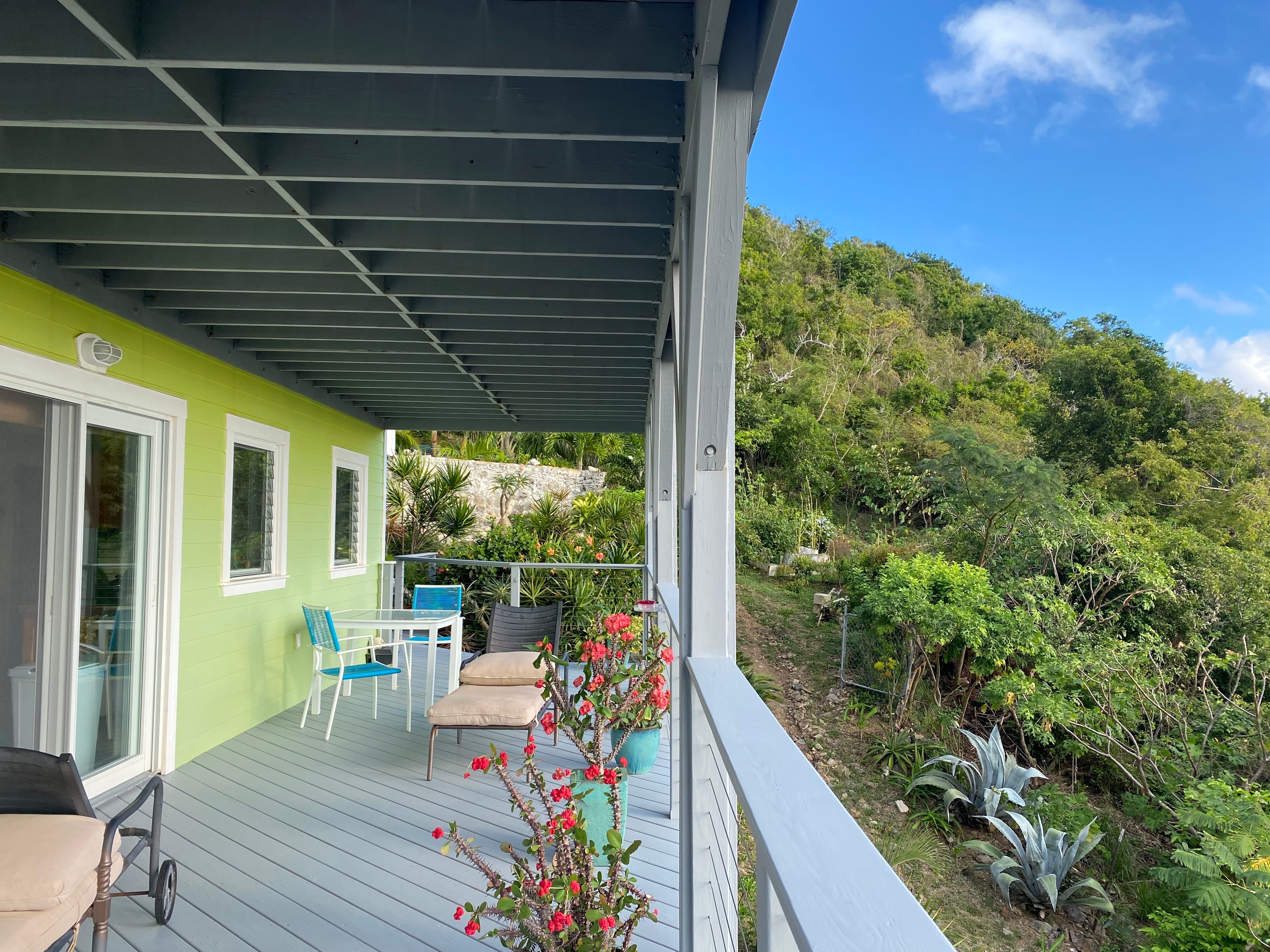
Due to the steady moderate temperature (high 60’s to low 80’s), heating and air conditioning are not necessary, although some homes on the island, including this one, have installed mini-split (heat pump) heating and cooling systems. Ceiling fans are used to recirculate the air. Window shades are drawn to limit the amount of solar gain. All the windows are louvered or have screens, allowing air flow for better temperature control. In this climate, wet clothing dries on outdoor clotheslines. Homes not connected to an electrical grid, use generators for a few hours a day to keep the refrigerator cold and to heat warm water for showers, laundry, and dishes.
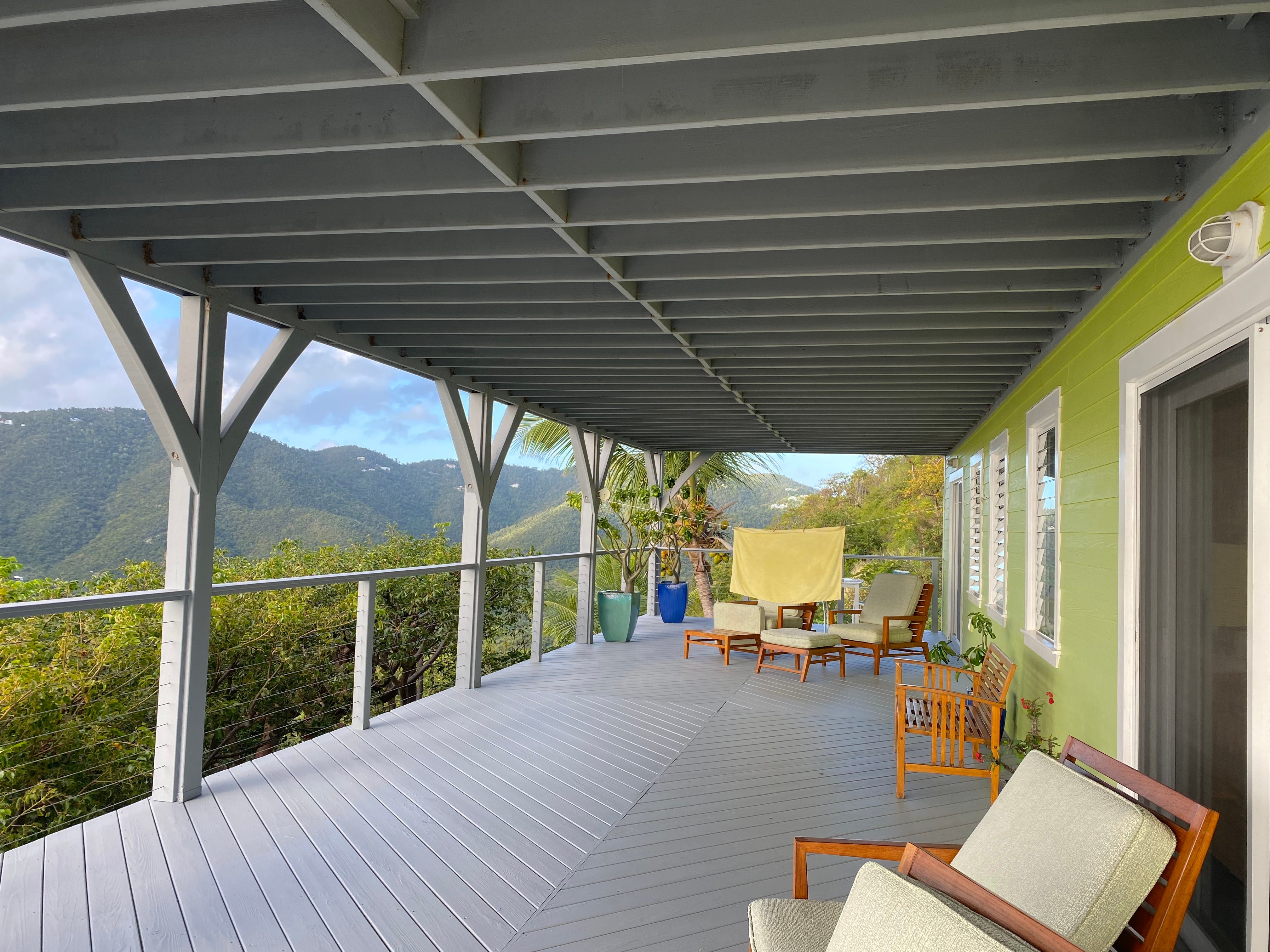
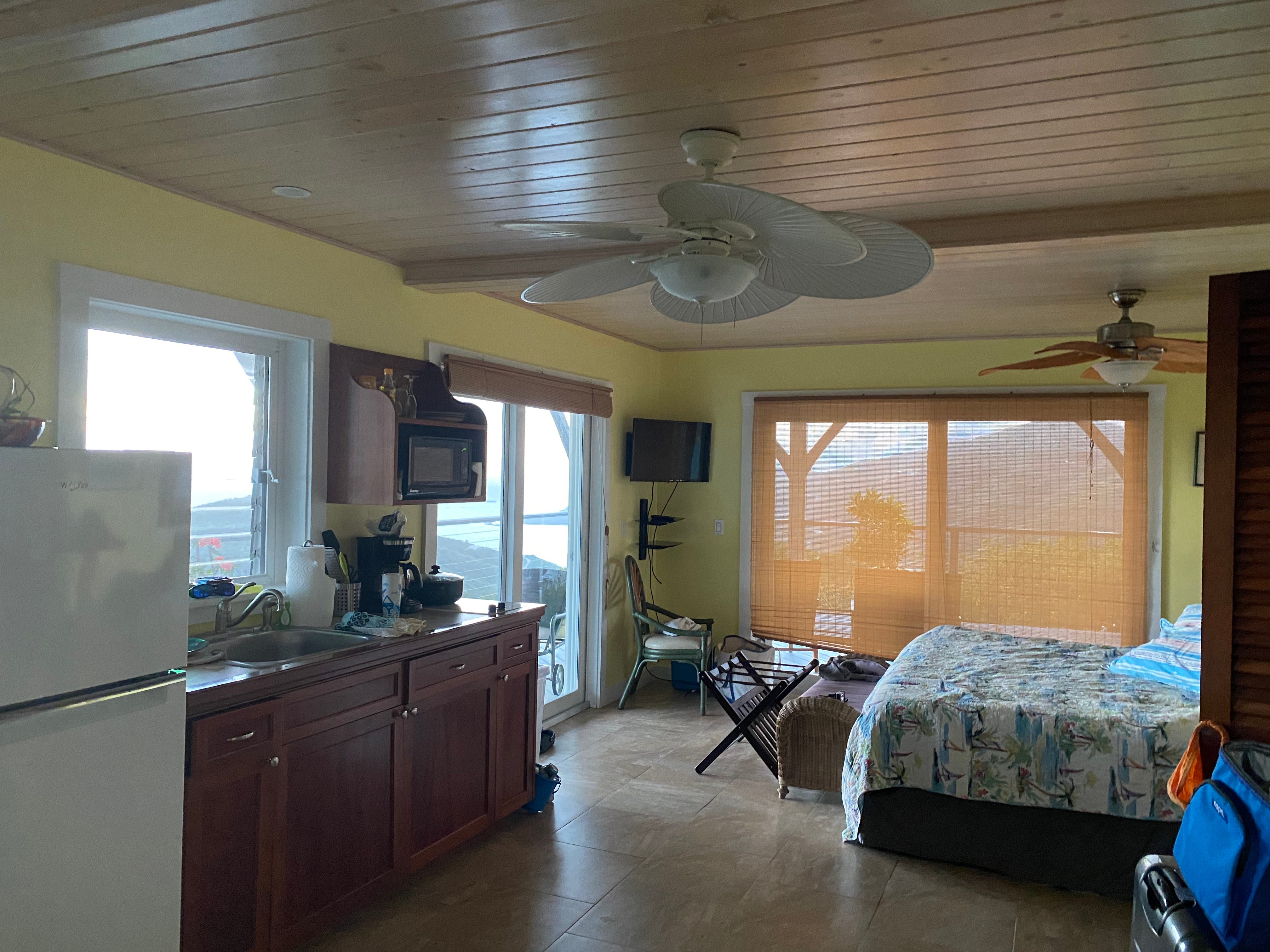
In early Sept of 2017, two Category 5 hurricanes, Irma and Maria, with sustained winds in excess of 200 mph, destroyed nearly all of the electric poles on St. John. Electricity was restored to Papaya Moon 3-1/2 months later, on Christmas Day. Returning to St. John in early October, Sue and Ron shared a generator with a neighbor, allowing both homes to have a combined 4 hours of power a day. Since most of the island’s boats were destroyed, even those moored in supposedly safe places, transporting food onto the island was a serious issue.
Although they have effective solar panels, but no battery back-up, they could not directly use the solar power in their home during that time because they had not installed the necessary conversion hardware. They have also not installed batteries, mainly due to their expense, and because they have been able to cope with power losses. Some of their neighbors have reported the destruction of their battery systems from lightning strikes, because they are located high on a hillside and that has also led to a reluctance to invest in such a system.
Power surges and dips are common enough that guests are urged to leave appliances unplugged until they are needed, to prevent damage.
Water is always an issue on St. John. The island is very hilly and there is no large source of fresh water. Most homes have one or more storage cisterns, and collect water from roof runoff. There are systems in most homes for filtering and purifying this water. If this water runs out, tanker trucks can deliver water to homes when needed, but it is expensive and may take a couple of days.
Water conservation is critically important. At Papaya Moon, the toilets have separate buttons for flushing liquid or solid waste, releasing less water for liquid waste. Alternatively, guests are urged only to flush solid waste. For further conservation, pump-driven hot water reaches the faucets without delay - no wasteful running of water needed. The user simply presses a button on the bathroom wall to activate the pump from the solar hot water heater, with electric back-up for use during cloudy days, to the faucet.
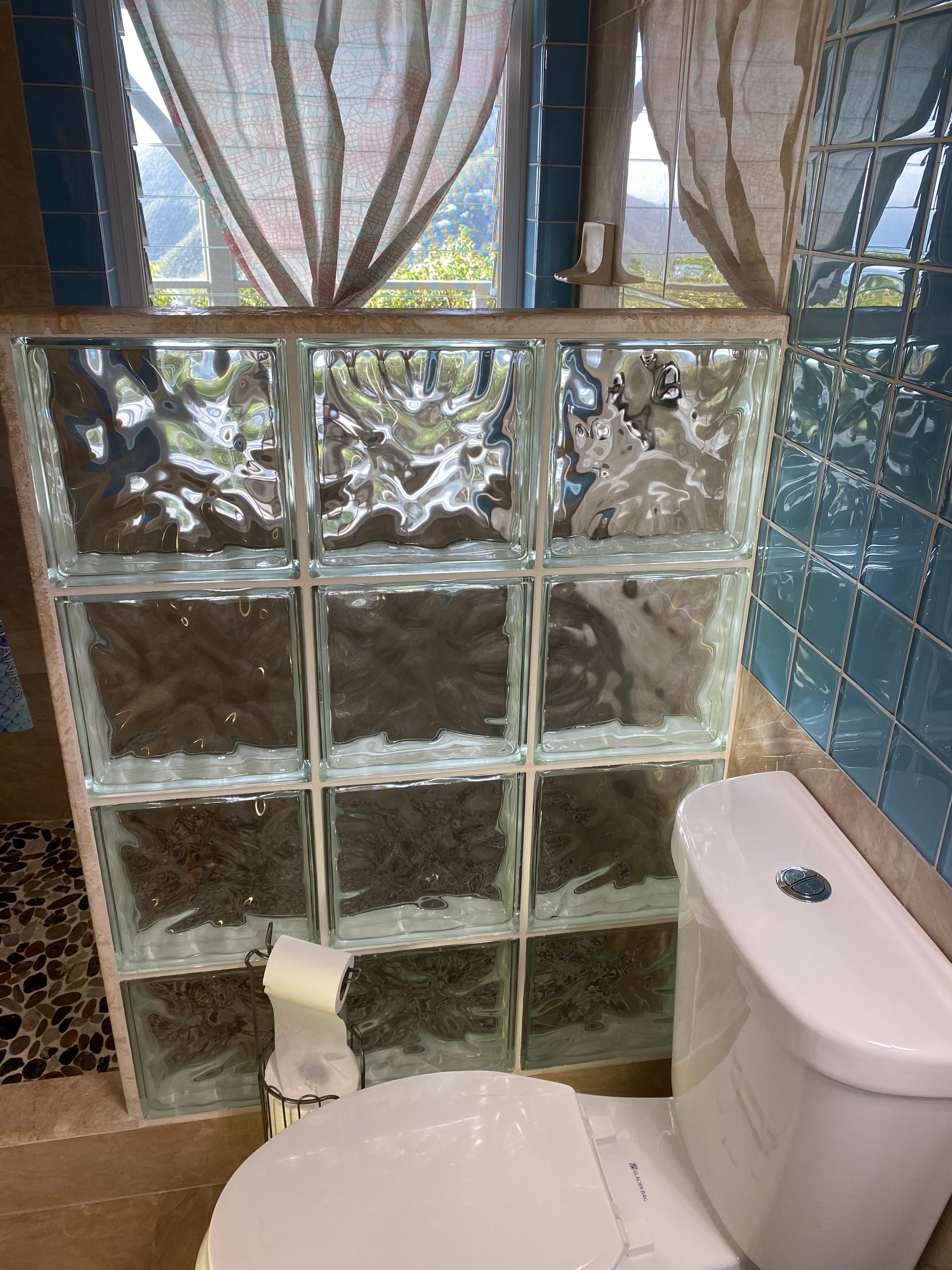
Waste water goes to a septic tank, which has its own leaching field.
Papaya Moon has a washer and dryer for laundry. The dryer is used mainly to speed the housekeeping tasks for vacationing guests (e.g. providing clean linens and towels), while the owners line dry their laundry outdoors.
Because of the dependence on boats for removing waste from St. John, and the island’s rugged terrain, and limited usable space (e.g. for composting or landfill), waste management is another challenge for residents. Island Green, a not-for-profit, started the local recycling center after the 2017 hurricanes. Residents from all over are asked to bring their recyclables to this site. Volunteers sort the recyclables received. They have also set up a website and a list of projects for the island.
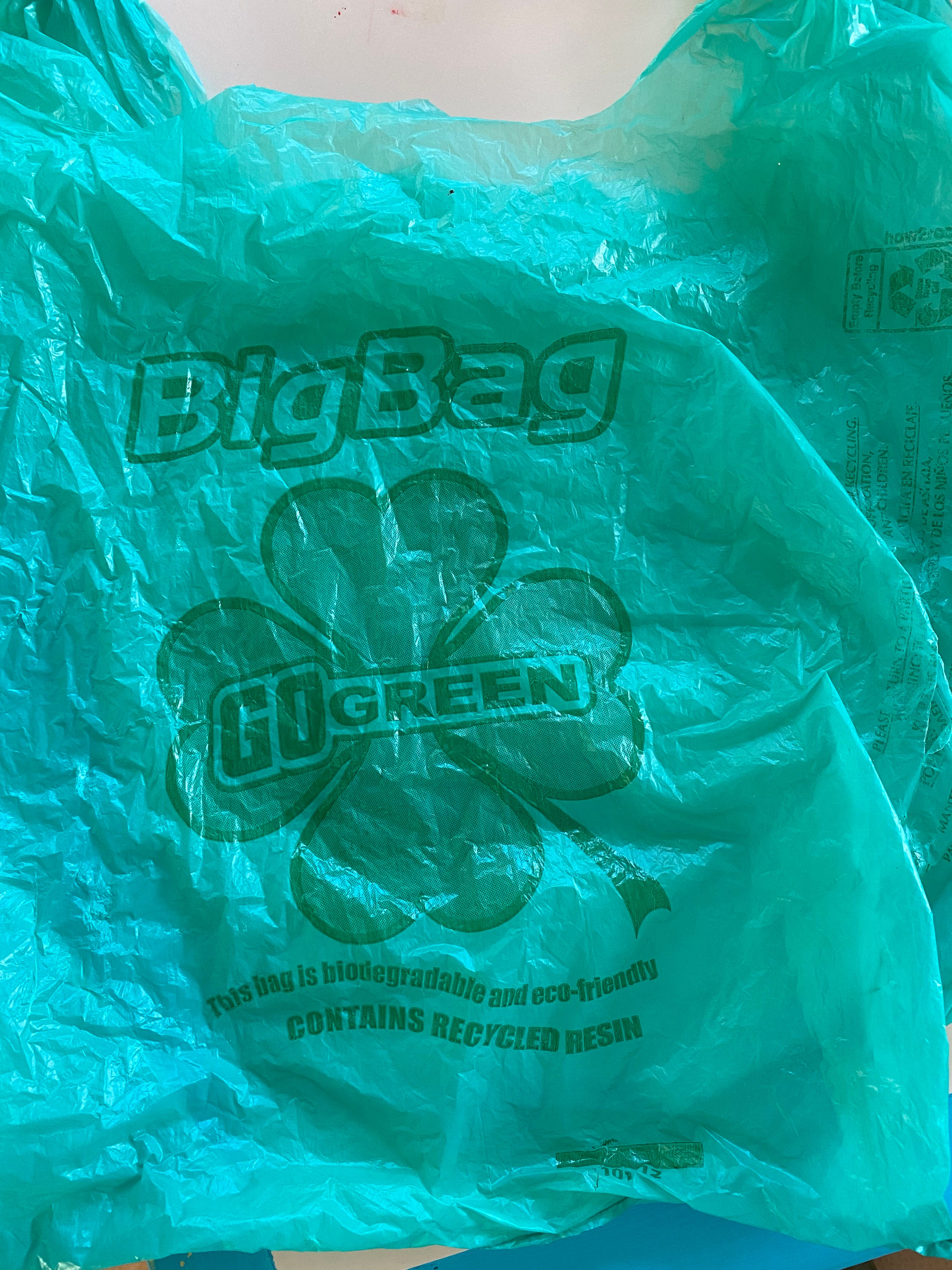
St. John experimented with a law to require the use of re-useable bags rather than single-use plastic bags, but rescinded it within months due to tourist pressure. (My thought: Bringing reusable bags is a big behavioral change for people coming from states or localities that have no such requirement.) Nonetheless, some local businesses still require re-useable bags. Others provide biodegradable plastic bags.
Some island residents and businesses are really on-board with recycling, even when it costs them money and time. St. John’s Brewery had to abandon their distinctive cans that were thinner than regular aluminum cans but reinforced with plastic. They were just too hard to recycle. So they voluntarily redesigned their packaging to return to a more traditional aluminum can.
Sue and Ron encourage composting by providing small containers for kitchen scraps in each unit, as well as separate containers for recyclables and regular trash.
Sue helps run “Stuff Depot”, an island-wide swap meet/flea market sponsored by the Coral Bay Community Council (CBCC), which was started soon after the 2017 hurricanes. It was meant as a place where people could get what they needed from others, or for people who were cleaning up after the destruction to bring items that were still useful, but that they couldn’t immediately use. She remarked that canned food was one of the most-exchanged items at that time. The swap meet/flea market continued for quite a while, declining in frequency, but still takes place about once a quarter, as part of the Island Green recycling operation. It helps to prevent items from ending up in the trash.
Sue shared concerns about the plastic bindings holding 6-packs of beer and soda together. As is well known now, these binders damage and kill birds and marine wildlife. Banning them or providing special disposal means would save a lot of wildlife.
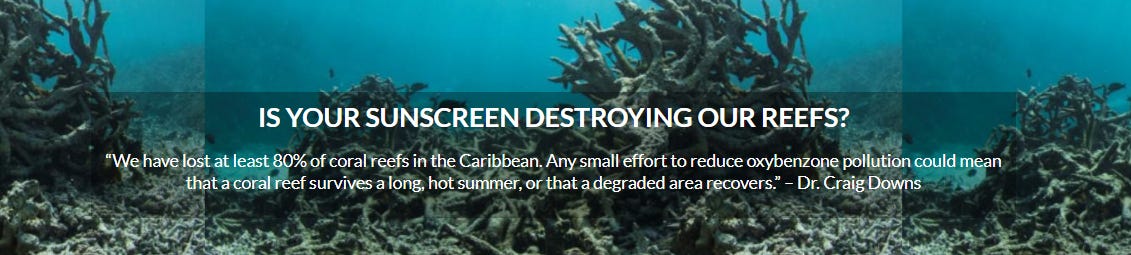
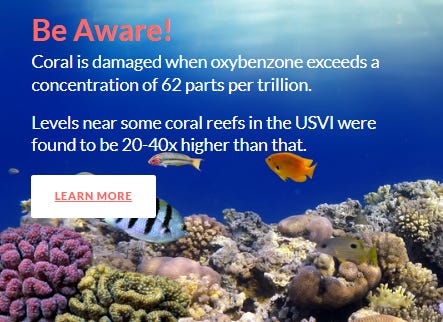
To preserve the coral reefs, local laws require that everyone to use “reef-safe” sunscreen. Stores are forbidden from importing or selling any sunscreen that does not conform to the regulations. The warning states:
AVOID: Sunscreens containing Oxybenzone, Octinoxate and Octocrylene as well as sprays, powders and SPF 50+
Here is a more detailed explanation of the law: sunscreen ban
For those of us who have been coming to St. John for a while, we have seen with our own eyes how the coral reefs have died off and become a shadow of their former glory. There are still protected sea-turtle nesting sites on the island though. A local man, Ital Delroy Anthony, is working with the Friends of the Virgin Island National Park, to document the local flora and fauna, and their uses by the native islanders in time gone by. He also laments the clearing of land without a record of what is cut down.
Sue remarked to me that to enjoy life as a North American on a remote island where little is under your control and many goods are unavailable, you have to adjust your attitude. For example, she has learned that “You don’t pick a recipe and try to make it. You see what you have and then figure out what you can do with it.” She’s also open to learning, as when a local chef’s recipe for readily available island okra led her to revise her opinion of that vegetable - and adopt the recipe for this new delicacy.
Conservation becomes an integral part of life. Learning how to repair and re-use items provides satisfaction.
It’s also worth noting that some of the local guides protect themselves from the sun completely, wearing a long sleeve swim shirt with a hood over a baseball cap, sunglasses, and a “buff” or “balaclava” that holds the hood and cap in place and covers the mouth and cheeks.
One more challenge is the battle against mold and bugs, encouraged by the warm, moist climate. Because of this, most people keep all of their food, including cereal, in the refrigerator.
Most of all, living on St. John requires someone who loves the outdoor paradise that it is enough to give up the conveniences that most of us take for granted. They are also on the forefront of climate changes, and they understand what the natural world means to all of us.
I hope you’ve enjoyed this story about how people are being inventive about coping with less energy, less water, and fewer throwaway items. Thank you, Sue & Ron, for sharing your insights and your lifestyle! While I don’t see most of us adopting such stringent measures, it’s interesting to see how a society adapts. It’s also important to understand that one or two or a few individuals have been able to conceive of what needs to be done, and to do it, and involve others. Think of what changes YOU can make where you live, to change the quality of the environment.
Last updated: 2/20/2025
No posts
Comments
Nothing yet. Say the first thing.
Sign in to join the conversation.