
Since ancient times, composting has contributed to resource conservation and circular economies1. Ancient humans wasted little. Later, early farmers created sustainable communities, in large part by feeding organic waste to livestock, and making soil- and crop-enriching compost by controlled decay of the remaining waste. With the evolution of modern cities, the link between food waste and composting has weakened. We need to renew and strengthen that link.
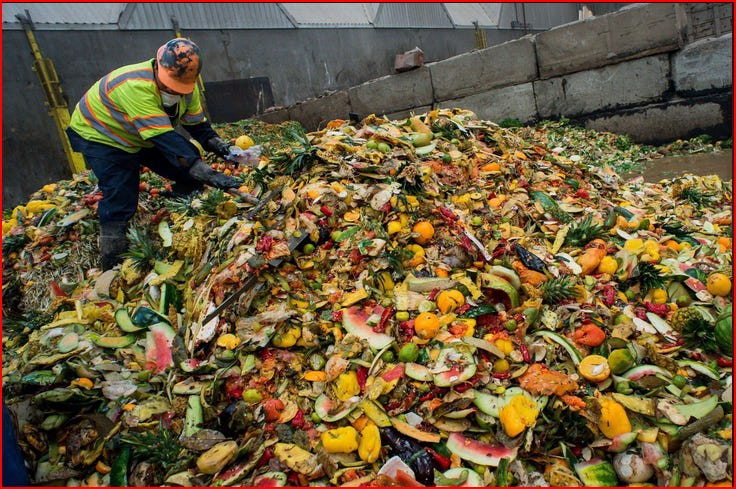
Why is the link important? The path from ancient midden heaps to modern landfills has involved the creation of a giant ‘garbage’ (solid waste) industry with serious environmental, economic and social problems. From collection and transport of solid waste, to construction and maintenance of landfills, the industry is costly, polluting, and often socially unjust (e.g., in the siting of landfills). New Jerseyans discard hundreds of tons of waste per day, with food making up the second largest component of the solid waste stream. In 2017, our State legislature set a goal of 50 percent reduction of food waste by 2030. Composting plays a key role in achieving that goal.
Food waste contributes significantly to global warming. The U.S. leads the world, with a third or more of the food produced wasted every year. Landfills are the repository for most household food waste and that of other large food waste producers (restaurants, schools, care facilities, supermarkets and others). In nature, over sufficient time, organic matter is fully broken down by microorganisms into carbon dioxide (CO2) and water. This ‘biogenic’ CO2, for millennia part of nature’s continuous carbon cycle, does not contribute to human-caused global warming. However, the low oxygen level in landfills directs much of the microbial decay of organic matter to an alternate metabolic path that produces methane gas. In 2022, municipal landfills contributed 14% of all human-caused methane release. In the short-term, methane is 80 times more potent than CO2 at trapping the sun’s heat in the atmosphere.
The #1 decision, after cutting household food waste (see suggestions), is to compost the remaining waste. Whether in the backyard, via a farm or other authorized composting operation, this decision diverts tons of solid waste from landfills. Compost is the prize we get, either from the backyard composter, or as a return from a town or commercial composting service. Compost is the nutrient-rich, moisture-retaining material that remains after considerable breakdown of organic matter by microorganisms under managed conditions. A great soil amendment, compost enriches garden soil and reduces or removes the need for artificial fertilizers, saving money and probably helping pollinator populations as well.
Though convenient, backyard composting is challenging. Commitment, knowledge, time, effort and money are required to nurture the healthy functioning of the microorganisms that digest organic matter and minimize methane formation. Some important considerations are the proper ratio of high carbon (brown) waste to high nitrogen (green) waste, the amount of moisture (dry bulking agents may be needed), frequent aeration (turning, mixing), and choice of compost bin or enclosure (wood is ideal, though rotating plastic drums and chambers are ready-made - albeit environmentally unfriendly). Throwing food waste into a hole or piling it in the yard, unenclosed by a container, attracts vermin. Meat and fish scraps are no-nos. Without special equipment, cold weather shuts down most backyard composting.
Professionally tended composting has the benefit of more certain and greater methane reduction. Under regulation by the Department of Agriculture, these larger compost piles (e.g, on farms), are aerated regularly and operate efficiently. Their size and construction (waste content organization) produce the high internal temperatures (130-160 degrees) that allow waste to break down all year. The heat also disables weed seeds and kills pathogens, making it safe to compost meats, meat bones, and shellfish. On farms with composting operations, the food scraps collected from municipal customers are fed, as needed, to the animals, reducing the price of composting services. Larger scale composting also significantly lessens the pressure on cities and states to commit more land and money to build new, or expand existing landfills. In New Jersey, the money saved could be budgeted for subsidizing the increased reach and convenience of composting. Ideally, all municipalities (not just a few) would pick up separated food scraps from residents on the same schedule as other recycling.
The NJ Department of Environmental Protection (DEP) is working on solving our solid waste management problems. Recently recognizing composting as a critical contribution to a sustainable solution, the DEP has developed regulations to minimize pollution by large scale composting operations. Currently, only two such facilities exist in New Jersey. A task force is now developing guidelines for smaller composting enterprises. Meanwhile, municipalities are gradually contracting with mid-sized farm-based composting businesses, operating with permits from the NJ Department of Agriculture, to provide services for their residents. Far from uniform, many towns require residents to pay monthly for farm food scrap pick-up, and to travel to a central pick-up location weekly with their buckets of scraps. Most households in those towns do not participate in recycling their food scraps. It seems clear that New Jersey needs mandatory, well-subsidized recycling of source-separated food scraps along with other mandatory recycling.
Though important in this effort, small composting businesses struggle with high permitting fees way out of proportion to the size of the business. Although the larger goal is mandatory state or town sponsored recycling of food waste (similar to other recyclable solid waste), we are underutilizing small existing composting businesses. Some, like Source Compost, will pick up your food scraps for delivery to a composting site, and, if you prefer, help you start your own - or improve your own - backyard composting system. Now is the time to contact your municipal Environmental Commission Chair, the NJ DEP (email: recyclingfacilities@dep.nj.gov) and your NJ state legislators to advocate for greater composting support and accessibility.
Last updated: 2/20/2025
No posts
Comments
Nothing yet. Say the first thing.
Sign in to join the conversation.