
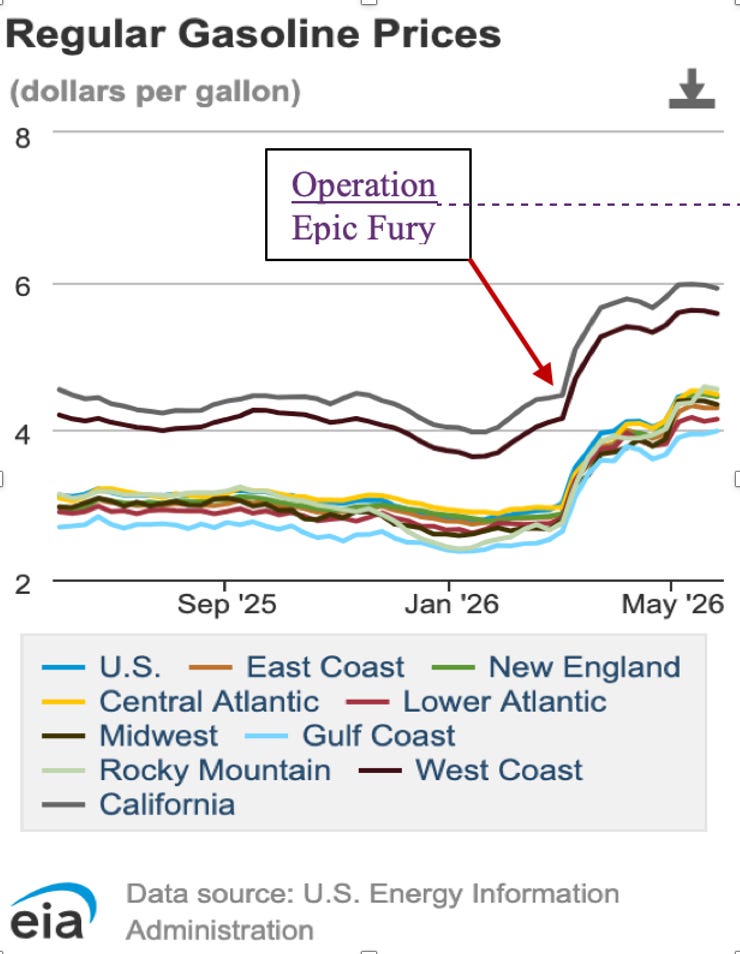
1. Setting the context
This was happening even though the US is a leading crude oil producer (roughly 13 million barrels per day in 2025), and also an exporter of crude (roughly 4 million barrels per day mostly to Europe, Asia, and Oceania). At the same time, the U.S. was importing roughly the same amount (mostly from Canada). In addition, the US has been importing gasoline for years (between 0.5 and 1.0 million barrels per day) and exporting between 0.75 to 1.25 million barrels per day. It seems that our refineries on the Gulf shore were built to refine heavy sulfur-ladden crude oil from Mexico and Venezuela and not the sweet light crude that is extracted elsewhere in the country. And so we import heavy dirty crude and export the sweet light variant.
Because of this extensive trade, therefore, US prices of crude oil and products, importantly including gasoline, are determined in international markets. Thus it is not a surprise that US prices respond when global crude oil markets are stricken by a supply shock elsewhere. For gasoline in particular the global oil price represents about half of the price at the pump, with the rest coming from refining costs, transportation costs, and federal and state taxes.
Figure 1 shows that world oil prices rose from $66 per barrel on February 28th (when Operation Epic Fury was unleashed) to $75 on March 4th (when the Strait of Hormuz was closed cutting off 20% of the world’s daily oil supply), $95 on March 9th, $98 on March 13th, $105 on March 30th, $111 on April 7th and back down to $96 in the middle of May. They had fallen further to around $87 per barrel in early June, but uncertainty about how the war will be resolved, and thus oil the oil price, remains high.
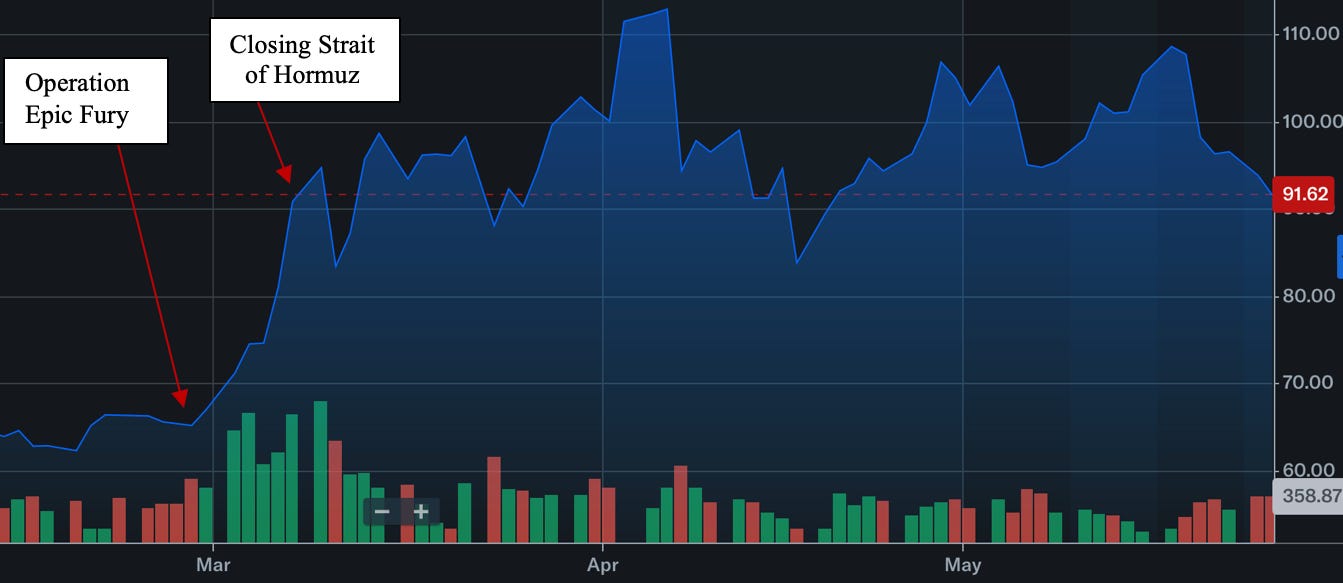
Figure 1. Four-month history of international crude oil prices through May 27, 2026. The jagged line plots one measure of crude oil prices. It show a sudden turn upward in early March, when Operation Epic Fury began, that has persisted since with the support of the closing of the Strait of Hormuz. The bars on the bottom show day to day increases (green) or decreases (red) in price. Notice the sharp jump in prices on the day that Operation Epic Fury began and persistent (if irregular) continuation starting on the day when the Strait of Hormuz was closed.
2. Some economic consequences.
In addition to releasing some of the oil stored in the Strategic Petroleum Reserve, the current administration has proposed to suspend the federal tax on gasoline and diesel fuel until oil prices fall (amount unspecified). This action would lower gas prices by 18 cents per gallon and diesel by 24 cents, not much energy cost relief for lower income drivers and the trucking industry. Additionally, this action would interrupt a revenue stream that is designed to support efforts to maintain our aging federal highway system.
The oil price spike has not been all bad for all everyone. It has clearly been a benefit for royalty holders and state tax authorities. It also is a benefit to stockholders of production companies. For example, the stock prices of the six “super major” oil companies (including Exxon-Mobil, Chevron, and Shell) have soared since the U.S.-Israel attack on Iran. As a result, their combined market capitalization[1] rose by $130 billion in just two weeks.
With limited and short-term responses by the federal government, the economic prospects are likely to darken. We are doubtlessly in a global oil market where a supply interruption anywhere affects consumers everywhere, and there are many potential pinch points. To say otherwise is simply wishful thinking. The only long-term solution is to reduce dependence on highly centralized sources in the oil-rich Middle East to decentralized domestic renewables.
[1] The market capitalization of a company is the market value of outstanding stock shares calculated as the product the market price of a share times the number of shares held by the public.
___________________
Gary Yohe is the receiving agent of Gary W. Yohe, LLC and Huffington Foundation Professor of Economics and Environmental Studies (emeritus), Wesleyan University.
Henry Jacoby is William F. Pounds Professor of Management (emeritus), M.I.T.
Richard Richels was lead author for multiple chapters of IPCC studies in areas of mitigation, impacts and adaptation.
No posts
Comments
Nothing yet. Say the first thing.
Sign in to join the conversation.