
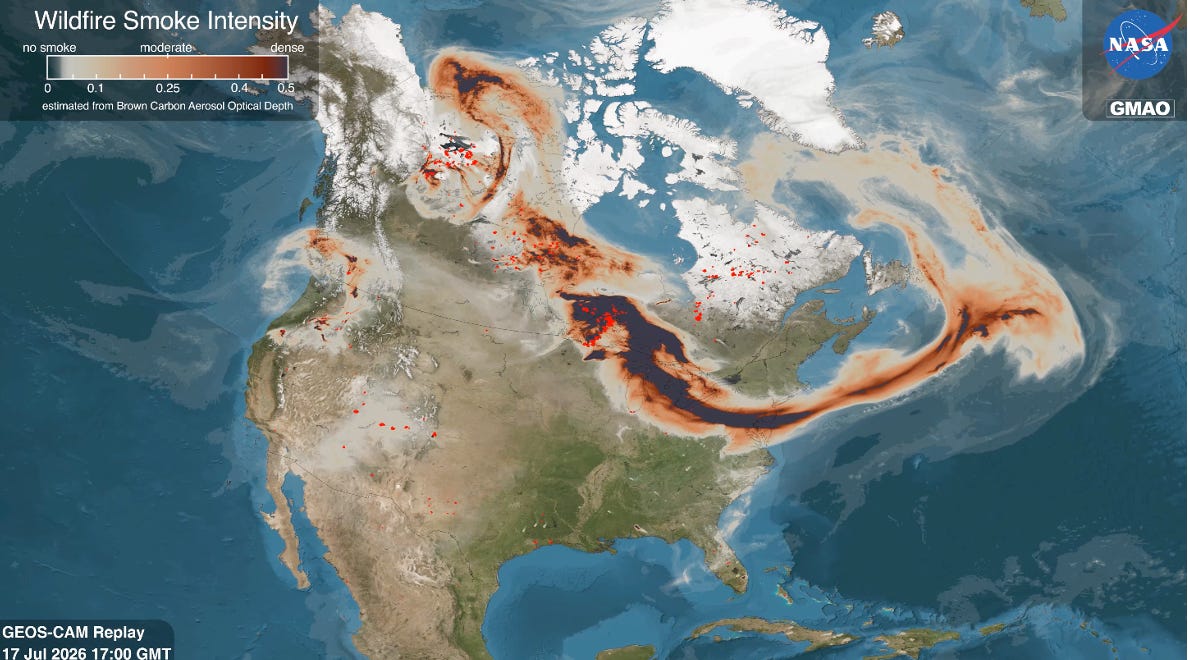
Some in the U.S. blame negligent Canadian forest management for the smoke plumes that have darkened skies and threatened human health across the upper Midwest and southern New England. They even include the President of the United States who claims he is, “. . . holding Canada responsible for the fact that they are not properly maintaining their Forests, and Brush”. There is blame for these increasing and ever more ferocious wildfires, but it is not appropriately directed at Canada.
Wildfires in the Canadian forests have been happening routinely since long before the industrial revolution, but their character has changed markedly over the past few decades. True, some of the more damaging fires that we now see are due to human activity--the way we manage landscapes such as forests, grasslands and cities, and how we manage fires when they occur. Indeed, much of the current science points to management and land use as the most important factors in explaining fires. But most of that science only applies to managed forests. In Canada, most of the forests that are burning now are not nor have they ever been managed.
Weather is a key determinant the frequency and intensity of many of the Canadian fire storms of 2026. Many are being ignited by natural processes like dry lightning. Also, they are erupting in locations where it has been extraordinarily dry for years, coupled with record high day and night temperatures and unusually strong winds. Unfortunately, they also are happening in locations that are so remote and so naturally rugged that they cannot be controlled. They burn themselves out eventually, often after heavy rains reduce their momentum.
None of this is unexpected. Warmer temperatures remove water from vegetative fuels making them both easier to ignite and more likely to spread rapidly. Where climate change has caused long term drought, record heat, and accelerated winds, the speed that fire races across forests and dry grass increases. Even urban areas can be explosive.
In short, when the Canadian forest is in a dry regime, climate change increases wildfire frequency by making ignition and spreading easier. It also increases wildfire intensity because there is more fuel to burn and because stronger winds blow airborne embers higher and farther.
It is also important to emphasize that the damage of wildfire smoke is real. Exposure to high concentrations of fine particulate matter (PM) in smoke poses serious health risks, and the levels of exposure are growing. The figure above shows the plume from the Canadian fires reaching the populated east coast of the United States and beyond on July 17th of this year. The figure below shows the plume from the historic 2020 California wildfires when 5 of the 6 largest wildfires in California history were all burning at the same time.
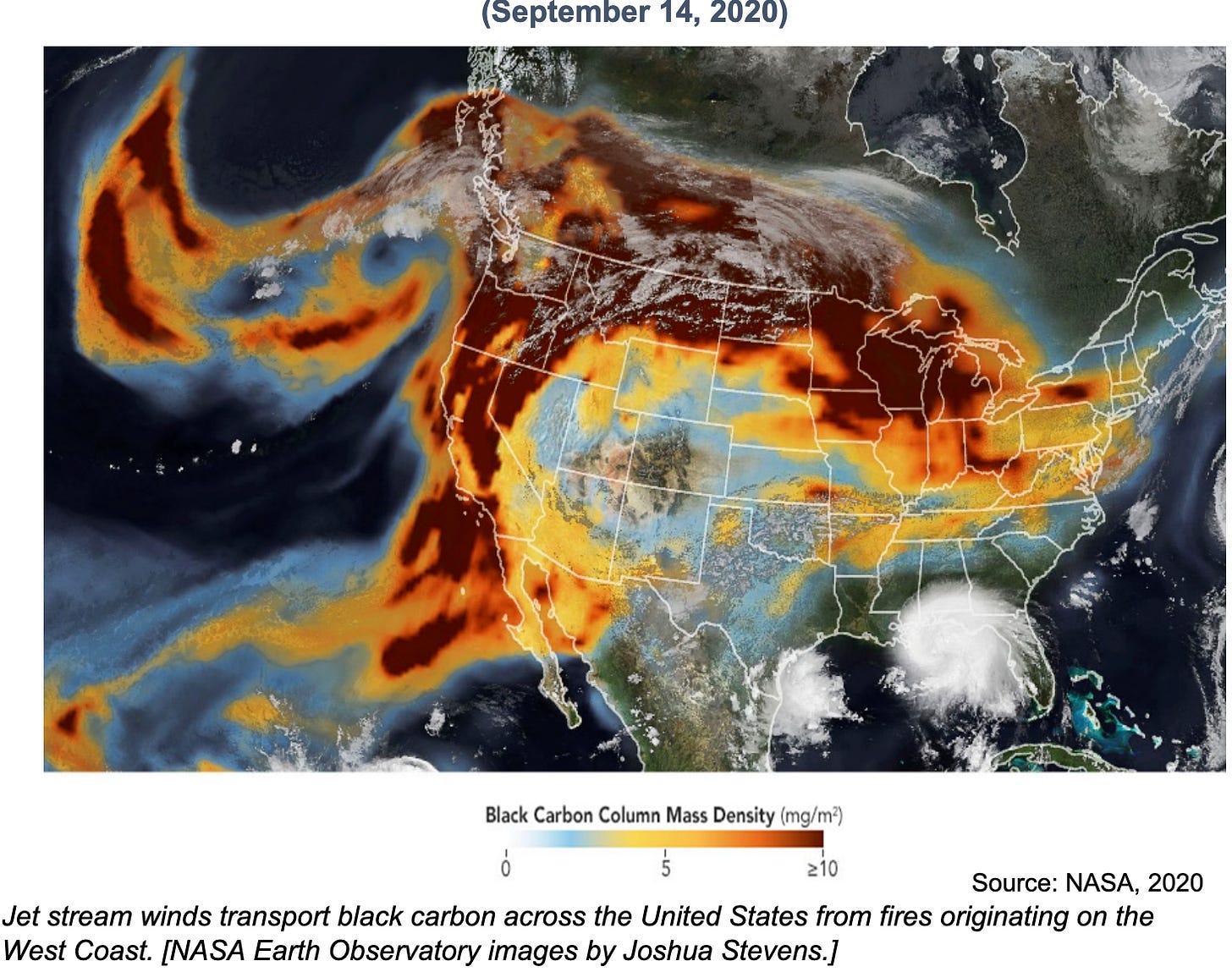
Fine particulate matter (PM2.5 or PM that is 2.5 ug/m3) when inhaled, goes deep into and lodges in the lungs, where it is absorbed by the blood stream. It then goes on to damage nearly all our organs. Most PM2.5 in U.S. air comes from burning of fossil fuels but the portion from wildfires is particularly damaging to human health. It is more toxic than “regular” PM2.5 because of its chemical composition and the way it affects the body. Moreover, it has been found that the mortality impacts of wildfire smoke can last up to three years after exposure.
The EPA Air Quality Index (AQI) summarizes air quality in more than 500 cities in the US. The measurements are used to communicate daily air quality levels to indicate how clean or polluted the air is and to notify the public when exposure is high enough to cause adverse health consequences. It is updated frequently to reflect current air quality conditions. The AQI is color-coded into six categories, from green (good air quality: 0 to 50) to maroon (hazardous with health warnings of emergency conditions, with everyone more likely to be affected than at lower levels of the AQI (301 and higher). Unfortunately, the AQI does not capture the extra toxicity of wildfire smoke, which means that in its presence the AQI may underestimate health risks.
Wildfire smoke is degrading the progress made in the US in reducing air pollution as measured by the AQI. Since 2016, wildfire smoke has eroded about 25% of previous multi-decadal reductions in PM2.5 concentrations in nearly three-quarters of the 48 contiguous American states. The contribution of wildfire smoke to regional and national air quality trends is likely to grow with climate change.
A recent analysis projected that, under a high warming scenario, PM2.5 from wildfire smoke could result in over 71,400 excess deaths per year by 2050, which would be a 73% increase over the estimated annual excess deaths from wildfire smoke in 2011-2020. Cumulative excess deaths could reach 1.9 million between 2026 and 2055. When monetized, the health impacts of climate-driven wildfire smoke could be among the most expensive consequences of a warming climate in the US.
In summation, uncontrollable wildfires are leading to the widespread exposure of millions of people to downstream toxic smoke, but Canada is not the primary culprit. Everyone who burns fossil fuels has contributed to their extreme numbers and record-breaking intensities. We are all partially responsible for the damage they cause.
_____________________
Gary Yohe is the receiving agent of Gary W. Yohe, LLC and Huffington Foundation Professor of Economics and Environmental Studies (emeritus), Wesleyan University.
Kristie Ebi is principal in ClimAdapt, LLC.
Richard B (Ricky) Rood is Professor Emeritus, Climate Science, University of Michigan, Ann Arbor; writer, speaker. https://OpenClimate.org/
Henry Jacoby is William F. Pounds Professor of Management (emeritus), M.I.T.
No posts
Comments
Nothing yet. Say the first thing.
Sign in to join the conversation.