
It doesn’t take a sophisticated content analysis to recognize that the volume of news coverage – both column inches and airtime – of climate change science and impacts has declined significantly from levels of recent years.
That’s the case in particular for general audiences viewing or reading the so-called “legacy media” – those serving large urban areas or via traditional broadcasts or major cable outlets.
It’s not that climate coverage is unavailable. Academic researchers provide quantitative data and analysis of global warming/climate change trends, and useful overviews of climate coverage are provided by groups like those at the University of Colorado and Yale University. Also, those wanting to seek responsible coverage can find it through targeted, and usually online, outlets, often at little or no cost.
The important factor here is that the broad general public now is far less likely than in the past to casually or routinely “encounter” climate news coverage. Now more often they must take the initiative to seek out those news stories, rather than have the news providers routinely come to them. That’s a big deal.
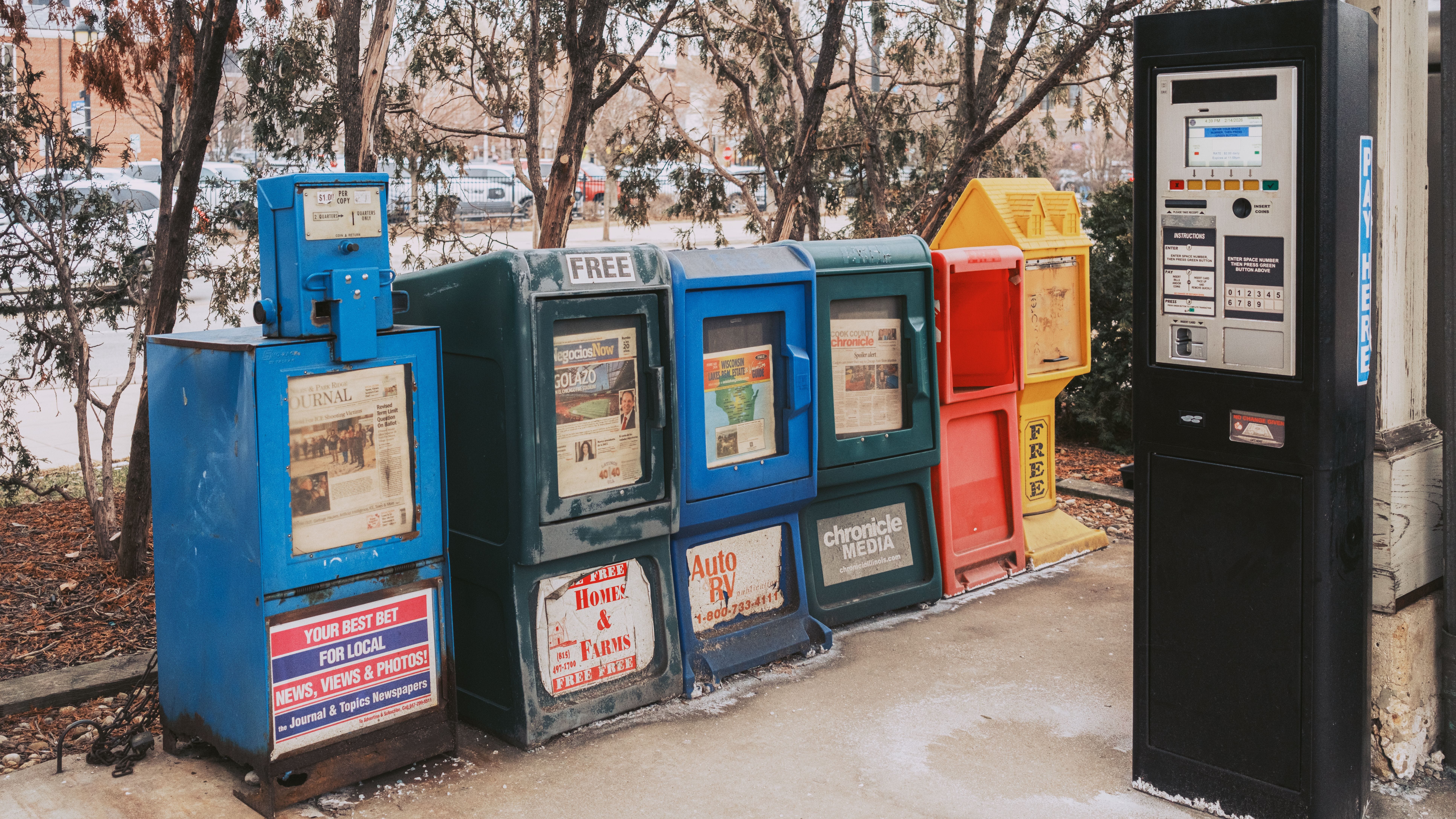
Nor does the ongoing decline in major media coverage of climate change news stand apart from declining major media coverage of other important news. The fact is that vast “news deserts” are appearing across the country.
At the turn of 2026 we in this Substack forecasted substantial changes in the mass media over the coming year. Truth is that many of those changes have come about, or are in process. For example, they have involved major long-lived news organizations such as national broadcast and cable networks, The Washington Post, and public radio.
Forecast for CNN: Cloudy
Take CNN. The roller-coastering “on again/off again/what now?” fight over CNN is the nation’s most closely watched and most important media merger story at this point. The $110 billion death-dance pits Skydance Media, the owner of Paramount, on one side and Warner Brothers Discovery on the other. The conflict over the potential merger, with the futures of CNN and HBO and more up for grabs, continues unabated.
Transfer of Warner properties to a Paramount group headed by the billionaires Larry and David Ellisons – both seen as Trump acolytes – is widely viewed in news circles as an effort to bring CNN, in particular, into President Trump’s corner. That is what media scholars say has happened at CBS since it was brought into the Paramount family. Such a move likely would lead to less frequent and less in-depth CNN coverage of climate change science and policy. The CNN newsroom is widely reported to be fearful of being muzzled and refrained from what they view as their responsibilities as independent and legitimate news journalists.
Recently a really big shoe fell – putting the whole transaction on hold. The parties agreed, at Paramount’s suggestion, to delay further action in light of antitrust lawsuits by 12 Democratic state attorneys general and unionized writers and editors. The on-hold standoff could last at least well into 2027, with still-unresolved differences being contested in litigation. One can only guess at the ultimate outcome.
The commercial TV news networks and PBS-NPR
The so-called “legacy” national television news networks – ABC and CBS, and to a somewhat lesser extent NBC, have undergone dramatic changes in the past few months. So too have public television and public radio.
CBS came under Skydance control when it was acquired by Paramount in 2025. That switch resulted in the selection of Bari Weiss to head CBS News, bringing widespread firings and fear of a pro-Trump bias in the legendary network’s news coverage.
Other legal pressure came more directly from the Administration. While not admitting to wrongdoing, CBS agreed to pay $16 million to President Trump’s future presidential library to settle a suit over the editing of content in a “60 Minutes” interview with then Democratic presidential candidate Kamala Harris.
The very public resignation of CBS News veteran “60 Minutes” journalist Scott Pelley, a former anchor of the CBS Evening News, has led to further concerns, some of which the younger Ellison sought to temper in an opinion column in The New York Times on August 4.
ABC has been subjected to similar heat. It paid $15 million to Trump’s future presidential library foundation and another $1 million for legal fees in a defamation suit brought by the President. Trump had charged that ABC’s George Stephanopoulos incorrectly reported that he had been found guilty of a “rape” of former Vanity Fair editor E. Jean Carroll. (Trump eventually paid Carroll $5 million after a jury found Trump guilty of sexual abuse, battery and subsequent defamation.)
NBC Universal, a major subsidiary of Comcast Corporation, was investigated by the Federal Communications Commission, FCC, over the network’s diversity, equity, and inclusion (DEI) practices. FCC chair Brendan Carr, a Trump appointee, has criticized the network’s coverage of Trump deportation policies. Also, President Trump has repeatedly threatened to revoke NBC\Comcast and ABC licenses for not carrying a highly political July 2026 prime-time speech he gave (only CBS carried it live and in full).
The Corporation for Public Broadcasting, PBS, for TV, and NPR, for radio, throughout 2026 have been coping with and adapting to the Republican-controlled Congress’s rescinding of $1.07 billion in 2026 and 2027 funding, earlier approved by the Congress in an unusual two-year appropriation. Roughly 70 percent of CPB’s annual federal funds of about $535 million had been going to the 1,500-plus local TV and public radio stations, mostly in small, rural, and remote areas.
NPR closed its dedicated climate desk and let go several of its science reporters. And CPB closed its doors entirely in January 2026. Public TV and NPR stations, have had to make reductions and patches in their newsrooms, including cutting back on climate coverage along with other news coverage.
The print media
Not all the upheaval in the media world so far in 2026 has been limited to broadcast and cable and public broadcasting. At the once-proud Washington Post, the paper’s popular and highly regarded “Weather Gang” – providing daily weather forecasts and keen insights on climate change goings-on – has folded and has been reincorporated by its founder, meteorologist Jason Samenow as an independent online outlet. The Post’s owner, Executive Chair Jeff Bezos and former CEO of Amazon, has narrowed the focus of the paper’s influential editorial page in ways that substantially de-emphasize climate change and other issues. (See an excellent Substack by former Post climate science reporter Chris Mooney on the Post’s editorial downsizing.)
Some specialized news organizations also have undergone contraction in the past few months. For instance, the well-regarded E&E News, with its frequent climate coverage, was first merged into a broader online newsletter by its then-owner, Politico. And well-regarded and veteran science and climate journalist Dan Vergano – at various times in his career previously with USA Today and National Geographic – was let go from Scientific American soon after a subsequent owner, Springer Nature, sold the magazine to Lab X Media. Stay tuned on that one.
More media changes are likely through the remainder of 2026. As the saying goes, “the beat goes on.” Just how that will apply to the newsroom climate “beat” –- and how some offshore outlets might figure into this morass -- remains to be seen. Perhaps in a subsequent post at this site.
___________________
Bud Ward spent five decades as an environmental and climate change journalist and educator.
Henry Jacoby is William F. Pounds Professor of Management (emeritus), M.I.T.
Richard B (Ricky) Rood is Professor Emeritus, Climate Science, University of Michigan, Ann Arbor; writer, speaker. https://OpenClimate.org/
Richard Richels lead author for multiple chapters of IPCC studies in areas of mitigation, impacts and adaptation.
Kristie Ebi is a principal in ClimAdapt, LLC.
Gary Yohe is the receiving agent of Gary W. Yohe, LLC and Huffington Foundation Professor of Economics and Environmental Studies (emeritus), Wesleyan University.
No posts
Comments
Nothing yet. Say the first thing.
Sign in to join the conversation.