
Doctors have a name for the person sitting in your program.
Your industry doesn’t, but medicine does, and they’ve been refining it for fifty years, so let me tell you what they know about your client that you might not.
Patients who questioned and compared. When the internet arrived, he gave them a name: the e-patient, one that is empowered and engaged. His colleagues mostly rolled their eyes.
Then came the era every doctor knows by heart: Dr. Google. Patients walking in with printouts. The profession complained about it for two decades, and the patients did not care and did not stop.
I think all of us can relate and admit consulting Dr. Google at least once or twice over the years.

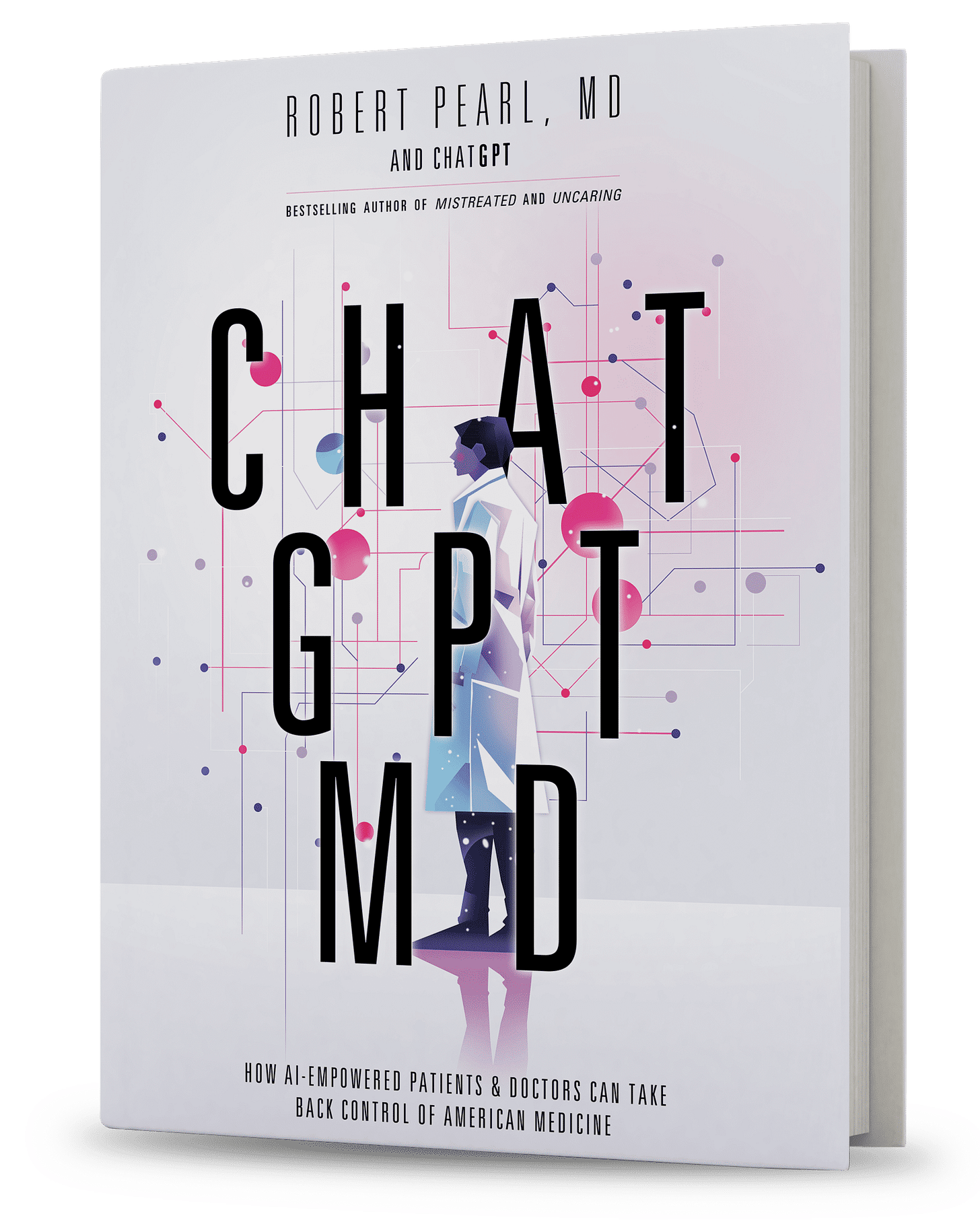
And in September 2023, Robert Pearl, who used to run one of the largest medical groups in America, wrote a piece in Forbes with a title that should make every coach and consultant pay close attention: “The AI-Empowered Patient Is Coming: Are Doctors Ready?”
He didn’t stop at the article. A year later he co-wrote an entire book about it - “ChatGPT, MD” - and his co-author, listed right on the cover, is ChatGPT itself.
Recently, The Lancet (a prestigious portfolio of over 20 global and regional medical and health journals) published a paper about the same person. Its title starts with four words that can be directly applied to any coaching or expert led business:
Fifty years of watching, naming, and studying their changing client. Now here’s what the data has found, all of it published as we are entering deeper into the AI era.
A major healthcare consumer index tracking a thousand patients found that 69% have used AI to get a second opinion after meeting with their doctor. Not instead of the appointment. After it. Nearly half do it repeatedly. And 29% say what the AI told them has actively influenced whether they follow their doctor’s recommendations.
The trend is tearing through mental health, too. The American Psychological Association’s Chatbots and Mental Health Survey reported that 39% of psychologists now face patients who self-diagnose using AI.
Even wilder: 35% say their patients are using AI as an additional professional, a second therapist in their pocket between every session.
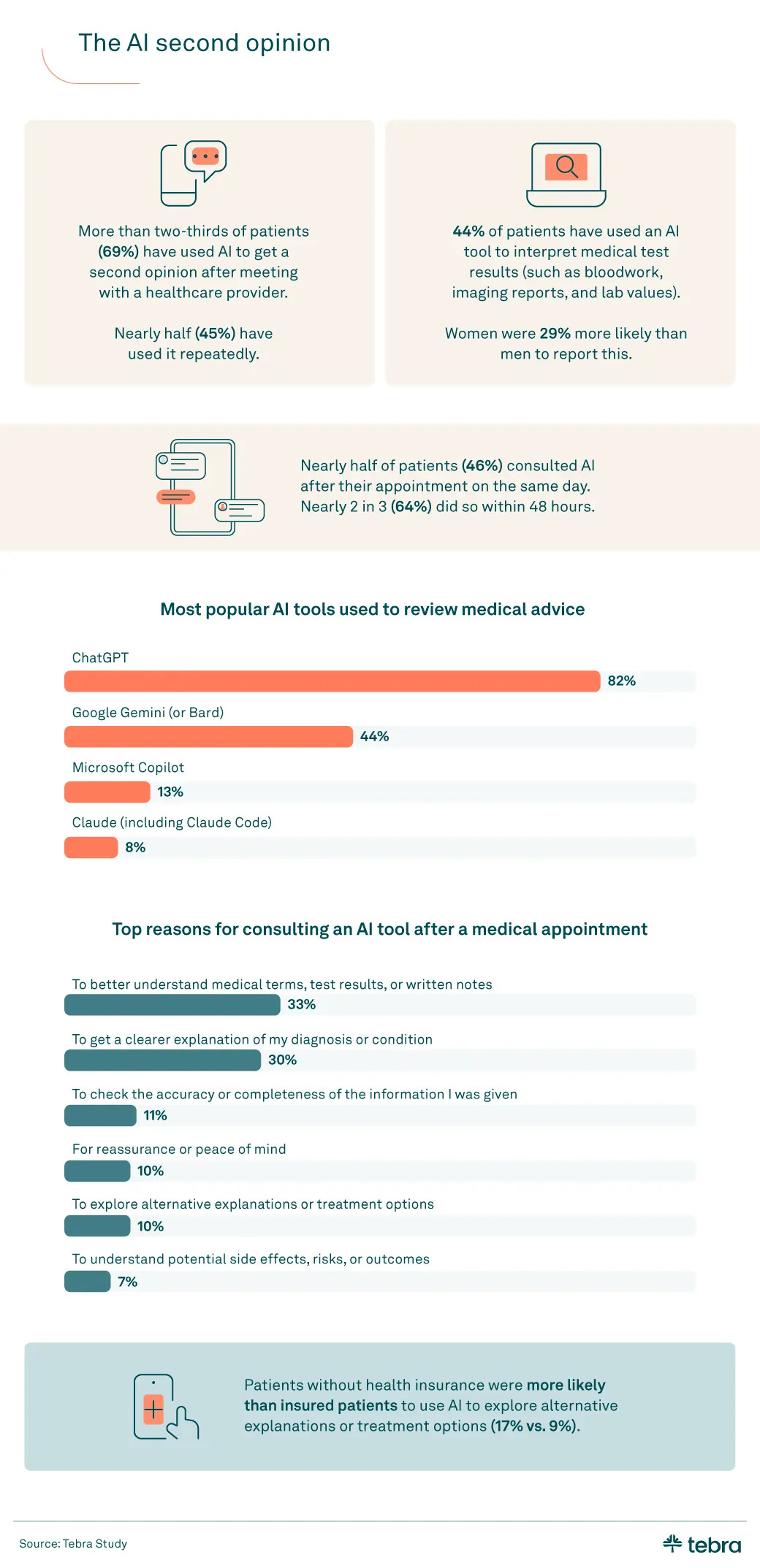
And it’s not just health. Researchers looking at consumer behaviors found that more than half of adults have already asked AI for critical financial advice.
So we have doctors, therapists and financial advisors who are among the most protected and trusted expert professions on earth, and their clients are second-opinioning them at scale, without asking permission.
And finally to question today’s letter is about:
If 69% of patients check their doctor’s advice with AI, what do you think your clients do with yours?
I can tell you, because I’ve seen it up close. A founder I worked with this year watched a client push back on her work using AI output. Work she’d been doing well for years.
The client didn’t call her first. They asked the louder voice in their pocket, and the louder voice answered with full confidence and zero context.
Nothing in her delivery had gotten worse. The person consuming it had changed.
I started writing about this person over a year ago and gave them my own name: the post-AI client. Back then it was a hunch built on patterns I kept seeing in client businesses.
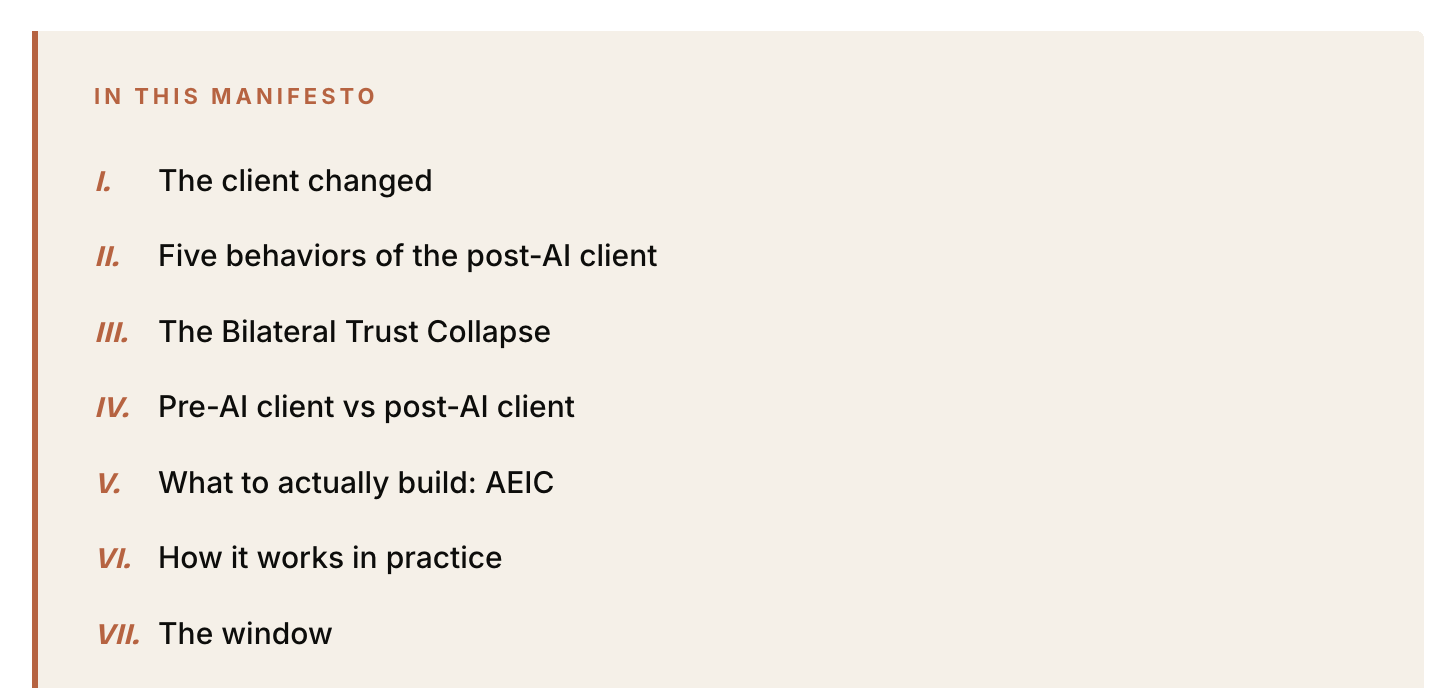
(click on the image above or here to read the full “After They Say Yes” manifesto on post-AI client)
I’ll be honest, it didn’t exactly set the world on fire, and there were weeks I wondered if I was describing something real. That’s the thing about being early: it feels identical to being wrong.
Then I stumbled on the “AI-empowered patient” and fell down the medical rabbit hole you just read.
Funny thing is, I’d dismissed the medical space completely up to that moment. We normalized second-guessing doctors so long ago - Dr. Google is older than my career - that I never thought of medicine as a preview of anything. But, it ended up being the head start.
Maybe that’s just the confirmation bias I needed. But I have zero doubt left:
Let me translate their findings into our world, because every number above has a twin in expert businesses:
The second opinion after the appointment? That’s your client pasting your advice into ChatGPT or Claude on the drive home.
The 29% whose compliance changed? That’s the client who quietly did the homework differently, or not at all, and never told you why.
The additional professional between sessions? That’s who your client talks to during the six days between your (group) calls.
Look at the medical numbers again: patients still went to the appointment. They still want the human. What changed is what happens around the human, in the gaps.
The silence between your sessions used to belong to you by default. Now something else lives there, and it never sleeps, never bills, and never says “I don’t know.”
The post-AI clients leave differently, renew differently, and trust differently - while the most program delivery and client experience was designed for the client who no longer exists.
If you want to know where your business is exposed to this:
where the silence is
where your contribution is invisible
where a louder voice could move in
how could you (re) design delivery for the post-AI client
…that’s exactly what I look for in the Retnetion Gameplan. Ninety minutes, your real client journey fully mapped out, plus a written 90-day action plan.
€444 while founding slots last. Reply or send DM for all the details.
-Filip “post-AI client” Sardi
PS. If you do nothing else: assume your clients already asking, without your permission. The 69% didn’t announce it to their doctors either.
No posts
Comments
Nothing yet. Say the first thing.
Sign in to join the conversation.