
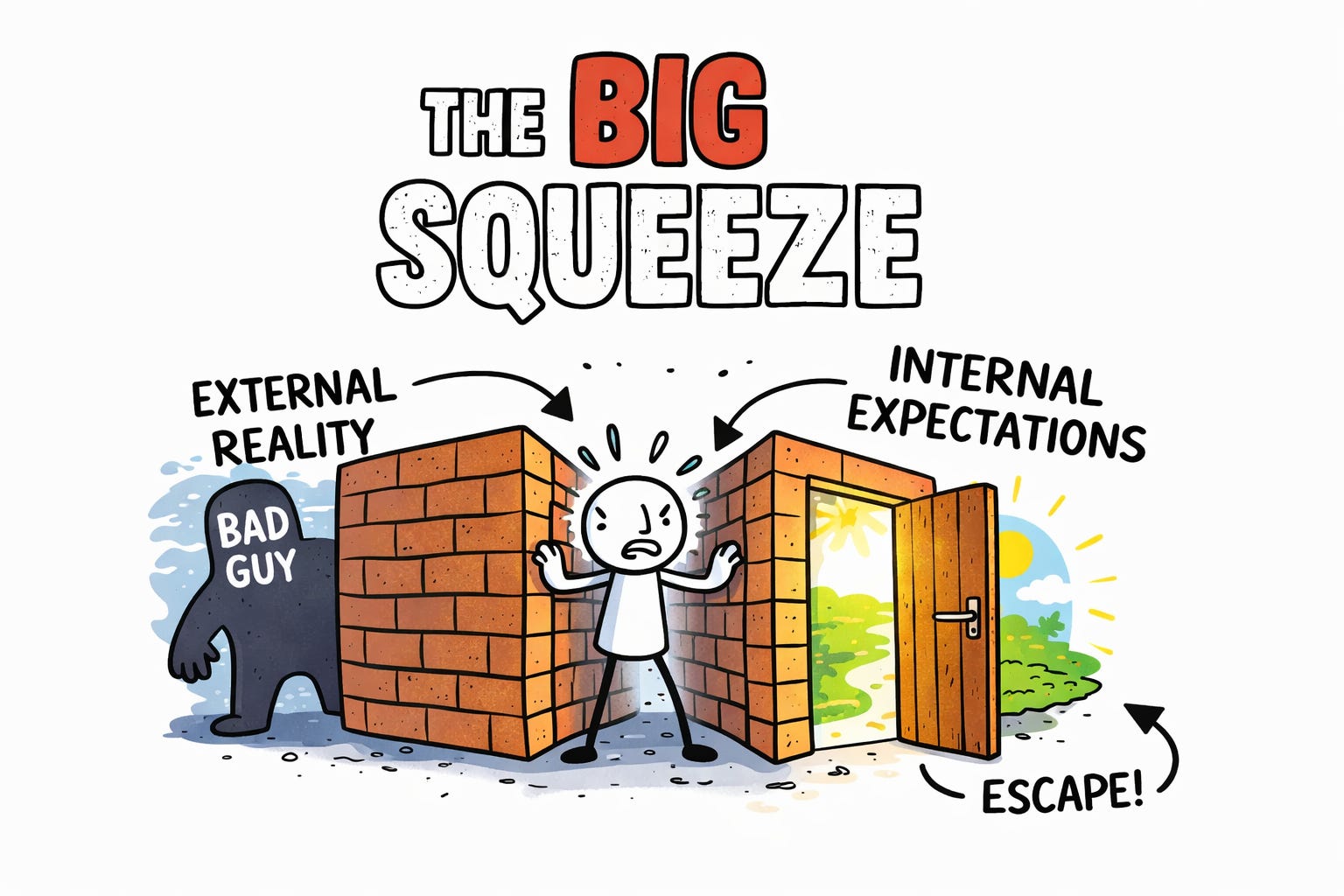
Here’s a scenario: You’re running from a Bad Guy. (Maybe you’ve had this recurring nightmare. Just me?) As fast as you run, you can’t seem to leave him behind. You try to use city streets to lose him, but the shadowy presence just keeps getting closer. Eventually, you turn down an alley and…
Shit! There’s a wall at the end. It’s too big to scale. You turn back to see Bad Guy gaining ground. You’re stuck. Nowhere to go. Heart beating out of your chest. Stomach falling straight through your feet. This is it. You close your eyes and smash yourself up against the wall, trying to disappear.
Wait…
What’s that? You notice that as you lean into the wall, it budges, ever so slightly. You push your shoulder into it. It moves a bit more. Breathing room! Right there, in the middle of the wall, hidden in plain sight, is a door. You push it open. You step through. You shut and lock it behind you. Relief washes over you. Saved!
Wouldn’t it be nice if this were available to us each time—figuratively speaking—we felt cornered in our daily lives, facing down the barrel of one of those menacing psychological pests: Impostor Syndrome; Running Out of Time; Fear of Failure; Bad Outfit Feeling1? Well, I think they are available to us—much more than we think. We’re mistaking doors for walls all the time. And learning how to locate them—how to find our way out of everyday squeezes—is an incredibly helpful skill.
A squeeze can only happen between two opposing forces. When I am feeling squeezed, it’s usually because I’m stuck between my internal expectations and external reality. I so frequently forget this. I’m so distracted by the intense feelings created by the external reality barreling down on me that my internal expectations—much like the wall in the scenario above—go completely unexamined.
For instance: almost every day I wake up with the sense of “I have too much to do.” My response to this perceived lack of time is to get ever more strict about time management: how I organize tasks, mitigate distraction, and increase productivity. In other words, I try to recalibrate all of the external elements—the things I “need” to do, and the time in which I “need” to do them—instead of asking if perhaps my internal expectations for how much I “need” to do might have been completely unrealistic in the first place.
Here’s another example: Several years ago, I decided to get Invisalign. Mind you, I had braces when I was a kid, so this was mostly a cosmetic decision. My wisdom teeth had never been taken out and my bottom teeth were (ever so slightly) crowded. Well, Invisalign is equally painful on your teeth, jaw, and wallet. You know what would have saved me not just money, but a bunch of literal and metaphorical headaches? Simply getting over my outsized vanity and deciding that it was okay that my bottom teeth were a little bit jacked up. I chose to use gobs of energy and a pretty nice rainy day fund to change something external (my teeth) rather than simply sit with the internal discomfort of having a wee bit of a snaggle tooth.
But this doesn’t just happen on the scale of cosmetic dental procedures. The more I started looking out for moments in my life where I felt squeezed, the more I noticed just how much I could cut through the day’s tension by checking what internal story I was holding onto and deciding, “It’s not a problem.” It’s not a problem that I didn’t finish everything I thought I was going to get done. It’s not a problem that I said that dumb thing at dinner three nights ago. It’s not a problem that I didn’t say anything useful in that meeting. It’s not a problem that everyone can see how bad my fashion sense is when I wear these pants. It’s not a problem that my friend is going to be seventeen minutes late and I’m going to have to sit here by myself like Steven Glansberg.
It might sound simple but it has been profoundly liberating to realize how much of the small-stakes mental disturbance in my everyday life can be mitigated by simply deciding that things that seem like A Big Deal are, in fact, not a big deal at all. This is the first way out of the squeeze.
Of course, not every squeeze is small-stakes. Life is full of actual Big Deals, like financial or health issues. And even below those high-stakes problems, there are plenty of instances where trying to convince myself something isn’t A Big Deal just won’t work. It could be an important project in my professional life, a physical fitness goal I’ve worked really hard for, or even a difficult conversation with a loved one. Telling myself these don’t matter isn’t going to work when, in fact, they certainly feel like they really matter — even if just to me.
In such a case, my instinct can be to try to even more relentlessly control external reality. Unfortunately, this approach often works like one of those finger traps: the more I struggle, the more squeezed I become. That’s because trying to manipulate external circumstances to create an internal feeling of order or calm often does the opposite. Think about it: Anything that has the possibility of being brought under control has the possibility to spin wildly out of control. The more elements “in my control,” the more aware I become of just how tenuous my illusion of control really is.
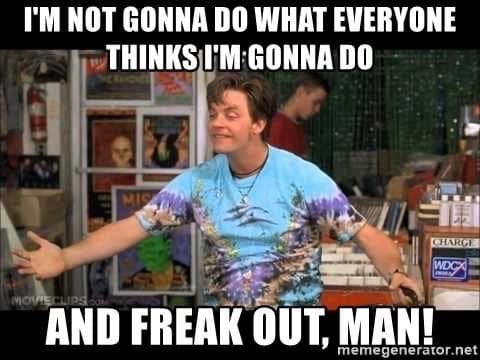
For example, running a marathon is an exercise in relentless control. The plan, the training, the gear, the shoes, the sleep, the eating, the drinking, the pacing, the pre-race bowel movement strategy… on and on it goes. The more attached I become to each element going “right,” the more fragile I can become. If I don’t get enough sleep, or my watch loses GPS, or I drop all my gels in the first 5 miles, or my laces come untied, or (sweet Jesus please no) I can’t get myself to go to the bathroom the morning before the race — all things that have happened to me – the more likely I am to flip out, man!2
This isn’t to suggest that I ought to forgo control entirely. Properly preparing for just about anything is a matter of control, and that control leads to feelings of autonomy and competence, which are two of the fundamental psychological needs that we need in order to be motivated to grow and develop.
But there’s only so much preparation I can do before it stops being productive and starts being a way to protect against feelings of uncertainty or vulnerability. At that point, any additional prep just continues to create anxiety because it reinforces the idea that failure is scary. If I’m trying to run an ambitious marathon time and my plan tells me to peak at 55 miles a week, and I decide to push to 65 because I really really want to PR, that’s a bad idea not only because I might injure myself, but also because it’s reinforcing the subconscious idea that I won’t be okay if I don’t hit my goal.
This is why relentless preparation has to be paired with relentless psychological flexibility and self-belief. Fear of failure isn’t really about the actual act of failing—it’s about all the feelings that often come after: disappointment, sadness, embarrassment, shame. The energy I could spend running those 10 extra miles would be far better spent trying to improve my capacity to be comfortable with those uncomfortable emotions.
A friend once shared a quote with me that said, “Anxiety is overestimating how bad something will be, and underestimating how well you can handle it.” This, then, is a second way to navigate a big squeeze: not lying to yourself that it is okay, but telling yourself—and believing it in your bones—that no matter what happens, you will eventually be okay.
One of the issues here is that this, like so many things, is simple to explain, and extremely difficult to execute. That’s because when it comes to scary internal feelings, we’ve developed protective patterns against them that are so deeply ingrained they’ve effectively become unconscious. As the Buddhist teacher Ken McLeod writes in his book Wake Up to Your Life:
“Patterns function for one purpose and one purpose only: to decay attention so that the emotional core of the pattern is never sensed, felt, or known experientially. To be present in life, we must engage these patterns in combat. To avoid this conflict is to give our lives to the patterns…The only weapon against the operation of patterns, the only weapon that makes victory possible is active attention.”
Mind you, this is an esteemed and long-time Buddhist, so if he’s using words like combat, weapon, and victory you know that it’s serious!
The gravity of the situation is justified. For instance, while writing this post, I got trapped in one of my most persistent patterns: perfectionism. I became consumed, frustrated, and squeezed by the idea that this Substack (which I write for fun by the way) needed to hit a standard of quality that would be supremely difficult if not impossible to meet.3 Think about that for a second: In a post that is about becoming both more cognizant of the squeezes in my life and more well-equipped to handle them, I got unconsciously caught in a squeeze.
But — and this is the good news — I was able to catch it much earlier than I would have been able to in the past. This is why beginning to notice these squeezes in my everyday life has been such an important practice. It’s a skill to be developed. The Buddhist nun Pema Chödrön talks about using each squeeze as an opportunity to wake up (becoming conscious of patterns) rather than go to sleep (let the automatic patterns run the show):
“Generally speaking, we disregard discomfort in any form as bad news. But… feelings like disappointment, embarrassment, irritation, resentment, anger, jealousy, and fear, instead of being bad news, are actually very clear moments that teach us where it is that we’re holding back. They teach us to perk up and lean in when we feel we’d rather collapse and back away. They’re like messengers that show us, with terrifying clarity, exactly where we’re stuck. This very moment is the perfect teacher, and, lucky for us, it’s with us wherever we are.”
This is, I think, the third way to cope with a big squeeze. If the situation is such that you can’t convince yourself that it already is okay, or you haven’t yet had enough experiences or trained the type of resilience to believe you will be okay, then the goal becomes just trying to bring more awareness into those moments where you’re feeling pinched, to make our unconscious patterns conscious. In this way, even if a squeeze doesn’t reveal a door you can step through, it might still provide a window so you can see where there’s deeper work to be done.
“Each day,” concludes Chödrön, “we’re given many opportunities to open up or shut down.”
Okay, fine, this one’s not as existential as the others.
This is why the obsession with optimization and routine often backfires. Very rarely do we get optimal conditions, which means instead of having a more optimized life, we just have more stress about trying to have the optimal routine in suboptimal conditions. Rigidity breeds fragility.
The standard? A Pulitzer, preferably, though I’d settle for a MacArhur “genius” grant, or even, like, five more subscribers. Subscribe! '
If you made it this far, and you liked what you read, and you think you might enjoy more like it in the future… subscribe!
If you’d like to further support my work (thanks!), the best thing you can do is share this with someone you think will find it entertaining or educational.
Thanks for reading!
If you enjoyed this, you might also enjoy…
Comments
Nothing yet. Say the first thing.
Sign in to join the conversation.