
Some interesting comments and discussion on my post from the weekend, so I thought I’d lift some out of the comments dungeon and bring into the daylight (along with, fwiw, my take on them):
• We should eliminate red-blue state ideology and politics in discussing reading. 👍🏼 This should be an easy one. I didn’t note any meaningful disagreement.
• The “reading wars” are over. Maybe, but how would we determine this? It’s evident there are differences among teachers and teacher prep instructors—perhaps the most relevant barometers. A 2019/2020 Education Week survey found disparities in how respondents reported teaching reading, heavily weighted toward “balanced literacy.” Two-thirds of teachers and nearly six in 10 teacher prep instructors identified “balanced literacy” as their “philosophy of teaching early reading.” Only 22% of each group identified “explicit, systematic phonics (with language comprehension as a separate focus).”
Analyses of reading courses in teacher preparation conducted by the National Council on Teacher Quality (NCTQ) provides additional insight. Although less than ideal for drawing national-level conclusions, particularly since many institutions decline to participate, these analyses also find consistent disparities around the country in what faculty teach prospective teachers about reading instruction. The 2023 report found that “40% of teacher prep programs are still teaching two or more practices that are incompatible with scientifically based reading instruction,” e.g., running records, guided reading, balanced literacy, miscue analysis, leveled texts.
Updated surveys might be helpful (a more recent NCTQ report is in the works), but even if we see movement toward common outlooks on teaching reading, more than likely we’ll still see important disagreements.
Maybe the “war” metaphor in reading has run its course. Let’s call it or them kerfuffles. Or sharp differences of opinion.
Whatever we call it or them, there remain profound disagreements, exacerbated by inadvertent misunderstandings and purposeful misinformation, about a matter that should not be controversial and for which the best evidence is very clear:
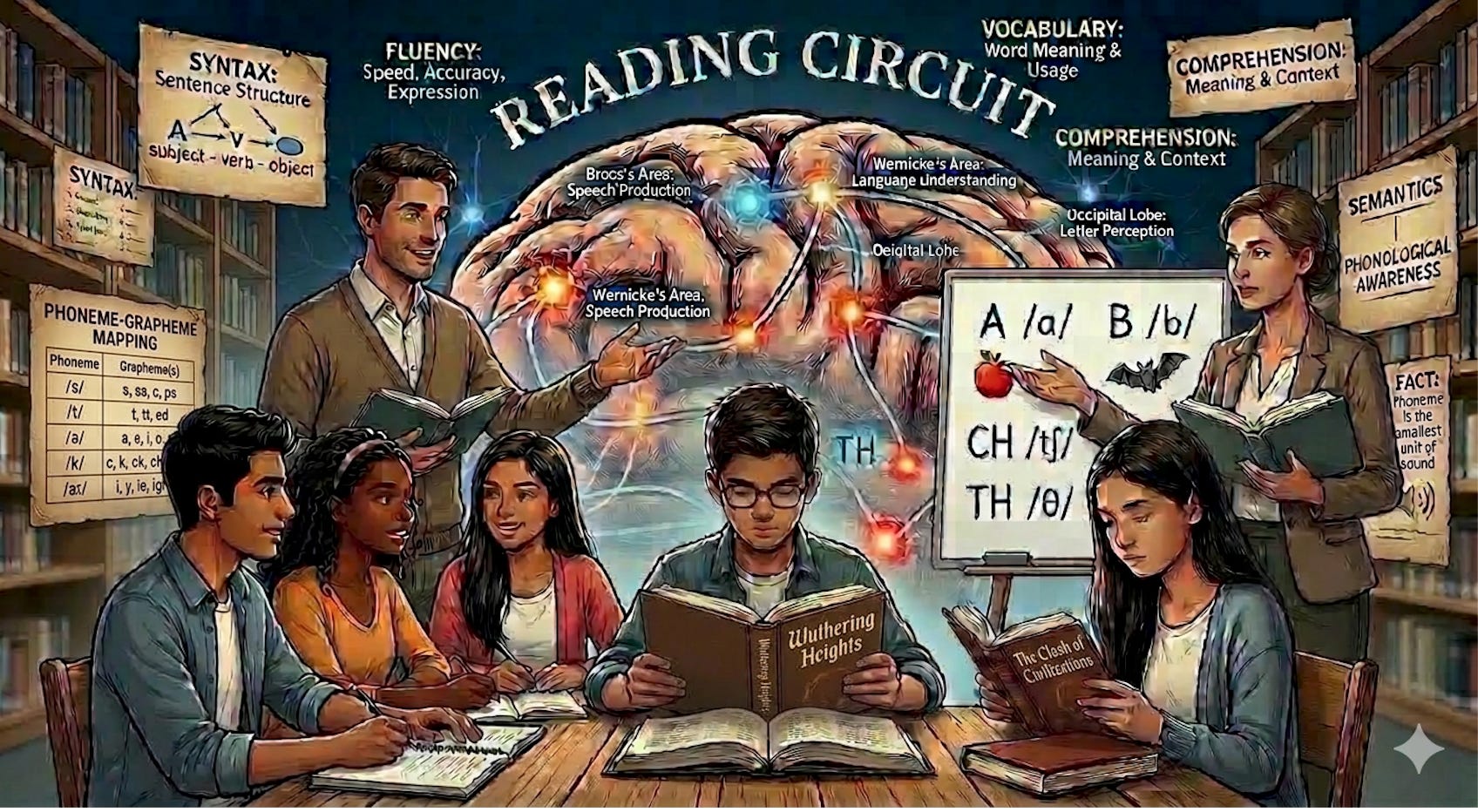
Reading requires that (a) the individual sounds constituting spoken works (phonemes) be linked—or bound, as the neuros say—to the written symbols representing those sounds (graphemes) and (b) that link must be linked (bound) to meaning, i.e., the language’s semantic system. Literacy is at the very least difficult without those connections being made in the brain. Direct, cumulative, systematic and explicit instruction, while no guarantee, increases the likelihood these connections will be made, thereby enabling individuals to read. Ongoing language development and knowledge growth, even as those bonds are being forged, and continuous reading engagement will contribute to continued reading development, which itself will contribute to continued linguistic, cognitive, and affective development.[1]
Our failure to come to a common understanding about matters for which the evidence is so strong is an enormous disservice to our students, even if not exactly a war.
• Everyone acknowledges the need for phonics. This is probably true. But the issue has shifted over the past 60+ years, give or take a century or two. Noah Webster, colonial and early American champion of an American dictionary and a speller for teaching reading, was a phonics man. He developed a syllabary for teaching children to read, a “bottom up” approach that taught the smallest units of sound-symbol associations first, then built up to words and texts. Horace Mann, in contrast, founder of the “common school” and Webster’s junior by about 40 years, favored the whole word method. He argued that reading was a meaning-based activity, and therefore teaching children to read should focus on meaning rather than the tedium of “sounding out” letters to identify words.
The challenge to “phonics” from the meaning perspective has undergone a fair amount of shape-shifting since the early 1800s. The “whole word” method gave way to “whole language” in the 1970s, which then became “balanced literacy,” or “three-cueing,” in the following decades. All three accord a role to phonics, but it’s inadequate, and they have been largely discredited if you pay attention to the entirety of reading research.
Efforts to revive their status as legitimate approaches to teaching reading have been driven recently by attempts to discredit the so-called “science of reading.” A good example is an unfortunate “monograph” by David Pearson and Rob Tierney, Fact-Checking the Science of Reading: Opening up the Conversation. Pearson and Tierney created a strawman version of the “science of reading” then gleefully attempted to obliterate it. If anyone wonders whether the reading wars exist, they should read this martial monograph.[2]
So, yes, at some level everyone agrees there is a need for phonics. But the question has become more subtle and complex. Balanced literacy and three-cueing advocates argue that phonics is just one of several equally valid options for learning how to read words. There are different flavors and labels for the same basic idea.
For example, Lucy Calkins popularized something called “MSV,” which is an approach to teaching children how to read words known as “multiple sources of information.” MSV stands for meaning, syntax, and visual. Phonics is presumably addressed in the “visual” part. But this is incomplete from the gitgo, since phonics is not simply seeing and recognizing letters but instead involves linking the visual to the auditory.
MSV is a cynical instance of “bait and switch.” Bait with a new term (MSV) but switch to “3-cueing” or “balanced literacy.” All three are variations on the “whole language” theme. By around the 2010s, give or take, balanced literacy/3-cueing had developed a bad rap. But Calkins and others kept the same basic concept intact—it had a huge following and still has a considerable one—and replaced it with “MSV.”
On the English Learner side of things, advocates didn’t even bother to re-label 3-cueing. Prominent English Learner advocate Kathy Escamilla, for example, in a 2022 webinar acknowledged the many criticisms of 3-cueing, but then boldly stated, “We have evidence that 3-cueing might be essential for bilingual kids.” To my knowledge no such evidence exists.
So, yes, everyone accepts that phonics has a role to play in teaching reading, but the essential questions are what role it plays, at what points in reading development, for whom, how prominent should phonics instruction be, and how does it fit into a comprehensive approach to reading instruction.
The neuroscientist Stanislas Dehaene has provided a profound insight, that the neural connections created by learning to read, and being taught to read, give us “the ability to access the spoken language system through vision.” Until we can access language—written language, aka print—visually, we can only access it orally. The vital connection is linking aural sounds to visual symbols, which then provides access to language through reading, which then further contributes to language, knowledge and other good things.
• Political reframing and getting the details right. Karen Vaites and others (including someone who backchanneled me) expressed dismay at Linda Darling-Hammond’s “political reframing,” meaning her apparent shift on the “science of reading.” Or as this other person put it, “she has not been an active proponent,” but now she wants to be “at the front of the train.” I can only say that people have a right to change their minds, and in this case I more than welcome it. As for being at the front of the train, no objection from me. She or anyone can be the engineer as long as they head in the right direction and stay on track.
Karen also says that Darling-Hammond gets some important details wrong. This is one of the challenges in this field and so many others. There are lots and lots and lots of details, compounded with lots and lots and lots of concepts. Not everyone is interested or even able to follow the debates and disagreements and come to informed judgments independently. So we rely on people we assume/hope are sufficiently expert and reliable. I know I do this with the neuroscience. I can’t make heads nor tails of brain scans; much less can I engage in evaluating that research. But I have reason to think that Stanislas Dehaene, Ken Pugh, Mark Seidenberg, Maryanne Wolf and others know what they’re talking about, in addition to the fact that the findings they report converge with classroom and instructional research, which I can evaluate independently.
So we must persevere to get this right, yes. The stakes are high, even if reading education doesn’t get the attention it deserves, distracted as so many of us are by the unspeakable things going on here and abroad at the instigation of feckless political leaders. We must do better, and as Karen says, with the wish that “people were less sharp-elbowed about these things.”
As always….
and, if you haven’t already,
for free.
[1] I won’t belabor the evidence here, since it is readily available in other posts on this Substack and many other sites, e.g., Evidence Advocacy Center, Colorín Colorado, Reading Rockets, Reading Universe.
[2] If you’re interested in my reply, see What “Science of Reading” are Tierney and Pearson actually fact-checking? And if you’re really into it, see here, here, here, and here.
No posts
Comments
Nothing yet. Say the first thing.
Sign in to join the conversation.