
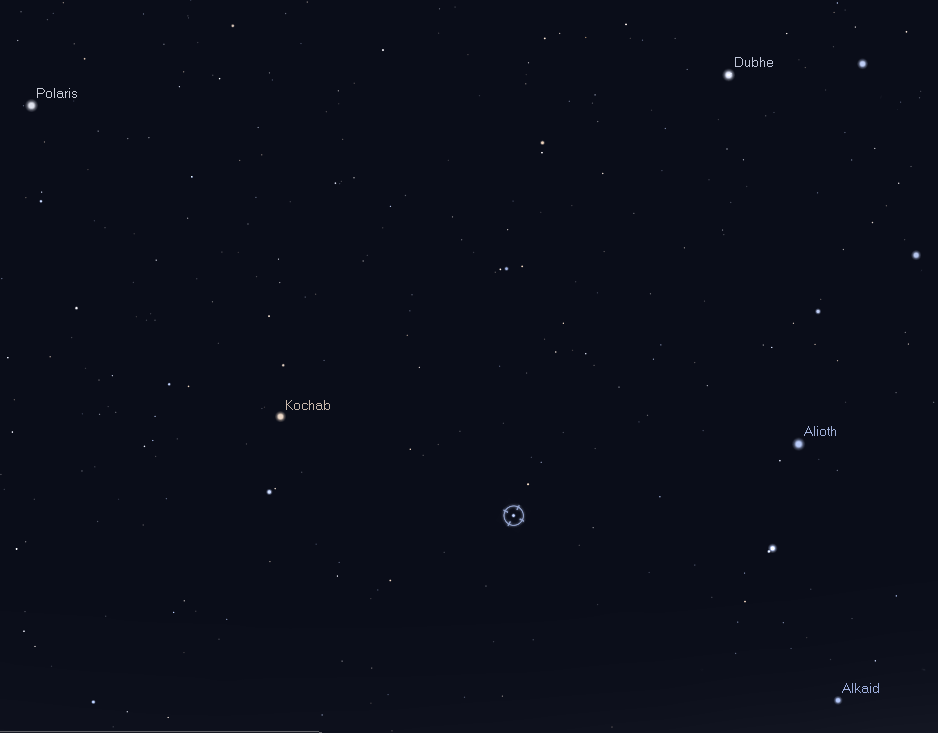
Cover Photo - Thuban, Polaris and Dubhe
Welcome to Issue #52 of The Classroom Astronomer!
Sky Lessons - Observing Keplerian Laws in Action, Part 2; More Jupiter/Saturn Moon Simulations
Last Free Post of Exploration of the Universe with Big Data - What Objects Are We Looking For, and Where?
In The Galactic Times #104
In this Issue of The Classroom Astronomer we’ll see the second of two articles in the Sky Lessons column you can use to teach about Kepler’s Laws. We will be using our Calendar and the Moon and Sun. Some new Jupiter moon simulations, useful for observing planning as well as for the Kepler’s 3rd Law demonstration from the most recent TCA Issue, is also shown.
The second and last free-to-all post on the Exploration of the Universe with Big Data postings is here (and in The Galactic Times). If the previous article was the stage setter, this article is the cast and sites of the action. We will talk about what stars, both known and unresearched, we will look for data and in which Big Data datasets we will look in.
Enjoy!
Dr. Lawrence Krumenaker, Publisher
Email: newsletter@classroomastronomer.com
Website: Classroomastronomer.com
In the last issue of The Classroom Astronomer we detailed the discovery by Johannes Kepler of three laws of planetary motion, all based on the observation that elliptical orbits, with the Sun NEAR but not in the geometrical center of the ellipse, made predicting where the planets would be in the sky much more precise than the ancient geocentric circles/spheres did. We then explored the last of the three laws, the Third or Harmonic Law, that found a mathematical relationship between planetary distances from the Sun and their orbital periods. An exercise using real or simulated observations of Jupiter’s moons was shown with which students could explore this and see that the law was universal, not just Solar System planets and the Sun.
Several simulations were pointed to for Jupiter and Saturn and their moons. Here is a list from Dr. Andrew Fraknoi on other simulations of this ilk online:
Exploring Kepler’s Laws of Planetary Motion (using a PhET simulation) – from the University of Tennessee: http://astrolab.phys.utk.edu/Lindsay_manual/kepler/kepler_laws_lab_v1.pdf
Calculating the Mass of Saturn (use Kepler’s 3rd law as modified by Newton) – from the University of Colorado Manual: https://www.colorado.edu/sbo/sites/default/files/attachedfiles/1010manual_s20.pdf (pp. 69-76)
Kepler’s Law and the Mass of Jupiter (from the motions of its moons) – from the New Mexico Institute of Mining & Technology: http://kestrel.nmt.edu/~dmeier/P327L_labmanual.pdf (pp. 58-61)
Kepler’s Laws of Planetary Motion II (Kepler’s Third Law applied to the moons of Jupiter) – from the manual by Huebner, Reynolds & Smith at University of N. Florida (Activity 17): https://digitalcommons.unf.edu/cgi/viewcontent.cgi?article=1000&context=aphy_facpub
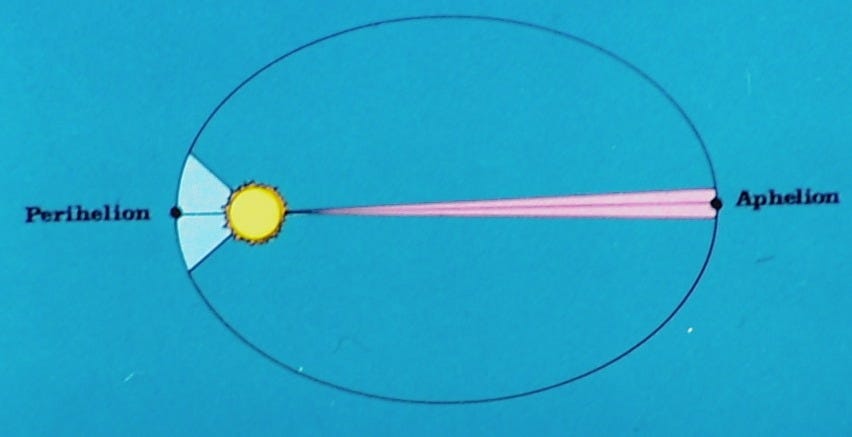
Kepler’s Second Law is also known as the Law of Equal Areas. Simply, the line from the off-centered Sun to the planet sweeps out a certain area in your choice of time period, no matter where in the elliptical orbit you measured that. As the Sun is off-centered, the planet would sometimes be closer to the Sun than at other times. As these swept-areas were roughly triangles, if the line from the Sun to the planet was shorter than average (i.e. the circular radius others expected) then the planet had to have a larger (albeit circular arc-segment) base to have the same area as when the planet is farther than average. But since the times of each triangular sweeping is the same for both, the planet had to move faster when closer to the Sun, and slower when farther, to get those areas the same.
How can you prove that observationally today? Surprisingly, simply. And in two different though similar ways.
First, our annual calendar is based on the Sun’s yearly path in the sky, but instead of dealing with what stars it is in front of, we deal with with positions caused by our Earth’s tilt. In a circular orbit, the time between solstices (when the Sun is at its highest or lowest celestial positions in the sky) and the midpoint (Equinoxes) when it crosses the celestial equator exactly between North and South Poles, should be identical. One can also look at this as in ‘what dates are the Sun, Moon and Earth lined up straight or making a 90-degree angle with the Earth at the vertex (for phases of Full, New, and the Quarter Moons) or the Sun at the vertex, and the Earth aligned with the major axis of the Earth’s elliptical orbit, or at a 90-degree angle?’
The solstices and equinoxes are not precisely lined up with the closest (perihelion) and farthest (aphelion) distance dates. The June solstice is on the 21st, normally, but aphelion—farthest distance position and date—is around July 3rd, a bit less than two weeks apart. Ditto winter solstice and Perihelion. But these are close enough not to be a source of critical error in testing the hypothesis.
To do this yourself, get any year’s Calendar and count the number of days BETWEEN solstices and Equinoxes. You have four such measures to make. For clarity, do NOT count those actual dates of solstice and equinox. In this example, we begin with the December 2024 solstice….
December solstice (21st) to March equinox (20th)— 88 days between them, not counting those dates themselves
March Equinox (20th) to Summer Solstice (June 21st) — 92 days….
June 21st to Autumnal Equinox (September 22nd ) — 92 days ….
That Equinox to the 2025 December solstice (21st) — 89 days ….
Obviously, it takes longer centered on that time frame around the Summer Solstice than the Winter one (Northern Hemisphere bias here). And thus we are moving slower in getting through those two quarters of the year. At that time Earth is at aphelion, our farthest distance from the Sun. It takes longer to sweep out that line, or in an easier observation, the quarterly motion of the Sun from North from South (or the other way, too). We move faster, take fewer days, at year start/end. So in winter up North we move faster, must be closer to the Sun (despite the chillier weather!).
To show this Law is universal, we can use the Moon’s hypothesized elliptical orbit. This time we use the time between New and both Quarters and Quarters and Full phases. Let’s use the last complete cycle of 2025, the November 28th First Quarter to December 27th First Quarter….
First quarter Nov. 28 to Full December 4th—days between them number 5.
Full to third quarter Dec. 11th — 6 days
Third quarter to New Moon Dec. 20th — 8 days between them.
New to next first quarter Dec. 27th — 6 days.
When is apogee, the lunar equivalent of aphelion, when it moves slowest? Somewhere around mid-December, in fact, the 17th. When is the Moon closest to us, perigee? Around the beginning of the month, in fact, December 4th.
Note, though, that these are NOT the same dates/lunar phases combinations six months earlier (or later). The Moon’s orbit compared to the stars has its perigee point pointing almost exactly the same place in this different time periods (though it DOES change over a short period of years). But the PHASES are relative to how the Earth, Moon, and Sun are oriented in space and as the Earth moves around the Sun (see the first part of this story!) those phases’ orbital positions change. Sometimes the Sun is ‘in front of the two other bodies’ and sometimes ‘behind’ when compared to the Moon’s ellipse. As a teaching exercise, prove that by calculating May-June phase cycles as we did above. The dates will be approximately the same time of the month for apogee and perigee but not the phases seen.
Finally, why are the Solstices NOT aligned with the perihelion/aphelion/major axis line? Partly because of the orientation of the Earth’s axis. It simply doesn’t point in the same direction of that axis. Second, as mentioned in an earlier article about Solstices, there was a ten-day shift in the calendar dates back in the late Renaissance.
In this last free-to-all article, the discussion will turn to the sample objects we will be using as examples of getting data, and a first list of all those datasets we will explore.
As mentioned back at the start of this Exploration, the author is engaged in two broad projects, each with two sub-projects within them. The first project is needing data for stars mentioned in astronomy books being worked on. The second is looking at unusual stars the author discovered back in the 1970s, some published in scholarly journals, some as yet not.
And as discussed in the last Exploration article in the January 1st issue of The Galactic Times and The Classroom Astronomer newsletters, it boils down to getting data on star magnitudes (brightnesses), locations (in various coordinates and distance), and color, i.e. photometric colors such as U-B or B-V or equivalents, and spectral type and/or odd characteristics in the spectra. Motions will be helpful, too.
Let’s look at all the projects and their stars, one by one.
Federation Space - A Star Trek Astronomy Book
In this book, based initially on an article in The Classroom Astronomer (TCA) and exists as a dated but still accurate but now a bit incomplete mini-poster available in the Hermograph Online Store, more than 50 stars exist in the real universe as well as the fictional one of the franchises of Star Trek. Among them are three stars of note:
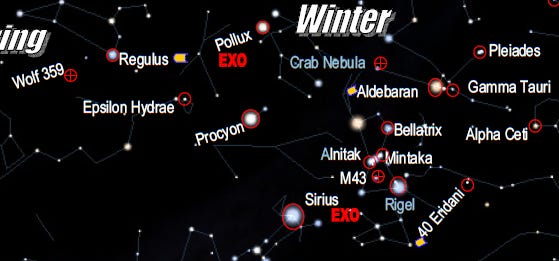
40 Eridani (Omicron-2 Eridani) is the home of the fictional race called the Vulcans.
Aldebaran has at least three planets in Star Trek. We wonder if there are any exoplanets for real. It is also visible in the current night sky (as is 40 Eri but Aldebaran is much easier to find).
Wolf 359 is the site of a pivotal battle in Star Trek: The Next Generation. It is a small red dwarf not far from the Sun, and not visible to the unaided eye but is telescopically in the early spring sky south of the main part of Leo the Lion.
Learning Astronomy Under the Northern Skies
This book is meant to be a 365-night resource for learning about astronomy. Three important stars used in this book include:
Polaris, (Alpha Ursa Minoris), the North Star. An F-type star, it ranks approximately 50th in brightness but is nearly stationary in the sky near the North Celestial Pole. It is slightly variable, and may have been fainter in the past. It is also a binary star.
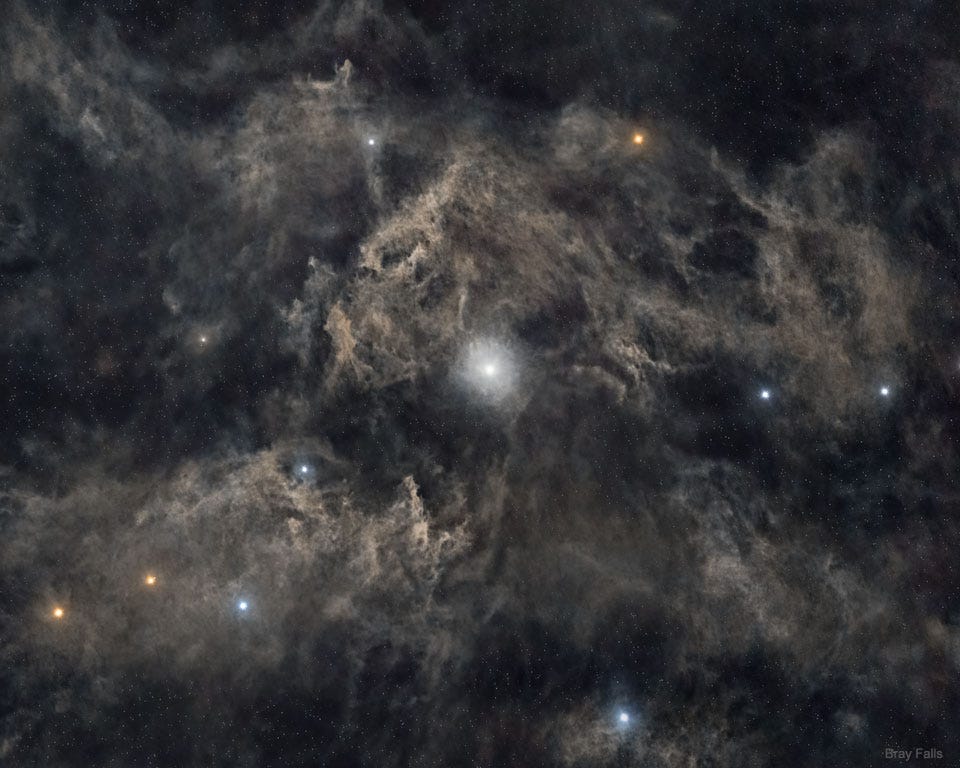
Thuban (Alpha Draconis). Even though it is NOT the brightest star in Draco the Dragon, it is historically important. Several thousand years ago, IT was the North Star.
Dubhe (Alpha Ursa Majoris). An orange star marking the top front edge of the Bowl of the Big Dipper. It is not an actual member of the Ursa Major star association but is traveling independently of most of the Big Dipper’s stars.
The locations of all three stars are shown on the map in this Issue’s Cover Photo.
Carbon, S- and H-alpha Emission Line Stars 1
At the beginning of his professional astronomer career, as an undergraduate and graduate student, the author searched numerous wide-field Schmidt telescope photographic plates in which a thin prism covered the telescope opening so that all star light became tiny spectra (in black and white usually as color films were pretty but not useful). There was a filter in the way so that only the area around the red Hydrogen Alpha Balmer line (H-alpha for short) would make it through.
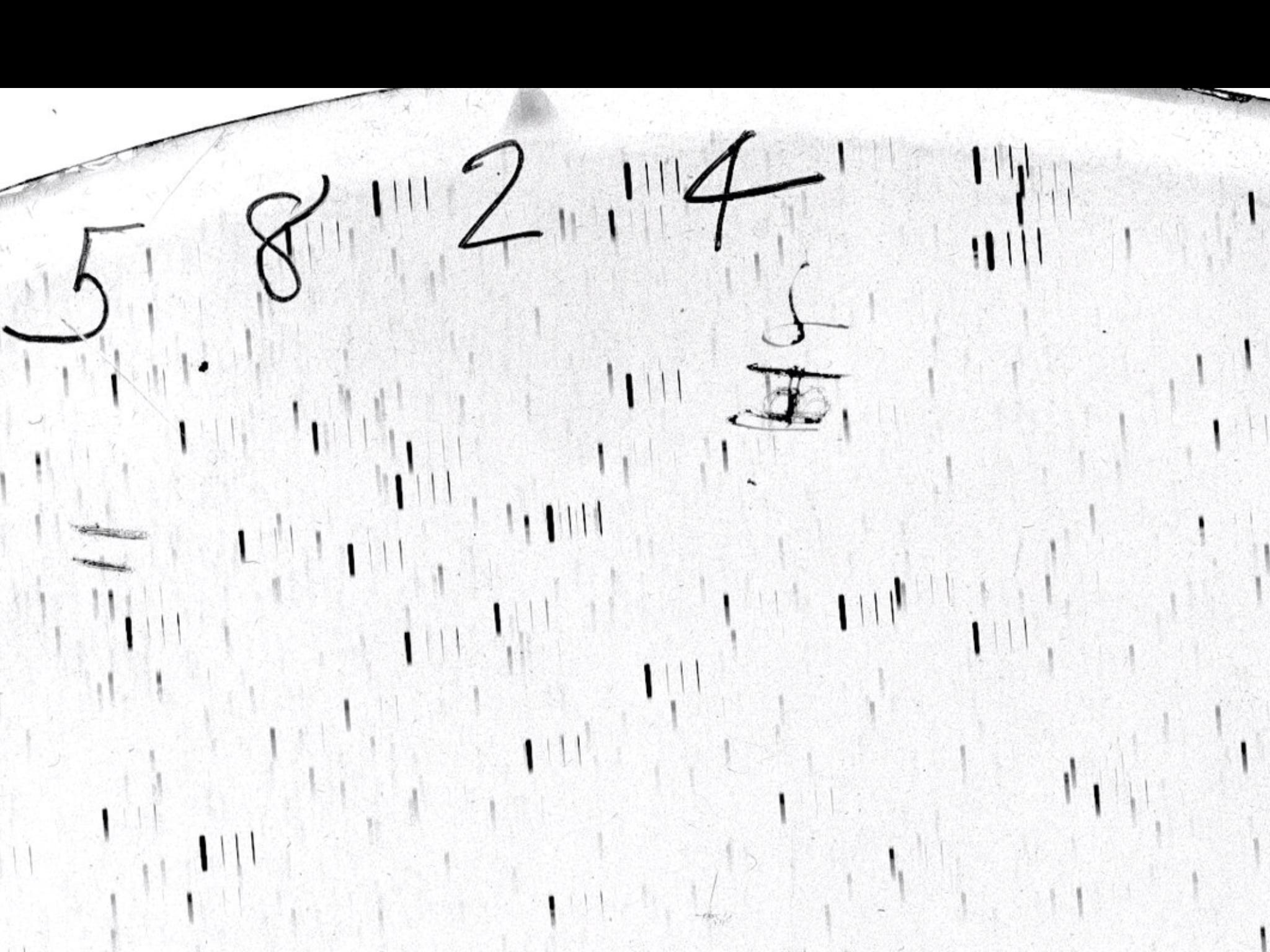
In most normal stars, H-alpha would be a dark absorption line in a bright continuum background. If there were a large quantity of Hydrogen gas above the star’s surface, that gas cloud might be forced to glow and put a bright emission line in place of the absorption line. A common example would be a Be (e for emission) spectral class star. But in some cooler temperature stars, Hydrogen is poorly, if at all, visible but certain molecules would present their absorption lines, usually much broader than H-alpha. (If you huntin the above photo, you can find some of them!) A star with a lot of carbon molecules in its atmosphere would present its bands and thus be called a Carbon star, with two sub-types, C and N stars. Stars with Zirconium Oxide would be called S-stars.
Many carbon and S-stars and stars with hydrogen emission lines arre often variable in brightness, too.
Two short articles in the Publications of the Astronomical Society of the Pacific detailed the first sets of discoveries of these stars, 16 in all.
Three objects have been picked to explore in the Big Data sets:
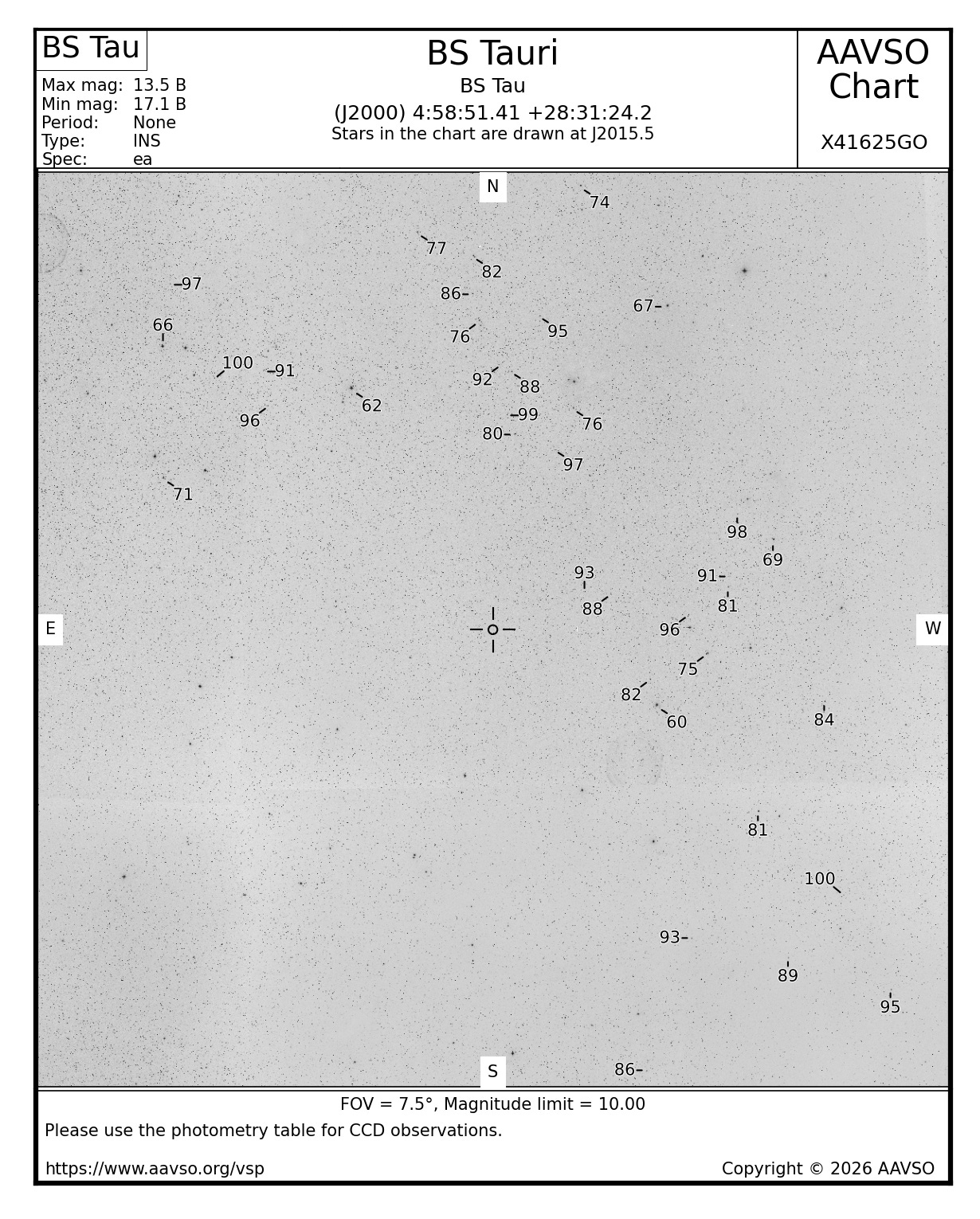
BS Tauri (BS Tau) is a star that was found almost a century ago and classified as various kinds of Irregular Variable star. But looking over a near-century of Harvard photographic plates (non-spectra, looking like dots in a sky photo), the author found there was an approximate 6 year periodicity when the star would disappear. It could be due to an inclined dust ring occasionally blocking the star light, or star spots, or an eclipsing type of companion. It is desirable to see if the periodicity still holds, and in all colors as that will help determine the cause of the dimmings.
An article by this author on this appeared in later years in the Journal of the AAVSO.
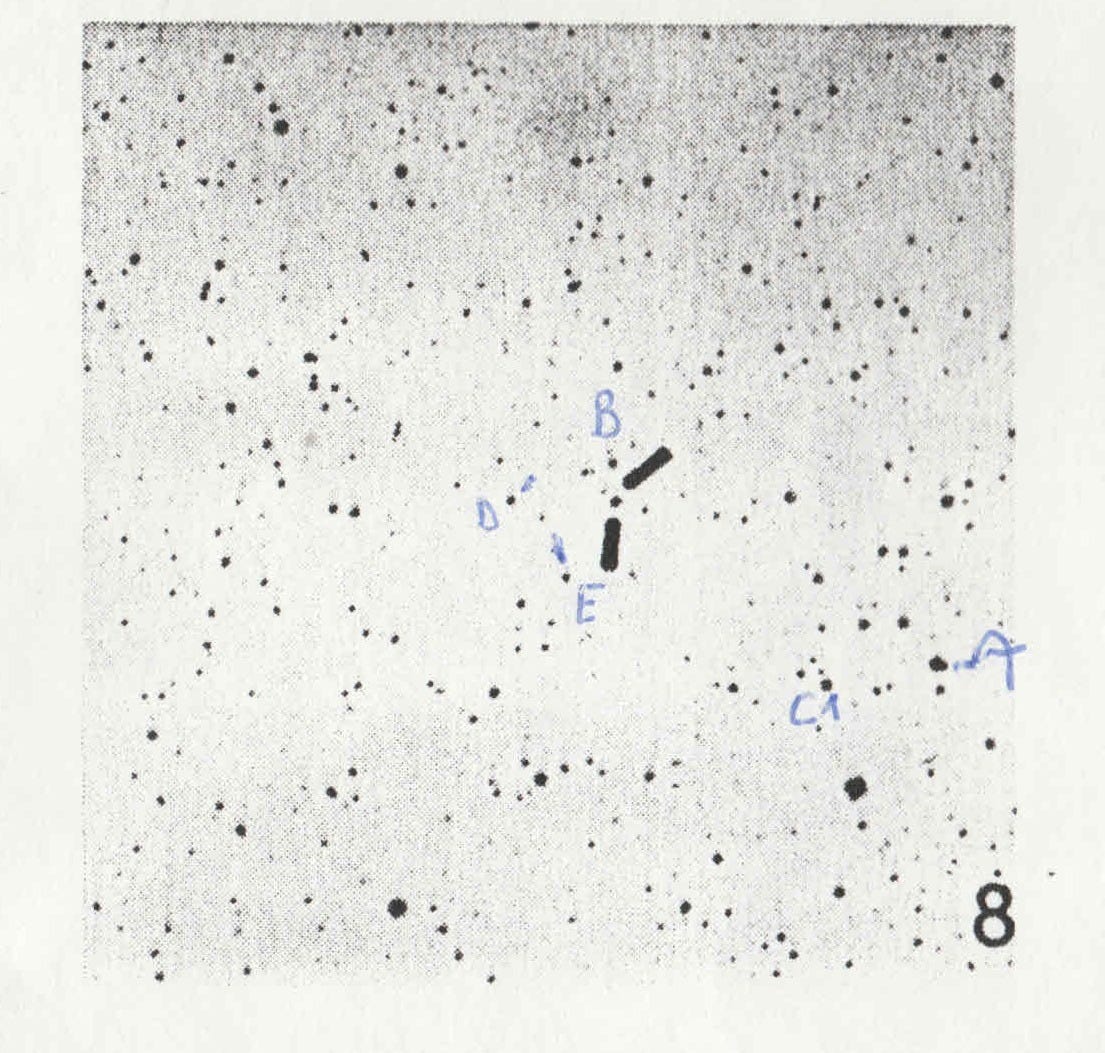
The second star is called K8, a carbon star that showed evidence of possible variability. Some stars near it were used as a set of standard stars but there is not yet enough evidence to see if it is variable in fact.
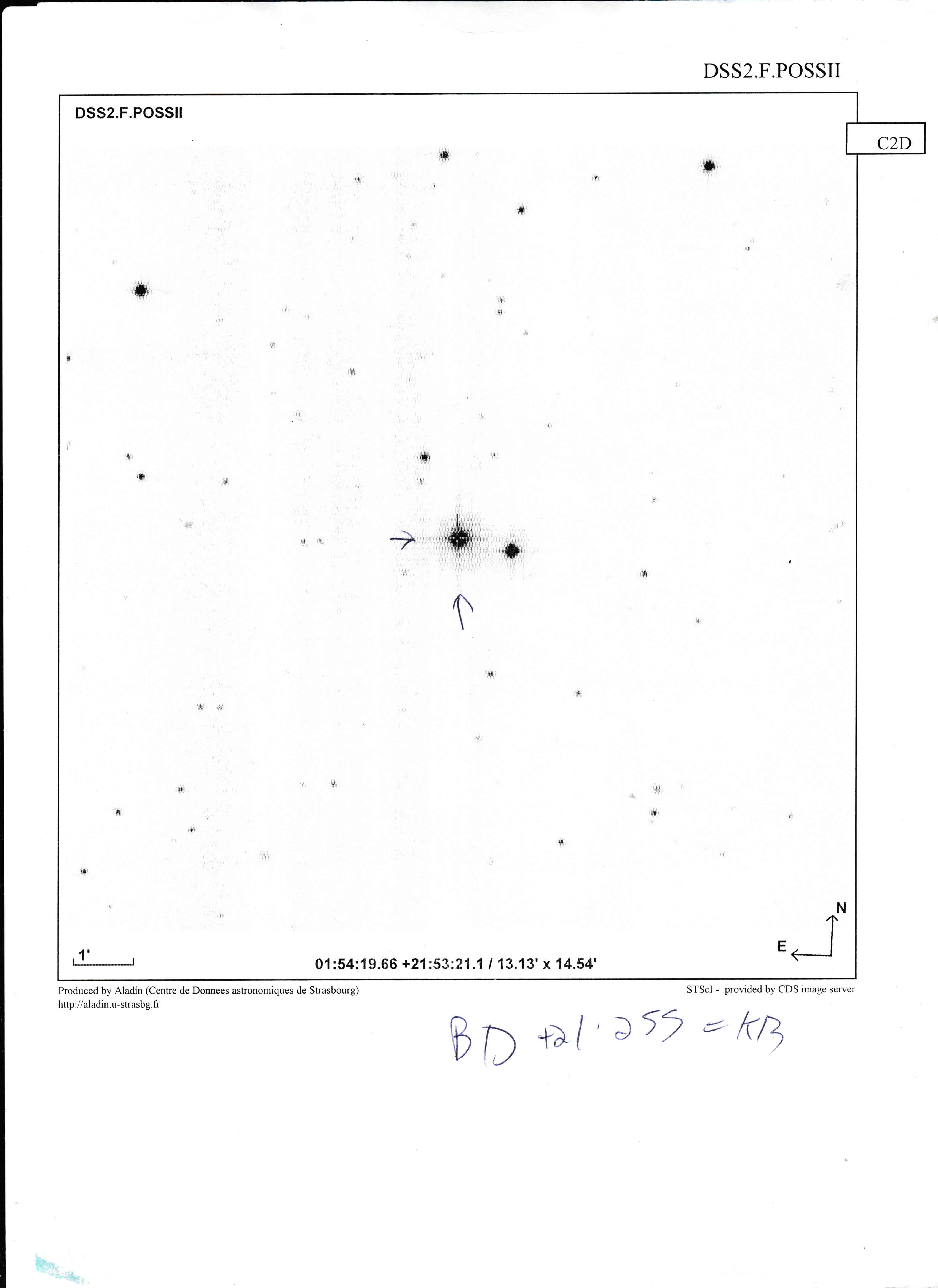
The last star is actually rather bright, enough to have been cataloged as a 9th magnitude star in the 19th-century Bonner Durchmusterung (BD) catalog of the Bonn Observatory. Officially star BD+21d 255, it was cataloged as star K13 in the author’s published work. It appears to be a pulsating variable star.
Carbon, S- and H-alpha Emission Line Stars 2
The last set of stars is unpublished data from the same era. All 9 of these are similar to the published set in that they were C, S, or H-alpha emission stars.
The only one to be looked at here is a very dim star provisionally named KU-11. Spectra has been obtained but nothing else. However, some variability seems to have been seen by others and the star may be a Mira-type Long Period Variable (LPV).
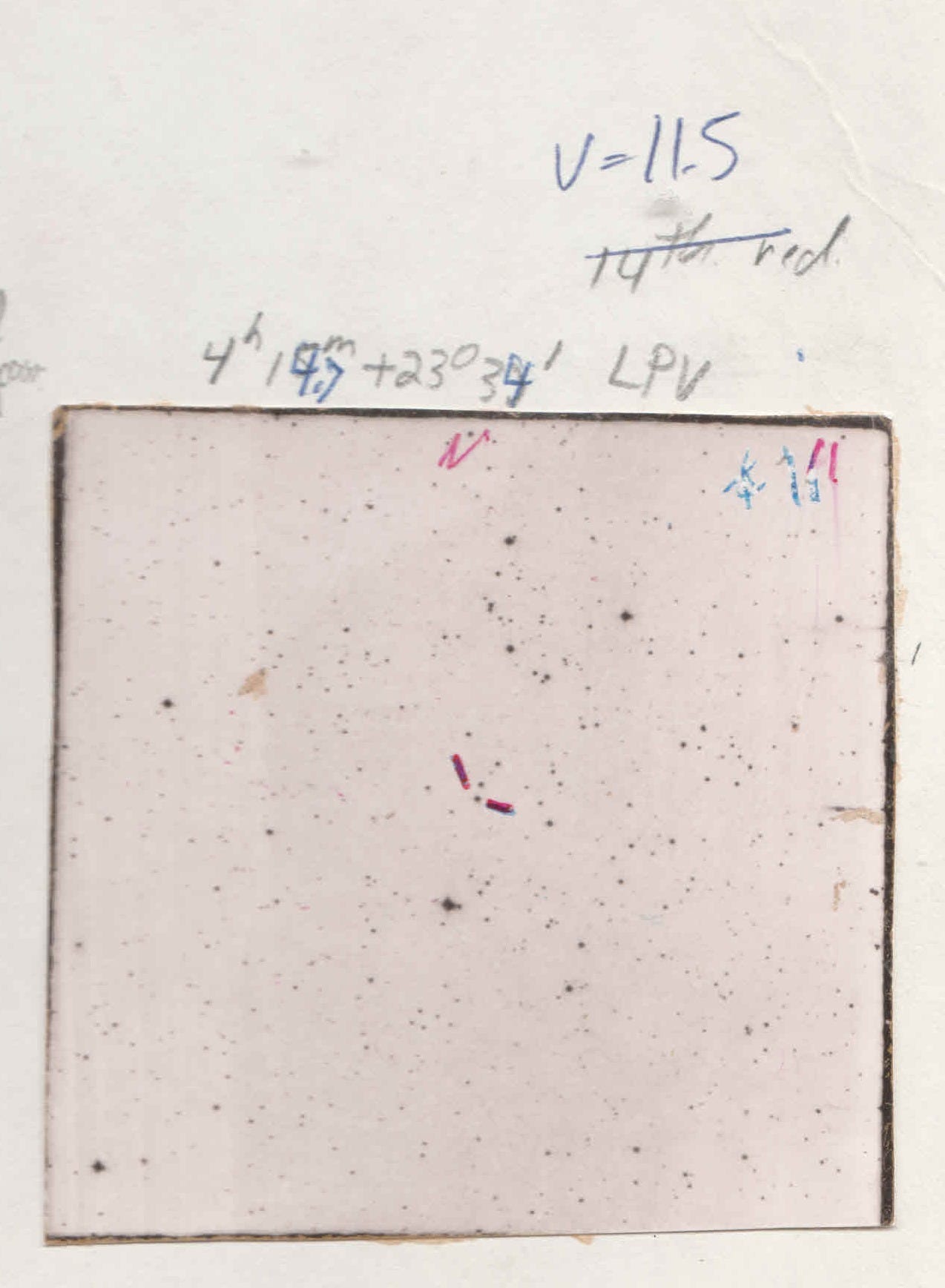
Stars like the K and KU stars have an additional problem to solve, initially, unlike Wolf 359 or Polaris. They need better identifications and current exact coordinates measured from maps, rather than searching by names. That is a skill that needs to be confronted in the data sets. Some datasets can make a map online from the stars in its records. Stars have coordinates listed in 1900, 1950, and in some cases, 2000 epochs, and all these have to be, um, coordinated with the observations from the observatories and space missions. The coordinates slowly change over time because of the Earth’s precession—the wobbling of the Earth’s axis. Maps are standardized to an epoch (year) every 50 years but the coordinates drift and need correction in between. It might be trial and error.
- - - - - - - - -
Where will we be going to find these stars? The following provisional list of Big Data sets is:
*Gaia *SDSS *VRO-(LSST) *EUCLID
+TESS +Kepler (MAST)
Pan-STARRS ASAS Catalina Chandra DESI VLASS WISE IRSA IRTF
NED ZTF
Those with an asterisk (*) are our first, primary data sets that will be explored and are largely visible light star surveys. Those with a plus sign (+) are hunters of exoplanets among the stars. Others in the list may be visible light, infrared, ultraviolet, X-ray or radio missions. We’ll tackle them later. NED is a galaxy archive, ZTF looks for transient phenomena, like novae, asteroids, and others.
See you in February!
- - - - - - - - -
If you are interested in this Exploration, you will need to subscribe as a PAID, or more nicely, a PREMIUM subscriber. It is $40/year, or $7.50/month.
I want to thank those persons who have signed up as Paid Subscribers to join me! The Chat is now open and pay-walled for Premium members only. If you are a Paid Subscriber, please introduce yourself on the Chat and mention any objects you plan to … Explore!
In the next, Paid, issue of both The Galactic Times and The Classroom Astronomer, the Exploration will begin, by using Gaia and several online tools to identify the coordinates, any other research history, and names if any of the stars shown here.
Dr. Larry Krumenaker, Publisher
The Classroom Astronomer Newsletter is a reader-supported publication. To receive new posts, subscribe and get the issue in your email inbox, rather than waiting a few more days for it to be posted on the website. To participate in the Exploration of the Universe with Big Data project, become a paid, Premium subscriber.
Cover Photo — Thuban, Polaris and Dubhe
Welcome to The Galactic Times Inbox Magazine Issue #104
Sky-Lites — Jupiter and Saturn Are All There Is; A Difficult Conjunction of Mercury and Venus
Last Free Post of Exploration of the Universe With Big Data —The Objects and the Data
In The Classroom Astronomer Newsletter #52
This newsletter is (c) 2026 Hermograph Press LLC, Opelika, AL. All rights reserved. No part of this may be reproduced without permission in any other medium, such as newspaper columns, webpages, blogs, etc. Please contact the undersigned for permissions, etc., and please do not feed the hungry lawyers…….
No posts
Comments
Nothing yet. Say the first thing.
Sign in to join the conversation.