
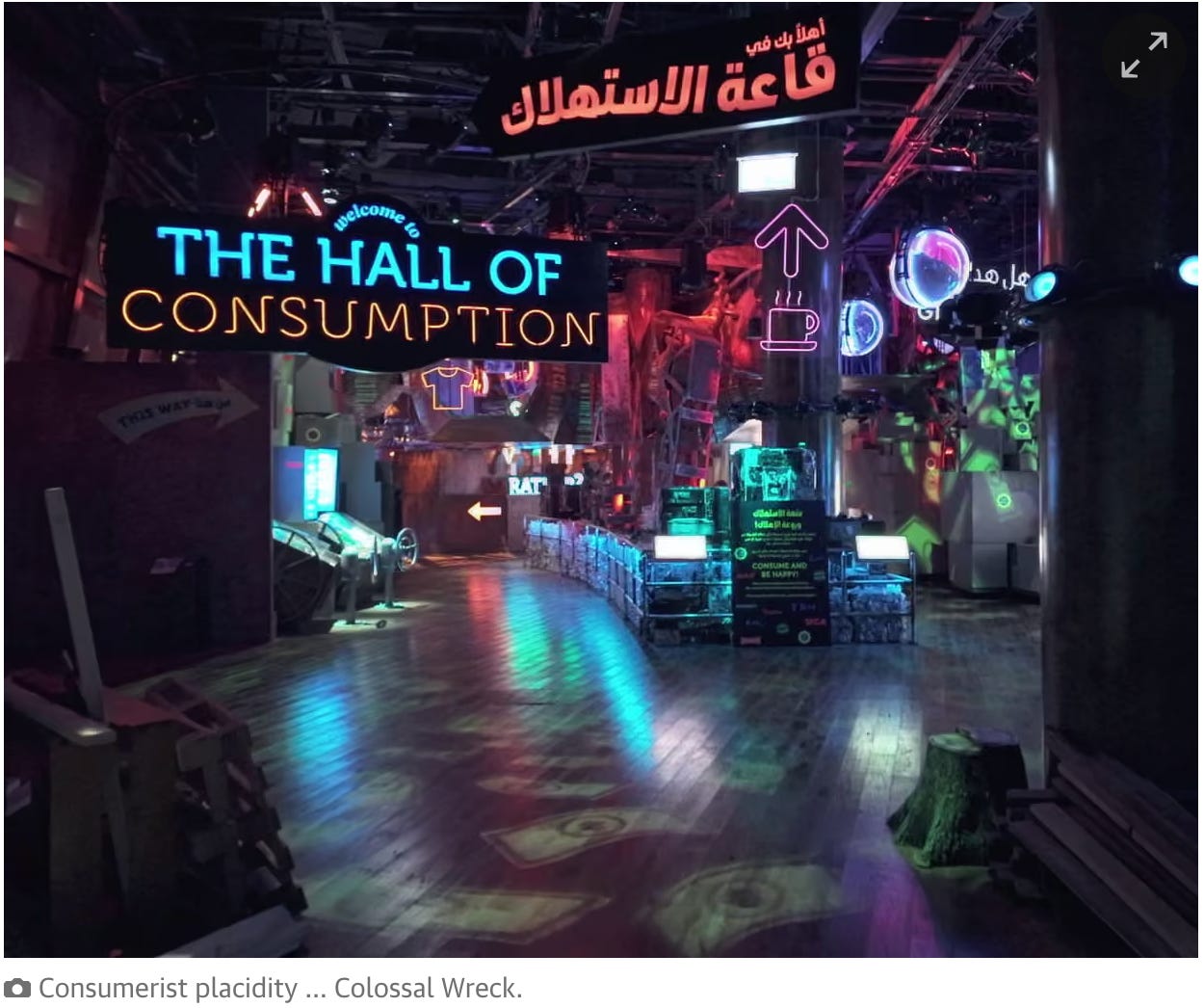
Late last year I sat on a panel with our friend Josh Appignagnesi to discuss his film, Colossal Wreck.
It was shot from inside the COP28 climate conference in Dubai, where Josh wandered with his phone on a selfie-stick, coming face to face with oil barons, lobbyists, indigenous activists and negotiators in a techno-utopian leisure city that, as Josh says, “happens to be built in a burning desert.”
At an earlier screening of a rough cut of the film, we’d talked about what improvements could be made. I remember reflecting then that a combination of the COP process, mixed with the actual horror of both climate breakdown and the utterly tragic outcomes from decades of international negotiation, meant that his film was the most realistic real-life horror film that I could imagine watching. I described it as utterly fucking horrific, which I think was possibly one of the best compliments Josh had ever received. He was obviously delighted at the time!
I hadn’t seen the film since it had been finished, so I was glad to go to a screening and reflect again – not only on the film, but also on the situation we had found ourselves in as a result of abject failure to tackle the climate crisis.
The night of the screening I travelled to a neighbourhood on the other side of town from where I lived, and I shared my popcorn with David Baddiel, no less. I’d been under an enormous level of stress throughout the year through work and personal circumstances, which probably wasn’t helped by the subject matter in the film, which Josh visualises so brilliantly: an impending dread over which you appear to have very little agency.
And that agency is even less now, given that the criminalisation of protest has prevented people from taking meaningful direct action, collective demonstration and organising. (As Anthea Lawson writes this week in her substack, “since 2019 more than 280 peaceful protesters against genocide and fossil fuel hegemony have served prison sentences in the UK. This is not normal.”)
But for me this issue of agency, especially in relation to us first knowing and then being able to do something about the systems of technologies around us, is what is at the heart of why Josh’s film is so fucking horrific (and so good).
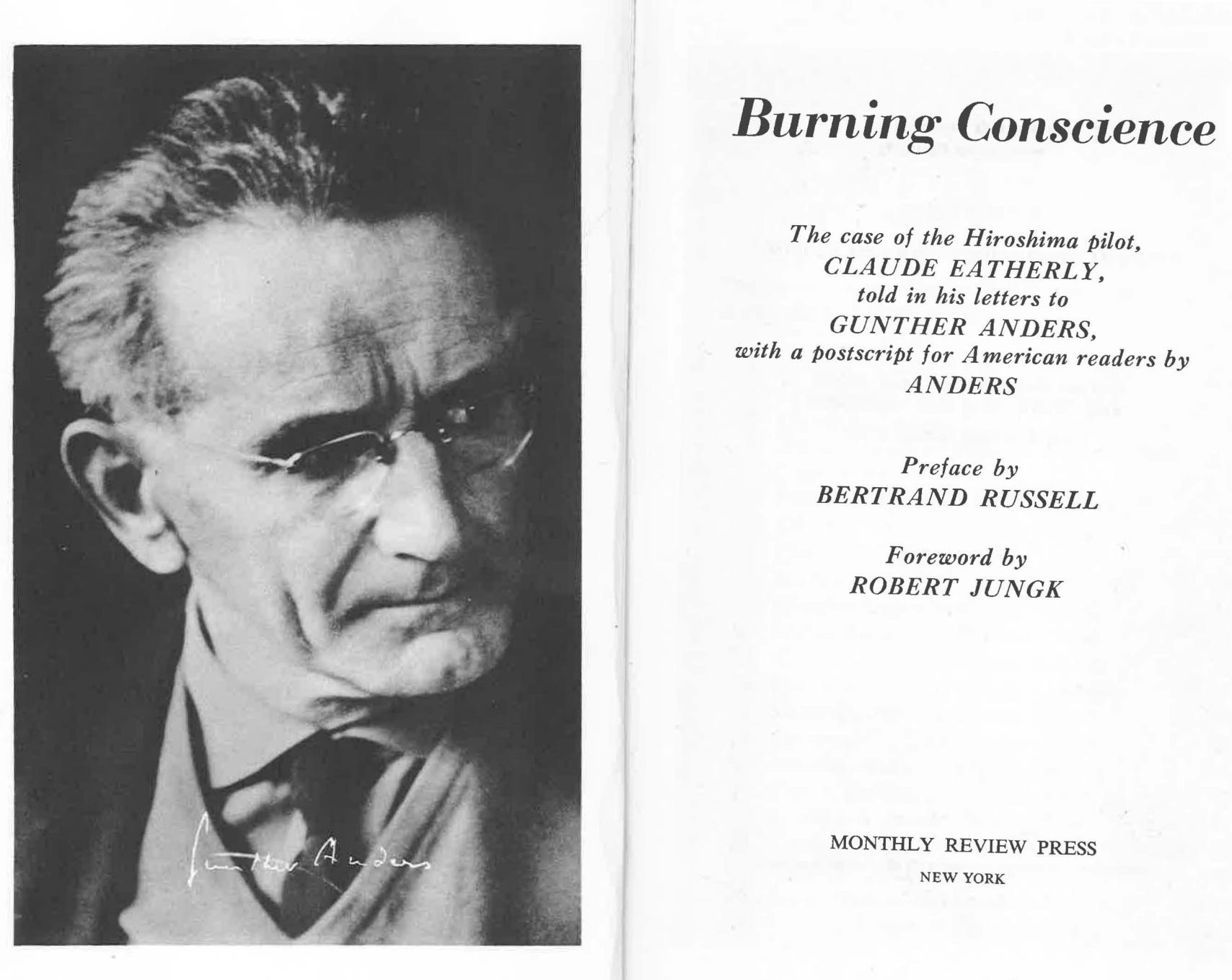
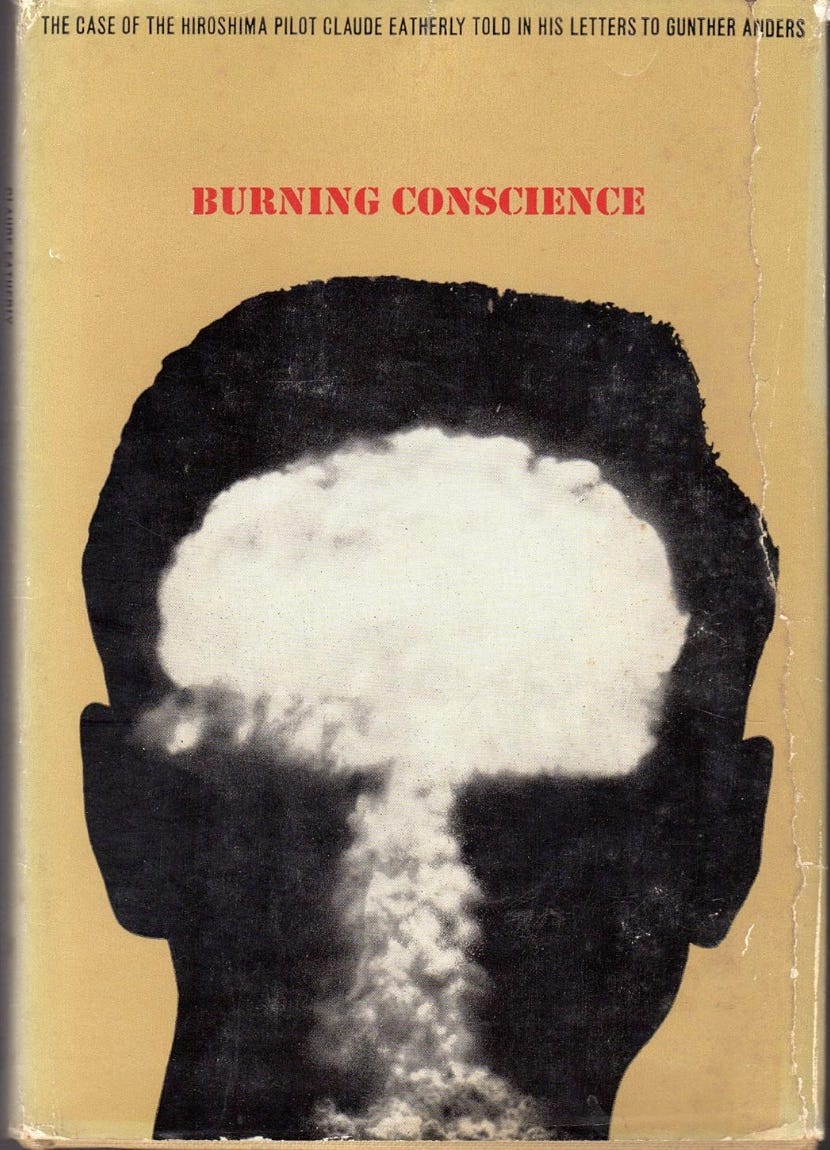
One of the books that I’d been reading recently – Burning Conscience – sprang to mind during the screening, as we were discussing the COP process and the climate crisis. Burning Conscience is a series of letters between the philosopher Gunther Anders and the weather plane pilot Claude Eatherley, who flew the weather plane in front of the Enola Gay before the atom bomb was dropped on Japan. The reflection in this book is that people simply don’t understand the scale of the technology they’ve invented, and therefore, of course, they can’t govern it well, and they can’t make decisions based on their understanding, because they don’t understand.
Eatherly was obviously horrified by what he had participated in unknowingly, simply by following the orders of the people who told him to go out and fulfil his duty that day.
Watching Josh’s film, it made me reflect that whilst we know a lot about the climate situation, the causes, and even the way it is economically tied into all of our lives and international affairs, and how the global negotiation has largely been deemed a failure by dint of the collective action problem, there is also a ratcheting system baked into the problem, around this awareness of the scale of the technology.
Whilst we produce more and more renewable energy, we don’t take the equivalent fossils offline; we simply add to the energy consumed in total. This is called the efficiency paradox, because whilst our energy consumption becomes more efficient and our energy production returns better energy on investment, we don’t reduce the overall amount. In fact, we are increasing the amount of energy we use.
And that’s because we have a problem of not understanding the way our technology really works. We understand it well enough to know what it does and how to make it do more of it with less effort. But we do not understand the human technology system that runs alongside it — which is a growth-based economy and an overall ratcheting system.
The problem then with not understanding our technology systems is that we can’t tackle the root causes because we’re dealing with things we don’t understand. We get sucked into processes we don’t see the scale of, until it is too late.
Claude Eatherly went “mad” and spent the rest of his life in and out of mental institutions. He was eventually trapped in one, because he became a threat to the U.S. Whilst the media and the government wanted to celebrate how the atomic bomb had “ended the war quickly for a major win for America and the rest of us”, Claude knew he’d done something so unforgivable, so unfathomably evil, and without giving his consent, that he couldn’t cope. He was desperate for the pain to stop. Gunther Anders recognized this response was not that of a “madman”, but the response of a morally healthy and sane human being overwhelmed by understanding the magnitude of his actions – and what the technology was capable of.
Eatherley became a lifelong anti-nuclear advocate. He tried hard to get people to listen to his lived experience and understand that indeed you cannot bomb your way to peace. He felt the lasting effects of the atomic megadeth were in the heads and hearts of Americans and the West, as much as the body-melting suffering was spread over the territory of Japan.
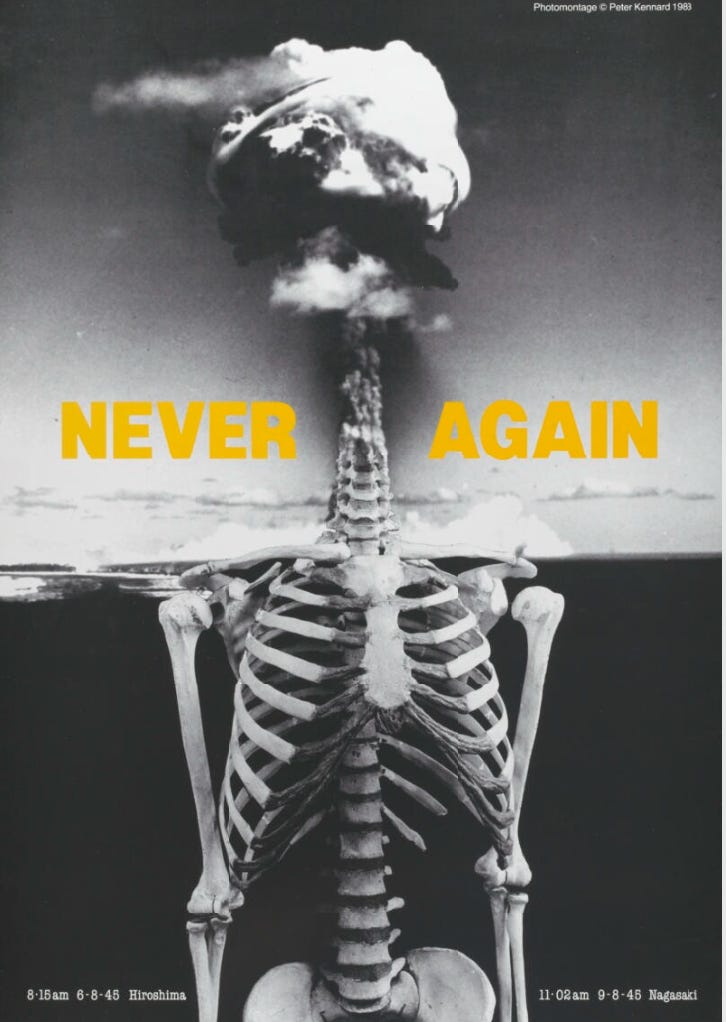
What happens when you decide that landing a single bomb in one place to brutally destroy hundreds of thousands of lives, is the new scope for technologically-driven violence? I still don’t think that we’ve really come to terms with what it is.
I’ve often said this about the climate crisis.
Because why should we expect ourselves to understand the crisis, if we can’t understand what the undoing of millions of years of evolution might mean?
For the planet-warming greenhouse effect, how could we understand what it means to dig up millions of years’ worth of sequestered carbon, spray it into the atmosphere over the course of just a few hundred years, altering the climate so much that the earth is warming a hundred times faster than it ever has in its history, undergoing a transformation that nature is not capable of producing by itself, and never has…
When you combine that with the wanton destruction of life and the foundations of life itself, both from biodiversity destruction, mass killing, and ecocide, and the spoiling of water and air, you can see that, in fact, we are very much in uncharted territory.
And this step into uncharted territory has been entirely facilitated by the development of technologies, which at the point of use we didn’t really understand, and we still don’t.
This is important, because the possibility of a reaction of humility to our circumstances seems ever more important.
If you don’t know everything and you act like you’re not sure, you usually make better choices than if you think you know everything, but have massive blind spots. It’s just basic risk management. Where there are gaps in your knowledge, at least you know that you don’t know, and you can tailor your behaviours accordingly.
But this is exactly what hasn’t happened.
Instead, we’ve been drunk on the cleverness of our science and the ways that we’ve found to dominate animals, nature, the living world, and humanity. This culture of systemic and technologically-supported domination is actually the same wherever we apply it: it’s the same culture so brutally applied to animals, to ecological systems, as it is used against human beings.
What humans are supposedly very good at is a thing called pattern recognition. We are supposed to be able to see things that happen repeatedly, and we quite literally make sense of the world by seeing things multiple times and agreeing that there’s a pattern and there’s something to be learned from it.
I’m trying to notice a pattern in our own ignorance. And I see it in our ignorance of the technical cleverness and human-supremacy that were the same in the creation of the atomic bomb and nuclear arms race, as I see in our ignorance of the technologically-supported domination of nature and the climate. I see it in the response of Claude Etherley, and I see it in Josh’s film – both being driven mad by the lack of understanding we collectively as humanity have about the technologies that are killing us.
This all seems to work in cycles. A sense of supremacy and hubris which leads to these kinds of outcomes. Because quite honestly, we’re just not that clever, and we need to be a little bit more humble about it.
The phrase ‘colossal wreck’ comes from the 1818 sonnet by Percy Bysshe Shelley, ‘Ozymandias’. The poem describes the fallen, broken statue of an ancient king lost in a vast desert. It has been called a meditation on the fleeting nature of political power and human pride.
It feels a very apt title for Josh’s film, the repeating cycles of madness that have come to be the COP process, what happened with nuclear weapons – and what’s happening now with AI.
If you want to watch the film, reach out to Josh here.

No posts
Comments
Nothing yet. Say the first thing.
Sign in to join the conversation.