
Welcome to the December CLAMOR! In honor of the holiday season, this month’s edition will explore sound’s power to connect us to one another, to ourselves, and to the Earth we share. We’ll begin with the “Sounds of Earth” launched into space nearly 50 years ago in search of a listener, one of many sonic frontiers explored in a new book, The Sound Atlas: A Guide to Strange Sounds across Landscapes and Imagination. Next, we’ll meet a man who relearned how to hear after a brain tumor silenced his world. His story combines the power of music and a pioneering therapy for auditory processing disorder, which has implications for how we think about hearing loss generally. Finally, there’s new research on music and dementia and the noise pollution threat to endangered whales.
Imagine picking a playlist for the cosmos, a sonic sampler of life here on Earth meant for an interstellar audience it might never reach. In the mid-1970s, this very task fell to the astronomer, Carl Sagan, who chaired a committee assembling the “Sounds of Earth” recorded onto gold-plated copper discs launched aboard the Voyager 1 and Voyager 2 spacecraft in 1977.
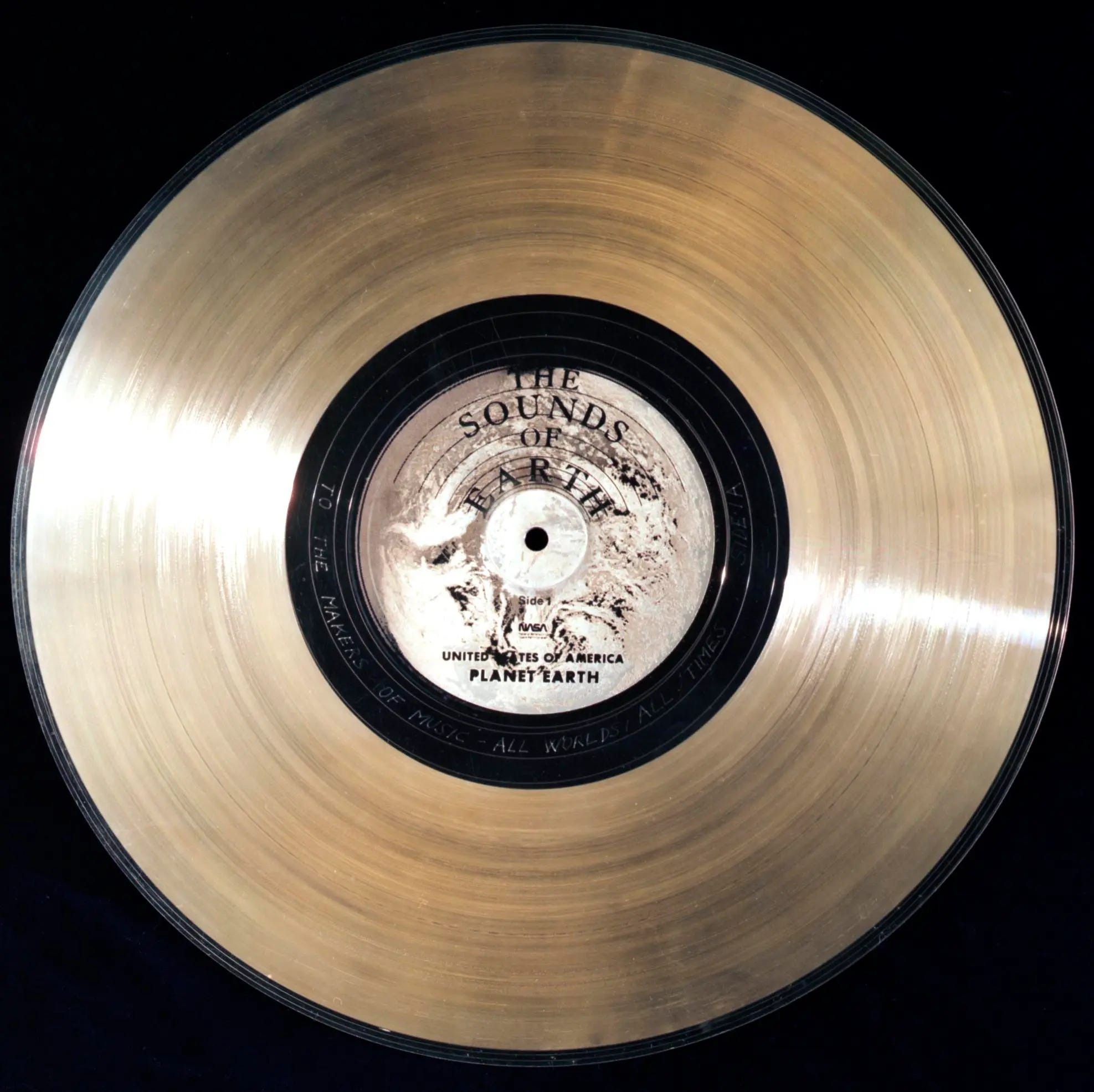
For music, Sagan’s committee included Bach, the Beatles, Chuck Berry, the gospel and blues music of Blind Willie Johnson, and an assortment of classical and folk music from around the world. They also included spoken greetings in 55 languages, with varied verbiage but similar vibes—Greetings to our friends among the stars. Welcome, whoever you are. We wish you peace. Then there were natural and human-made sounds, such as wind, thunderstorms, birdsong, hyenas, elephants, jet engines, footsteps, and a human heartbeat.
The story of Voyager’s golden record is featured in the final chapter of The Sound Atlas: A Guide to Strange Sounds across Landscapes and Imagination, a new and remarkable book by nature writers Michaela Vieser and Isaac Yuen.
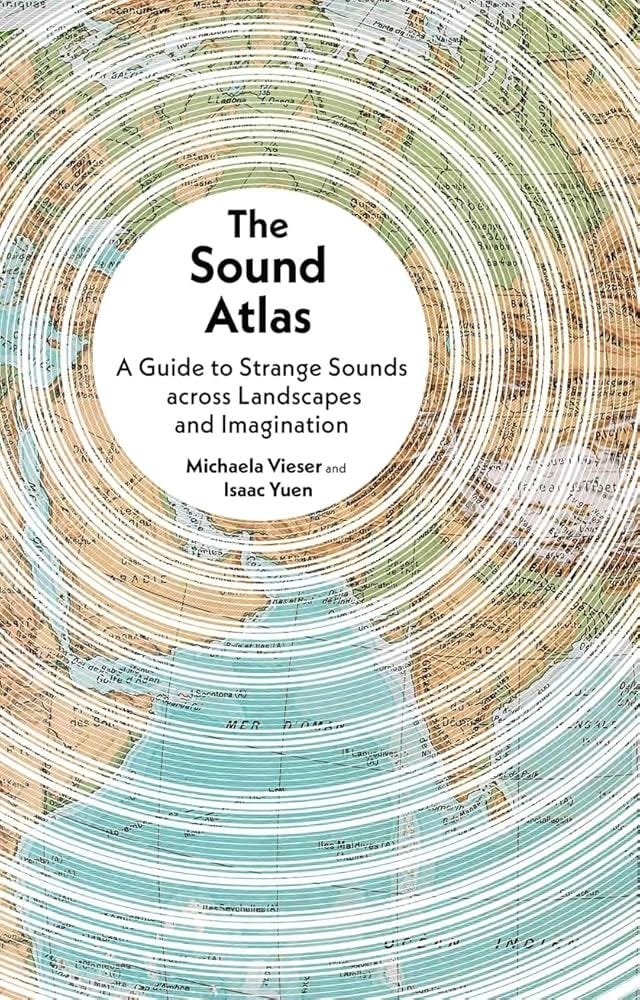
The book is a slim volume of 36 chapters, each about four pages, stretching across time and space to unearth nuggets of soundscapes that might otherwise escape notice, from the singing sands of the world’s deserts to the “ghost army” of sound effects, fake radio traffic, and inflatable tanks that deceived Hitler in WWII.
Every chapter is a lyrical mix of science, history, philosophy, and beautifully rendered sound description. We learn about the acoustic arms race between bats and the moths they hunt using echolocation: Unloved, unlauded and at home in the dark, bats are the phantom aces of the animal kingdom. There’s an homage to the cicada: Song is the only means they have to assert themselves upon the world, and by extension upon us, via their sheer volume and vitality.
In one chapter, we meet French artist Marguerite Humeau, who set out to resurrect the sounds of prehistoric animals by reconstructing their vocal tracts, including Lucy, the 3.2 million year-old hominid who lived in what is now Ethiopia.
Later, there’s a chapter about the mysterious Taos Hum and other global hums—many of which are eventually traced to some human or natural source. Vieser and Yuen celebrate the stubborn mystery of other hums, like the one in Taos, excerpting an essay that the English writer D.H. Lawrence wrote after moving to Taos in 1928 in the hopes that a high, dry climate would relieve his tuberculosis (the disease would kill him two years later):
Superficially, the world has become small and known. Poor little globe of earth, the tourists trot round you as easily as they trot round the Bois or round Central Park. There is no mystery left, we’ve been there, we’ve seen it, we know all about it. We’ve done the globe and the globe is done.
The book’s preface invites readers to sample the chapters randomly “pinging from location to location,” as I did. Or, the book can be read in linear fashion, as it follows a loose chronology—beginning with radio astronomers Arno Penzias and Robert Wilson hearing low-level interference they initially pinned on pigeons roosting in the antenna, but later discovered was cosmic microwave background radiation, “the afterglow that verified the Big Bang” and ending with Voyager’s sonic message in a bottle.
Reading the book’s final chapter kindled memories of visiting the Air and Space Museum in Washington, DC with my family in 1982. I was 8 years old, and so I was naturally thrilled by the fighter jets, the space capsules, and the lunar module. But I remember lingering for a long time at the Voyager exhibit.
The display featured a duplicate of the golden record and listed all the bits of humanity we wanted the universe to know about us—the diagrams of DNA and other molecules, anatomical renderings of humans and other species, and a pulsar map of the Milky Way that pinpointed Earth’s location. There was a welcome and an openness in this collection, and the best kind of pride, which was reflected in the sounds chosen for the golden record. We hadn’t simply equipped the space craft to engage in passive listening, nor some desultory pinging. No, we had blasted a sonic buffet into the cosmos, replete with hyenas, thunderstorms, and Johnny B. Goode!
There are moments in life that radically alter one’s perspective about what’s important, what lasts, and how vast the unknown truly is. In 1982, both Voyagers were still relatively close to Saturn, still squarely in our cosmic neighborhood. But the exhibit made clear that the spacecraft would keep going, keep exploring, and keep searching for listeners in the years and decades to come.
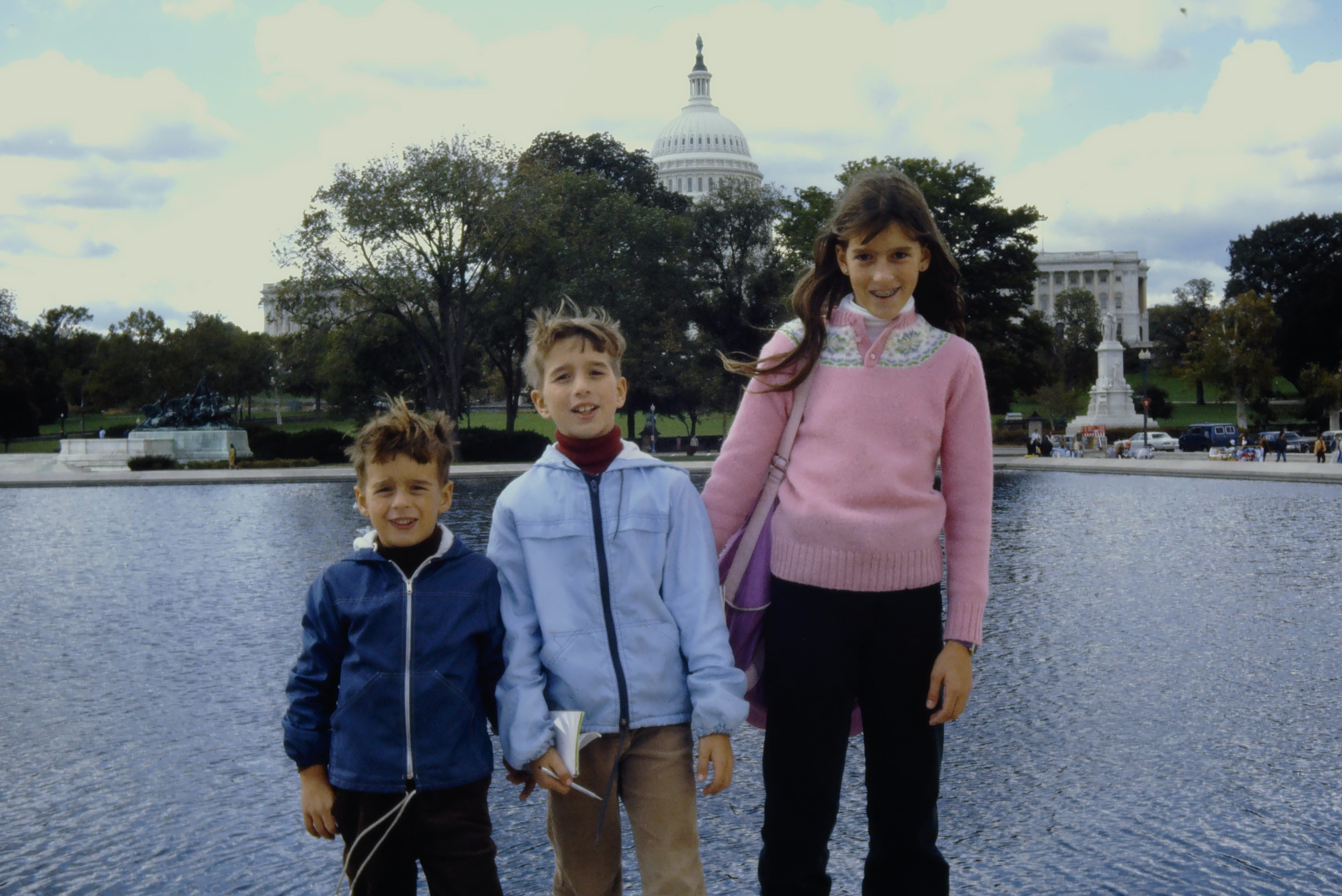
Decades feel much briefer to me now than they did in 1982 when I stood in the museum contemplating Voyager 1’s next stops after Saturn. How old would I be when it departed the solar system? Almost 40? Unthinkable! Yet here we are, and then some.
After passing close to Saturn’s moon, Titan, Voyager 1’s flight path took it beyond the ecliptic plane where planets in our solar system orbit. Voyager 2 kept going to visit Uranus and then Neptune in 1989, after which its camera shut down. Voyager 1’s camera blinkered off on Valentine’s Day 1990, after transmitting a series of planetary images known as the “Solar System Family Portrait” that included an image of Earth that Sagan famously described as a “pale blue dot.”
From then on, we could no longer see what the Voyager craft saw. But we could still listen for their reports picked up by NASA’s Deep Space Network, a global array of massive radio antennas. Voyagers 1 and 2 continuously transmit data on plasma density, magnetic fields, and cosmic ray interactions. In 2012, Voyager 1 entered interstellar space (Voyager 2 would do so in 2018), and today it’s nearly 16 billion miles from Earth and adding another 38,000 miles every hour. Scientist estimate that the Voyager craft may run so low on power in five years or so that they’ll no longer be able to communicate with Earth. Even if their power supplies can be stretched further, they will likely fly beyond the range of the Deep Space Network by 2036. After that, they’ll continue their mission in silence.
If the Voyager craft ever do deliver their acoustic payload, then one sound our interstellar listeners will hear is laughter, from Sagan himself, as I learned from The Sound Atlas. What will these listeners make of this fragment of human joy or mirth? It may be the perfect response to blasting our Earth-bound sounds into space—profound, yet absurd.
Voyager 1 won’t get near another star for another 40,000 years—and a red dwarf at that, known as Gliese 445, part of the little dipper. It will take about the same amount of time for Voyager 2 to near Ross 248, another red dwarf, in the constellation Andromeda. Astronomers have yet to discover planets near either star. While the golden record is packed ready-to-play with a stylus, sound waves are altered by whatever atmosphere transmits their energy, and their potential listeners will need physiology for sensing the sound and an intelligence evolved to interpret those sensations.
Nevertheless, as long as Voyager survives on its journey, the possibility remains that Sagan’s laugh and the rest of Earth’s playlist will be heard one day to finally join us with another corner of the universe. As Vieser and Yuen conclude: “Hope is a mysterious quantity, sometimes manifested through the making of a message sent into the void, regardless of the odds, with the noblest of intentions.”
Matt Hay went deaf at 25, but he taught his brain to hear again with the help of classic rock and intensive auditory training, a story detailed in the short (18 minute) documentary Between Two Ears, which was released on YouTube in October. The film’s driving force, co-writer, and co-star is Angela Alexander, an audiologist and an expert in auditory processing disorder, who worked with Hay to retrain his brain.
Hay was a college student in the early 1990s when he learned that he was going to lose his hearing. An MRI revealed that the trouble he’d had understanding people on the phone or in noisy situations was due to a brain tumor impacting his auditory nerve caused by a rare brain disease called neurofibromatosis type II, and it was only going to get worse.
A music lover, Hay decided to make a playlist of his favorite songs while he still had hearing—66 tracks in total, by musicians like the Beatles, Elton John, Bob Marley, U2, and Peter Frampton. He then listened to his playlist on repeat, so he could still “listen” to them in his memory when his hearing disappeared. A few years later, Hay’s world went silent.
He opted for surgery, which could remove the tumor but wouldn’t restore his hearing, so he elected to go a step further and have the surgeons put in an auditory brainstem implant that could translate soundwaves from an external receiver, bypass his ears, and directly buzz an area known as the cochlear nucleus complex, the first relay station for auditory processing in the brain. The day the doctors switched on the implant, Hay could detect sound, but he couldn’t hear.
“Everything sounded like a bottle cap in a garbage disposal,” he recalls in the film.
So, Hay once again started listening to his playlist of favorite songs on repeat. His implant butchered the music, but Hay knew better, because every melody, every chord progression was cemented in his memory, and as he listened and mentally corrected what he heard, he guided his auditory processing into a gradual recovery. That’s about when Hay’s story was picked up by NPR in a podcast called “The Soundtrack of Silence” that aired in 2017. That podcast was heard by the actor Channing Tatum, who optioned the movie rights for Hay’s story in 2019 (the movie will star Tatum as Hay, and is in development by Paramount Pictures).
“So Matt Hay, was already famous by the time I met him,” Alexander told me in an interview. At the time, Hay was able to understand about two thirds of words in quiet, which his doctors found remarkable. Alexander told him, “We can do better than that.”
She’d been helping patients with auditory processing disorder (APD), which can result from a wide range of causes, everything from autism to stroke to head trauma. Most of these folks have normal hearing sensitivity. Meaning, they can sense sounds along the normal range of frequencies and decibel levels. But they struggle mightily to understand people in noisy situations.
Understanding APD and the auditory training that Alexander undertook with Hay starts with this basic premise: We sense sound with our ears, but we hear with our brains. We are born with the ability to sense sounds, but we learn to recognize, distinguish, and understand those sounds over time. For a century, the gold standard screening for hearing loss has been the audiogram, which measures how well you can detect beeps at audible frequencies. That’s important, but it’s not hearing in the real, human sense.
As I wrote in Clamor, “most people don’t complain to audiologists about missing particular pitches. They are instead distressed by struggles to converse with friends and loved ones in a crowded place. They miss out on the stories and can no longer engage in the banter. They’re embarrassed by their need to constantly ask others to repeat themselves.”
Alexander is among a growing number of audiologists who think her field should expand its approach to hearing difficulties, beyond the ears. Here’s how she described auditory training to me: The first step is phonemic training, in which a patient learns to recognize letter sounds without lip reading. With practice, patients recognize the sounds faster and more accurately.
“We usually train three to four new sounds per week, and then we keep layering,” she said, “by introducing new sounds, until a person is working on 32 or 34 sounds.”
The next part of a training session is a speech-in-noise task, in which patients try to understand target words in increasing levels of background chatter. There are two goals with this task. The first, she explained, “is we want to help a person just survive noise.” While that might sound dramatic, it likely also sounds familiar to people who experience the anxiety and fight-or-flight that kicks in as they struggle to hear at a noisy gathering. The second part is to improve their accuracy, and that’s a lot easier after a few sessions, “when their amygdala isn’t quite so fired up from the noise.”
Training sessions also include some short-term memory work and some speech-sound blending. “It’s kind of like circuit training,” Alexander explained. After 12 one-hour sessions of auditory training, once a week, for 12 weeks, Hay was able to recognize between 87 and 92 percent of speech in quiet.
If you want to learn more about Hay’s story, here’s his website, and he published a memoir last year, too.
Acoustic Odds and Ends

Book News! Nature listed Clamor as one of the 10 Best Books of 2025!
A recent study led by Australian researchers linked regular listening to music or playing an instrument to significant drops in dementia risk. The study, published in the International Journal of Geriatric Psychiatry, analyzed several years of data from multiple longitudinal studies of more than 10,000 Australians aged 70 and up, and found that people who reported regular music listening had 39 percent less risk of developing dementia than those who rarely or never did, and those who played an instrument had a 35 percent reduction in dementia risk.
The results come with the usual caveats about self-reported behavioral data and correlation not being causation. Another recent study published by the journal Aging, Neuropsychology, and Cognition, looking into links between music making and general cognitive decline in aging (not dementia risk) found mixed results. The authors of that study noted another challenge in researching music as medicine—defining the dose.
There are only a few hundred North Atlantic right whales left in the world. In this podcast, produced by The Daily Mail, environmental journalist Jenn Thornhill Verma explained how human noise may be driving these whales closer to extinction (In a fun twist, the podcast is called The Decibel, but it’s a daily news podcast, not sound specific).
Thanks so much for reading CLAMOR! Please spread the word and subscribe for free to receive new posts and support my work.
No posts
Comments
Nothing yet. Say the first thing.
Sign in to join the conversation.