
Welcome to the January CLAMOR! This month is part one of a two-part look at using tech to take on traffic noise, and we’ll hear one entrepreneur’s plan to break India of its honking habit (next month, noise cameras coming to a street near you). Then, I’ll share some exciting book news, a new study about the price of quiet, and how a blind astronomer translates light data into sound and listens to exploding stars.
The honking habits of India’s drivers have withstood decades of accumulating noise laws, escalating fines, periodic police crackdowns, and many, many public-awareness campaigns. Could technology finally break through the noise? An Indian serial entrepreneur named Satyen Engineer believes his latest venture, YHonk, could help calm the cacophony.
YHonk features a small in-vehicle device that tracks horn use along with speed, location, timing, and other contextual data fed into a central dashboard. Pilots of the system on public transport and other vehicles in several cities reveal some shocking baseline honking behavior and provide a platform for a range of interventions that have just started to be tested.

I recently interviewed Engineer who shared documentation on YHonk’s pilot studies and origins—the technology was patented in 2015 and won both funding and startup support from the United Nations Development Programme in 2020. Reporting on YHonk reminded me just how formidable the noise dragon is that it seeks to slay.
India has had anti-noise laws on the books since the late 1980s. Drivers can be fined for unnecessary honking (1000 Rupees, about $11 for a first offense and double for repeated offenses), and India has long prohibited honking in “silence zones”—a 100 meter buffer around noise-sensitive places such as schools, houses of worship, and hospitals. Honking aside, there are strict legal decibel limits for silence zones (50 dB during the day and 40 dB at night).
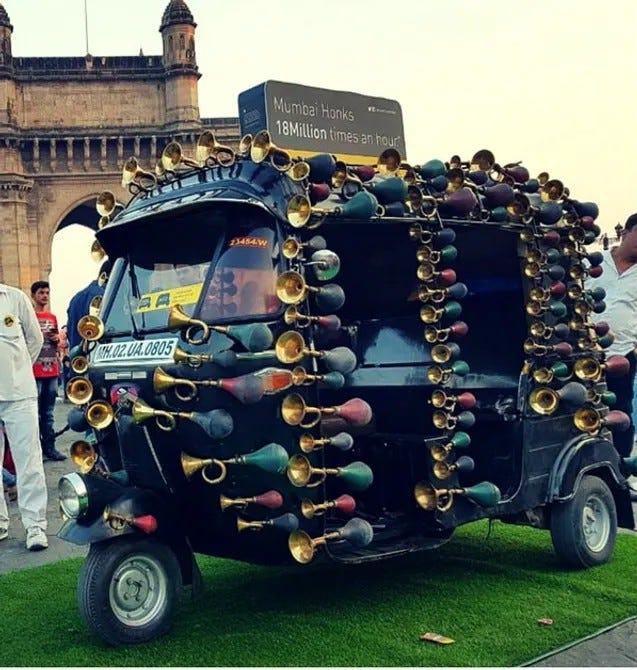
But enforcing these laws is another matter. A 2017 study of silence zones around India found that none of them met the legal standard. Likewise, on roads where honking is ubiquitous, singling out individual drivers to fine seems arbitrary and ineffective, and police opt instead for periodic “no honking days” of intense, albeit fleeting enforcement, while also leading or joining campaigns like the 2018 “Horn Vrat” (a fast from honking) when an autorickshaw festooned with bulb horns drove around Mumbai to raise noise-pollution awareness and discourage honking.
“I personally do not say not to honk. I say honk when required,” Engineer told me. “Every vehicle in the world has a horn, and the horn is there for a reason.”
The problem, he and others have noted, is that drivers in India use their horns for every reason, and for no reason. I’ve lived most of my life in cities, so I’m fluent in honk for hi there, wake up! stop! and move, motherbleeper! But, I didn’t realize how expansive a honking vocabulary could be until I visited India in 2019, funded by a reporting grant, to cover a growing anti-noise movement for Undark magazine.
Roads in Indian cities are overstuffed with vehicles of all sorts. Motorcycles slice between lanes, and pedestrians are often forced into the street when sidewalks are either missing or crammed with vendors. Honking becomes reflexive under these conditions, expanding into an all-purpose signal of intent—to turn, to pass, to nudge oneself another few forward. Honking also serves as a general venting of frustration at stoplights and other obstacles, and, of course, as a retort to other habitual honkers.
As part of my reporting for the Undark article, I had called Ritesh Vijay, a senior principal scientist with India’s National Environmental Engineering Research Institute (NEERI), and arguably the nation’s foremost honking authority. Vijay spoke to me while walking to his office in the city of Nagpur, and our conversation was repeatedly interrupted by loud horn bursts. “Sorry!” he said with a quick laugh. “My God! You can see how noisy it is!”
NEERI had recently published a major noise pollution study of 27 Indian municipalities, including Nagpur, which concluded that honking was the biggest noise culprit. As noisy as Nagpur was, it wasn’t the worst of the cities NEERI studied, and neither was the megacity of Mumbai, which I had visited a few weeks before the call. No, the cacophony crown went to the comparatively small metropolis of Ulhasnagar, home to about half a million people on Mumbai’s outskirts.
In Ulhasnagar, which I also visited, weekday traffic averaged 91.4 decibels! That’s lawnmower-loud, hearing-damage loud. For comparison, traffic noise studies in New York and other American cities tend to measure somewhere around 70 to 75 decibels on average, which isn’t healthy but doesn’t pose nearly the same threat to hearing. Indeed, study after study finds exceptionally high rates of hearing loss among India’s traffic cops, not to mention the well-established links between noise exposure and heightened risks for hypertension, heart disease, and stroke. Below is a 30-second snippet of video I recorded in Ulhasnagar (September 2019).
While there are good, even life-saving reasons to honk, constant honking isn’t just irrational, it’s ultimately self-defeating. Not only does laying on the horn at a red light accomplish nothing, but the more honks there are vying for attention, the less effective every honk becomes. One consequence is decibel escalation. Standard horns struggle against the growing din, and the demand for louder, after-market horns in Indian cities is reportedly flourishing. Beyond loudness, there are also limits to driver attention and the desensitizing results of signal overload (like hospital “alarm fatigue” among clinicians).
In 2020, the Mumbai traffic police went so far as to rig visible decibel meters to several traffic lights at busy intersections which would restart the countdown to greenlights if the honks of impatient drivers hit 85 decibels. The police even made a video of their initiative, which they dubbed, “The Punishment Signal.”
All this honking hasn’t made India’s roads any safer. In fact, the number of deaths due to road injuries rose nearly 60 percent between 1990 and 2017, according to a study in the Lancet. Indeed, writing in Forbes India, the anti-noise activist Sumaira Abdulali blamed constant honking for road rage and aggressive driving. “An emergency warning device in the rest of the world, horns are not a substitute for the ordinary use of brakes, for road discipline or for other driving skills,” she wrote. “In fact, honking promotes speeding, overtaking and other rash driving.”
At a minimum, YHonk aims to make drivers and the people who employ them (such as transport authorities and municipal governments) more aware of their honking behaviors. For instance, a year-long pilot of the devices on five buses in the city of Hyderabad tabulated more than 940,000 honks. Assuming 5 days of driving per week, that would mean each bus honked more than 700 times a day if the honks were evenly distributed. However, the study revealed that one particular driver was responsible for nearly half of the honks.
“I mean, a bus driver could have a situation where he needed to honk four or five times a day,” Engineer speculated. “But more than that, there is something wrong with your driving behavior.”
YHonk’s dashboard drops a location pin for every honk, which turns red in a silence zone. Late in 2025, YHonk concluded a pilot with police vehicles in the city of Ahmedabad, two months of baseline measures followed by a third month during which silence zone honking generated a text message alert urging drivers to be more careful. As of this writing, the results are still being analyzed.
As Engineer acknowledged, sometimes silence zones aren’t well demarcated, and drivers could use some help knowing when they’re in one. He said he’s reached out to Google Maps to see if this could be added to their suite of traffic notifications.
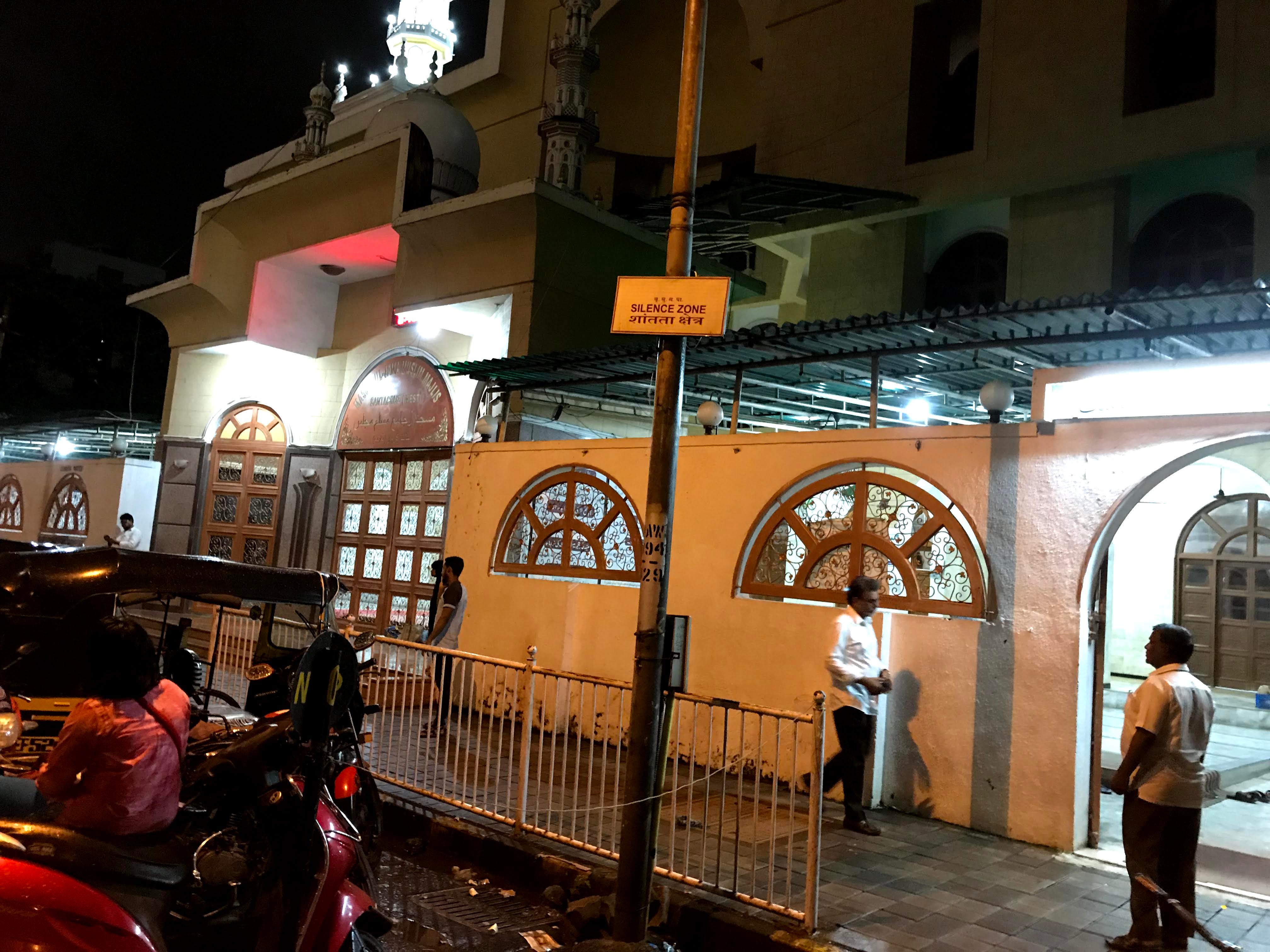
Even in a silence zone, drivers sometimes must honk to keep themselves and others safe, which complicates any path between remote data and noise enforcement. As Engineer explained it to me, YHonk is a source of evidence. “We will provide all the data of honking violations to the traffic police department and leave it to them to make a decision.”
The data could also go to transport authorities, delivery companies, and others that employ drivers, who could use it to craft both sticks and carrots to encourage horn restraint, such as financial incentives for drivers who meet low honking thresholds. Still, as columnist, Bairaj Chawalgami, recently opined in the Daily Exelsior, a newspaper in the city of Jammu, changing India’s honking culture will take a combination of efforts. “A systemic approach, supported by both policy and public participation, is essential if any meaningful change is to be achieved,” wrote Chawalgami. That approach included legal enforcement, education and awareness, technology, and infrastructure improvements to lessen the “traffic chaos.”
Ultimately, breaking the honking habit will take a critical mass of drivers lifting their hands from the horn, enough to shift constant honkers from the norm to the exception on the roads. Engineer told me his plans to reach these numbers with YHonk in Ahmedabad. The city is due to host the Commonwealth Games in 2030 and wants to host the Olympics in 2036, which will put pressure on authorities to reduce noise and other pollution, according to Engineer.
A decade ago, the International Olympic Committee made environmental protection and sustainability a key component for would-be host cities, and Ahmedabad has a serious noise pollution problem. Engineer recently met with the Home Minister of Gujarat, the Indian state containing Ahmedabad, a man named Harsh Sanghavi, who also happens to be the Sports Minister.
“I said, I can help you reduce the noise pollution in the city,” he recalled. “The plan is to put the device in 1,500 municipal corporation vehicles.”
I was unable to confirm this plan with the Minister, but Engineer told me that if that first phase is successful, they would expande to all municipal vehicles, then cargo vehicles registered with the local Road Transport Office, and eventually licensed taxis and autorickshaws, which would amount to hundreds of thousands of devices tracking honks on the city’s streets.
“We believe we’ll be making a huge impact,” he concluded. “A huge impact.”
Acoustic Odds and Ends

Book News! I’m thrilled to announce that I’ll be on two panels at the Tucson Festival of Books hosted by the University of Arizona on March 14-15, 2026. I’ll join science writers Carl Zimmer and Sharon Udasin for “The Hidden Environment: What We Breathe, Drink, and Hear” and then for “Noise, Quiet and Well-Being” I’ll pair up with Rachel Kolb, author of Articulate:
A Deaf Memoir of Voice (I’m reading this right now, and it’s excellent).

Last month, the Wall Street Journal covered a study from the National Bureau of Economic Research that found home values of houses within 100 meters of newly constructed highway noise barriers rose nearly 7 percent more than a control group of comparable homes 500 meters away, and the most gains went to homes closest to the hulking walls where the noise reduction was greatest (an estimated 1 percent increase in home value for every decibel of noise reduced). Extrapolating these findings, the authors estimated that traffic noise reduces property values by about $110 billion nationwide.
As a sidenote, other studies find that traditional highway noise barriers have little to no benefit for folks living more than 100 meters away. In fact, because sound travels in waves that reflect and refract, soundwalls can sometimes make traffic noise worse for these more distant homes.
I’ve become fascinated with sonification in which visual or numerical data is converted into sound. Last year, for example, an installation by the composer Peter Batchelor broadcast sonified data on the health of a forest ecosystem via tree mounted speakers in England’s Alice Holt Forest. Or, want to hear centuries of global warming as a musical composition? Check out this recent sonfication work by the mathematician, composer, and data scientists, Harlan Brothers:
Finally, here’s a video in which the blind astronomer, Wanda Diaz-Merced, explains how she studies explosive gamma-ray bursts made by collapsing stars in distant galaxies by listening to the sonified data of light-intensity changes.

Thanks so much for reading CLAMOR! Please spread the word and subscribe for free to receive new posts and support my work.
No posts
Comments
Nothing yet. Say the first thing.
Sign in to join the conversation.