

My brain took a beating during another dive into Mr. French’s Economic Development issue paper from his election website. I think this was worse than the Recompete portion of the paper, and worse than the Substance Use topic of another issue paper.
In other words, it’s bad, but only if you’re thinking while reading it. Hopefully my meme-filled review will lessen the torture.
Let’s start where Mr. French begins his economic masterpiece: a single, magnificent paragraph under the “What’s the Problem?” section that attempts a triple-somersault of economic logic.
“Lower median wages have hampered our resident’s ability to compete for existing housing and their ability to stimulate demand for starter homes. The shift to a tourism economy has motivated some property owners to transition homes completely out of residential uses and into short-term rentals that provide accommodations for visitors. This increased competition has likely limited the development of larger hotels or resorts.”
Read that again. Slowly.

In three short sentences, voters are asked to believe that low local wages prevent starter-home construction, which drives homeowners to open Airbnbs, which then somehow strikes terror into the hearts of commercial hotel developers — convincing them to abandon multi-million-dollar resort projects.
Where is the data? Where are the feasibility studies? Where is the hotel developer on record stating, “We were going to build a 200-room waterfront convention hotel in Port Angeles, but then Brenda put her 2-bedroom guest house on VRBO, so we called off the cranes”?
It doesn’t exist. Instead, the claim relies entirely on the hedge-word “likely.”
Here is what actual economic data and local market realities tell us:
The Lodging Deficit: Port Angeles isn’t suffering from an oversupply of “shadow hotels.” Local business analysis and event planning data show the area suffers from a net ceiling on lodging. When large conventions, regional sports tournaments, or festivals try to book Port Angeles, they are turned away or forced to cap registrations because there aren’t enough concentrated room blocks (like the 186-room Red Lion).
STRs Can’t Anchor Conventions: A 300-person conference cannot sign a master contract across 60 scattered residential Airbnbs. They need centralized meeting halls, banquet facilities, and bus parking.
Real Commercial Hurdles: Hotel development is stalled by high interest rates, commercial lending guidelines, labor shortages, and municipal utility constraints — not because a family rented out a cabin for Lake Crescent visitors.
By scapegoating Short-Term Rentals, Mr. French builds a convenient villain. But as a narrative, it’s a series of disconnected leaps wrapped in speculative political fluff.

Moving right along in the “Problem” section, Mr. French turns his sights to the rural infrastructure crisis:
“Being a rural area, we do not always have the infrastructure necessary to support business development. Many businesses in the West End have struggled to solve water or septic issues because there are no larger water systems or sewer systems to connect to. Planning, developing, and expanding sufficient utilities has not always been a priority of local governments in our region, and our businesses have suffered the consequences of that lack of foresight.”
This paragraph is written in a masterclass of passive voice. Utility expansion “has not always been a priority” of “local governments.”
Who are these shadowy “local governments” lacking foresight?
Let’s check the calendar. Mr. French served on the Port Angeles City Council for five years (2018–2022) and has served as Clallam County Commissioner for District 3 — which explicitly includes the West End (Forks, Sekiu, Neah Bay, Clallam Bay) — since January 2023.
Mr. French writes like an outside armchair critic auditing the county’s historical blunders. Yet he is the incumbent sitting in the executive chair.

To top it off, he even boasts in a footnote in this same paper that he was a “principal writer/editor” of a report detailing how local public policy decisions and a lack of infrastructure halted regional economic recovery. He literally helped write the diagnosis years ago, has sat in office ever since, and is still handing voters the same unacted-upon prescription.
If utility foresight was neglected in District 3, the commissioner representing District 3 might want to look in a mirror before writing the critique.
When you flip to the “What’s the Solution?” section expecting a policy fix for the STR crisis, the starter-home deficit, or West End septic systems, you get this lonely nugget:
“Infrastructure investments need to support economic development. Zoning and land use policies need to support economic development. If we want to attract large employers, they need access to appropriately zoned land that’s available for purchase and connected to utilities.”
That’s it. That is the entire zoning strategy.
Notice what is missing? Everything mentioned in the problem section.

There is zero policy proposed for starter homes. Zero framework for balancing STRs against hotel development. Just a vague platitude stating that “zoning and land use policies need to support economic development.”
For a sitting County Commissioner who directly oversees the County Comprehensive Plan and the Department of Community Development, telling voters that “zoning needs to support development” is like a chef announcing that “food needs to be cooked.” We know. How are you going to cook it?
In the resume section, Mr. French flexes his key accomplishments:
A $35.6 million federal Recompete Pilot Program grant.
$935,000 in Opportunity Funds to Forks for Riverside Forest Products recruitment.
$1.75 million to the Port of Port Angeles for the Marine Trades Center.
A $3.3 million state capital budget proposal for western PA UGA wastewater.
Updating the Agricultural Accessory Use Code for agritourism.
Let’s give credit where it’s due: securing workforce grant money ($35.6M Recompete) is great for job training, childcare vouchers, and equipment grants. But workforce training is not physical infrastructure or zoning reform.
Approving pass-through grant checks for outside entities (the City of Forks, the Port of Port Angeles) does not mean the County built municipal water mains or fixed rural septic rules. Furthermore, listing a $3.3 million proposal to the state budget highlights that the county hasn’t actually funded or built that wastewater capacity itself.
When you scrub the list for actual county legislative or regulatory action on zoning, you find an Agritourism code update. That helps farm stands, but it does absolutely nothing for starter homes, commercial hotel zones, or rural West End utility capacity.
Finally, we arrive at “What’s Next?” — where an incumbent commissioner lays out his future vision:
“Identify proper industrial land... We should be open to rezoning... or ideas like a UGA swap or expansion.”
“Host a summit between City and County permitting staff and large employers...”
“Proactively work with Clallam EDC... to develop economic development plans for our Urban Growth Areas... (such as Clallam Bay/Sekiu and Carlsborg).”
Every single item on this list falls directly under the statutory authority of the Board of County Commissioners (BOCC):
UGA Swaps and Rezoning? The BOCC literally votes on Urban Growth Area boundaries and Comprehensive Plan updates.
Permitting Traps? County permitting staff (Department of Community Development) report up through county administration. A commissioner doesn’t need a “summit” to direct staff to fix permitting bottlenecks; they have administrative oversight.
Unincorporated UGAs like Carlsborg and Clallam Bay? These aren’t cities — they are unincorporated areas under direct county jurisdiction.
After nearly a decade in local elected office, framing baseline county administrative duties — rezoning land, directing permit staff, and updating unincorporated UGA plans — as future “ideas to explore” raises a simple question: What were you waiting for?
When you digest the rest of Mr. French’s paper, the pattern becomes impossible to unsee: it is a document built on historical blame, administrative passivity, and convenient omissions.

Take his broader “Solution” text, which reads like a collection of generic corporate mission statements. We are told that economic development “needs to be our top priority,” that workforce programs “need to be informed by employer needs,” that we must “be a business-friendly county,” and that permitting staff “need to care.”
Notice the phrasing: “needs to be,” “need to care,” “we need to listen.” He relies entirely on passive normative statements rather than active policy commitments. There isn’t a single ordinance proposed, not a specific zoning code targeted for reform, and no direct policy mechanism outlined.
Suggesting that the county’s core solution is to “amplify external partners” like Peninsula College or the Chamber of Commerce effectively shifts the burden of leadership onto non-profits and business groups, begging the question of what the County Board’s actual, direct policy job is supposed to be.
Even more glaring is how the paper handles historical cause and effect: it leans on distant history while scrubbing current policy conflicts entirely from the record.
To explain current housing shortages, Mr. French points all the way back to the Great Recession of 2008 for wiping out local builders. Using an 18-year-old macroeconomic event as a primary explanation allows him to bypass a far more relevant question: why hasn’t county permitting reformed to encourage new builders today?
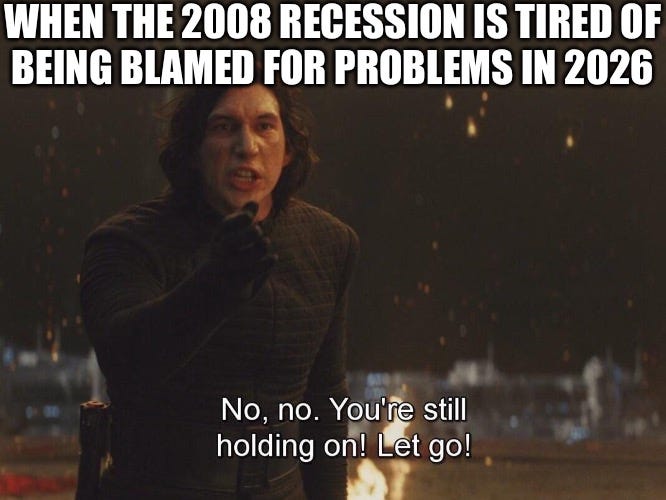
But what he actually scrubs from the record entirely is the impact of environmental activism and state forestry policy.
On the Olympic Peninsula, you cannot write a serious diagnosis of working-class job losses and depleted timber tax revenues — revenues that directly fund fire districts, schools, and rural infrastructure — without addressing decades of legal challenges, DNR legacy forest decisions, and conservation mandates that locked up working timberlands.
By scrubbing environmental policy conflicts completely out of his paper, Mr. French delivers a “safe,” politically sanitized analysis that avoids alienating advocacy groups — and in doing so, ignores one of the single biggest drivers of rural economic transformation in Clallam County.
When an incumbent commissioner hands voters a paper that blames 2008 market crashes and short-term rentals, ignores the timber policy debate, delegates solutions to outside colleges, and promises to “explore” zoning powers he already holds, it isn’t an economic blueprint.
It’s an admission that after nearly a decade in office, the plan is simply to keep doing what he’s always done.

Clallam County Code (CCC) Title 33 — Land Use and Development Code
Source: Clallam County Planning Division
Key Provisions: Defines zoning categories (e.g., Rural Commercial, Rural Village, Urban Center), structural footprint limits (such as the 6,500 sq ft commercial cap in Rural Village zones), allowed vs. conditional uses, and set-back/density requirements.
Revised Code of Washington (RCW) 36.70A — Growth Management Act (GMA)
Source: Washington State Environmental & Land Use Hearings Office (ELUHO)
Key Provisions: Mandates comprehensive land-use planning, establishes Urban Growth Area (UGA) boundaries (RCW 36.70A.110), and restricts urban-level infrastructure expansion outside designated UGAs to curb rural sprawl.
City of Port Angeles Short-Term Lodging Ordinances (Ordinances 3577, 3714, 3728, 3733, 3748)
Source: City of Port Angeles Official History of Short-Term Lodging Regulations
Moratorium Record: City of Port Angeles Press Release — Limited STR Moratorium
Key Provisions: Establishes the 200-unit citywide cap on non-owner-occupied (Type II) short-term rentals, defines Type I owner-occupied restrictions, and institutes inspection and license transfer rules.
US EDA Recompete Pilot Program — North Olympic Peninsula Coalition
Key Provisions: Details the ~$35.6M U.S. Economic Development Administration federal grant implementation across Clallam and Jefferson Counties, including allocation leads for maritime workforce expansion, timber composite innovations, and barrier removal.
Lower Elwha Klallam Tribe Waterfront Hotel & Field Hall Campus
Project Profile: Waterleaf Architecture — Elwha Hotel Development Plan
Key Provisions: Documentation for the downtown Port Angeles 106-room hotel development on remediated brownfield land adjacent to Field Hall and the ferry terminal.
WA Dept. of Natural Resources (DNR) Trust Land Statutory Authority
County Financial Reports: WA DNR Clallam County Income Reports & Distributions
Key Provisions: Outlines the legal mandate (County Forest Transfer Lands under RCW 79.64.110 and the 1984 Skamania v. State Supreme Court ruling) requiring DNR to manage trust forests for maximum long-term revenue generation for county services and school districts.
Primary Source Document: Mike French Economic Development Issue Paper
Local Civic Podcast & Economic Data Reference: Hey PA! Podcast Episode 13 - Steven Pelayo Interview
Disclaimer: This article was drafted in collaboration with an artificial intelligence that possesses zero voting rights in District 3, owns no short-term rentals in Carlsborg, and was not harmed during the logical dissection of this issue paper. All snark was organically harvested from local public records and basic economic principles; the AI merely provided the digital keyboard, pointed out the passive voice hiding in plain sight, and wondered where all the septic systems went.

As of 3:23pm on August 12, 2026, the amount of ballots counted was 45%, another 1% increase from the day before.
No major differences; Jake is still leading for Clallam County Commissioner District 3. Marcia Kelbon continues to lead for Legislative District 24, Position 2.
The results website states: Next Update Expected Tuesday, August 18, 2026, 11:00:00 AM
Clallam County Election Result Updates
Mark your calendars for Thursday, August 27th, a candidate conversation with Jake Seegers & Mike French at the Sequim Grange; hosted by the Calico Cat Club. Free and open to all. Details available online here and in the Google Event Invite.

Help get the petition to 600 signatures! You can sign the petition without displaying your name; the signature still counts, but if you want your name not to be seen by others, uncheck the box about displaying your name before clicking the submit button. Thanks to Terri D. for starting the petition!
4PA: A Clean & Safe Community for All
Monday Meetings Google Event Invite

New issues published at 6am every Monday and Thursday.
Senator Mike Chapman: (360) 786-7646, email form
Representative Adam Bernbaum: (360) 786-7916, email form
Representative Steve Tharinger: (360) 786-7904, email form
Mark Ozias: Mark.Ozias@clallamcountywa.gov
Randy Johnson: Randy.Johnson@clallamcountywa.gov
Mike French: Mike.French@clallamcountywa.gov
Loni Gores, Clerk: Loni.Gores@clallamcountywa.gov
Find all other Clallam County officials, offices, and employees in the staff directory.

No posts
Comments
Nothing yet. Say the first thing.
Sign in to join the conversation.