

Intro Haiku:
French-fried policy
The marxist philosophy
Taxed insanity
On my TV during the podcast: Peaceful 1950s Summer Night in a Vintage Beach House
If readers missed Part I, click here to read French-Fried Policy: Why Mr. French’s Homelessness Plan is Overcooked.
But the review of Mr. French’s Public Safety, Substance Use, and Homelessness issue paper isn’t finished yet.
After sifting through the bureaucratic droppings in that document, something far more revealing than operational incompetence comes into focus. Strip away the government-speak, and the actual engine driving Mr. French’s agenda becomes clear: an ideological commitment to taking money from one group and giving it to another, also known as Marxism.
Mr. French talks about homelessness funding like it magically drops from the sky. Well, it doesn’t.
It comes from RCW 36.22.250 — a stealth tax engine baked into every piece of property paperwork filed at the county courthouse. Mr. French even says it out loud in his paper:
“We should create a Safe Parking Program in the Port Angeles area using funding sources that Clallam County has access to (such as document recording fees).”
Here is how the game works: Every time you buy a home or record a standard land document in Clallam County, the auditor charges a baseline $20.50 recording fee, then tacks on $183.00 in state-mandated surcharges — bringing the total cost to record a single page to $203.50.
Out of that $203.50 bill, over 89% ($183.00) isn’t for filing paperwork — it’s a forced tax earmarked for government homelessness programs. When Mr. French pitches a “Safe Parking Program,” he’s saying that he plans to keep picking the pockets of home buyers to fund government-managed encampments.
$20.50 Base Recording Fee
Auditor Administrative Base Fee
$100.00 Affordable Housing Surcharge
RCW 36.22.250 Housing/Homelessness Programs
$62.00 Homeless Housing & Assistance
RCW 36.22.250 Local Homeless Housing Operations
$1.00 Land Records Digitization
RCW 36.22.170 Improvement of records system
$20.00 Building Communities
RCW 36.22.250 Affordable Housing for All
Total First-Page Fee: $203.50 ($20.50 Base + $183.00 Mandatory Surcharges)
Olympia uses a trick: call the tax a “fee,” and you never have to ask voters for permission.
State lawmakers can raise this recording surcharge whenever they feel like it. No ballot measure. No vote. No consent. The county auditor simply demands more cash at the counter, turning a land deal into an unvoted revenue stream for state social experiments.
The irony in Mr. French’s paper is thick. In one section, he whines about high housing costs keeping young families from buying a home. In another section, he defends the exact fees inflating those costs.
It’s a dumb, perpetual government loop:
Step 1. Jack up fees on property records to fund homelessness projects.
Step 2. Raise closing costs for local home buyers.
Step 3. Ponder publicly why nobody can afford a house.
Step 4. Demand higher fees to “fix” the crisis created in step 2.
Taxing home ownership to make housing “affordable” is economic arson.
Clallam County’s high median age creates a clear split: retirees who built equity elsewhere before moving into the area, and young local families trying to buy their first home.
When housing prices explode, struggling working-class locals naturally get mad at wealthy newcomers outbidding them. But blaming retirees who worked decades for their savings misses the target entirely.
Newcomers didn’t break the market; politicians did. Officials like Mr. French push endless rules, higher property assessments, and mounting paperwork fees. Wealthier transplants can absorb an extra fee hike without blinking, but local working kids get crushed before they even reach the closing table.
The county uses this demographic friction to distract from the real issue: government policy screwing over both sides.
This isn’t a mistake. It’s Marxist theory in action: from each according to ability, to each according to need.
The Ability: Working families and buyers saving up to buy a piece of dirt.
The Need: Free government vouchers, services, and managed encampments.
When government squeezes private land transactions to keep people dependent on state handouts — without requiring rehab, work, or accountability — it isn’t helping anyone. It punishes productive citizens, forcing them to subsidize poverty.
Look at the streets. Where are the new recovery beds? Where is the addiction treatment expansion? There only seems to be a high-priced administrative apparatus managing the misery.
So, where does the money go? Hypothetically, into management fees, “feasibility studies,” site security for empty lots, or rent checks for non-turnover housing units like Dawn View Court, as shown in Part 1 of the French-Fried Policy. Because the system’s inner mechanics are unproven, the exact destination remains a black box.
Here are the only hard, disconnected facts available:
Under RCW 36.22.250, the county takes a strict 10% administrative cut from document recording surcharges ($18.30 out of every $183 fee).
The remaining 90% ($164.70) routes directly to private non-profit contractors as “program delivery.” Once that money hits private accounts, detailed line-item oversight ends.
On a projected $500,000 document fee windfall, the county keeps $50,000, while $450,000 flows into private non-profit ledgers shielded from public view.
Meanwhile, Clallam County’s general budget spends $40.794 million on 331 full-time employees, backed by the county’s general fund analysis.
Employee labor costs account for 71% of the general fund budget, leaving a $19.3 million shortfall.
How much of that pass-through money reaches actual client care versus vendor overhead? It is unknown — and impossible to connect on paper.
While much remains unclear, one thing is certain: property buyers, local businesses, and everyday taxpayers are forced to hand over these inflated recording fees at the counter to fund the entire system. The homelessness industry needs people stuck in tents — otherwise, the government checks stop coming and the county payroll starves.
That $183 surcharge is the rate today. Tomorrow, lawmakers can bump it to $250, and homeowners won’t get a single vote or say in it.
This is the baseline choice: free-market capitalism versus socialized government entrapment.
In a reasonably free market, local government keeps paperwork fees cheap, clear, and strictly limited to basic functions — like keeping land records straight and fixing roads. Under socialized government control, every home sale is treated like a public piggy bank.
People don’t have to stay and take it. Over 20 states offer lower regulatory burdens, zero state income tax, and significantly lower cost-of-living index numbers with dirt-cheap filing fees that leave property owners alone.When a county treats workers like a cash machine, people do the simplest thing possible: they load the moving truck and leave.
Mr. French’s homelessness plan isn’t just broken — it’s ideologically corrupt.
This administrative revenue pump punishes local working families who are priced out of closing tables, while burning the retirees who moved here to enjoy their hard-earned peace.
Instead of a safe, clean community, retirees get the privilege of paying inflated taxes and fees just to navigate around sprawling homeless encampments, overflowing shopping carts, questionable sidewalk stains, mentally unstable people in the middle of roadways, and open-air drug use.
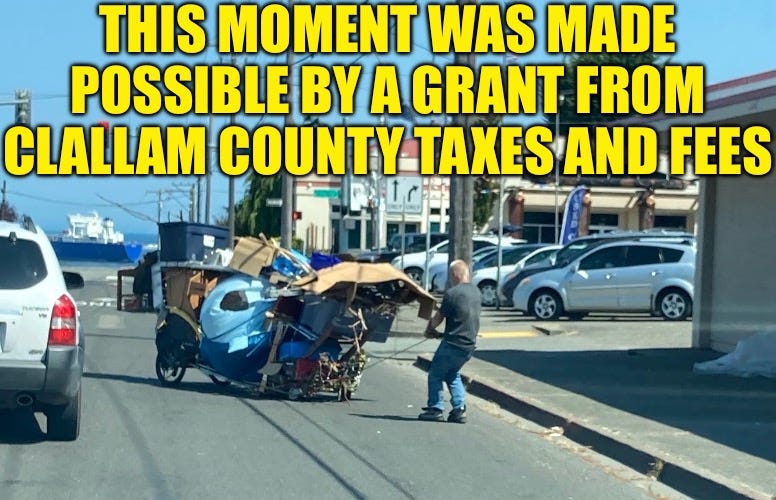
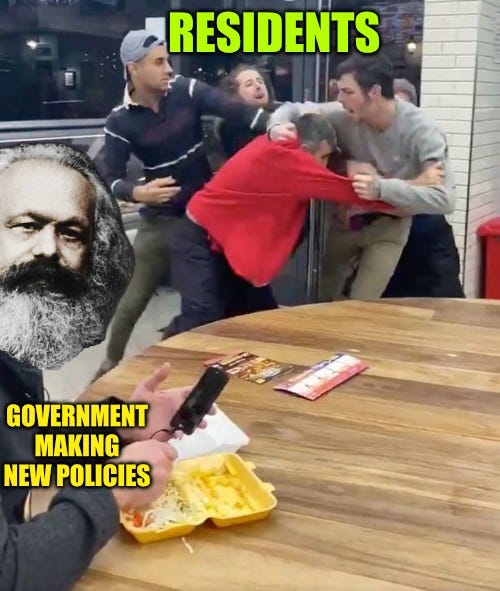
Worse yet, by pouring public funds into NGOs and county programs that fail to move anyone out of addiction, mental illness, or life on the street, the government deliberately pits neighbor against neighbor. Taxpayers grow resentful of the homeless, the homeless grow hostile toward the community, and the working class blames wealthy retirees.
This is the political distraction trick in full effect: while residents waste their energy fighting each other on the sidewalk, the wrist-twisting government turns the financial screw on everyone. Government collects the cash, the homeless stay homeless, the drugged stay drugged, and the residents inherit the decay.
Instead of offering fiscal accountability, Mr. French’s issue paper leaves local taxpayers with six direct, unresolved questions:
What exact benchmark or total dollar amount is expected to permanently resolve local homelessness?
Does county-funded “affordable housing” exclusively target low-income applicants, or can local working-class households qualify?
How many individuals have permanently transitioned off county housing vouchers into self-sufficiency in the last 12 months?
What is the current total administrative overhead cost across all county-funded homelessness programs?
What specific audit mechanisms track whether third-party grant recipients meet their performance targets?
How many new affordable housing units were actually built in Clallam County using document fee surcharges over the past three years?
Notice to Readers: AI software was used strictly as a research tool to scrape statutory texts, cross-check fee tables, and organize data. 100% of the editorial direction, voice, critical analysis, and human skepticism was directed and written under strict human oversight.

Jake Seegers will have a booth all four days and Jeff Tozzer will be with him!
Fair info available here
Submit your fair theme idea for the 2027 fair here
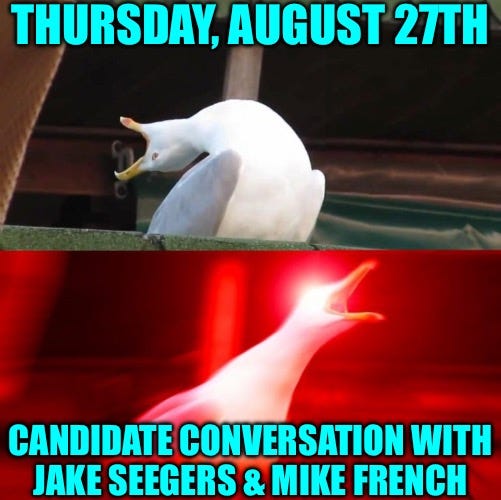
Thursday, August 27th, a candidate conversation with Jake Seegers & Mike French, candidates for Clallam County Commissioner District 3, at the Sequim Grange; hosted by the Calico Cat Club. The event is free and open to all. Information available online here and in the Google Event Invite.
Help get the petition to 600 signatures! You can sign the petition without displaying your name; the signature still counts, but if you want your name not to be seen by others, uncheck the box about displaying your name before clicking the submit button. Thanks to Terri D. for starting the petition!
4PA: A Clean & Safe Community for All
Monday Meetings Google Event Invite

New issues are published at 6am every Monday and Thursday.
Senator Mike Chapman: (360) 786-7646, email form
Representative Adam Bernbaum: (360) 786-7916, email form
Representative Steve Tharinger: (360) 786-7904, email form
Mark Ozias: Mark.Ozias@clallamcountywa.gov
Randy Johnson: Randy.Johnson@clallamcountywa.gov
Mike French: Mike.French@clallamcountywa.gov
Loni Gores, Clerk: Loni.Gores@clallamcountywa.gov
Find all other Clallam County officials, offices, and employees in the staff directory.
Comments
Nothing yet. Say the first thing.
Sign in to join the conversation.