
This article includes the talking points created by ChatGPT that we covered in our podcast. The complete automated transcript of the podcast can be accessed by clicking the ‘transcript’ button under the podcast window at the top of the article.
Will things get better?
Does voting even matter?
What can I control?
On our TV during the podcast: Tokyo Aoyama-Itchome Walk Japan
Podcast: Are You Black Pilled? Pt. 1
In Part One, we talked about three pills.
The blue pill means accepting the reality you’re given and going back to sleep. The red pill became a metaphor for discovering that the world may not work the way you were told. And the black pill takes that skepticism one step further: “Now that I see how badly things work, I don’t believe anything I do can change them.”
That distinction matters. Being angry isn’t being black-pilled. Distrusting government isn’t being black-pilled. Thinking an institution is corrupt — or even believing America is headed in the wrong direction — doesn’t automatically make someone black-pilled.
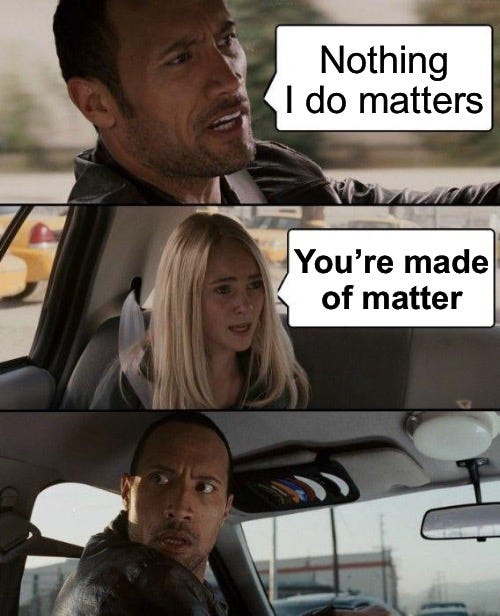
The black pill begins when skepticism turns into fatalism: “Nothing I do matters, so why bother?”
In Part One, we also looked at American history and saw that people have faced enormous crises before. Revolution, civil war, world wars, depression, political violence, nuclear threats, terrorism, and financial collapse all looked frightening to the people living through them. They didn’t know how those stories would end.
We also looked at how much an ordinary American has today that even someone as wealthy as John D. Rockefeller couldn’t have bought a hundred years ago.
So we ended with a question: If life is so prosperous, why doesn’t it always feel that way?
And now we’re going back to the political question we started with: If you’re unhappy with the direction of the country, does giving up make sense — or does it make things worse?
There’s a psychological idea called hedonic adaptation. The basic idea is simple: humans get used to things.
Something improves your life, and at first it feels amazing. Then it becomes normal. Eventually, you may wonder how you ever lived without it.
Indoor plumbing, air conditioning, internet access, and smartphones all went from remarkable luxuries to things we barely notice — until they stop working.
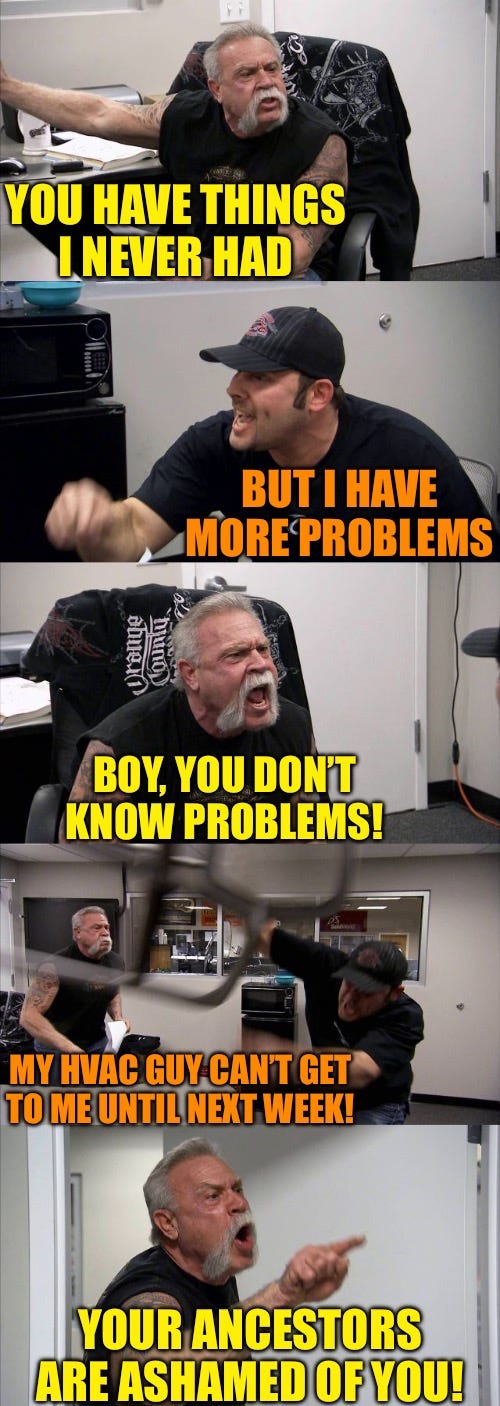
That creates a strange problem. The better life becomes, the higher our idea of “normal” becomes. Yesterday’s miracle becomes today’s expectation.
That doesn’t mean we should stop trying to improve things. It means we should be careful about assuming that having more problems than our ancestors somehow means we have a worse life than they did.
What’s something that used to feel like a luxury but now feels necessary?
Do we get unhappy because our lives are worse — or because we expect more?
How do we keep trying to improve things without taking everything we already have for granted?
One reason people become politically discouraged may be that they expect too much from a single vote.
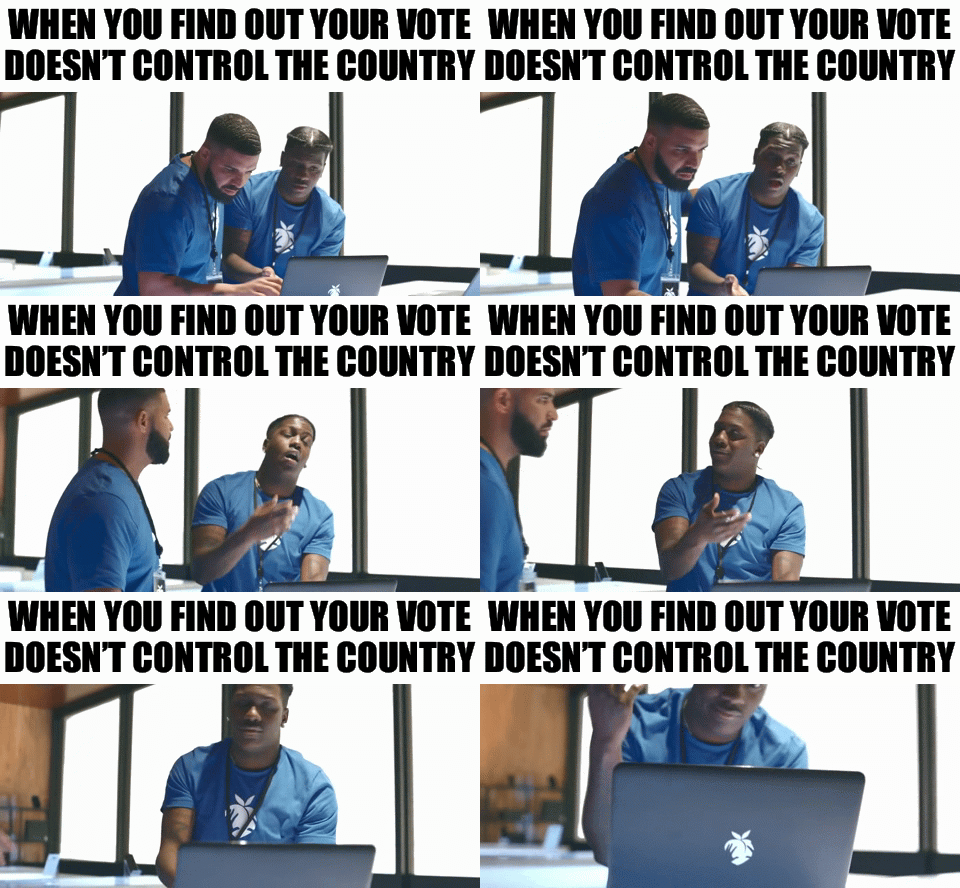
People say, “My vote doesn’t matter.”
In one sense, that’s true. There are hundreds of millions of Americans. Your individual vote was never supposed to give you control over the country.
Civic engagement in the democratic process doesn’t promise, “You will get your way.”
It promises something closer to, “You get a voice.”

And politics is much bigger than a presidential election. There are congressional races, state legislatures, county commissions, city councils, school boards, ballot measures, primaries, political parties, campaigns, community organizations, public meetings, local journalism, and ordinary people trying to persuade their neighbors.
The closer government gets to home, the more possible it becomes for a relatively small number of involved people to have an impact.
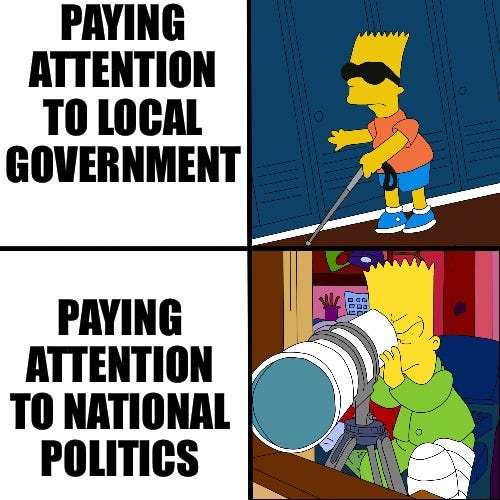
Do people pay too much attention to the president and not enough attention to local government?
Where can an ordinary person actually have the most influence?
Is saying “my vote doesn’t matter” sometimes an excuse for not getting involved in anything else?
Here’s the contradiction at the center of political black-pilling.
Suppose you believe people with terrible ideas have gained control of important institutions. You decide to stop participating. You don’t vote, attend meetings, organize, volunteer, support candidates, persuade people, or run for anything.
What happens?
The people who continue participating now have more influence.
They don’t need you to agree with them. They simply benefit from your absence.
That’s how political black-pilling can become self-fulfilling. You predict that you’re going to lose, and then you make choices that make losing more likely.
Who benefits when ordinary people decide politics isn’t worth participating in?
Is choosing not to participate actually a political decision?
What’s the difference between refusing to support something you believe is wrong and simply giving up your influence?
There’s a bad argument we don’t want to make: “Life is historically good, so stop complaining.”
No.
America has real problems. Government fails. Institutions become corrupt. Policies have consequences. People abuse power. Debt, crime, war, economic opportunity, and civil liberties all matter.
And the country is not guaranteed to keep improving. History gives us plenty of examples of countries and civilizations that declined.
But recognizing that possibility isn’t the black pill.
The difference is simple: Concern says something could go wrong. Fatalism says nothing can be done about it.
Those are not the same thing.
We don’t have to choose between pretending everything is wonderful and believing everything is hopeless. We can appreciate what is good, recognize what is broken, and still believe that our actions can make some difference.
How do we criticize America without deciding America is doomed?
Which problems deserve serious concern rather than another social-media panic?
Can being grateful for what we have actually make us more motivated to protect and improve it?
You don’t control Washington. You don’t control Congress. You don’t control hundreds of millions of other Americans.
You never did.
But you control considerably more than zero.
You control whether you vote. You control whether you know what’s happening in your community. You control what you teach your children, whether you help your neighbors, whether you build something, and whether you participate in the life around you.
You also control how much time you spend consuming content designed to make you angry and hopeless.
New Radicals: You Get What You Give
This world is gonna pull through; don’t give up, you’ve got a reason to live; can’t forget, we only get what we give
And you control what you do after discovering that the world is imperfect.
You can withdraw from it. Or you can engage with it.
Maybe the answer to the blue pill isn’t the black pill. Maybe it’s simply seeing reality clearly without surrendering to it.
You can believe the country has serious problems while recognizing something equally true: for all its faults, this is an extraordinary time and place to be alive.
And if something needs fixing, declaring it hopeless is probably the least useful thing we can do.
What are we most optimistic about over the next 20 years?
What are we most concerned about — and what can ordinary people realistically do about it?
If someone listening has become genuinely black-pilled about America, what would we tell them to do tomorrow morning?
Jesus Jones: Right Here Right Now
There is no other place I wanna be
Tuesday, August 18th will be the next update of the primary election results:
Clallam County Election Result Updates

Jake Seegers will have a booth all four days!
Fair info here
Hours & admission prices here
Submit your fair theme idea for the 2027 fair here


Thursday, August 27th, a candidate conversation with Jake Seegers & Mike French, candidates for Clallam County Commissioner District 3, at the Sequim Grange; hosted by the Calico Cat Club. The event is free and open to all. Information available online here and in the Google Event Invite.

Beat the summer heat with cool smoothies and other tasty treats from Aloha Smoothies. No smoothie packets or artificial sweeteners; real food that’s really good. Friendly owners who love what they do. It’s a great local business to support.
Follow Aloha Smoothies on Facebook here
Find Aloha Smoothies contact info, hours, and more on Google here
Address: 412 S Lincoln St, Port Angeles, WA 98362
Help get the petition to 600 signatures! You can sign the petition without displaying your name; the signature still counts, but if you want your name not to be seen by others, uncheck the box about displaying your name before clicking the submit button. Thanks to Terri D. for starting the petition!
4PA: A Clean & Safe Community for All
Monday Meetings Google Event Invite

New issues are published at 6am every Monday and Thursday.
Senator Mike Chapman: (360) 786-7646, email form
Representative Adam Bernbaum: (360) 786-7916, email form
Representative Steve Tharinger: (360) 786-7904, email form
Mark Ozias: Mark.Ozias@clallamcountywa.gov
Randy Johnson: Randy.Johnson@clallamcountywa.gov
Mike French: Mike.French@clallamcountywa.gov
Loni Gores, Clerk: Loni.Gores@clallamcountywa.gov
Find all other Clallam County officials, offices, and employees in the staff directory.

Comments
Nothing yet. Say the first thing.
Sign in to join the conversation.