
If you are in a room full of biologists and want to start a fight, you can simply ask: ‘What is a species?’ Or better yet: ‘Do subspecies exist?’
Then sit back, grab some popcorn, and watch them quarrel.
Why is it so hard to define what a species is? To start off, there are about 26 recognized species concepts in the scientific literature1. Here, however, I will highlight just four of the major and most commonly used species concepts, along with the strengths and weaknesses of each.
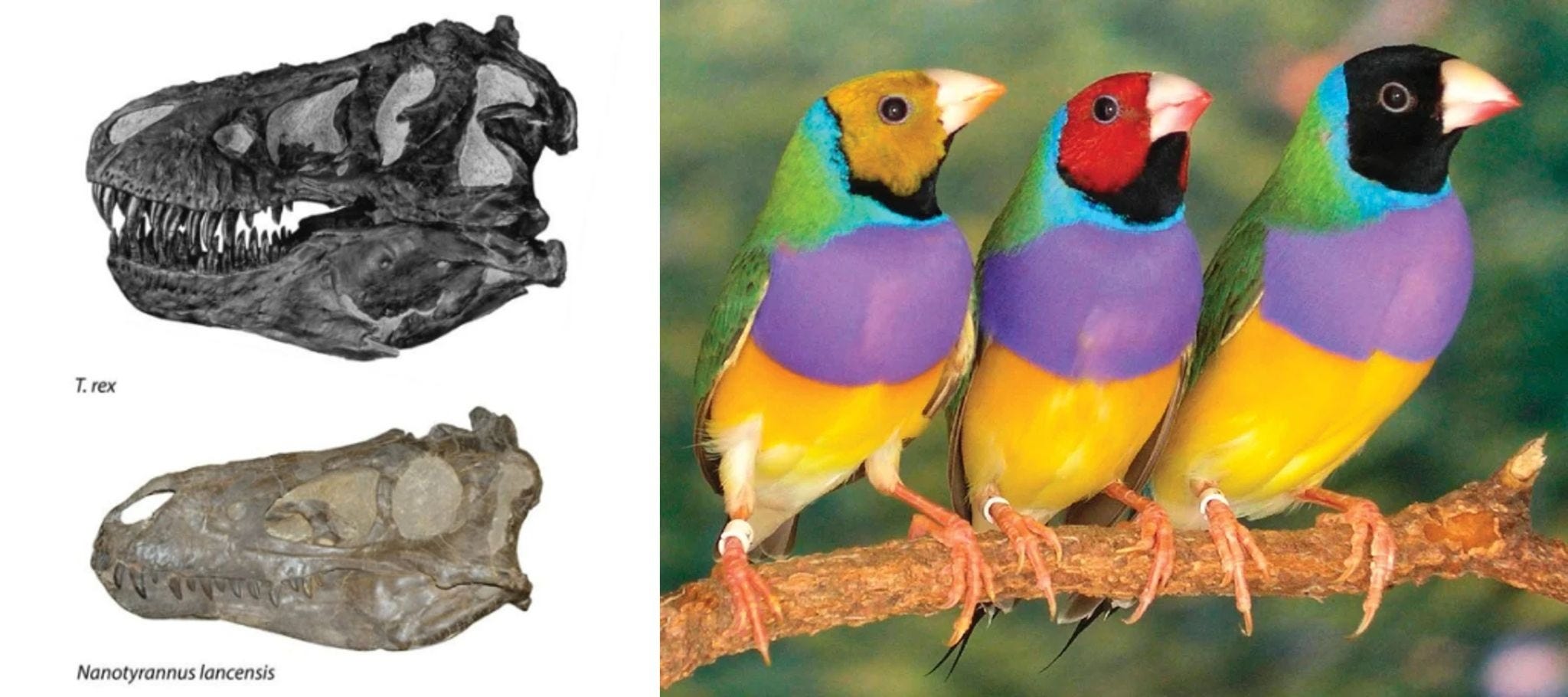
The morphological species concept classifies organisms into species based on their morphology, or physical appearance. Individuals within the same species are more similar to one another than to individuals from different species.
This is one of the oldest methods used in classification, including in the Linnaean system of taxonomy: domain, kingdom, phylum, class, and so on. It emphasizes the outward appearance of organisms rather than behavior, in part because classification was often done on preserved specimens rather than live animals.
One strength of this method is that 99.9% of all species that have ever lived on Earth are now extinct, and most of the time all we have are their fossils. For creatures that we know only from the fossil record, like dinosaurs, we classify them by describing and comparing their morphology. Fun fact: paleontologists recently found new, and perhaps conclusive, evidence that Nanotyrannus is a separate genus rather than simply a juvenile T. rex2, ending the decades-long debate on this question.
But the strength of this approach is also its weakness. If a species can produce different phenotypes, a phenomenon called polymorphism, such as in Gouldian finches, one could mistakenly classify them as different species based on morphology alone. Many organisms are not only polymorphic, but also sexually dimorphic, meaning males and females look different.
Additionally, there are also cryptic species, which look nearly identical but are genetically distinct. For example, giraffes were once thought to belong to a single species, but genetic studies now support recognizing four species3. This makes the morphological species concept difficult to apply.
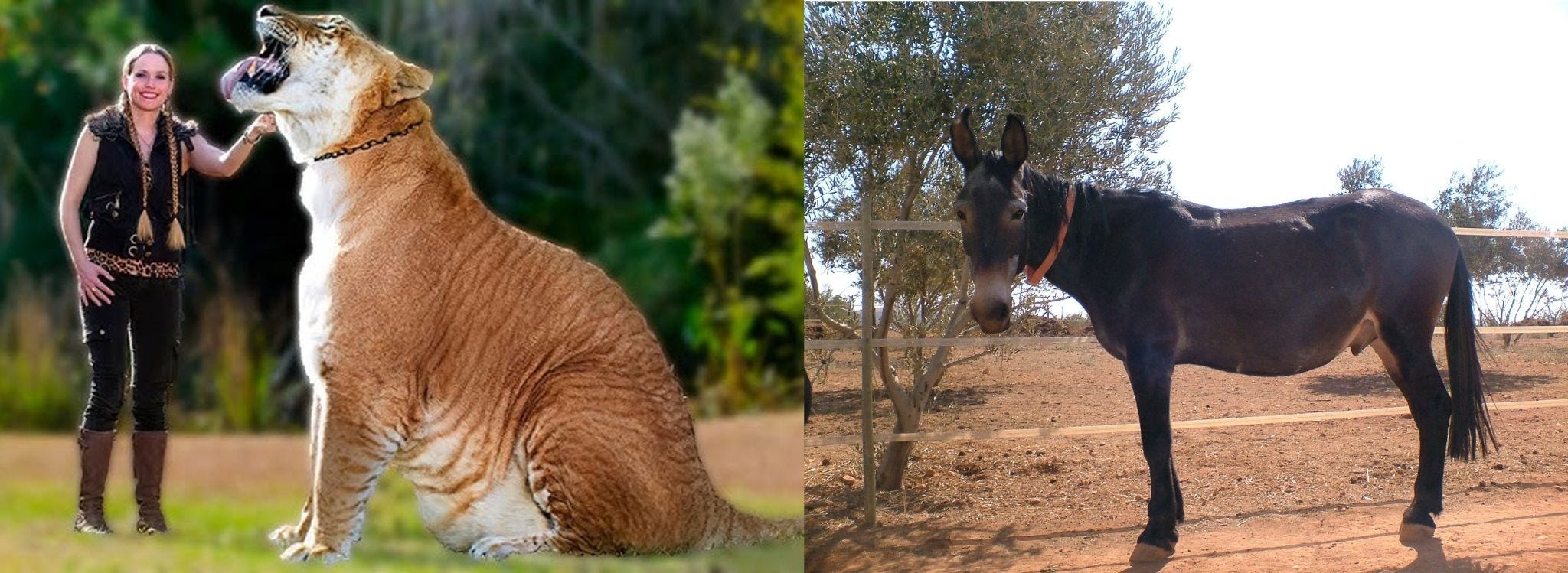
Coined and popularized by evolutionary biologist Ernst Mayr in the mid-20th century, the biological species concept defines species as interbreeding natural populations that are reproductively isolated from other groups. At first glance, the concept is straightforward and easy to understand. But in practice, there are some important nuances.
For example, all three wolf species — gray, red, and Ethiopian wolves — can interbreed and produce viable offspring. According to this species concept, some would argue that there is really only one true wolf species because of hybridization. Additionally, domesticated dogs (Canis lupus familiaris) are technically a subspecies of the gray wolf (Canis lupus).
Many species can produce hybrids, which is more common in plants than in animals, yet their offspring are often infertile, such as mules and ligers. This species concept is limited to sexually reproducing organisms, and many organisms reproduce asexually. It is also not applicable to extinct species known only from fossils. With allopatric, or geographically isolated, populations, it is difficult to know whether they once were, or still are, capable of producing fertile offspring in nature. Lastly, this definition of species is not always helpful for conservation efforts. If all wolves and dogs are considered one species, what makes gray wolves in Yellowstone distinct from Ethiopian wolves?
If two species can produce viable offspring in captivity, but it never happens in the wild, does that make them separate species?
In this concept, a species is defined as a set of organisms exploiting, or adapted to, a particular ecological niche. Unlike the biological species concept, the ecological species concept focuses more on functional roles than on reproductive isolation.
A species can be thought of as a group of populations that compete more with their own kind than with members of other species. This is because organisms that are more similar to one another tend to have more overlapping needs. As a result, they are expected to compete for the same niche and are therefore more likely to belong to the same species.
In the diagram above, grasshopper sparrows live in grasslands, and they are more likely to compete with their own kind than with black warblers, which live in dense oak forests. The ecological species concept is mainly about ecological competition and niche occupation.
One criticism of this method is that it depends on how we define niches, and that is not always clear. Many species also change their niche over the course of their lives. Second, it is not always easy to determine the degree to which two or more organisms are actually competing ecologically.
Just tell me what a species is already!
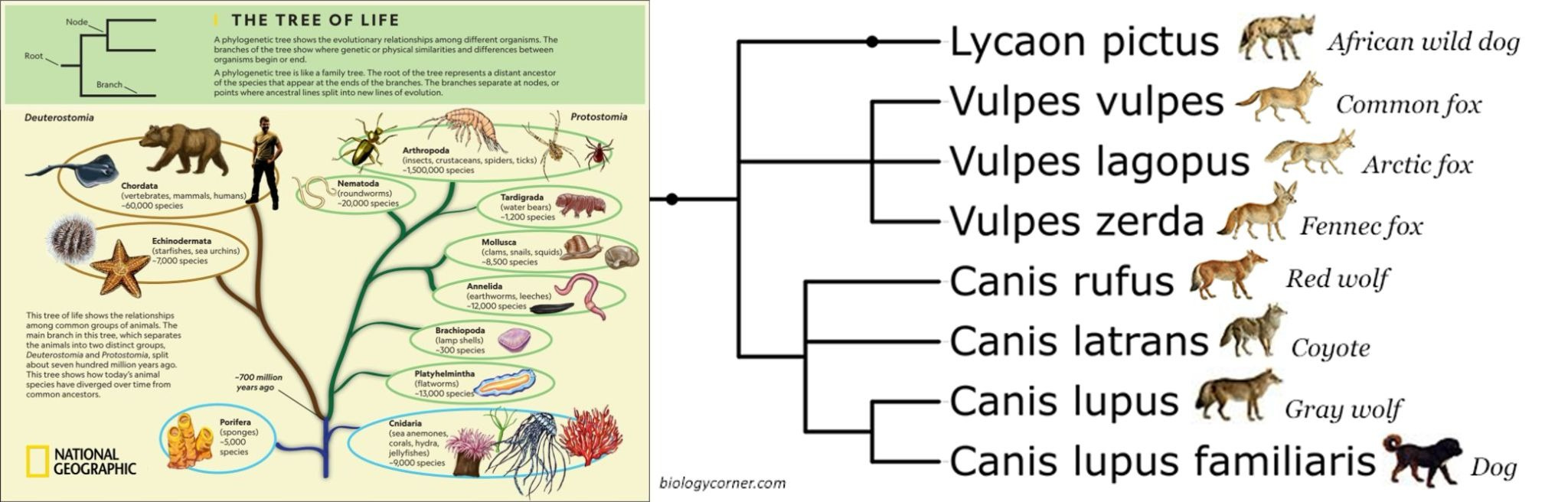
Closely related to the evolutionary species concept, the phylogenetic species concept is often associated with paleontologist George Gaylord Simpson (1951).
“A single lineage of ancestor-descendant populations that maintains its identity from other such lineages over time and space, possessing its own independent evolutionary fate and historical tendencies”4
If you take the DNA of some organisms and compare how similar they are, you can group them into something called a cladogram, or phylogenetic tree, with each branch representing a lineage, like the one above for foxes and wolves. If you extend this to all major living things on Earth, you get the so-called tree of life, because all life shares common ancestry at some point in the past.
A species is then defined as the tip of a phylogenetic branch. This is usually determined using certain parameters or thresholds of similarity in DNA sequence. It may feel a bit arbitrary or vague, but in many ways that simply reflects how fluid species really are in nature. Nature does not care about our definitions of species. Species are all related, and life never stops evolving.
The biggest strength of this approach is that it takes the relatedness of organisms seriously by comparing their genetic blueprints. If you have the DNA of an organism, even if you have never seen it before, you can often figure out how it is related to other living things on Earth and where it fits in the tree of life.
The challenge is that every species has its own evolutionary history, and some species evolve faster than others. Rates of molecular evolution — how quickly DNA sequences change over time — can differ drastically. For example, the scientific consensus is that tunicates (Urochordata) are more closely related to vertebrates than lancelets (Cephalochordata). However, tunicates have undergone more extensive genomic rearrangements than lancelets. That is one reason researchers often use lancelets to model the ancestral state of vertebrates5.
Another challenge is that resolving deep phylogenetic relationships is often difficult, because every living lineage has been evolving for millions or even billions of years. This often leads to debates and sometimes even major revisions in how we understand certain groups to be related6. That does not mean biologists doubt the big picture of evolution, or the tree of life itself. It just means there is still debate about where exactly some of the branches go.
Still, molecular phylogenetics often gives us more confidence in evolutionary relationships than morphology alone. When DNA sequencing became widely used, Darwin’s theory of evolution was put to the test, and molecular phylogenetics not only supported common descent but also helped us better understand the mechanisms behind how species evolve.
As we move toward sequencing all life on Earth7, the power of the phylogenetic species concept is only beginning to be realized. As an evolutionary geneticist, it is probably not surprising that this is my favorite species concept.

In the end, no one truly knows what a species is, and no single definition can fully capture that. Not only because there are many ways to define it, but also because species exist along a continuum, a continuous spectrum. So we should not expect to be able to classify organisms into neat binary bins, and maybe we should stop trying to force nature into them.
Each species concept has its own strengths and limitations. Some are better suited for morphological data, while others are more useful for conservation or for testing evolutionary hypotheses.
Unlike mathematics or physics, which are often bound to certain laws and constants, biological species are hard to define by strict rules. There are no hard boundaries between species, but rather gradients and transitions shaped by common descent. That is why the phylogenetic species concept is my favorite: it best captures the evolutionary relationships among organisms.
I hope by now you can better understand how challenging it is to define what a species is. And once you recognize the fluidity of species, you are one step closer to understanding why evolution is the centerpiece of biology.
Hi! I am Chi-Jing Leow, a Christian biologist. I am also a follower of Jesus, and I care deeply about exploring the topics at the intersection of science and faith.
References:
https://ncse.ngo/species-concepts-modern-literature
https://www.science.org/content/article/surprise-there-are-four-species-giraffe-not-one
E. O. Wiley, The Evolutionary Species Concept Reconsidered, Systematic Biology, Volume 27, Issue 1, March 1978, Pages 17–26, https://doi.org/10.2307/2412809
Putnam, N., Butts, T., Ferrier, D. et al. The amphioxus genome and the evolution of the chordate karyotype. Nature 453, 1064–1071 (2008). https://doi.org/10.1038/nature06967
https://www.science.org/doi/10.1126/science.aef5589
Lewin, H. A., Robinson, G. E., Kress, W. J., Baker, W. J., Coddington, J., Crandall, K. A., Durbin, R., Edwards, S. V., Forest, F., Gilbert, M. T. P., Goldstein, M. M., Grigoriev, I. V., Hackett, K. J., Haussler, D., Jarvis, E. D., Johnson, W. E., Patrinos, A., Richards, S., Castilla-Rubio, J. C., van Sluys, M. A., … Zhang, G. (2018). Earth BioGenome Project: Sequencing life for the future of life. Proceedings of the National Academy of Sciences of the United States of America, 115(17), 4325–4333. https://doi.org/10.1073/pnas.1720115115
No posts
Comments
Nothing yet. Say the first thing.
Sign in to join the conversation.