
The Story of Everything is a faith-based documentary based on the work of Stephen C. Meyer, the current leading voice for Intelligent Design (ID). I watched it the first day it came out in theaters. Not because I was particularly excited, but because, as someone who thinks about science and faith on a daily basis, I felt like I ought to see it and give my honest thoughts.
I was pleasantly surprised that they offered free tickets to students on opening weekend. I ended up paying only 19 cents because of some add-on convenience fee. Not too bad.
I am an evolutionary geneticist. I have a BA and an MS in biology, and I am currently working on my PhD. That is just to say that I might know a little bit more than the average person watching this film. I am also a Protestant Christian. The core theology I hold to can be summarized by the Nicene and Apostles’ Creeds.
So I am reviewing this as a Christian scientist. Spoilers Alert!
My central problem with the film is not that it argues for design or purpose. As a Christian, I fully accept that. My problem is that the documentary treats biological evolution as if it were inherently purposeless and meaningless.
And that, to me, is the biggest issue with the film.
Lee Strobel, the author of The Case for Christ, opens the documentary by inviting the audience to consider the evidence for themselves.
“There have been two stories told of the same reality. One says there is an intelligent Designer. The other says we evolved in a mindless way by accident. Which one is true?” (paraphrased)
What is the story of everything? They asked the key question.
The documentary spends almost an hour talking about the Big Bang and fine-tuning. I will dedicate more time reviewing the biology portion, since that is my area of expertise.
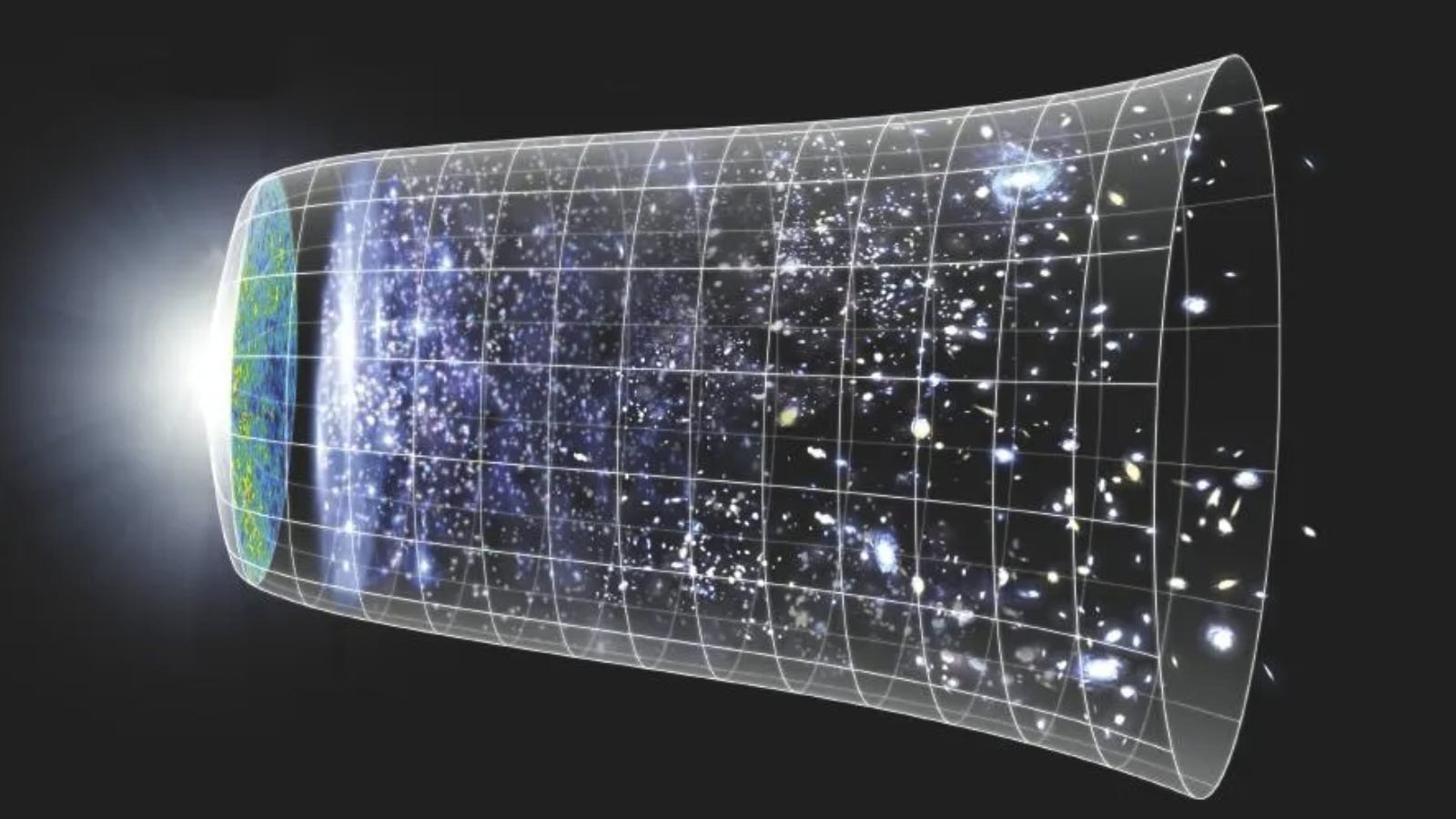
The documentary gives a fairly comprehensive history of how modern cosmology shifted from the idea of a static, eternal universe to a finite and expanding universe. The discovery of the cosmic microwave background and the redshift of distant starlight point to the universe once being in a hot, dense state before expanding outward.
Stephen Hawking and others calculated backward toward what is often called the “singularity.” Fred Hoyle also played a key role in the discovery of fine-tuning, starting with the precise conditions needed to make carbon and moving toward many other constants that appear incredibly narrow. The universe seems to be finely tuned to allow life. Even the position of Earth seems to be in the right place. The Goldilocks universe and the Goldilocks Earth.
I am not an astrophysicist, so correct me if you are an expert in this. Meyer and others argued strongly that the Big Bang was indeed the beginning of space and time. Is this true? I think the more scientifically accurate way to say it is that our modern understanding of physics breaks down at the singularity. Currently, we do not know what is beyond that. Could this be the beginning of spacetime? Maybe. Regardless, I believe that God is the ultimate creator of all things.
Recently, the James Webb Space Telescope has found many surprisingly mature galaxies shortly after the Big Bang1, potentially rewriting our understanding of the early universe and cosmic timeline. I also did not like how Meyer mocked theoretical physicists who propose the multiverse as an explanation for fine-tuning. First of all, the multiverse theory is not completely unreasonable. It might be unlikely, but it is still plausible. Second, even if multiverses exist, that does not necessarily rule God out either. Why would God be limited to creating only one universe? To claim that the multiverse theory is just an atheist attempt to work around fine-tuning felt unfair to me.
This is the same argument proposed by Michael Behe 30 years ago in his book Darwin’s black box (1996). He argued that the machineries of the bacterial flagellum are too complex to have evolved by incremental steps. A classic “irreducible” complexity example promoted by ID.
In Chinese we call it 炒冷饭, stir frying leftovers or repackaging old content. I do not need to go into details on this. Here are some resources2 and a paper3 if you would like to read about it. If you like videos, Stated Clearly recently published a series of videos on YouTube describing how flagellum evolved. Nevertheless, it’s worth noting that Behe himself seems to accept evolution by common descent4.
Meyer quoted Darwin from On the Origin of Species:
“If it could be demonstrated that any complex organ existed, which could not possibly have been formed by numerous, successive, slight modifications, my theory would absolutely break down.5”
Meyer then said that Darwin did not know about these irreducibly complex organs, and that evolution was proposed as a “designer’s substitute.”
This is a serious misrepresentation.
Of course Darwin didn’t know everything we know today. But to say that these “irreducible complex” structures disprove evolution is just plain wrong. The blood clotting cascade, for example, was once proposed as an example of irreducible complexity, but we now have evidence for how it evolved through processes such as gene duplication67. Second, the theory of evolution is based on multiple independent lines of evidence, to say evolution was merely the alternative explanation of God’s work is utterly false.
Modern cell biology and genetics did not disprove evolution. If anything, the discovery of DNA and genomics only strengthened the case for common descent by giving us a clearer mechanism for how variation arises and how it can be tinkered by natural selection.
If we can show, which we already have in many cases, how these complex structures evolved in a stepwise fashion, does that mean life is not intelligently designed? I don’t think so.
To me, this is where the irreducible complexity argument becomes dangerously close to a God-of-the-gaps argument.
Abiogenesis, the process of life arising from non-life, is still an active field of research with not one but multiple hypotheses.
James Tour is the biochemist who champions this section for Intelligent Design. He said that “the poor early Earth was mindless… and molecules don’t come together on their own.”
Intelligent Design proponents argue that abiogenesis is virtually impossible. This lies outside my expertise. Is abiogenesis really impossible? Or just improbable? I don’t know. Some suggest that maybe we have been looking in the wrong place. What if life originated outside Earth? After all, the five building blocks of DNA have been found on asteroids8.
That does not solve every problem, of course. But it does show that the origin-of-life question is still an active scientific question, not a settled debate.
Here is my thought. If one day scientists make new discoveries and propose a solid model for abiogenesis, how would Christians react? I expect the ID folks and many Christians would not embrace it. We might even say “it’s just atheists trying to explain something without invoking the divine.” Do you see the dilemma?
In the film, they present the information enigma - where did information come from? The definition of information is another topic worth discussing in detail. But Meyer stated information is not just a unique set of symbols, but the symbols have to have functions. How DNA molecules attract to each other might be due to biochemical forces (bonds), but the arrangement of the DNA is not due to that.
John Lennox said that when we see information, we always associate it with intelligence, with a mind. Meyer illustrated this with an animation of a bunch of monkeys typing random words on keyboards, suggesting that information cannot come from randomness. This is a misleading way to frame evolution!
Here is what I disagree with. The order of DNA is not merely caused by the biochemical bonds between nucleotides, but certain genetic arrangements (or code if you will) are more likely to get passed down to the next generation. While mutation can be sporadic - generating random sequences, the selection on the genetic variation are not random at all. That is because when you have a beneficial trait in an organism, the genetic codes underlying that are selected by natural selection. That is not monkeys typing randomly and somehow producing Shakespeare. This is self-replicating life, with strong selection acting on certain combination of genetic variations.
New “information” can certainly arise through mutation and evolution. One common mechanism is by gene and genome duplications, which is part of my PhD work. Research has shown that even randomly generated DNA sequences can have some function, or even improved function, compared with the original sequence.91011

The problem of gratuitous beauty is a philosophical claim drawn from biological observations. The argument is that extravagant and “unnecessary” beauty in nature far exceeds what is required for survival or evolution, suggesting a divine Creator rather than just natural selection. Meyer said this is a “huge problem” for evolution. Is that so?
Their assumption about evolution seems to be that everything we see in nature has to serve some specific evolutionary purpose. But this is not true.
A trait can persist in a population if it is neither strongly advantageous nor strongly harmful to an organism’s survival. Additionally, deleterious or harmful traits can continue to be passed down when selection is not strong enough to remove them from the population.
Second, we all know that beauty is in the eye of the beholder. One can easily conclude that a mandarin duck is beautiful. But what about a naked mole rat that never sees sunlight? A bunny? A tarantula? Is one more beautiful because it’s more intelligently designed? Does God show favoritism in what he creates?
Yes, as a biologist, I am fascinated by the tremendous beauty in nature. But I do not have to draw that conclusion from something that serves no evolutionary purpose. Nature is beautiful as it is. The gorgeous peacock feathers displayed for courtship are still beautiful even if they serve a role in survival and reproduction.
I think creation made through evolution is beautiful and wonderful. Just because something has an evolutionary purpose does not diminish its beauty.
For millions and billions of years, creatures evolved without human eyes to see them. Distant black holes crash and form supernovae — the greatest fireworks that most human beings never saw, except God.
Creation is for God, and beauty is according to his standards, not ours. Nature is beautiful not just because we can see it, but because of him who made all things.
When you draw philosophical conclusions from scientific evidence, you are making a metaphysical leap of faith. You are crossing from a scientific claim to a philosophical claim, such as “there is an intelligent Designer and Creator,” as Meyer and others suggest.
When Richard Dawkins writes, “The universe we observe has precisely the properties we should expect if there is, at bottom, no design, no purpose, no evil and no good, nothing but blind pitiless indifference,” that is also a philosophical and worldview claim.
Science describes the mechanisms. It can tell us how stars form, how species change over time, how genes mutate, how traits are inherited, and how natural selection acts on variation. But whether these natural processes are ultimately purposeless or guided by God falls outside scientific inquiry.
That is a philosophical and theological question. This distinction matters a lot!
Darwinian evolution is a scientific theory, not a philosophical claim. I have written about this elsewhere, including some of C.S. Lewis’s thoughts on evolution.
Many people abuse evolution to support their worldview like Richard Dawkins. But many Christians fall for the same mistake in the opposite direction, including Meyer.
In the documentary, Meyer frames evolution as a mindless and meaningless process. But that is not a scientific claim. That is a philosophical claim!
Just like entropy in the universe increases over time, or water molecules cycle through atmosphere and rivers, evolution is just what happens to life over time. It is a mechanism. It is metaphysically neutral, meaning it does not say whether life has a purpose or not.
Evolution ≠ mindless & meaningless
The evidence for evolution is overwhelming. From the fossil record to comparative morphology to genetics, the evidence points to common descent. I have written elsewhere about how genetics rules out the “common designer” argument.
Here is what I want you to know: like myself, there are many Christian scientists who accept evolution.
You do not have to choose between accepting evolution and believing that the world has purpose and meaning.
God can work through anything, even evolution. He is behind the history of life just as he is behind the history of the universe.
Nothing presented in the film is really “new.” The arguments from the Big Bang and fine-tuning have been around for a while. I generally accept a finite, non-eternal universe and the fine-tuning for life as compelling evidence for a Creator. But I think their view of the multiverse theory was unfair.
The ID critiques of evolution based on “irreducible complexity,” the information enigma, and the problem of gratuitous beauty have not challenged, let alone overturned, Darwin’s theory of evolution.
Would I recommend this film to others? I don’t know. I think it could be a good conversation starter. But there is some serious misinformation about evolution in it.
Would a non-scientist enjoy this film? I don’t know, perhaps not. The documentary is an hour and 45 minutes long. My wife kindly joined me at the theater, but she said the film was long and she did not understand most of it. For people who have taken some college-level science courses or have a degree in science, they might find it fascinating or entertaining. Though I disagree with quite a few things, the film was decently well made. I took seven pages of notes in the theater to write this review…
Would an atheist scientist change their mind after watching this? Maybe, but like I said, when you look at the evidence, you still have to make a metaphysical leap of faith to claim that there is or is not a God.
At the end of the film, Meyer circles back to the opening question:
“So, what is the story of everything? Is the universe operating by purely naturalistic processes and random chance, or does everything have the fingerprint of the Creator?”
The film presents the choice as one between a teleological worldview, where the universe has purpose, and a dysteleological worldview, where it does not. Without hesitation, I would identify with a world that is full of purpose and meaning.
But here is the catch: a purposeful and meaningful worldview and evolution can coexist. They are not mutually exclusive.
There is a third option. I’d argue it’s a better and more accurate story of reality.
My whole work on this platform has been about showing the scientific evidence for evolution while also showing how it does not necessarily contradict a Christian worldview.
As an evolutionary biologist, I am mind-blown every time I learn about how a novel trait or phenotype evolved through evolution. That is so creative. And I know the God behind this.
I am not more amazed when something “could not have been made by accident or chance.” I am more amazed when I discover how a particular gene or function evolved, and I think to myself: “This is how God did it.” And he lets us play the detective game to find out. How fun is that?
At the end of On the Origin of Species, Darwin concluded
“There is grandeur in this view of life, with its several powers, having been originally breathed into a few forms or into one; and that, whilst this planet has gone cycling on according to the fixed law of gravity, from so simple a beginning endless forms most beautiful and most wonderful have been, and are being, evolved.”
Darwin saw how wonderful and creative evolution is in bringing about the diversity of life. Evolution does not rule out meaning and purpose.
Christianity tells us the ultimate meaning and purpose of our existence, and evolution describes the process of how God created life.
That, to me, is the more robust and compelling story of everything.
P.S. I wanted to publish this as soon as possible because the documentary is rolling out this weekend, and I suspect some people, especially Christians, will watch it. That is why I wanted to put my review out there. If you find it helpful or know someone who might want to read it, feel free to share the link.
I especially welcome people with different views to comment—with respect and sincerity, of course. I look forward to engaging on this topic.
Hi! I am Chi-Jing Leow, an evolutionary geneticist. I am also a follower of Jesus, and I care deeply about exploring the topics at the intersection of science and faith.
References:
https://www.nasa.gov/missions/chandra/nasa-telescopes-spot-surprisingly-mature-cluster-in-early-universe/
https://biologos.org/articles/bacterial-flagellum-irreducibly-complex
Beeby, M., Ferreira, J. L., Tripp, P., Albers, S. V., & Mitchell, D. R. (2020). Propulsive nanomachines: the convergent evolution of archaella, flagella and cilia. FEMS microbiology reviews, 44(3), 253–304. https://doi.org/10.1093/femsre/fuaa006
Darwin, C. (1859). On the origin of species by means of natural selection.
Doolittle R. F. (2009). Step-by-step evolution of vertebrate blood coagulation. Cold Spring Harbor symposia on quantitative biology, 74, 35–40. https://doi.org/10.1101/sqb.2009.74.001
Coban, A., Bornberg-Bauer, E., & Kemena, C. (2022). Domain Evolution of Vertebrate Blood Coagulation Cascade Proteins. Journal of molecular evolution, 90(6), 418–428. https://doi.org/10.1007/s00239-022-10071-3
Koga, T., Oba, Y., Takano, Y. et al. A complete set of canonical nucleobases in the carbonaceous asteroid (162173) Ryugu. Nat Astron (2026). https://doi.org/10.1038/s41550-026-02791-z
Neme, R., Amador, C., Yildirim, B. et al. Random sequences are an abundant source of bioactive RNAs or peptides. Nat Ecol Evol 1, 0127 (2017). https://doi.org/10.1038/s41559-017-0127
Yona, A.H., Alm, E.J. & Gore, J. Random sequences rapidly evolve into de novo promoters. Nat Commun 9, 1530 (2018). https://doi.org/10.1038/s41467-018-04026-w
Gianni, E., Kwok, S. L. Y., Wan, C. J. K., Goeij, K., Clifton, B. E., Colizzi, E. S., Attwater, J., & Holliger, P. (2026). A small polymerase ribozyme that can synthesize itself and its complementary strand. Science (New York, N.Y.), 391(6789), 1022–1028. https://doi.org/10.1126/science.adt2760
No posts
Comments
Nothing yet. Say the first thing.
Sign in to join the conversation.