
How to describe something that doesn’t exist. Especially a feeling.
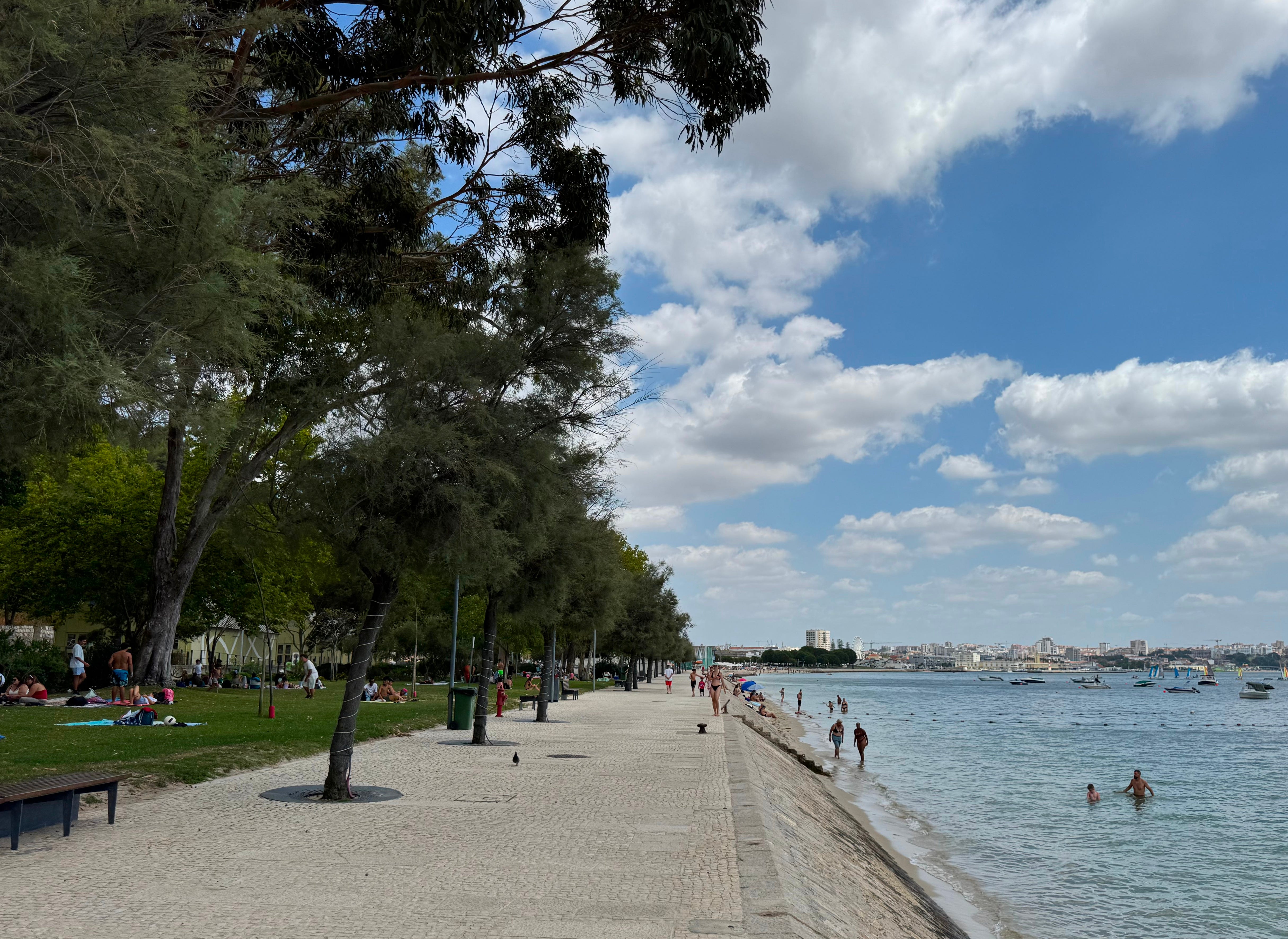
I’ll make a first attempt by describing the Sunday-morning scene in my city.
Regular readers know Setúbal is where Portugal’s Sado River empties into the Atlantic Ocean. I’ve written about the mesmerizing marinas and some public art along the riverfront. Seafood restaurants, pubs and cafes line the street across from the promenade, and farther west, the waterfront gets more recreational at the foot of the Arrábida Natural Park. There’s a popular city beach with a bar/café called Rockalot where an outdoor DJ is always playing something smooth. Beyond that, a club where you can take sailing lessons or rent kayaks, and farther still, shady lawns, a basketball court, spaces with workout equipment and another café that feels like a locals-only secret back in the trees.
I’ve spent time in a lot of American cities with popular public spaces, and it’s always good to see people out enjoying them. The same thing is true for Setúbal’s waterfront. People are always out fishing from the rocks, strolling or jogging along the paths, playing or lounging on the grass, swimming at low tide. But Sunday mornings are the best — a beautiful array of far more people, of all ages and in all imaginable configurations of family and friends, outside enjoying the place and each other.
On one of those Sunday mornings not long ago, as I watched kids kicking around balls, folks lying on blankets, elder elders chatting on benches, everyone relaxing, I kept wondering: This same scene could be happening anywhere in the United States, so why does it feel so different?
It was the absence of fear.
I didn’t go talk to any of the Portuguese people, or the tourists I know to be enjoying Setúbal’s public spaces on any given day, so I was making an enormous assumption. But also: fear is an energy you can sense. In America, fear is a survival instinct whenever more than a few people are gathered in one place.
It’s fear, mainly, that anyone with a semi-automatic or an SUV will start mowing people down. Or fear of just getting hit by a stray bullet. Or, at the very least, the fear that someone nearby might be a danger physically or politically.
I’ve written before about the feeling of safety here. Portugal is objectively one of the world’s most peaceful countries and also one of the safest. I’ve written about how it took us a few months to even notice this strange sensation of safety, and about how it feels safe to walk, as a woman alone, in the middle of the night.
I’m writing about it again, with no concern about redundancy, because the more I experience it, the more it’s worth repeating.
Meanwhile, one of this week’s headlines from the U.S.: “9 separate mass shootings across US leave 9 dead, 60 injured over the weekend.”
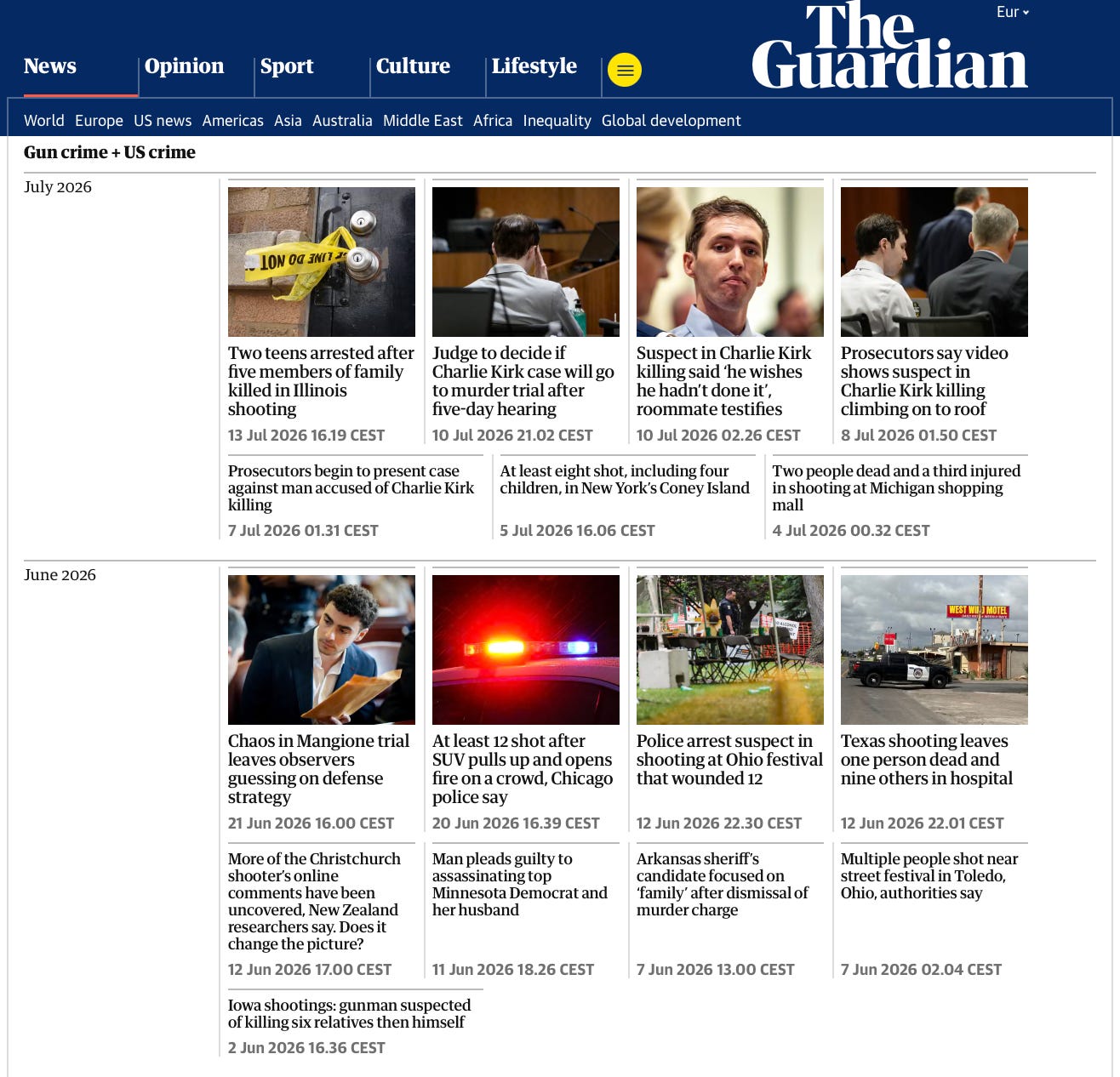
I still read news from U.S. sources, but increasingly the ratio tilts toward European media outlets, particularly The Guardian and the BBC, because I still need news in English. They are bracing in their assessments of the United States’ behavior.
On Wednesday, for example, the Guardian’s morning newsletter, headlined “How Trump’s Iran gamble has produced a crisis reshaping the global order,” reminded readers of the president’s election-night promise in 2024: “I’m not going to start wars.” By that time most of us had years of proof that everything out of his mouth was the opposite of reality, but I confess it was still a bit stunning to see this reminder in print.
The Guardian seemed shocked too. “His decision to bomb Iran on 28 February in partnership with Benjamin Netanyahu was astonishing both in its aggression and its audacious break with this promise,” wrote Hettie O’Brien. “Trump did nothing to prepare the US for war, gave seemingly no thought to the fact that Iran would inevitably hold the strait (of Hormuz) hostage if it came under attack, and resorted to contradictory explanations for his decision.” And so on, about the president’s “fatal miscalculation.”
While the United States threatens to destabilize the world, has killed thousands of people and racked up tens of billions of dollars in its war with Iran, millions more Americans are going hungry because of cuts to food programs. Mass challenges to the midterm elections are sparking predictions about the end of American democracy. And now the country’s suffering an entirely preventable outbreak of explosive diarrhea.
What I want my American family and friends to know is that I’m still paying attention. Many of them are working tirelessly for a better world, so I also want to give them hope.
A few days ago, I tested my impressions of Setúbal’s Sunday mornings with a Portuguese friend, one who has traveled extensively in the United States. She knew immediately what I was saying about the noticeable absence of fear among people out in public. “We don’t have that here,” she said.
So I’m reporting from on the ground over here to say that yes, there really is a different way to live.
Comments
Nothing yet. Say the first thing.
Sign in to join the conversation.