
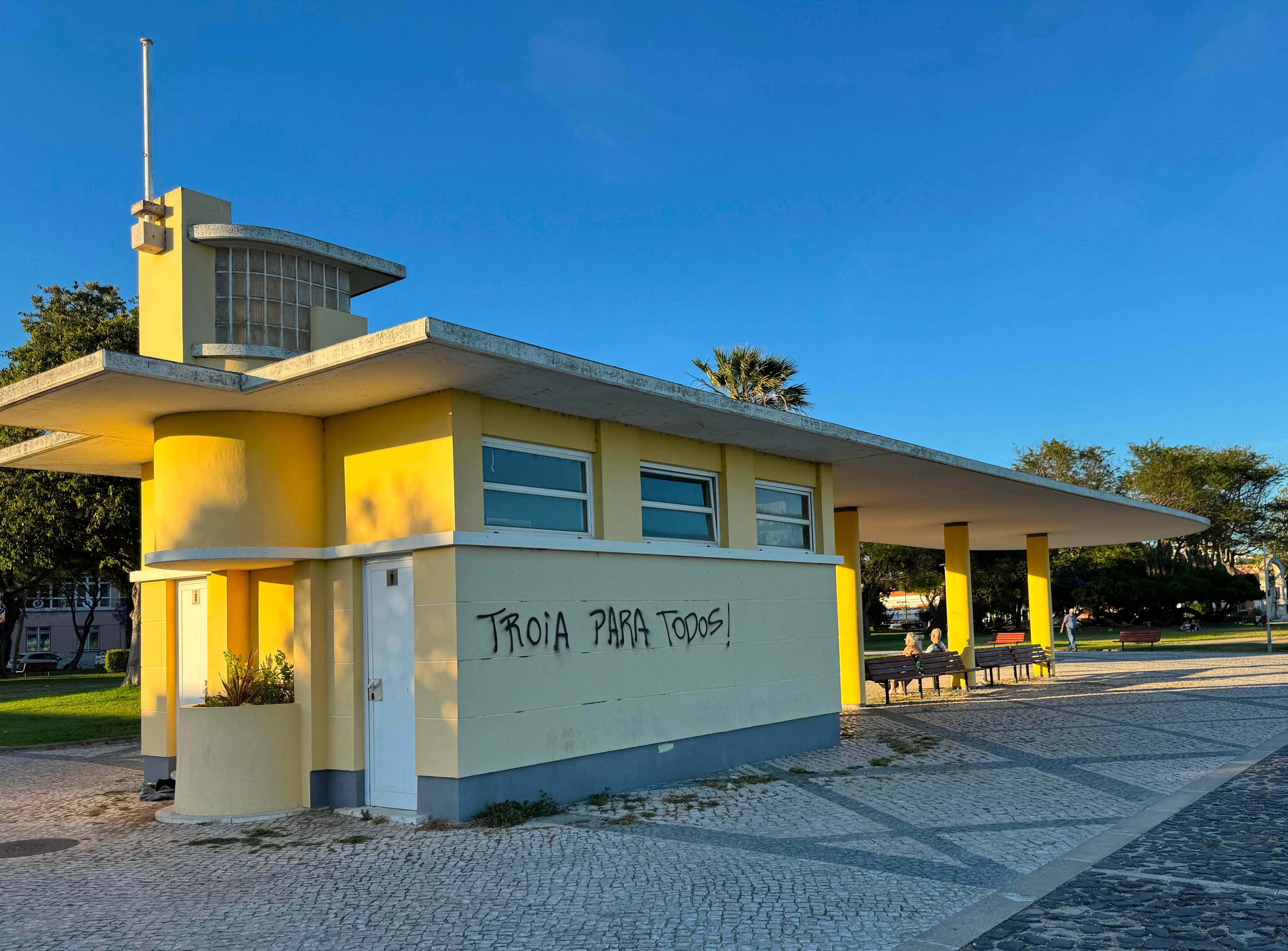
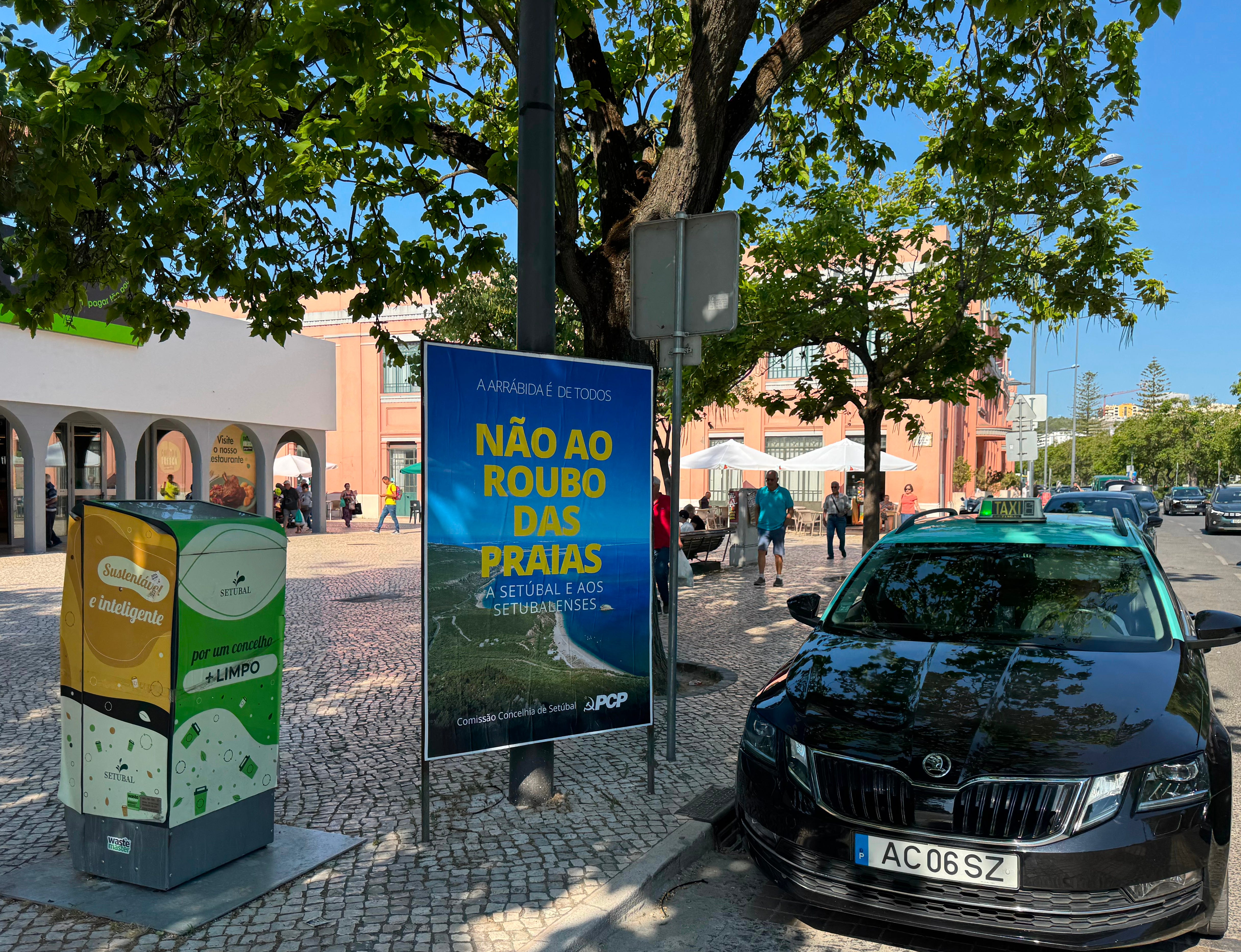
The big controversy in town this summer has been about a wealthy property owner’s effort to privatize five beaches in the nearby Arrábida nature preserve.
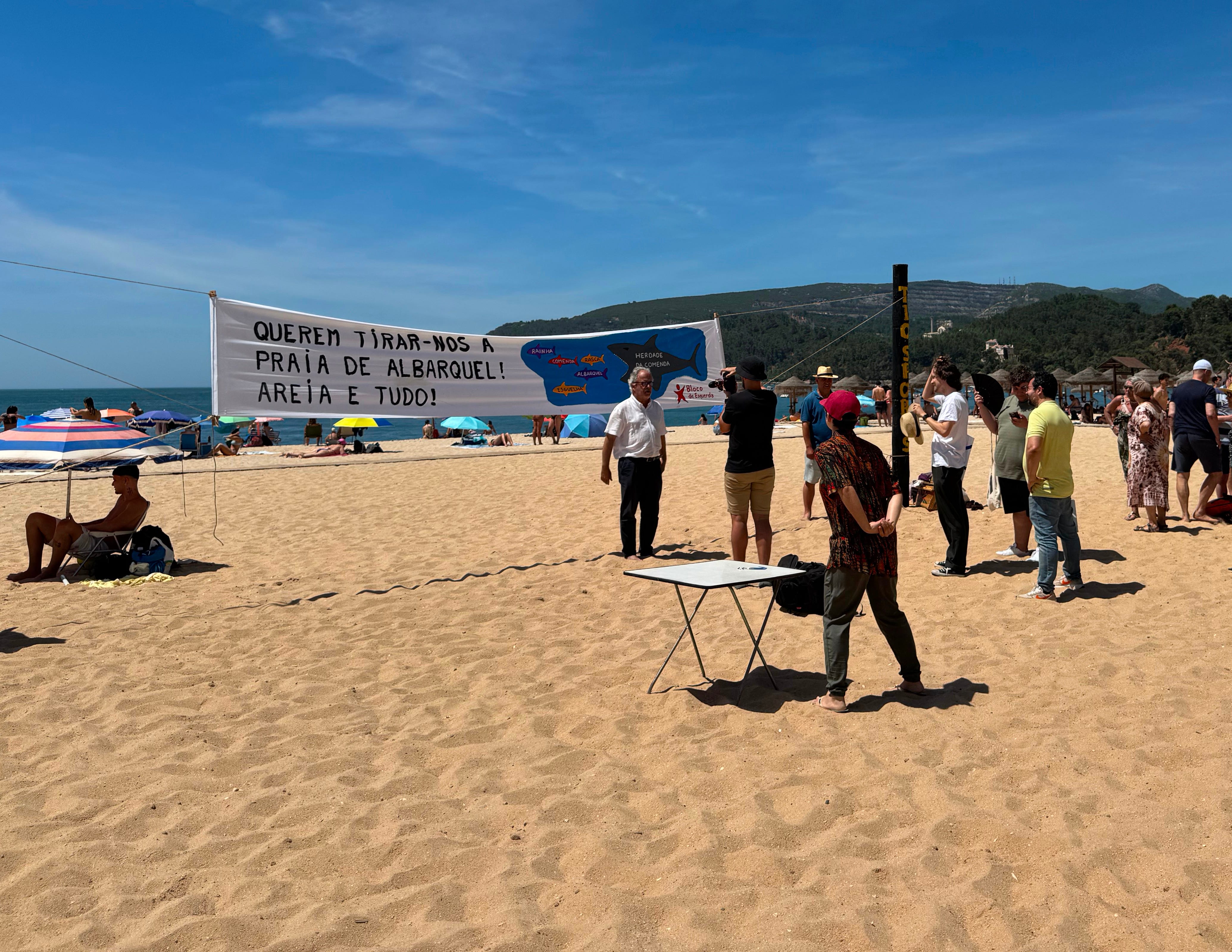
Back in May, members of Setúbal’s Bloco de Esquerda (Left Block) political party planned a protest at Praia de Albarquel, one of the beaches in question and my favorite beach because it’s within walking distance from my apartment. So I headed over to see what was happening.
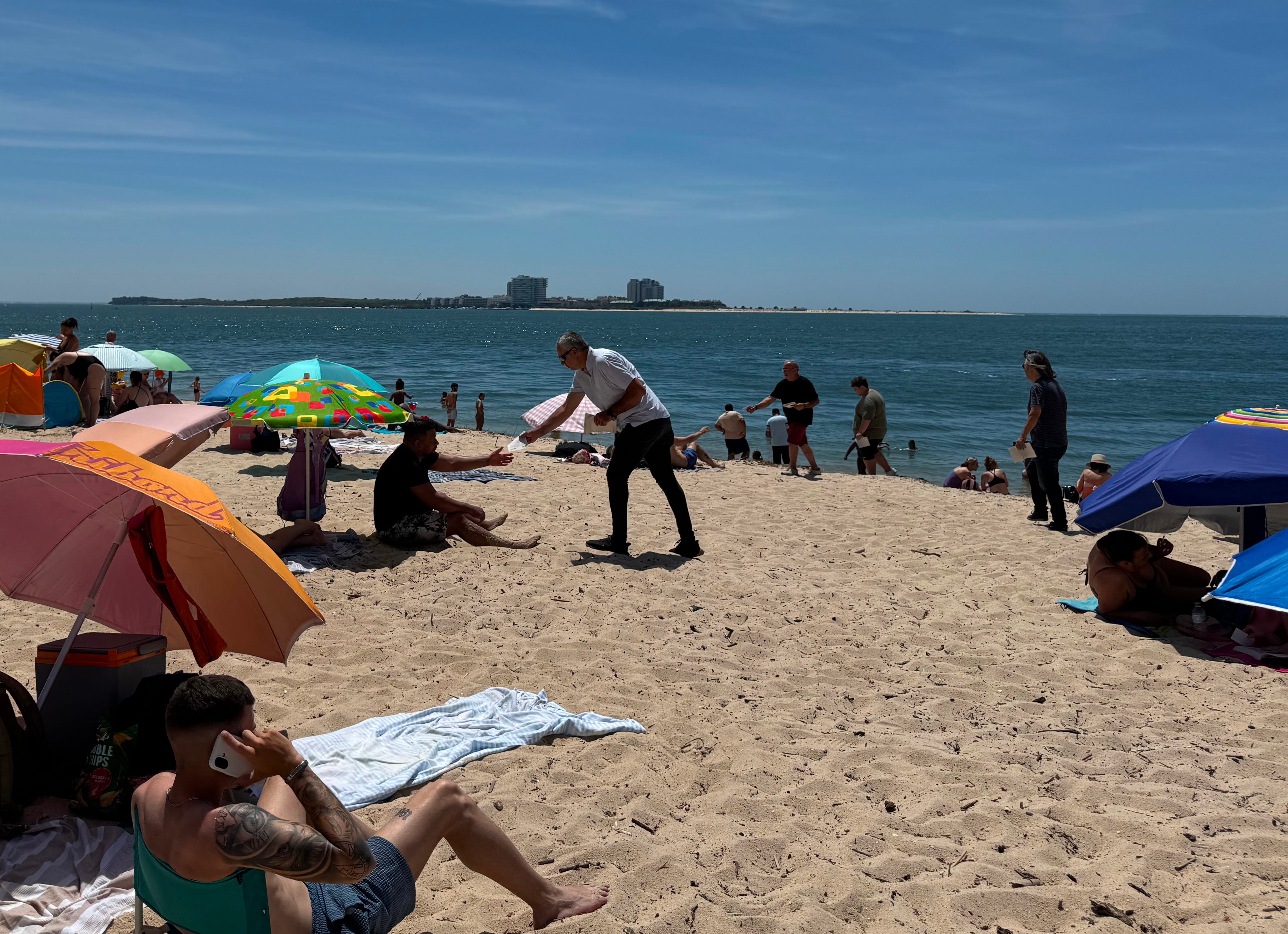
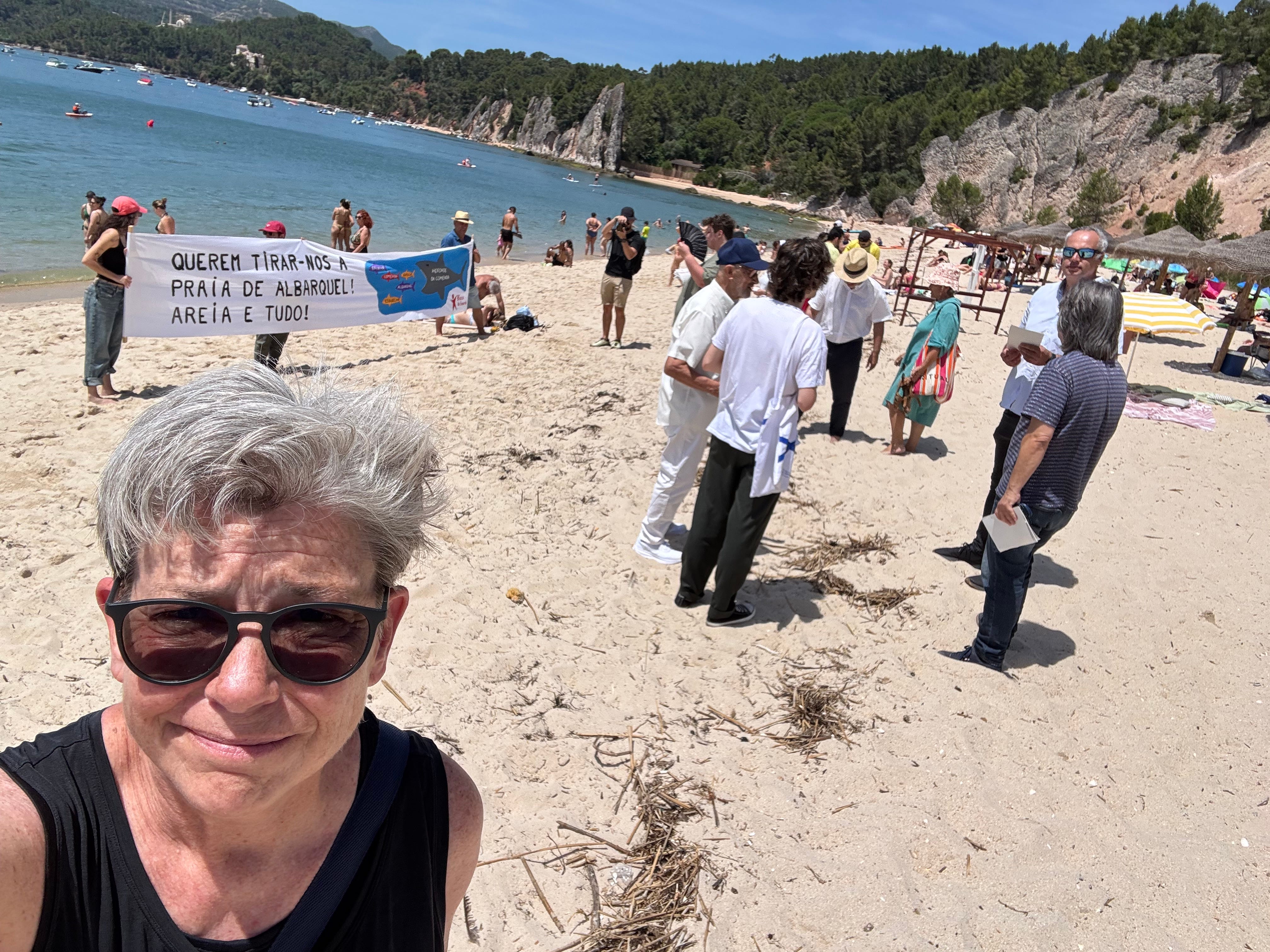
At first, the protest looked a bit pathetic: just a dozen or so people. They put up a banner, one stood in front of it and gave a speech and another one videotaped, while a beach full of people paid no attention. I expected it to end there. But then the banner holders, the speaker and the photographer moved on and repeated this bit at different places on the beach, while a few others passed out fliers to everyone under an umbrella or on a blanket. The hand-to-hand passing of fliers turned into conversations, and I watched as folks who’d paid no mind to the sign-video action sat up. Their body language suggested they cared. I’ve seen a lot of ineffective protests in my long career as a journalist, but this one turned out to be an impressive display of communication and education.
I wanted to write about it at the time because I was fascinated by the fact that Portugal’s constitution says beaches belong to the people. Coming from highly privatized America, the idea of constitutionally protected public beaches blows my mind.
But also, it seemed there might be some exceptions here, or previous court rulings allowing some fences to cut off some areas of Albarquel. And rumors were spreading about developers’ payoffs to city hall. My impulse was to get to the bottom of it. My ability to do so was zero. Even if I wanted to — an instinct I battled internally because I am in fact retired — I knew it wasn’t just a language barrier that would prevent me from understanding the nuances of real estate contracts, local ordinances and the country’s constitution. I also had no clue about local history, customs, longstanding grievances, favoritism and vendettas. After decades of needing to know everything, I had to let it go.
This was when I began to feel nervous about the future. My wife, Lori, and I had been here just over nine months at that point. We’d done what we thought were the hardest parts: leaving the United States, making it over here, getting oriented, completing the first round of bureaucratic requirements to become legal residents. What I hadn’t anticipated was how, relieved of all that work, I would suddenly have enough head space for a flood of new existential questions.
As of this week, we’ve been in Portugal for a year. Readers who’ve followed this journey closely might recognize a sentence I’ll now use for the fourth time: “Some folks know my tendency, when under pressure, to measure progress in 90-day increments.” In November, after the first three months, I wrote about the calmness of knowing I’d never feel settled. In February, at six months, I wrote about the strange sensation of safety (a topic I recently returned to in more detail). In May, at nine months, I wrote about our one-year anniversary of leaving Kansas City.
When we arrived in Setúbal early last August, our first friend Gaby was marking the end of her first year here. I tormented her with questions. What had been her three biggest surprises? Her three biggest challenges? How had she changed? Gaby struggled to answer. Now I know why.
I can’t answer those questions myself.
I can describe three surprises. 1) How strange it feels to make a bunch of new friends in one’s 60s, yet it’s been surprisingly easy — among English-speaking immigrants, anyway. People quickly move beyond superficialities and bond over the relatively unusual and extremely high stakes moves we’ve all made. 2) How bizarre it feels, geographically, that the continent to the south is not South America but Africa — that’s where birds here fly for the winter, and dust blowing up from the Sahara is a regular part of life here. 3) How silly I was to assume that cicadas buzzing from trees was a sound unique to summers in the U.S. Midwest.
I can talk about the three biggest challenges. 1) Learning Portuguese. 2) The deep sense of cultural cluelessness, accompanied by an urgent desire to know the entire history of a country that’s thousands of years old. 3) The corollary: I left a place I knew everything about — that was my job, and a whole life’s experience — and have claimed as home a place I’ll never fully know, no matter how much I study.
How have I changed over the past year? I can now speak and read a bit of a new language. I’ve fallen in love with the city of Lisbon. I know more people from countries other than the United States. I do most business in euros. I don’t have to do much mental math, anymore, to know what time it is when it’s 17:30 or 22:00. I’ve just voted from abroad. I barely notice, and am not offended, by everyone smoking. I’m generally calma calma. Tranquilo.
All of that’s true. But it’s nowhere close to conveying how this really feels. Because I’ve only just begun to acknowledge the losses. And to face the immensity of: What now?
Even the obvious answer — more writing — is complicated. A project I’ve been working on for a long time needs more attention. It’s a story entirely about America, at a time when I also need to focus more on being a good resident of Portugal, and of Europe. So, a head-splitting double challenge. Rebalancing my writing time means giving myself permission to slow down here on Substack, where I’ve now written 55 columns, one almost every week, for more than a year now. Self-imposed/inflicted deadlines were good for transitioning away from that long career in journalism, and I’m beyond grateful to everyone who’s been reading. I’ll keep writing, just a bit less often and predictably. As I wrote in my first piece here, on July 5, 2025, only one thing is certain: “Everything is subject to revision.”
Meanwhile, other journalists have the beach situation covered. News outlets in both Portuguese and English are on it, so I don’t have to be. Soon after the action at Albarquel, Bloco de Esquerda circulated a petition that would force the Portuguese Parliament to debate the issue. This required 7,500 signatures; last time I checked, 15,333 people had signed. Organizers also held another protest, this time a march through the Arrábida, on July 19.
Beyond the reporting by Portuguese news outlets, The Guardian’s Adam Almeida has provided crucial international context.
“Residents of Setúbal, a working-class coastal city just south of Lisbon, invoked their memories of learning to swim in Arrábida’s frigid waters and insisted their children should enjoy the same right,” Almeida wrote after the July 19 action, in an opinion piece headlined "Fight them for the beaches: The real villain of Europe’s overtourism is big business.”
Demonstrators chanted that “Arrábida is not for sale” and held signs that read “No to new kings”. The language clearly resembles that emerging from Albania, in response to Ivanka Trump and Jared Kushner’s plans to build a luxury hotel on the island of Sazan and develop the nearby Zvërnec peninsula. Trump’s wanderlust-laden ambitions have generated the country’s largest uprisings since the fall of communism, bringing tens of thousands on to the streets of Tirana in protest. What the media has termed the “flamingo revolution”, where environmentalists raised concerns over the planned disruption to the area’s natural habitat and delicate ecosystems, has transformed into a national debate about corruption, oligarchic interests and luxury tourism in the Adriatic nation.
These features map closely on to the scenes on Portugal’s Atlantic coastline. Arrábida was classified as a biosphere reserve by Unesco last year, recognising the interconnected beauty of its pine forests, long sandy beaches and intergenerational traditions of fishing, olive cultivation and wine production. Not unlike the Trump-Kushners, the Mirpuri family, reportedly behind the privatisation push, are a well-connected business dynasty. They made their fortune in commercial aviation and have been awarded Portuguese government contracts. Abroad, they have been accused by campaigners of having leased their fleet to carry out deportation orders, including for the UK Home Office. A protester interviewed by TVI explained that many are drawn to this fight because they have already experienced the loss of Tróia — an adjacent peninsula now referred to as the “Hamptons of Portugal”, which reportedly hosts properties owned by Nicole Kidman, George Clooney and the Duke and Duchess of Sussex.
The battle for Arrábida reflects many of the recent changes that now threaten Portugal’s way of life. Going to the local beach is an important ritual for Portuguese families in coastal areas. But while its surging economy and fiscal responsibility is lauded in the Economist and the Financial Times, more than a third of the population can no longer afford to go on a week-long holiday. As I have written in the past, younger generations feel they have been left with no choice but to seek brighter futures abroad. All of these circumstances have a significant effect on the nation’s psyche, producing a general sense of pessimism and indignity.
All of which sounds mighty familiar, and not just because I’m now living in Setúbal, gazing west at the Arrábida all day, but because I watched big business’s near complete takeover of the United States, too.
One thing that hasn’t been a surprise over this past year is witnessing how America exports problems. But over here, it’s also easier to see how all the world’s problems are the same. Now, what to do about them.
Comments
Nothing yet. Say the first thing.
Sign in to join the conversation.