
Providing quality civic education for all students is a crucial step in preparing young people to take an active part in community life. Civic education can build the knowledge and skills students need to become engaged citizens, but developing civic skills and dispositions requires more than teaching students how government works. At its best, civic education can serve as a bridge between students and the communities, institutions, and issues that matter most to them. Place-based civic education creates that connection by linking classroom learning to opportunities for participation close to home. A new study from the Pew Research Center demonstrates why this kind of civic education is especially important for today’s young people.
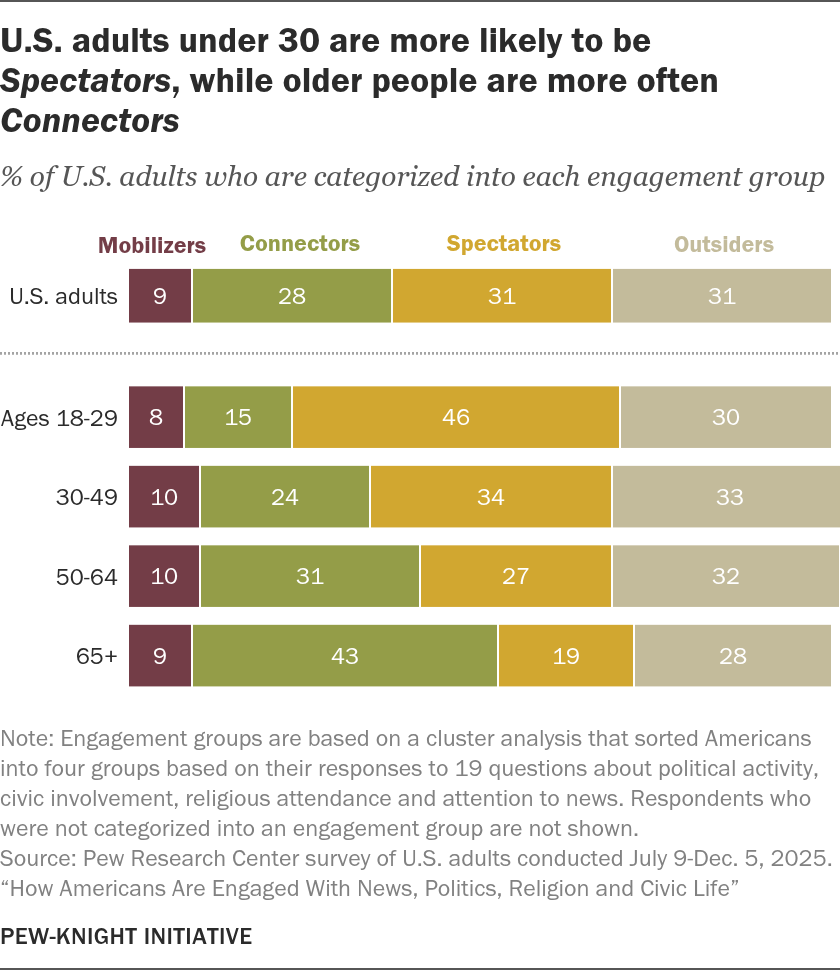
Pew’s study identifies four distinct profiles of civic engagement among the American public. Drawing on survey data about political, civic, religious, and news-related activities, Pew classifies 9% of Americans as Mobilizers, who are heavily involved in politics; 28% as Connectors, who are active in their communities and participate in religious, civic, and lower-cost political activities; 31% as Spectators, who follow public affairs but largely remain on the sidelines; and 31% as Outsiders, who participate at relatively low levels across civic life.
However, among young adults ages 18 to 29, the distribution looks strikingly different. The shares of Mobilizers and Outsiders are similar across age groups, but young adults are far less likely to be Connectors—15%—and much more likely to be Spectators—46%. This does not mean that young people are uninterested in public life. Many are paying attention, discussing the news, and engaging with political information. What they often lack are ways to turn that attention into participation.
Pew’s findings show that young people are much more likely to engage with news and politics online. Fifty-nine percent of young people reported liking or saving a news post during the previous week, while almost two-thirds had privately discussed or shared news online. Both activities were more common among young adults than among older Americans. These forms of engagement matter. Saving an article can be a first step toward learning more about an issue, while sharing a story with a friend can begin an important conversation. Online spaces also allow young people to find information and connect with people.
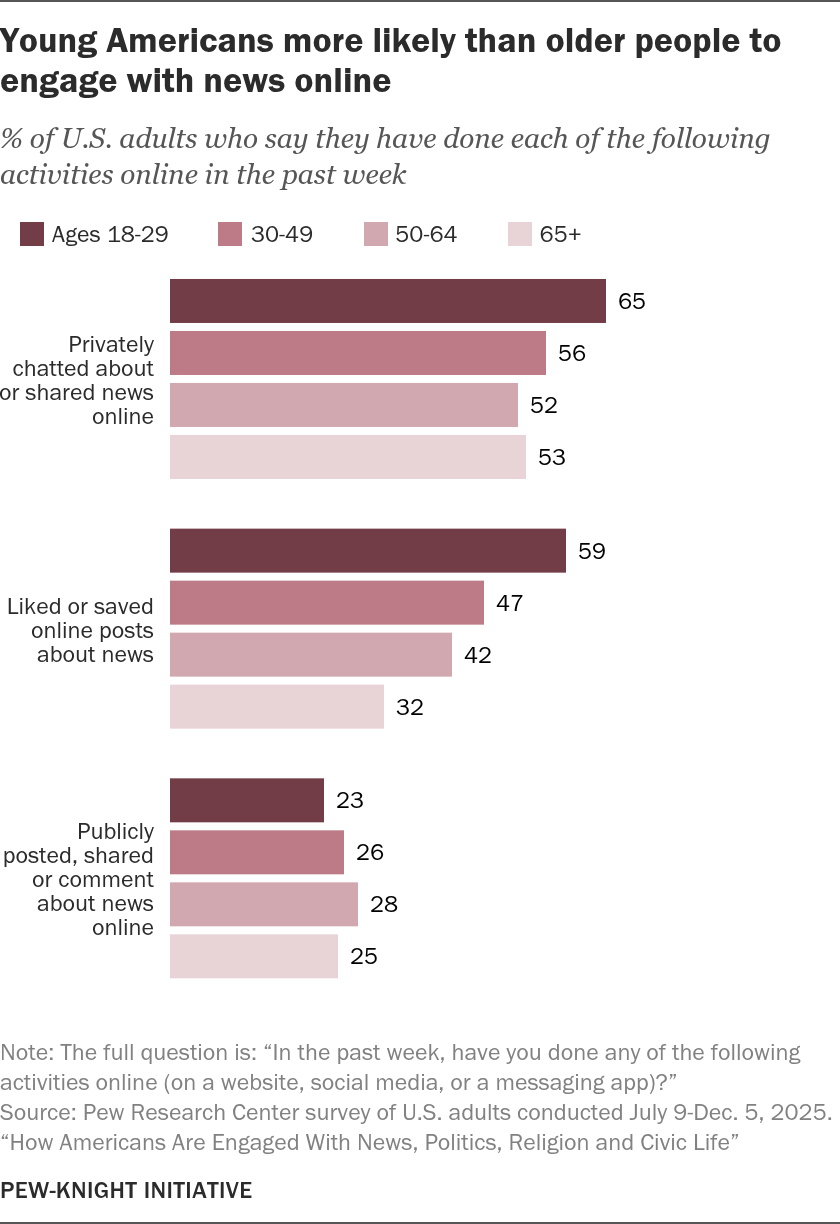
Unfortunately, digital engagement can easily remain private. Young people may follow and react to an issue without ever finding a clear way to participate. Online engagement can expose them to politics, but becoming a Connector requires more than attention. It also requires relationships, a sense of belonging, and opportunities to act alongside others in a community.
Place-based civic education can provide that connection. By examining issues in their schools, neighborhoods, and communities in person, students begin to see public life not as something that happens only in Washington or on their screens, but as something happening around them. They learn how local concerns become public issues and how people can work together to address them, making civic participation feel more relevant to their own lives. Schools can give students an early point of entry into civic life. Rather than waiting until they are older, wealthier, or more settled, young people can begin developing the habits of listening, collaboration, and problem-solving in their current communities.
At our recent Civic Education and America’s 250th Symposium, co-hosted with the American Political Science Association, making civic education relevant to students emerged as a prominent theme. Several educators shared ways they help students learn about and participate in their local communities. At Western Connecticut State University, students in Howell Williams’ class examine Danbury’s legacy as the “Hat City,” exploring how the industry that helped build the city continues to shape its identity. At Morningside University, Chase Privett asks students to participate in campus, community, and political activities, helping them build relationships and practice the different skills each setting requires. Both approaches give students opportunities to move beyond observing public life and begin finding their place within it.
Project Citizen, a project-based curriculum from the Center for Civic Education, offers another model for helping young people move from Spectators to Connectors. Students investigate a problem in their community, develop a public policy proposal, and present their ideas. In the process, they learn to collaborate with peers, consider different perspectives, and engage with the institutions and people who shape public life in their communities. The program can also connect students’ online and offline worlds. An issue first encountered through the news or social media becomes something they can investigate locally and address with others.
We are excited to put some of these approaches into practice tomorrow with high school students attending the Peace Ambassador Leadership Summit at Georgetown University. Students will work through the steps involved in creating policy change, focusing on problems they have observed in their own communities. Our hope is that they leave with a clearer understanding of how public policy works, greater confidence in their ability to participate, and practical tools they can use when they return home.
Pew’s findings suggest that many young people are already paying attention to public issues. The challenge is showing them where and how they can act. Civic education can turn attention into participation, helping young people become more deeply connected to the communities around them.
—Patrick McSweeney, PhD - Research Specialist
References:
Pew Research Center, July 2026, “How Americans Are Engaged With News, Politics, Religion and Civic Life.” https://www.pewresearch.org/journalism/2026/07/16/how-americans-are-engaged-with-news-politics-religion-and-civic-life/
No posts
Comments
Nothing yet. Say the first thing.
Sign in to join the conversation.