
August 19th | A Conversation with Ald. Bennett Lawson: Join Strong Towns Chicago, Chicago Growth Project and A City That Works to talk housing with Ald. Bennett Lawson. We’ll be at Big Gay Sal’s Pizza in Lakeview from 5:30-7:30pm. Our events are always free, but it’s helpful if you register here to let us know you’re coming.
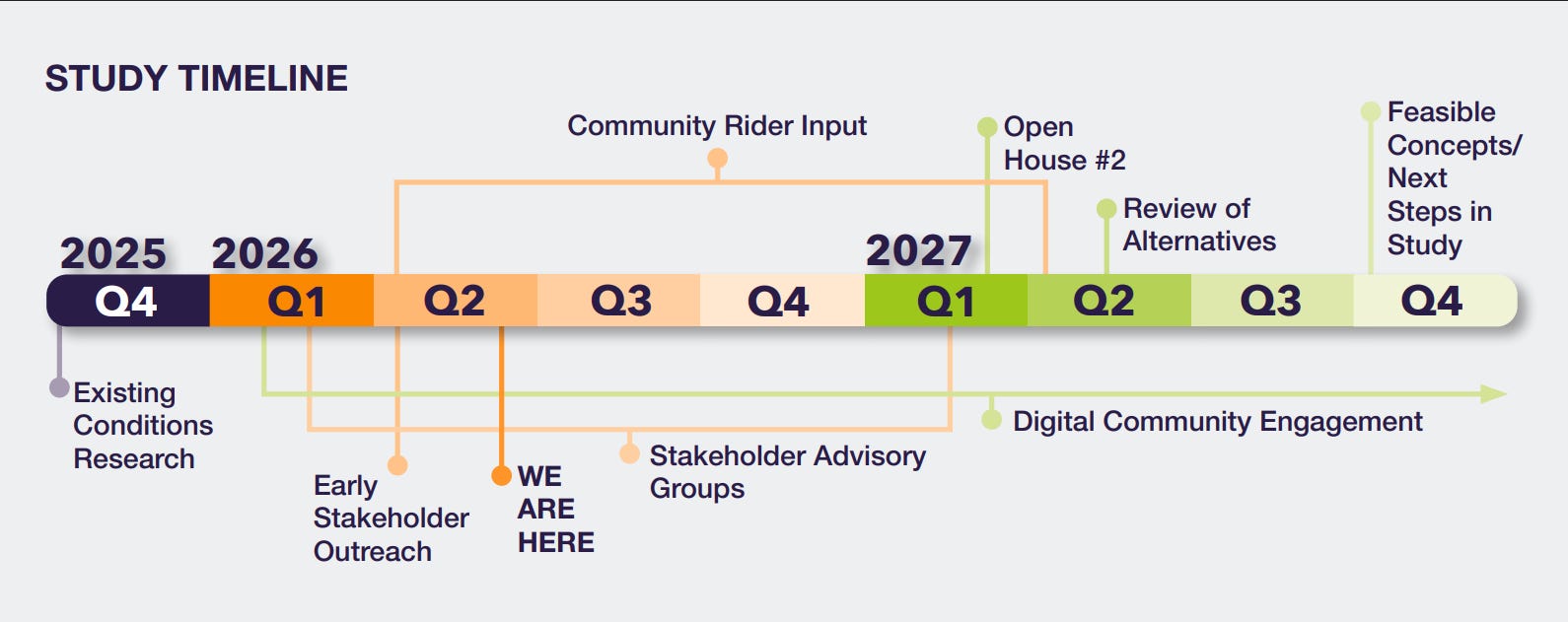
Timeline released by the Illinois Department of Transportation to consider the possibility of modernizing the existing Clybourn Metra Station. Source: IDOT.
We’ve written previously here about state capacity – the inability of government to deliver on the promises it makes to citizens. “State capacity” is a pretty terrible term for the problem. But it can best be thought of as a creeping set of constraints on government processes that result in ever greater dysfunction in service delivery. Put another way, when you subject governments to six-month hiring timelines and 17,899 page environmental impact statements, you end up with $440M train stations, 1,000 missing affordable housing units, and hundreds of unsolved murders.
But many of these broken processes are submerged deep within the bowels of government, and it’s often hard to tie any one of them neatly to a specific outcome.
Take the new timeline floated by the Illinois Department of Transportation to rebuild Metra’s Clybourn Station. IDOT suggests that it will take more than two years of community input and alternatives analyses to begin to consider the possibility of replacing the existing station.
You read that right – two years to admire the problem, before even beginning to proceed with “feasible concepts.” Once IDOT and Metra land on what those feasible concepts are, things are likely to take much longer. Metra’s recently completed Peterson and Ridge station ended up taking 15 years and almost $28 million to build.
These delays are likely driven by some mix of required community and governmental input processes, environmental and historic preservation signoffs, less-than-cooperative partners in city government, and a dependence on outsourced engineering partners instead of in-house expertise.
But which of these problems is the biggest? Which are politically feasible to fix? And if someone at the newly created Northern Illinois Transit Authority actually fights to fix one of them, will that actually speed up the project – or will it just run into some other blocker that holds up progress for another years?
To fix this – and crucially, to keep the same problems from emerging in new form as soon as you turn to something else – government needs better systems to surface implementation barriers, and feed them back to executives and policymakers. That includes identifying well-intentioned policy mandates that are actually extremely difficult to implement, as well as an interlinked morass of personnel, procurement, and inter-governmental constraints that slow things down.
At the federal level, Jennifer Pahlka and the good people at the Niskanen Institute are working to build better feedback loops into the federal policymaking process. They recently published a very cool report aggregating qualitative input from federal workers on the biggest constraints in their roles.
Unfortunately, there doesn’t appear to be anything similar yet emerging at the state or local level. And for a couple reasons, the problems are often greater the further down the chain you go.
Constraints snowball
Much of the work of the federal government is actually carried out through grants that cascade down through state and local governments (and their non-profit partners). Each level of government can add its own constraints – but none have the ability to simplify or streamline rules.
The result is a one-way ratchet that applies all the rules of the federal government, plus a double-helping of restrictions and constraints at the state and local levels. A developer using Low-Income Tax Credits to finance an affordable housing project is subject to all of the Federal rules, plus any additional rules added by Chicago’s Department of Housing – plus any other rules added if they take money from the State of Illinois, Chicago Housing Authority, or other funding sources.
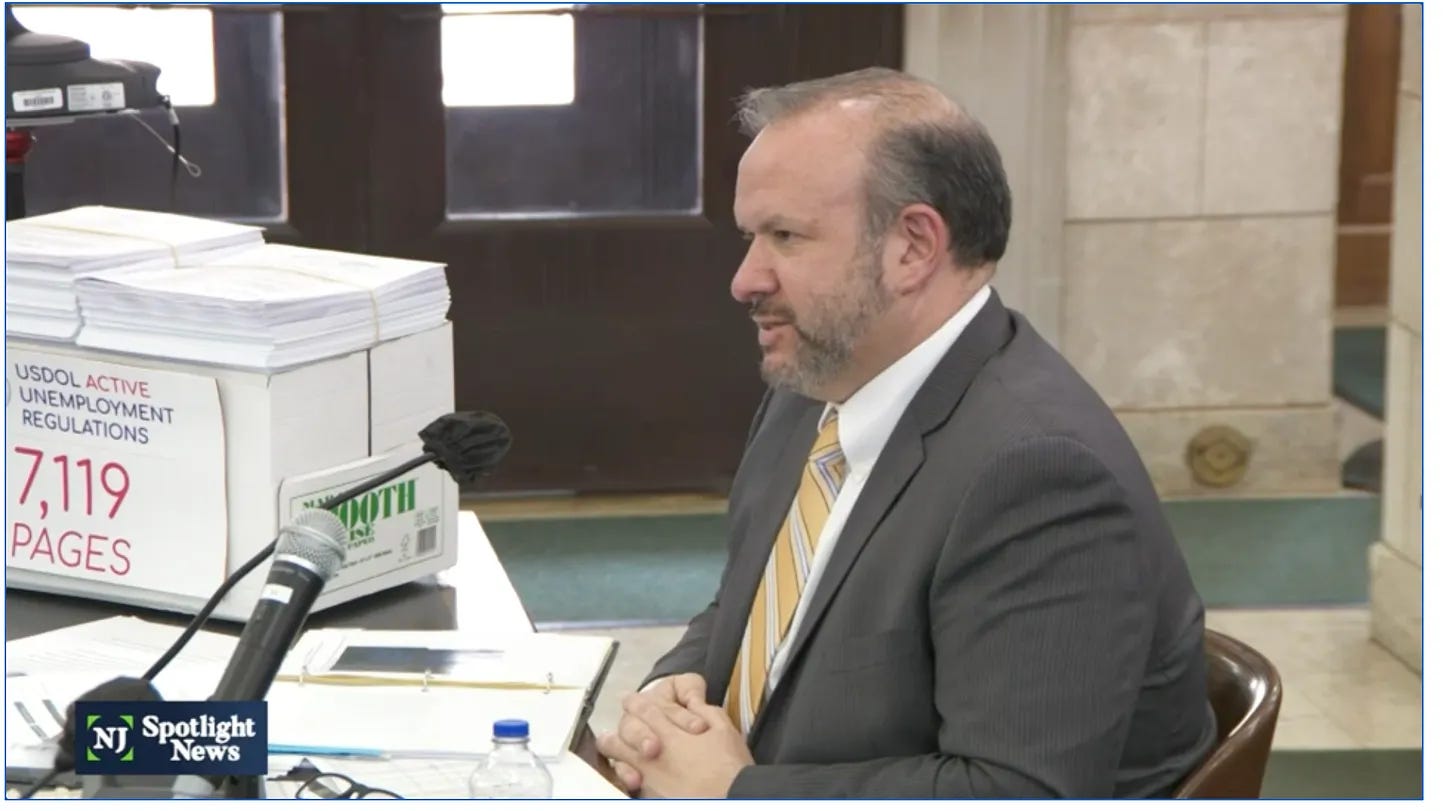
New Jersey Labor Commissioner Robert Asaro-Angelo testifies to state legislators next to a box containing the 7,119 pages of active Federal regulations governing the state’s Unemployment Insurance program. Source: NJ Spotlight News via Eating Policy.
It doesn’t help that public sector entities are naturally risk averse, and will often pass along the most restrictive interpretation of rules handed down from above. When I was in the Mayor’s Office, funding programs with Federal American Rescue Plan dollars, the city was paying a contractor to pre-emptively audit our desired spending categories, even while the Treasury Department had put the phrase “broad flexibility” into almost every section of its guidance. Then we in turn applied the full rulebook of city rules onto our grantees.1
Naming problems requires picking jurisdictional fights
Theoretically at least, every employee of every federal agency ultimately reports to the same boss. But much of local government depends on the cooperation of leaders at different levels. In transit, for example, the Chicago Transit Authority relies on the Chicago Police Department to provide security for the system. In addition to the CPD transit detail, CTA also pays a hefty chunk of money to CPD officers for overtime to cover the system.
But my understanding is that CPD has not taken that responsibility particularly seriously – which is why you’ve likely seen plenty of officers standing around stations holding their vests, but very few actually walking rail cars and enforcing the rules. This is especially true for overtime details that don’t have high-quality oversight and management, with clear objectives and supervision from leadership.
This obviously puts CTA in a tough position; the transit agency is getting blamed for safety issues (and losing riders in the process). But Interim CTA President Nora Leehrsen can’t exactly go out and publicly call out CPD without risking even less support, even if CTA knows what specific management changes are required at CPD to get better support.2
This problem gets even harder when agencies report to different political masters. CPD detectives, for example, have to do the legwork to collect evidence to bring charges in criminal cases. But the State’s Attorney’s Office makes the final decision about whether to press charges. If the State’s Attorney Office starts declining to prosecute, that can quickly demoralize cops doing the legwork – or provide a justification for them to stop doing their jobs. And even a well-meaning State’s Attorney’s Office that’s graded on its win-loss rate in court may find reasons to decline to prosecute tough cases that are harder to win.
These problems are likely to get worse
Unfortunately, in the short term, there are reasons to expect that these problems are going to get worse. It’s harder for the City and State to work with a federal government that is becoming more erratic, abusive, and vindictive. The erosion of support for local journalism makes it harder to do the deep investigative work necessary to uncover these problems. And faster turnover in Mayoral administrations makes it more difficult to build the relationships and institutional knowledge to bridge interagency divides.
Finally, in Chicago power is becoming ever more diffuse. The next Mayor will no longer have control over the CTA Board or Chicago Public Schools, and the Chicago Police Department is now subject to a wide range of oversight organizations that disperse authority and accountability for any individual decision. There are good reasons for some of those changes, but they will make it even harder to assign blame when dysfunction emerges in city government.
The path forward
So we’re fighting an uphill battle here. This also isn’t a situation any one actor can fix. But that means that a wide range of partners can help.
First, and foremost, public sector agencies need to do a better job listening to frontline employees. To be clear: this does not mean another round of input sessions where everyone gets to be heard, sticky notes get put on maps, and real action grinds to a halt. Instead, agencies need better processes to source constraints from their frontline workforce, aggregate and filter them over time, and then start to act on the constraints that are impinging on the actual performance of the workforce.3
Any version of that process will likely generate a bunch of noise. To be successful, such a process likely needs to include an option for anonymity, make it clear that the point is to identify workplace constraints rather than employee grievances, and aggressively highlight the changes that are made as a result of the feedback.
Second, elected and appointed leaders need to be more willing to go public with the constraints holding their teams back. I get that this is hard – admitting you have challenges (including challenges with other units of government) is an easy way to open the door to more criticism or look like you’re simply shifting blame.
But for deep, structural problems in city government, it’s no longer plausible to argue that the emperor is simply experiencing a momentary wardrobe malfunction. We saw this argument from former CTA President Dorval Carter in the runup to last year’s fiscal cliff, and it went over like a lead balloon.
It is possible for capable leaders to point to progress, express thanks to partners, and highlight specific challenges or needs for their agencies. Ideally, this is also a path to taking measured, but clearly defined risks – with electeds or agency leadership acknowledging an effort to try something new, and acknowledging the possibility that it may need to be rolled back.
Finally, oversight and advocacy institutions need to be more willing to surface these obstacles as part of their work. Inspectors General have powerful tools to identify performance failures in and across government.4 It is of course necessary for them to look at more bog-standard versions of fraud and misconduct in government. But at the margin, it’d be helpful to see more in-depth reports on bad city processes, and fewer quick hits highlighting minor misallocated payments on city emergency programs.5
I get that this is challenging. Traditionally, Inspectors General have been packed with lawyers looking for misconduct - and Chicago has given them plenty to work with. But in the long term, an oversight model that simply looks for missteps and then demands additional processes and checks in the future is likely a counterproductive waste of government resources. Oversight agencies need to aim higher, and do harder systems-level work.
A similar principle applies to issue advocates, and the philanthropic organizations that fund them. Issue-based organizations are naturally going to prioritize accomplishing a specific task. But while you can find dozens of reports over the last few years advocating for Chicago to accelerate its efforts to replace lead service lines, and even a few calling out very high costs, those reports rarely advocate for specific changes to city codes or processes.
Again, in the short term this is understandable! Advocates (and donors) are generally motivated around specific causes. And it’s often easier to try to grind out one more win than ask uncomfortable questions about broader systems and coalition partners. But without deep reforms to enable functional state action, progress on issues like housing, transit and public safety are likely to be temporary at best.
Hold elected officials accountable for results
But while government needs to do a better job listening to its workforce and asking for help, and auditors and advocates need to do a better job identifying systemic problems, the public expects elected officials to deliver results. Residents don’t really care which board members are appointed by whom, or whether their highways are patrolled by the Chicago Police Department of the Illinois State Police.
And that’s ok! If we’re able to effectively identify problems inside and between governments, elected officials should be able to resolve those problems within the political process.
When things get bad enough, that still happens today. It’s not an accident that after years of public safety complaints, the Cook County Sheriff is now actively patrolling parts of the Red and Green lines, walking through cars, enforcing quality of life issues, and cracking down on fare evasion. Crime on the system is down dramatically.
The goal, however, is to pull off systematic changes like this even when government doesn’t have a looming fiscal cliff. It will take more work to make this a standard part of public sector processes.
I pulled a provision out of our standard grant boilerplate that required small community based organizations have cybersecurity insurance to run a program that basically just involved putting friendly faces on commercial corridors – but I’m sure there were plenty of other things that we did that made life harder for the Community Based Organizations we were working with.
It probably doesn’t help that she’s been stuck with the ‘interim’ tag for more than a year and a half.
And note - if you are a frontline public servant at the City, sister agency, or other unit of government, we’d love to talk to you about ways to improve the delivery of public services. We’re also eager to publish good ideas - including anonymously if need be.
We cite Chicago’s OIG constantly. The workflow they made for the city hiring process remains one of the most useful (and horrifying) pieces of work I’ve come across.
To be clear – that doesn’t mean the Chicago Moves program was administered perfectly. But “here are the system level challenges with city payment and disbursement processes,” is a lot more useful than issuing an advisory noting that the user of a city transit benefit managed to use a prepaid card to buy groceries instead.
Comments
Nothing yet. Say the first thing.
Sign in to join the conversation.