
As regular readers know by now, Circular Dispatch doesn’t chase the latest climate catastrophe. We look for the ideas, innovations and policies that could change what happens next. But every so often, a stark reminder of what’s at stake demands attention.
This week, India ranked second from the bottom on Yale’s Environmental Performance Index, a result that has reignited debate over both the country’s environmental record and, predictable, about the index’s methodology. Either way, it is a timely reminder that the work of finding solutions has never mattered more. So welcome, and...
When we think about climate action, elections rarely come to mind. Yet India’s general election is the largest democratic exercise on Earth, involving nearly 970 million eligible voters, over 1.05 million polling stations, and millions of election personnel spread across every corner of the country. The sheer logistics are staggering. So too, inevitably, is the environmental footprint. Campaign materials, banners, plastic flags, single-use decorations, transport, temporary infrastructure and election-related waste all add up, even though few studies have tried to measure the total impact.
That is what makes the concept of ‘green elections’ by IAS officer Heera Lal particularly interesting. Green innovations from within the bureaucracy are still rare, which is precisely why they deserve attention when they emerge. This concept is built around a simple but important idea: elections can be a platform for environmental stewardship rather than environmental damage. The model promotes reducing single-use plastics, replacing conventional campaign materials with biodegradable alternatives, encouraging plantation drives and mobilising election officials and citizens around sustainability, all within existing Election Commission guidelines. Lal will be speaking at an online event being organised by Greengine Environmental Technologies – check out Carbon Dating below for details.
One of my highlights from last week was attending a Nadhi-SheForClimate gathering that brought together women founders, investors and researchers working across climate, materials, biotechnology, manufacturing and deep tech. The energy in the room was mellow but golden. These weren’t conversations about “raising awareness”. They were about solving hard engineering problems, commercialising research, building companies and getting breakthrough technologies into the real world. That is where India’s climate transition will increasingly be won or lost. The discussions were refreshingly candid. Women still receive just 2 percent of venture capital funding, while only around 10 percent of India’s deep tech ventures are founded by women. Yet the advice from women investors was unequivocal: build credibility, ask for introductions, make the pitch and, as one participant memorably put it, be “shameless”.
Another message came through just as strongly: community is infrastructure. Deep tech startups need much more than capital. They need shared labs, commercialisation support, trusted manufacturing partners, early validation and networks that open doors. Climate technologies face an additional hurdle. With little or no green premium in India, they must compete on price and performance from day one. That makes collaboration indispensable. A special shoutout to Shalini Bharat and Nadhi for creating a space where ambitious women can find the connections, confidence and support needed to turn bold ideas into real-world climate solutions.
As communities across the world endure deadly heatwaves and floods, the world’s six biggest oil companies are expected to earn $45 billion in just three months, putting them on track for $147 billion in profits this year. According to Oxfam, emissions from just six of these companies – BP, Chevron, Eni, ExxonMobil, Shell and TotalEnergies – were enough to contribute to around one in four heatwaves worldwide between 2000 and 2023. Yet they plan to increase oil and gas production by 14 percent by 2030.
Oxfam argues that a tax on the profits of the largest fossil fuel companies could raise $400 billion in a single year, enough to meet the annual climate adaptation needs of low and middle-income countries. Whether or not governments adopt the proposal, it reflects a growing global conversation: if those who profit most from fossil fuels also contribute more to climate solutions, the world can move closer to a fairer and faster transition. Read our report.
We’re partnering with Earth Inherited to bring you two audio-visual stories. EI is a platform for India’s sustainability ecosystem that creates content and runs education programmes for practitioners, operators and entrepreneurs to understand and apply sustainability in their work.
In this fortnightly series, EI looks inside a business or sector, its mechanics, the trade-offs and what actually makes it work. This time, their focus is on what it actually takes for a brand to trust recycled plastic, through a conversation with the founders of Banyan Nation, one of India’s leading plastic recyclers.
India’s recycling system did not begin with startups but with its vast informal network of kabadiwalas, who have collected and sorted household waste for decades. Banyan Nation’s innovation is not collection itself but building the missing layer that brands need: consistent grading, reliable procurement and traceability. Plastics vary widely – PET bottles are relatively easy to recycle, while polypropylene and polyethylene, which dominate India’s plastic market, are much harder to sort and process.
Quality, however, depends as much on cleanliness as traceability. Contamination determines whether recycled plastic can match virgin material, which is why brands have taken years to adopt it at scale. Today, recyclers such as Banyan Nation can deliver consistent quality batch after batch, even though India’s supply of recyclable plastic already far exceeds demand. The real challenge is connecting brands to that existing supply. Extended Producer Responsibility has accelerated this shift by making companies responsible for the fate of their packaging, turning recycled plastic from a difficult sales pitch into a business necessity.
This series features one idea from a practitioner conversation. In this video, Mukund Rajan, Chairman, ECube Investment Advisors, speaks to Anant Goenka, Executive Director, The Indian Express Group:
“In 2015, we were debating what major sustainability challenges a group like Tata should engage with. Just before one meeting, Norges Bank, the Norwegian sovereign fund, decided to decarbonise their portfolio, and one of the stocks they divested from was Tata Power. That one action, an investor stepping back from stocks too reliant on fossil fuels, led Tata Power to pivot from thermal power to renewables. When incentives and market pressures work together, you get very significant strategic choices being made.”
Earth Inherited is running Business and Biodiversity, a three-day online course, from 6 to 8 August. Built for anyone navigating biodiversity risk in their organisation. Apply here.
India’s carbon markets promise new income for farmers, but most smallholders remain locked out. Our latest explainer examines the barriers keeping them from earning carbon credits, and what needs to change to make climate finance work on the farm. Don’t miss the featured image.

In Ludera village of Himachal Pradesh’s Chamba district, the signs of water stress appeared long before ‘climate change’ became a buzzword. The district lies on the banks of the Ravi river. For generations, residents moving livestock to higher-altitude grazing grounds during summer months depended on small natural springs for drinking water. Himachal Pradesh is responding with a different kind of climate adaptation. How? Find out here.
Intermittency, energy storage, smart grids and demand flexibility sound technical, but together they explain how renewable energy can keep the lights on around the clock, even when the sun isn’t shining and the wind isn’t blowing. Our explainer’s here.
If you’ve been confused about what sustainability really means in the grand scheme of climate crises, masterminds from our team produced this field guide for you!
For this week’s climate opportunities, head to our Careers Catalysts portal. Among other exciting openings, we suggest you check out:
Climate Innovators Challenge for Youth (CLICY) 2.0, The Energy and Resources Institute
📥 Apply by 31 July
Senior Manager, Climate Risk Stress Testing, Standard Chartered Bank
📥 Apply by 1 August
📍 Bengaluru, India
Deputy Programme Manager, Climate Change and Green Economy, Centre for Science and Environment
📥 Apply by 3 August
📍 Delhi
Communication and Programme Support Intern, Wild Tales Foundation
📥 Applications open
📍 Remote
So what are you doing this weekend? Get ready for some Carbon Dating – we’re adding events from more and more cities each week.
If you’re a journalist, do look up the workshop ‘Media for Climate Change: Future Ready for Global Markets - Decarbonising the Textile Supply-Chain’. Tomorrow is the last date to apply for the event which will be held in Tiruppur, Tamil Nadu.
The Naturalist School is organising a Citizen Naturalist (Foundation) Course in Bengaluru and Hyderabad, from 31 July – 9 August 2026. In Nagpur, Pint of View is hosting “Nature: The OG Superhero”, an expert-led public lecture on 2 August 2026. And there’s a Food Forest Online Workshop by Kilukka Farms.
Finally, there’s till time to sign up for the 7th CII International Energy Conference and Exhibition (IECE 2026) in New Delhi.
The empire is confused!
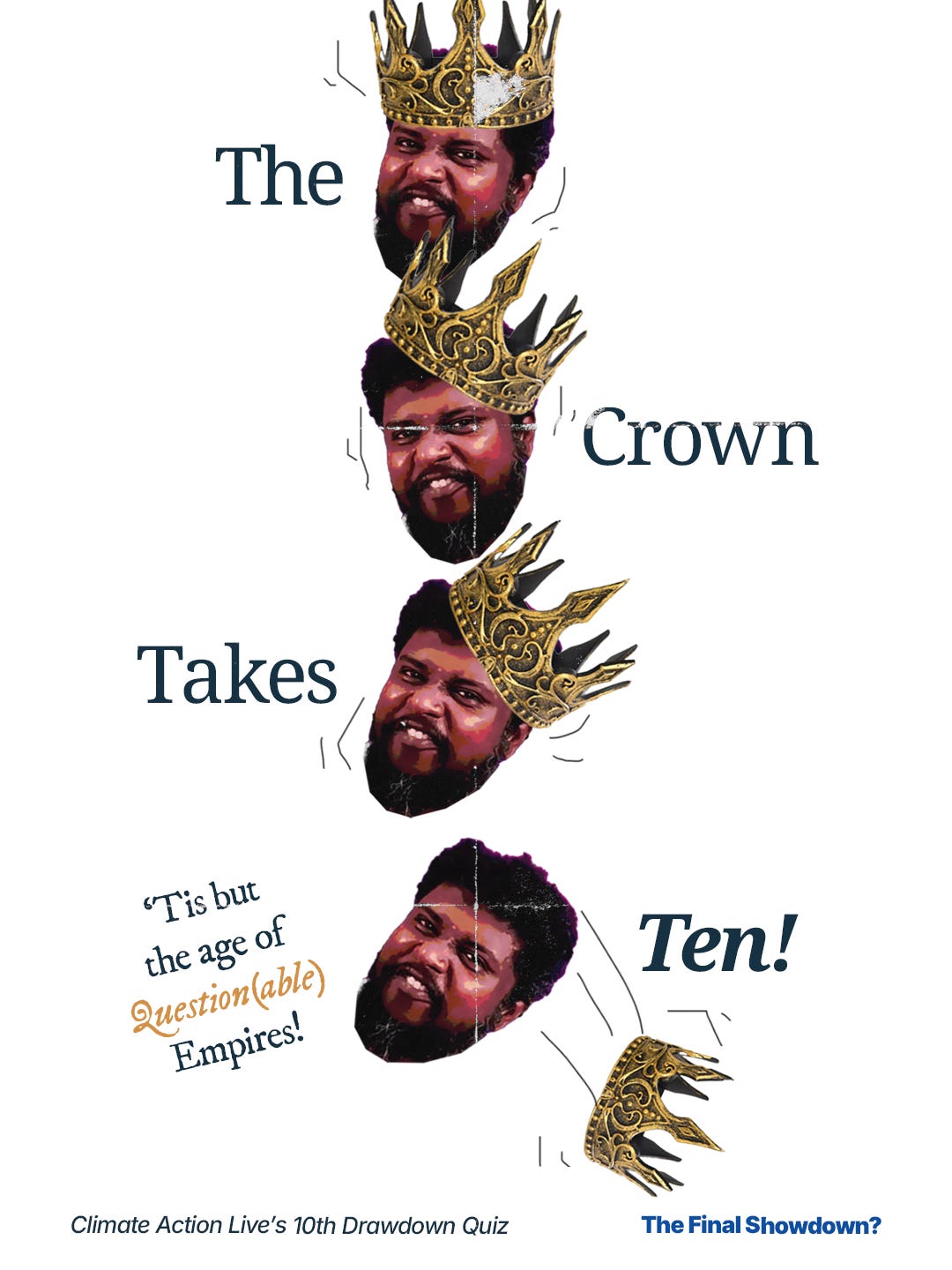
Chief of Introspections, Head of Scientific Tempers, and our very own quizmaster at the Homely Ministry, Mr. Berty Ashley, has an important announcement to make!
“Friends!”, he says, “The monsoon sesh is in order, this is the final countdown! There is no turning back now! Let’s show them what it means to riddle, for this befuddled empire ought not be cradled!” Berty has always had a thing for rhymes.
We know you’ve loved his weekly appearances, but now that he’s done his deed and y’all have risen to the age of question(able) empires, he is off to feed the donkeys. He’s also very Quixotic.
BUT NOT WITHOUT ONE LAST SHOWDOWN, FOR ‘TIS THE AGE OF QUESTION-ED EMPIRES. THE GONGS HAVE GONGED! (subject to marketable risks*)
The game this time is OBVIOUSLY very tough. Boss level and all that. You see, from quiz wizard Deeptha Vivekanand to Berty, the crown has taken ten, so play well, and help Climate Action Live come ALIVE.
*Try and you might win (like we’ve already seen). But please read the offer documents carefully before resisting.
Play it here, comment with your scores below, and follow Berty on Instagram! GO GO GO!
That’s all folks! See you next week.
Madhur Singh & Gulal Salil
Team Climate Action Live
No posts
Comments
Nothing yet. Say the first thing.
Sign in to join the conversation.