
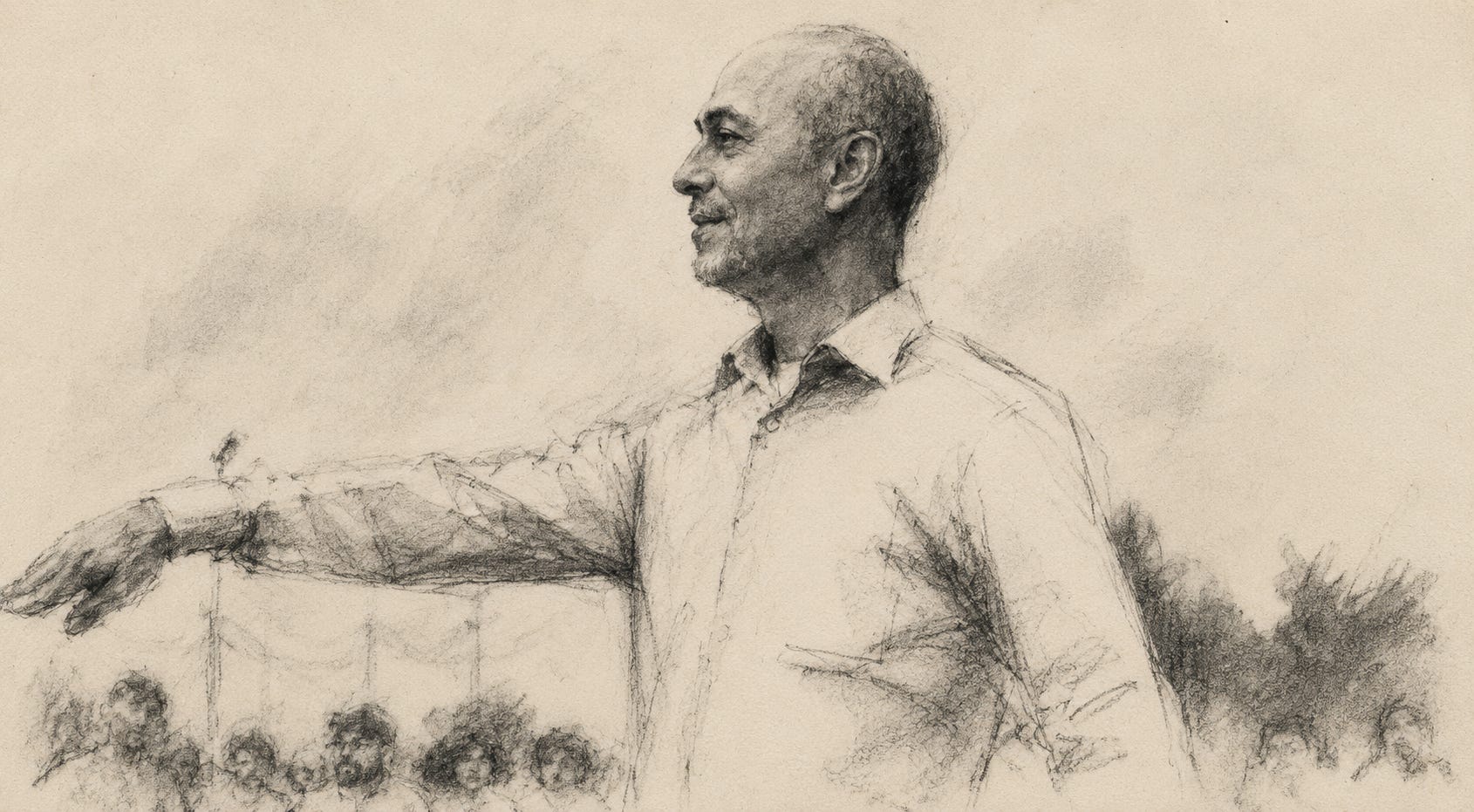
Auladin Sarabievich Dumanishev [Думэныщ Iэулэдин] (b. 1954, Nartan, Kabardino-Balkaria) was a choreographer and People’s Artist of the Kabardino-Balkar Republic. He was appointed Artistic Director of the ‘Kabardinka’ Academic Dance Ensemble during the upheavals of 1991.
According to Dumanishev, in the culture of some peoples it is music that prevails, in others singing, and in others still the dance. The Circassians, by contrast, possess a tripartite unity of music, dance and song: three elements of folk culture fused into a single harmonious whole. The new artistic director directed his work towards restoring this unity, in which the spirit of the people finds its expression.
Under Dumanishev the ensemble began to incorporate ancient dances, music and instruments into its repertoire. In search of ethnographic material, the choreographer visited Kabardian villages in Kabardino-Balkaria, Mozdok, Adyghea, Shapsughia and Karachay-Cherkessia.
Working by his own empirical method, he recorded a great quantity of musical and choreographic material. The writings of the Circassian scholars S. Mafedzev, Z. Naloev and B. Bgazhnokov, devoted to ancient Circassian rituals, games and dances, proved invaluable to the ballet-master. In recognition of the ensemble’s achievements, it was awarded the title ‘Academic’ in 1994.
It was largely thanks to Dumanishev that the traditional institution of the ‘Khatiyako’ began to revive. He drew the idea of bringing the ‘Khatiyako’* into the dance from B. Kh. Bgazhnokov’s book ‘Circassian Play’.
*Khatiyako [хьэтиякIуэ]: master of (the dance) ceremonies, rewarded with gifts for his work. Among his duties was to choose and pair the dancers, indicating them with his decorated staff (хьэтиякIуэ баш, khatiyako bash).
The bare outline of a career seldom conveys what was at stake within it. Dumanishev’s years at the head of Kabardinka fell within a moment of rare openness, when the loosening of Soviet structures allowed questions of national identity to be asked aloud and answered in public form. What had been a ‘national’ ensemble in the Soviet sense, a showcase of folk colour arranged for the stage, became under his direction an instrument for a different proposition: that there existed a distinctly Circassian way of moving, of dressing and of carrying oneself, and that this way of being was worth recovering from the archive and from village memory before it slipped beyond recall.
That endeavour did not unfold in isolation. It belonged to a wider current of cultural reassertion that ran through the North Caucasus in the early 1990s, carrying scholars and artists into public prominence and binding the work of the dance floor to the work of the lecture hall.
The fullest account of Dumanishev’s reforms, and of how the politics of the republic in time overtook both the troupe and its choreographer, comes from Charles King and Sufian Zhemukhov in their study ‘Dancing the Nation in the North Caucasus’. The passage that follows is drawn from that work.
Dancing the Nation in the North Caucasus, Slavic Review Vol. 72, No. 2 (Summer 2013), pp. 287-305
Auladin Dumanishev, the chief choreographer of Kabardinka during most of the 1990s, looked back to Soviet-era scholarship as a way of remaking the ensemble’s repertoire, rejecting the classicism of the past and seeking to root the repertoire in moves and melodies seen as more typically local. A fundamental source became the three-volume Folk Songs and Instrumental Melodies of the Circassians, published in 1980 but rarely used by choreographers before 1991.
Under Dumanishev’s leadership, Kabardinka also came to abandon the idea of incorporating dance forms from across the Caucasus—part of the troupe’s history going back to the 1930s—and focused instead on dances that were cast as quintessentially Circassian. The ensemble also engaged in its own version of ethnographic categorization, elaborating the distinctions between regional subgroups from Greater Kabardia, Lesser Kabardia, the Kabardians of Mozdok, and the Bzhedug, Shapsug, and Ubykh groups of western Circassia. New musical arrangements were craft ed to incorporate the shyk‘epshyne, or primitive fi ddle, in addition to the more common accordion. New costumes dispensed with the highly stylized Soviet-era dress in favor of versions taken from nineteenth-century prints of Circassian soldiers and women.
Final segment of the choreography W’erq’ Q’afa (in Circassian Уэркъ Къафэ) = Dance of the Nobility, by the State Academic Dance Ensemble ‘Kabardinka’, performed in Amman, Jordan in 1998. Choreographer: Auladin Dumanish(ev). (Думэныщ Iэулэдин - Dumanish Auladin) Soloists: Kuday Fatima & Bitoq Aslanbech
When the new program premiered in Nalchik in August 1993, the event was something of a sensation. Not only did the staging and choreography mark a radical departure from the predictability of a “national” show during the Soviet period, but a new dance known as the uerk΄΄ k΄΄afe, or dance of the nobility, created a new narrative of aristocratic bearing that would have been difficult to stage in a socialist context. As with the later adyge jegu, Kabardinka valorized dignity as an essential component of proper Circassian style. Good taste and civilized bearing were consciously opposed to the proletarian and egalitarian values of the Soviet past. Male dancers were prohibited from splaying their fi ngers, for example, while women were instructed to keep their hands always below shoulder height—movements that were thought to embody propriety and refi ned behavior. Scores of professional and amateur dance groups in the Caucasus and among the Circassian diaspora followed Kabardinka’s example. Dumanishev was recognized for his professional achievement and named “People’s Artist of Kabardino-Balkaria” in 1994. Kazbek Balkarov, one of his students and a major figure in republican dance in his own right, described Dumanishev’s methods: “Auladin Dumanishev taught me love for Circassian dance when I performed with Kabardinka. He brought us together regularly and lectured on Circassian history, folklore, and culture. He talked so eloquently that I lost interest in anything else. Since then, I have felt a strong love for my people. And that was Auladin’s gift .”
Dumanishev’s star fell as quickly as it rose, however. In 1998 he was dismissed from his position as the head of the dance troupe, part of a government-ordered reconfi guration of cultural and artistic institutions in the republic. Dumanishev’s decline coincided with the general suppression of expressions of ethnic sentiment in the republic in the late 1990s. By this stage, the national movement that had attended the end of the Soviet Union—and which had pushed Naloev, Bgazhnokov, Dumanishev, and othersinto positions of prominence—had waned. Bgazhnokov’s calls for ethnic revival, even deploying the language of colonialism as a critique of Russian policy in the north Caucasus, were increasingly perceived by the local administration as dangerously radical.37 While public intellectuals and artists had, for much of the 1990s, been central fi gures in the public life of the republic, their role soon fell victim to a republican-level administration most concerned with state security and delivering up votes for central candidates in legislative elections.
Paradoxically, the state’s attack on Kabardinka eventually opened new avenues for non-state-supported dance troupes to emerge. Especially once political change in the republic brought a new elite to power—with the younger businessman Arsen Kanokov replacing the aging Valerii Kokov as president in 2005—other organizations were freer to challenge the old hegemony represented by Kabardinka. The adyge jegu movement was one manifestation of this relative thaw, but quite another was the establishment of a formal dance ensemble known as Khatti.
Khatti was founded by the dancer and choreographer Kazbek Balkarov, who recruited his members from Dumanishev’s dance school, K΄΄an, and was himself one of Dumanishev’s former acolytes. Balkarov continued his teacher’s quest for ethnic authenticity, though his approach was substantially different.
No posts
Comments
Nothing yet. Say the first thing.
Sign in to join the conversation.