
Last year, at a breathwork gathering in the Cradle of Humankind, that place that reminds us of shared origin, shared ancestry, I had a vision of facing flames. In my body, the past and future collided viscerally with each other. The past that sits in my bones is a memory of funeral pyre, of approaching licking flames. There was a time, in my lineage, when widows were expected to throw themselves on to their husband’s pyre, to burn because life had no meaning without him.
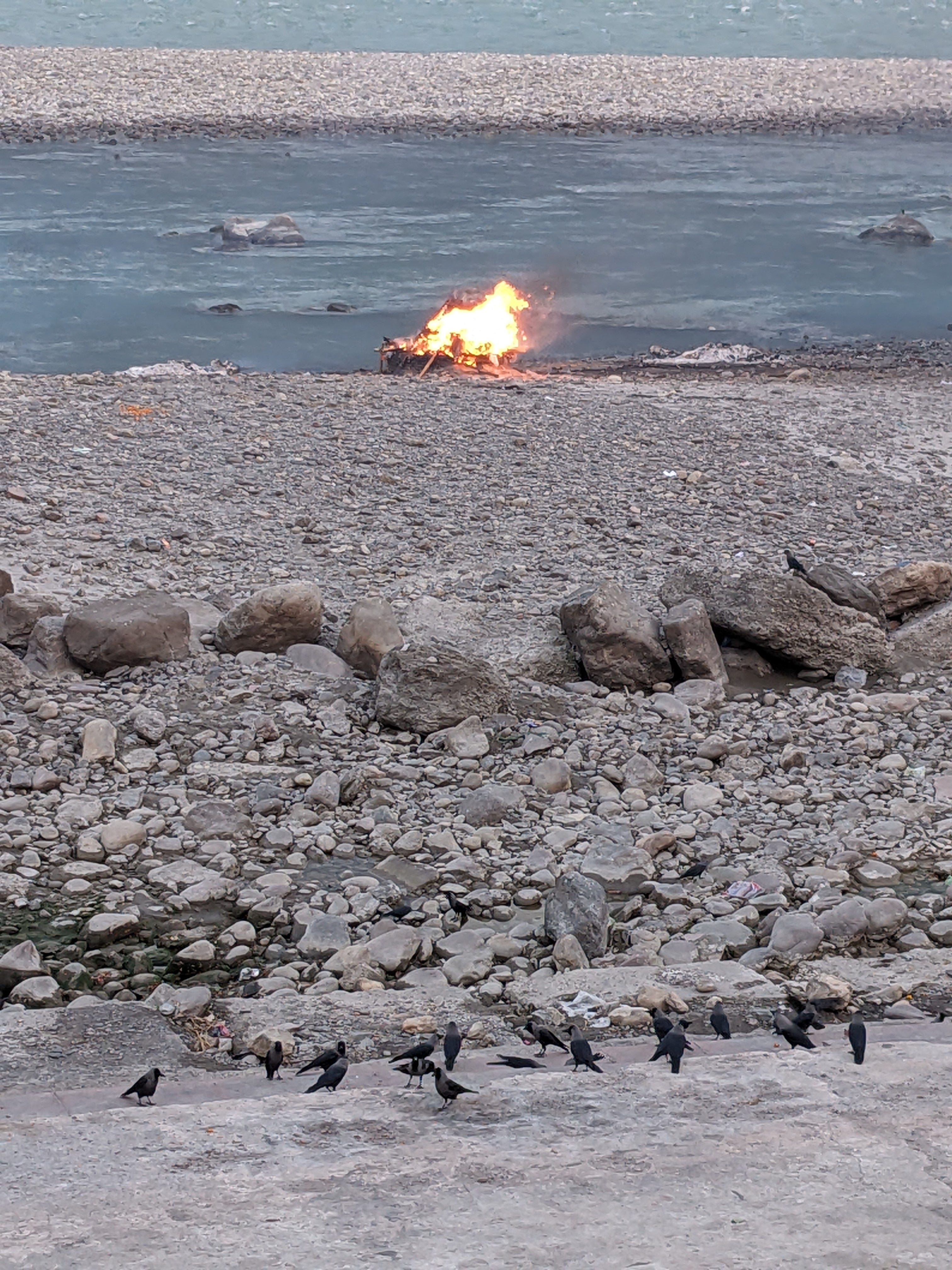
(my first night in India, in Rishikesh, in December: a funeral pyre burning alongside Ma Ganga)
To be human is to be afraid of fire. I’m not alone in the primordial fear that lives in my bones. And the future, the one where we have to learn how to be with each other when the air is thick with smoke, and our homes have turned to ash, is here. My six-year old niece lives in California. Wildfire has been present for all of her short life. Our house in Cape Town was evacuated once as the UCT library burned and flames leapt over the highway and helicopters filled their buckets from the school swimming pool next door. It is human to be attached to your home, to your books, to your pictures, to the box of drawings that your boy did when he was little. It all matters, and in the end, none of it matters. A friend tells me about being in her home while it burned to the ground. Just last year, another friend had firefighters arrive just in time as the flames threatened at her boundary wall. Like LA, Cape Town is a place where we have built our homes in the path of cyclical fire.
I don’t know about you but I have always imagined that we’ll know when we’ve arrived in the apocalypse. That there will be a single cataclysmic moment, like in the movies - and then we will know that the moment has arrived where we need to flee, where we need to figure out how to survive. I didn’t know that it would be like this. That temperatures would gradually rise, each year breaking new records. I didn’t know that the natural disasters we’ve always lived alongside would accelerate - and that there would still be pauses between them so that we would be lulled again, we would forget again. Because we want to forget. It is excruciatingly painful to not forget.
You may be enraged about the political context that surrounds the LA fires: the incarcerated firefighters, the failure to see the connections between war mongering and climate change, the refusal to take accountability, the way hearts open for the suffering of some and stay closed against the suffering of others. It is enraging. AND it is often easier to be angry than to be sad and afraid. We have to feel it all: the rage, the judgement, the despair, the flickers of unexpected joy, the fear, the astounding humility of our shared precarity.
True compassion is non-directional. It may be a particular encounter that instigates a heart resonance - but that resonance is for the shared condition not for the particularity. As LA burns, the heart resonance that is evoked is for the loss of home, the terror of flame, the shattering of the illusion that we can somehow secure our lives against the elements, that we can hold the future at bay.
I don’t have the answers for how we learn to be in our beloved burning world, but I do know that we have to learn and we have to learn fast. When I had those visions last year, I knew that I had to feel the terror and somehow keep breathing, to stay in my body, to choose to be present with the full force of it. We have more courage than we know. The courage to love our lives ferociously. To dance when we can, to gather loved ones, to sit quietly, to take refuge with trees, to eat cake, to laugh.
I know that the lessons from palliative care are profoundly necessary - how to hold each other’s hands, to sit in the grief, to do the best we can until the very end. Palliative planetary care doesn’t negate the possibility of a shift in trajectory, it is an invitation to expand our definition of hope to include hopefulness for how we navigate our reality. It draws our attention to all of the micro opportunities for relief. We all need to learn the work of death doulas, the work of presence at the threshold.
Comments
Nothing yet. Say the first thing.
Sign in to join the conversation.