
When France’s CNC announced a dedicated support service for filmmakers facing pressure to restrict their freedom of expression, my first reaction was scepticism. My second was something closer to hope. This piece is an attempt to work out which one is justified and what would need to be true for the hope to win.
The CNC — the Centre National du Cinéma et de l’image animée — is France’s national film agency. It funds, regulates and promotes French cinema, and its reach extends across the entire ecosystem: production, distribution, festivals, archives. When the CNC speaks, the French film industry listens. It is not a peripheral body issuing a polite statement. It is the institution that holds the keys.
Two weeks ago I wrote that the real failure in the Nadav Lapid affair was not the boycott. It was the institutions. Festivals and funding bodies that lacked the courage to stand by their decisions, to put the conflict in public where it belongs, and to stop transferring the cost of their fear onto the artist.
CNC president Gaëtan Bruel said it plainly: “Creative freedom is not defended only when it is comfortable or consensual. It is defended precisely when it becomes difficult.”
It is almost exactly what I argued for. So the question is not whether the gesture is welcome. It is whether it becomes something more than a gesture.
“The reason so many festivals and cultural institutions in our country receive support from central government and local authorities is precisely that they fulfil a public interest mission,” said Bruel. “As such, they bear a particular responsibility: that of ensuring the conditions are in place for the circulation of works, for debate, and for the exchange of viewpoints.”
He is right. Publicly funded cultural institutions exist precisely to protect the conditions for free expression, not just when it is easy, but when it costs something. That principle is worth defending, and the CNC is defending it.
But there is something in Bruel’s language worth sitting with. Festivals fulfil “a public interest mission.” Using that logic, a festival such as FIDMarseille should serve France. The CNC clearly does not think it did and is now intervening to say so.
And France, like every state, has interests.
So the question the CNC’s new support service cannot quite answer in advance is this: whose freedom of expression does it exist to protect, and whose pressure does it exist to resist?
There is an unspoken dimension to this intervention. The CNC does not merely advise French festivals. It funds them. When it says festivals bear “a particular responsibility” to ensure the conditions for debate and the circulation of works, it is not offering a philosophical observation. It is reminding its dependents of the terms of their relationship.
Read that way, the support service is also a chastisement: a signal to every French festival that the CNC is watching how it handles the next difficult case, and that how it handles it may have consequences.
The service is open to all: filmmakers, artists, producers, festival organisers, artistic directors. Anyone facing attempts to restrict their freedom of expression can contact the CNC directly and receive tailored advice, support and expertise. On paper, that is genuinely broad. A Palestinian filmmaker dropped from a French festival under pressure would, in theory, qualify.
It will be instructive to see how the CNC administers judgment in practice.
The doubt I have is not about stated intention. It is about the structural pressures that shape institutional decision-making before anyone reaches a conscious choice. Unconscious bias is real. So is the gravitational pull of knowing where funding comes from, which relationships matter, which controversies a state body can afford, and which it cannot.
The CNC may act in complete good faith and still find that its support service, in practice, activates more readily for some kinds of pressure than others.
That is not a cynical reading. It is what institutions do. And it is also part of what makes the boycott argument harder to dismiss than its critics allow. Decades of experiencing exactly this pattern have made Palestinian filmmakers and their allies deeply sceptical of institutional good faith.
There is, however, a sharper version of this doubt. The CNC did not intervene primarily because it cared about Lapid as an individual. It intervened because a French-funded festival yielding to external pressure as FIDMarseille did represented a visible failure of the principles French cultural life is supposed to rest on. Lapid was the occasion. The argument is laïcité — the secular framework under which French cultural institutions operate according to French law and French principles, not according to pressure campaigns whose logic is external to that framework.
That is coherent and internally consistent. But it means the CNC is defending France — its own cultural authority, its own secular model — rather than defending a filmmaker. The fact that the beneficiary happens to be an Israeli dissident is almost incidental. Which raises the harder version of the consistency question: France will apply this principle readily when the pressure conflicts with laïcité. The question is what happens when it doesn’t.
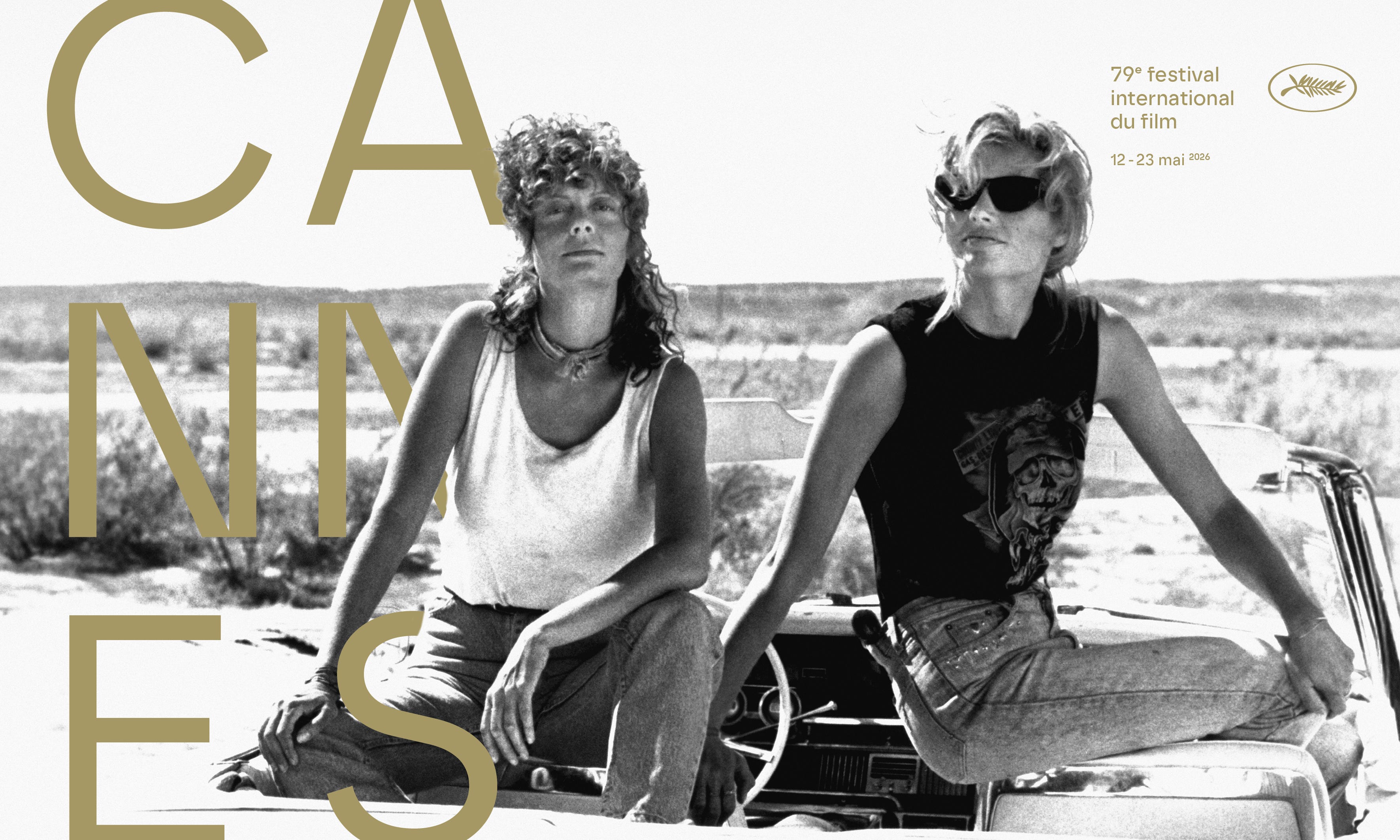
The Cannes poster this year illustrates the difference precisely.
Thelma & Louise: Sarandon and Davis choosing their own fate over surrender to a system that will not give them justice. I should say plainly that reading this as a statement about Gaza is my own interpretation: Cannes made no such claim. But Sarandon had been in the news for the damage her pro-Palestinian stance had done to her career, and the image arrived inside that context. That is exactly the point. Neutral cultural symbols are never entirely neutral. They arrive inside a political context, and audiences read them there.
One could read that poster as feminist defiance, Hollywood memory, cinephile nostalgia, or a coded political image about refusal and abandonment. The fact that all of those readings can coexist is what makes it useful. It shows how cultural institutions can carry political meaning while preserving plausible deniability. A political position expressed as an aesthetic choice is hard to attack, because the attacker has to admit they understood the meaning.
That is not a side issue. It is exactly the terrain on which the CNC’s initiative will operate. A support service can present itself as neutral, procedural, technical: advice, expertise, defence of expression. But it too will be read politically, because every case it chooses to support, and every case it does not, will acquire meaning.
France has room for that kind of ambiguity. Germany has much less.
The Berlinale operates in closer proximity to a state whose position on Israel is not merely a policy preference but part of the country’s postwar political architecture. Staatsräson — the doctrine that support for Israel’s security is a German reason of state — places a heavy thumb on the scale. Berlin can open debate, but it cannot pretend the debate takes place in politically neutral conditions.
The contradiction between programming films like No Other Land and governing under Staatsräson was always going to surface publicly.
FIDMarseille had more room than Berlin and did not use it. The festival’s director signed the Le Monde letter, expressed solidarity, said the right things, but signing a statement is not the same as acting on its principles when the moment arrives. The filmmaker-first approach was available: stand by the invitation, put the conflict in public, let the withdrawing filmmakers withdraw.
Instead, the quieter path was chosen, and the cost was transferred to Lapid.
What the CNC’s gesture cannot quite reach is the specific human position Lapid occupies and why that position matters for the argument being made.
His films are themselves a political statement, made over years at real cost. Ahed’s Knee is named after a Palestinian teenager imprisoned for slapping an Israeli soldier. It won the Jury Prize at Cannes in 2021. It is about an Israeli filmmaker facing censorship from his own government. He put her name in the title of a film his own state would prefer did not exist. Synonyms is about an Israeli man who moves to Paris and tries to shed his Israeli identity entirely the psychic cost of being that, the impossibility of escaping a state that attaches itself to you whether you want it to or not.
Lapid is not a confident outsider crossing a boycott line. He is the thing being boycotted. He is Israeli, and after FIDMarseille he said very little. A silence with its own quality. Not defiance, not self-justification. Something more like the silence of someone who understands why the trap exists even as he is caught in it.
His function is not to build bridges. It is to be a witness, to make Israeli dissidence visible in international cultural space, to keep the internal fracture open, to demonstrate that resistance to the state exists inside the society being boycotted. That matters strategically, even when it matters uncomfortably. The boycott that caught him did not remove a representative of the Israeli state. It removed the most visible evidence that opposition to that state exists within it.
Which is why the CNC’s initiative, for all its untested criteria, exists in more fertile ground than anything Germany could launch. France has the political and cultural architecture to make it mean something. Whether it chooses to is the question.
European institutions have shown how quickly support can be built when political will exists. After Russia’s 2022 invasion, Ukrainian filmmakers were met with emergency residencies, co-production funds, festival slots and public solidarity. Those interventions mattered.
But the unevenness is hard to ignore. Palestinian filmmakers have been displaced for decades. The equivalent infrastructure — emergency funds, dedicated residencies, support services — either does not exist or exists in far more limited form. The contrast is not explained by complexity alone. It is explained by geopolitics.
Which is why Kaouther Ben Hania’s refusal in Berlin mattered.
During the Berlin Film Festival period in February 2026, at the Cinema for Peace gala (an institution-adjacent event that presents humanitarian and politically minded film awards alongside the festival ecosystem, but is not part of the Berlinale itself) the Tunisian director of The Voice of Hind Rajab refused to take home the Dove for Most Valuable Film of the Year. She left the trophy in the room.
“I refuse to let their deaths become a backdrop for a polite speech about peace,” she said. “Not while the structures that enabled them remain untouched.”
An institution reaching toward Palestinian cinema with one hand while providing, in her words, “political shelter” to the structures enabling genocide with the other. The CNC’s new support service will need to answer the same question Ben Hania was posing in Berlin: which side of that contradiction does it actually sit on?
The conditions exist in France for this to mean something real. The political architecture, the cultural tradition, the diplomatic positioning, none of that exists in Germany in the same way. But architecture is not policy.
Tricia Tuttle, the Berlinale’s director, has articulated a position that sounds remarkably similar to what the CNC is now proposing: a festival that defends artistic freedom, stands by its filmmakers, and refuses to let politics dictate programming. Berlin’s position collapsed not because Tuttle was insincere, but because when the moment came, the weight of the German state fell on one side.
The CNC has more room than Berlin ever did.
This is where advocates of strong positions — including those calling for boycotts — perform an unlikely but necessary function. Constant pressure, constant demands for justification, force institutions to account for their decisions rather than retreat into comfortable neutrality.
The question is not whether the CNC shares those advocates’ conclusions. It is whether, faced with their challenges, it can demonstrate that its decisions are being made without political bias.
For that to be testable, the CNC needs to publish records: who it has supported, on what grounds, and how it navigated cases where the political pressure ran in the other direction. Not a policy document. A track record.
That is the only thing that turns a gesture into a structure.
Cinema in One Take is a podcast and a substack about culture, cinema and the ideas that connect them. Hosted by two film insiders.
How Oscar Campaigns Are Won
·
Mar 16
In the age of social media, perception can overtake performance. Michael B. Jordan kept the focus on the work. Others became the story.
No posts
Comments
Nothing yet. Say the first thing.
Sign in to join the conversation.