
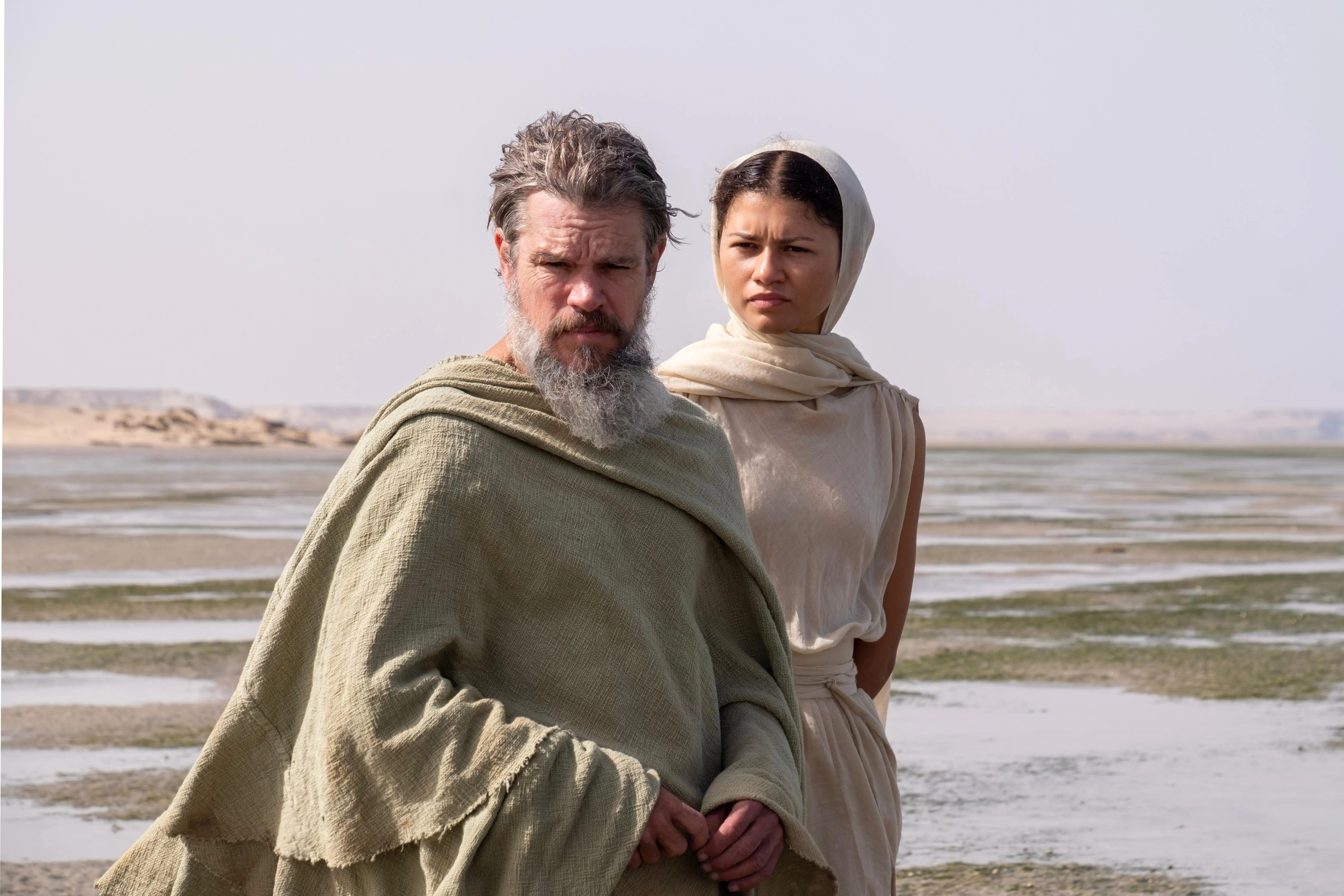
On the Cinema in One Take podcast this week, Emma and I discussed how Elon Musk has criticised the casting of Christopher Nolan’s The Odyssey. We wondered whether engaging with him merely gave more oxygen to provocative posts designed to generate debate.
But colour-blind casting is an important topic, so we dealt with his wayward position on Lupita Nyong’o, Homer and “historical accuracy”. If you want to hear what we said, you can listen to the Cinema in One Take podcast. I encourage you to do so.
What I am more interested in highlighting here is how Musk turns an ideological attack on a movie into a business strategy aimed at boosting the value of the companies he controls.
Whatever else his tweets are designed to do, they turn the grievance into publicity for one of his businesses. In the instance of The Odyssey, that business is Grok Imagine.
Thanks for reading Cinema in One Take's Substack! This post is public so feel free to share it.
The way I look at his tweets is heavily shaped by Jo Piazza’s incredible book, Celebrity, Inc.: How Famous People Make Money. I met Piazza at a film festival in Aruba, in 2010 I think, and she told me about the book she was about to publish and sent me the galleys. Little did I know it would become a bible on the mechanics of social media before social media became all-pervasive.
Essentially, it broke down how famous people’s public behaviour, especially their “fights”, was designed — often by marketing and publicity teams — to drive up their personal revenue. The chapter I was most taken by was about the 2007 “beef” between 50 Cent and Kanye West, who just happened to be releasing albums on the same day. What appeared to be some public dick waving was actually marketing. It did not matter who sold more records, because they both won.
Remember Barbenheimer? The same thing. Would Nolan’s film beat the summer blockbuster from the studio he had walked out on? Or should we go and see both movies? You decide. The result: the best weekend at the box office for years. Everyone happy. Barbie took more cash, Nolan more Oscars. Job done.
Movies have known this for a long time. Ryan Murphy’s excellent Feud: Bette and Joan relayed how Robert Aldrich cast Bette Davis and Joan Crawford in What Ever Happened to Baby Jane? so that he could use their decades-old animosity to feed tidbits to gossip columnist Hedda Hopper, keeping the film in the news. It was box-office gold, and they even used the feud in the subsequent, successful Oscar campaign.
When I was growing up, it was all about Schwarzenegger versus Stallone. I had posters of Rocky and the Terminator next to each other on my bedroom wall in the 1980s. Who had the biggest muscles, killed more people onscreen and was the better actor were hot topics in the school playground.
The rivalries can be real or fake. It does not matter, because the old adage that there is no such thing as bad publicity holds true. If you can become the story, it will give whatever you are pushing value. Entertainers know it. Musk knows it.
So this is the frame I would hang around Musk’s proclamation that Grok Imagine will make a “historically accurate” version of The Odyssey — note that even he does not have the brass balls to say “better”. One only has to look at the clip created by Grok Imagine to know that it has TV movie written all over it.
Not that I think Musk particularly cares how good the film will be, should it materialise. His single post — “Before this year ends, Grok Imagine will make a full-length movie of The Odyssey that is historically accurate and true to the art of Homer” — created a story about Grok Imagine that news outlets around the world repeated on his behalf, giving him and his tool thousands of column inches of free publicity.
He has framed the debate around the supposedly “woke” nature not just of Nolan but of Hollywood as a whole, calling the casting an insult to Homer, who he claims described Helen as “fair skinned, blonde”. In doing so, he has positioned his AI platform as the director that will right the wrongs not merely of the movie business but, given the political movements he supports, the wider social order he believes has gone astray.
Disputes over casting, race and “wokeness” are far more interesting to write about than a software update.
The timing of all this is well worth sharing because it is so convenient.
On 12 June 2026, SpaceX, the company that owns xAI, one of whose products is Grok, listed on the Nasdaq in the largest initial public offering in stock-market history, making Musk, on paper, the first trillionaire in recorded history.
Musk has made billions, by understanding that attention is fungible. A dispute he starts over a film can reinforce his identity as a technological insurgent, create engagement on X, promote Grok and remind investors that they should buy into his companies.
The bigger the battle, the larger the story. So, if you are going to take on the movie business, there is currently no director more bankable than Christopher Nolan. Unlike, say, James Cameron, he is a director who holds a traditional belief in what film is, and a credible and powerful voice against the idea that generative AI can or will replace human creativity. On brand, but perhaps not the best analogy, Nolan has dismissed AI as a “Trojan horse”.
Nolan’s proof is The Odyssey, shot entirely on IMAX film — the first film ever made entirely with IMAX cameras — using actors, physical locations, huge sets and practical production methods wherever possible. It is a box-office smash. Its success makes all the campaigning Musk has been waging about it being “woke” and inauthentic to the art of Homer seem ridiculous. Audiences have clearly not been listening to him.
That success makes Nolan the ultimate counterexample to the story Musk is selling.
But that is not to say Nolan has won, because Musk does not have to prove his product is better than Nolan’s, only that it can coexist in the same space and possess merits of its own. He knows that cheaper production costs are not really a badge of honour in the movie business, so instead he is selling the idea that Grok will not pander to modern sensibilities around colour and transgender casting.
That is the cultural dividing line Musk is trying to sell.
So Musk is no longer merely saying that Grok Imagine can generate audiovisual images. He is saying that it can correct Hollywood: faster, cheaper and without the ideological compromises he tells his audience have corrupted the existing industry, no matter how false the dichotomy.
It is the shark going after the biggest boat in the water, not because the boat did anything to it, but because attacking the biggest boat is the most visible thing a shark can do.
What is worrying here is that Musk is going after artists who have no interest in, or anything to gain from, being part of his game. 50 Cent and Kanye West were mutually benefiting from their feud. Nolan made a film. Nyong’o accepted a role. Neither agreed to become material for someone else’s AI-product launch. Neither will gain from it; worse still, they will most likely become targets of abuse.
Musk gets the upside. They absorb the noise.
Let us also not forget that Musk controls the company where the dispute begins. X was folded into xAI in 2025, which was then acquired by SpaceX. The provocation promotes Grok while also generating engagement for X, creating value across the same corporate structure.
Musk might argue that Nolan’s Odyssey benefits from the attention too. The difference is that Nolan and his cast never volunteered their work as material for Musk’s product campaign.
It is hard to dismiss the irony in hearing this particular company owner speaking the language of fidelity and respect.
Grok has spent much of this year under regulatory and legal scrutiny because users were able to create manipulated and sexualised images of real people without their consent. Regulators in Britain and the European Union have opened formal investigations, while people whose images were allegedly manipulated have filed lawsuits against xAI. It seems Musk chooses when authenticity is a must-have ingredient for audiovisual creations.
The promise of a respectful, authentic Odyssey is arriving from a technology that has not yet established that it can consistently respect living people.
Whether Grok Imagine ever delivers a version of The Odyssey is secondary. Musk has already taken somebody else’s years of work, attached himself to it to promote his own product, and correctly calculated that the media would market that product for free because the controversy generates clicks.
The next time a famous story is cast or adapted in a way that can be framed as cultural betrayal, watch for the same sequence: grievance, announcement, AI solution, authenticity claim, media coverage, investor attention.
The argument will appear to be about the artwork.
The ideology may be sincere, but the machinery underneath it is financial.
For Apple users link HERE
For Spotify users link HERE
No posts
Comments
Nothing yet. Say the first thing.
Sign in to join the conversation.