
Everyone knows that app dating is the worst. So I’m all for people trying to create in-person events where singles can meet and mingle in real life.
I went to one of these events in October. I was still on the apps and not having a ton of success. I forget how I heard about it. Probably an Instagram ad. It was called The Feels. It took place in the city (San Francisco, for you nonlocal peeps). It wasn’t cheap. But I decided I would bite the bullet, stomach the $100 it cost to attend, and drive up to the city for it on a Wednesday night.
Spoiler alert: I did not make a “connection.” But it did reveal how little instruction women receive about how to give consent. And how often, doing what feels right means overriding decades of societal expectation and lived experience.
The Feels seemed like the kind of endeavor where consent would be paramount. It was a “somatic experience,” grounded in mindfulness and wholehearted presence. They even had a tab on their FAQ’s specifically about consent.
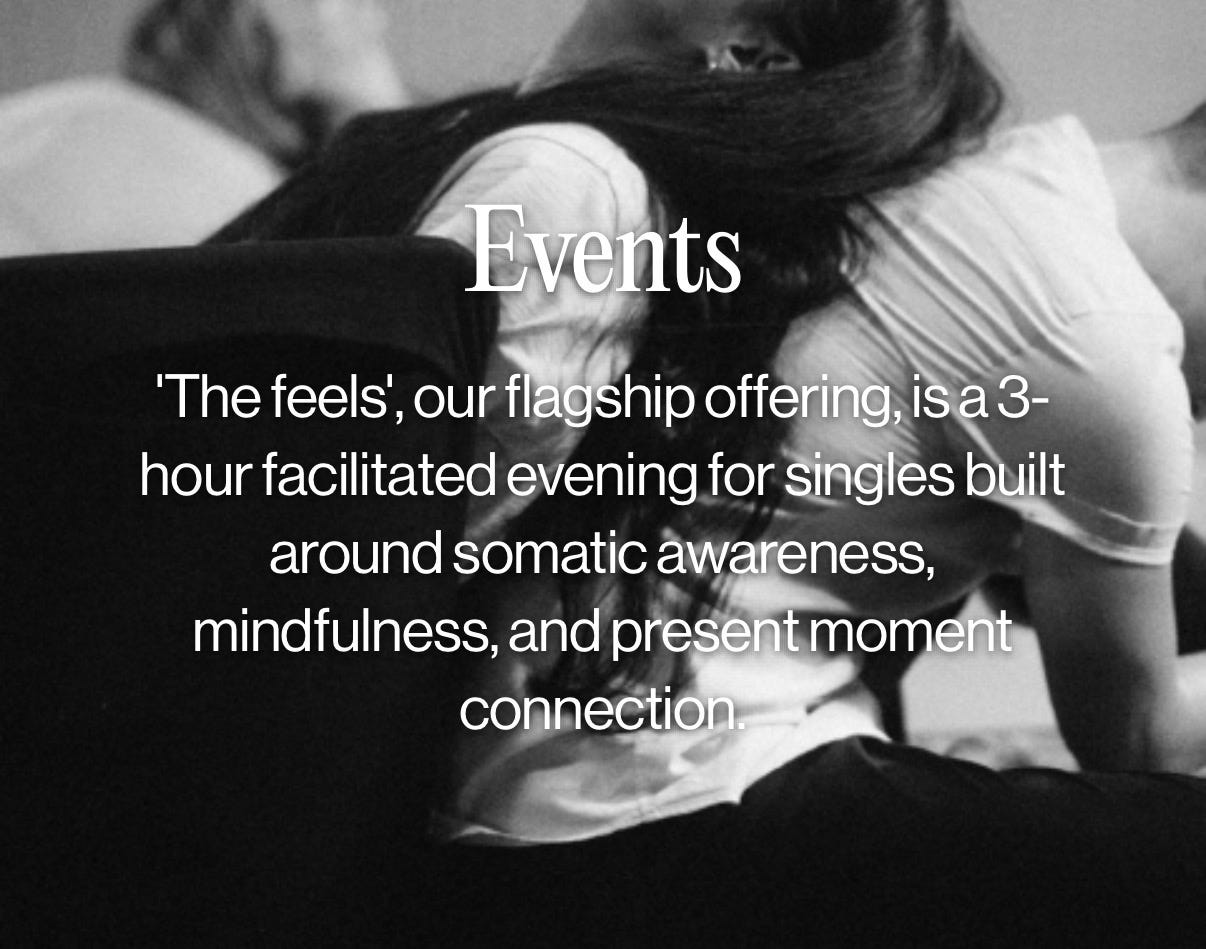
This wasn’t speed dating. You had to be willing to do exercises with people you didn’t know, like eye gazing and long hugs. Then you would chat about the experience. And then be paired with someone new to do a different exercise. It sounded potentially awkward, but I also appreciated that the organizers were trying to provide an alternative to the current dating scene, which if you haven’t noticed, has some major flaws.
I ended up attending with a guy who I’d been set up with, and we’d gone on two dates. I really liked him (except for the fact that he lived in Oakland, a real haul from where I live on the peninsula). But I wasn’t sure we were really in the right space to take things to the next level. I sent him the link and asked whether he might want to go with me. Yes, it would be weird to essentially take a date to a dating event, but I worried if I didn’t have someone else to go with me, I might chicken out.
Low and behold he was down for it. We met for drinks before the event at the rooftop bar and then walked into the venue together.
It was held in the downstairs event space of The Proper Hotel. We arrived during the time reserved for mingling before the official start of the event. There was a cash bar, and a place to leave bags, jackets and shoes. A quick scan of the room led me to believe that this event would not end in a successful pairing for me. But I planned to stay open. And see what transpired.
Honestly, other than my date, there was only one person whose energy I was attracted to, but she was a woman, and this was a “het monog” event (aka for people who are heterosexual and monogamist. The Feels also hosts events for people who are queer and people who are ethically non-monogamous or ENM).
Finally, it was time to enter the room. No alcohol was allowed inside. There were about 40-50 attendees. We gathered in a big circle. The facilitator, an attractive woman in her thirties, invited us to go around the room, say our name and a word that described how we felt. Then we were to begin the experience.
The Feels works hard to have an equal number of guys and girls at each session but there were more guys than girls at this event, a real problem because the entire experience is based on being paired up.
There were four somatic experiences for the night which meant that you’d be paired with four different people. Then, if you wanted to mingle afterwards with people you didn’t have the chance to be paired with, there was an informal hang at the rooftop bar (though not everyone attended). You could also reach out to The Feels team about a “missed connection.” In addition, you got added to a WhatsApp group of all The Feels alumni in the area, which was another way to connect with singles in this community.
The facilitator paired us up for the first exercise by essentially putting us with the person standing next to us. For the next three sessions, we would “choose” our partners. But the process for doing so had some serious flaws. Especially for women who have been socialized to prioritize the feelings of men.
Consent was a key component of this process. You were only supposed to accept invitations if you wanted to. You were allowed to say no. She encouraged you to say no to a pairing unless it was a full body yes.
She turned on upbeat music. We were instructed to walk around the room, in random directions, aka don’t all walk in a circle. Ideally, this meandering would mean we would meet the gaze of other people in the room. We could choose to dance around to the music, be playful, feed off each other’s energy, show our personalities. Then, the asking would begin. The guys would be “choosing” for this next round of exercises.
Problem #1: As stated, there were more guys than girls. So inevitably, several guys would be left without a girl to partner with. They could choose to partake in the exercise with another guy. If they didn’t feel comfortable with this, they could just sit the exercise out.
Problem #2: The facilitator didn’t clarify how to turn down these requests. And for women who have been conditioned to read the room and prioritize the comfort of others over their own, saying no can feel damn near impossible.
So, the music turned on. We began our perambulations. It wasn’t quite as awkward as it sounds. I’d done this kind of exercise at Esalen when I attended a workshop with Bessel van der Kolk. But then it was time to ask. And within the span of 15 seconds, I had three different men ask me to partner with them. These requests were communicated via eye contact, a raised eyebrow, an open mouth about to speak. Before they could even get the words out of their mouths, I would shake my head no. As I did that once, the next man was there. Do you? No. And again, do you? No. Finally, a few seconds later, another man, another raised eyebrow, and I had no no’s left. I nodded, desperate to relieve myself of the discomfort of refusal.
We sat down, now partnered for the next exercise, and tears rushed to my eyes. I wasn’t sure what the emotion was about. I thought in the moment it was my body not being able to tolerate all that refusal. Like it was overloaded by the experience of turning a man down. Not once. Not twice. But three times.
But here is another reason I think tears arose.
When I said yes to this fourth man, it was not a full body yes. I wanted to say no but my body was in panic mode, so I overrode it. And I hated how that felt, even as I didn’t have another alternative.
Saying yes when you don’t mean it, takes something from you.
Despite all our discussions of consent in today’s post-MeToo world, do we teach girls how to say no? Do we instruct them in how to check in with their body, and detach from the desire of their partner, to be able to tolerate the displeasure or disappointment of a man? Consent does no good as a concept unless it is truly taught. We can’t just ask men to ask for it. We have to teach women how to truly give it. To have their yes’s mean yes. To learn how to feel and say their no’s.
When I think about the concept of consent, I always think of the essay by Melissa Febos in Girlhood (that was excerpted in The New York Times Magazine). She goes to a cuddle party to practice consent. And as they are going over the rules before the party begins, as they actively practice asking and giving verbal consent, the hosts give an additional instruction. They are to role play asking, saying no, and then the person who has just technically been rejected is instructed to say this: Thank you for taking care of yourself.
Thank you for taking care of yourself. A verbal affirmation that you did the right thing. An expression of gratitude to remove any vestiges of guilt.
I love that exchange and think that response might have helped me with my discomfort.
But even with these helpful parameters, Febos struggles:
““Hi,” he said affably. “Want to spoon with me?”
“Sure,” I said. I did not hesitate to assess whether I really wanted to spoon with him. I had no lucid thought about it at all. I simply agreed and we settled on the chenille-blanketed floor. He curled around me. I did not think, I do not want this man’s body curled around me. My uneasiness did not occur as a thought at all. It was more like a shift in temperature or light, a texture inside of me that roughened.
“Can I rub your arm?” he asked, his breath on the back of my neck.
I nodded. I did not think of the verbal consent requirement. His body was warm against mine, and his touch didn’t wander from my arm. I felt the nubs on the sleeve of his onesie rub against my bare skin. I wondered for how long I needed to remain in this position to avoid seeming rude. To describe the way I felt as a “maybe” would be generous, but I did not consider Rule 5 (If you’re a maybe, say no). I did not feel “encouraged to change my mind.”
That is, whatever the culture of the cuddle party, the culture inside of me presented its own dictates.”
We had been given no such parameters about how to manage consent and someone else’s no at The Feels. So of course I struggled. I felt like with every no, which was honoring my body, I was disappointing someone else. With each no, I felt a weight of responsibility, the burden of disappointment I inflicted. This was exacerbated by the fact that several of the men I said no to were then stuck without female partners and had to do the next exercise with another man. I felt like it was my fault. I was the reason for their pain.
I’m grateful for alternatives to the app dating scene. And yet, an experience designed to circumvent our old patterns seemed to just reinforce the divide.
Being placed in a room with a bunch of men who are there specifically to make a connection is a different dynamic than at the typical bar. I don’t think I’d have trouble saying no to someone out in the wild. But because each person walked into that room with expectation and hope, having spent $100 in hopes of making a connection, because the experience itself requires a kind of vulnerability, I think I didn’t want to be the one to impact their experience in a negative way. I wanted to prop up their egos, no matter how it impacted me.
Sometimes I think we do this because we have learned the hard way that upsetting a man can put us in peril. So, we have attuned our bodies to accommodate. To fawn. To suffer to stay safe. We know no other way.
I don’t know how we fight against years of conditioning in the span of one night.
It makes me wonder how we can raise girls who can comfortably say no and not feel guilty. It makes me contemplate whether we can teach all people to respond to refusal with such a kind phase: thank you for taking care of yourself. If we can create ecosystems of care and reciprocity and love that are not codependent or fueled on women’s over-functioning.
I understand why a company like The Feels exists and maybe if I’d gone again, I’d have had better luck. I would have been more prepared for my discomfort at saying no. Maybe I even could have asked if they ever let women choose first. I’m lucky now to have found someone who has been a fully body yes from the start.
But either way, I want to learn how to refuse a man and not have it pain me.
Thank you again for being a reader of The Mother Lode. It has been quite a journey since its inception in November 2021, when I was still married and trying to figure out why marriage and motherhood were so stifling. I’m so grateful to have found ways to make myself feel more free, namely through MDMA therapy, unfawning, and divorce.
Annual paid subscribers get a 30-minute zoom with me to discuss any topic of their choosing. And your financial support helps me stay focused in this space.
Comments
Nothing yet. Say the first thing.
Sign in to join the conversation.