
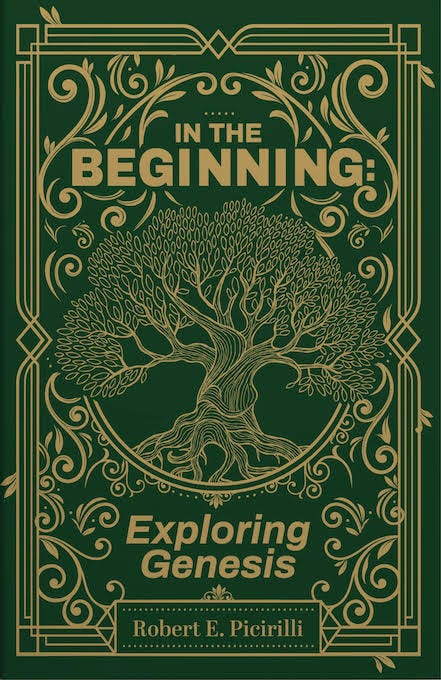
On the heels of Dr. Robert Picirilli’s latest publication, In the Beginning: Exploring Genesis (Randall House, 2026), I’m pleased to have his permission to publish some additional insights he shared with me recently surrounding the age of the earth, science, and Scripture.
Introduction
For some years I have argued that we who take the Bible seriously do not have to accommodate the billions of years claimed by some scientists for the age of the earth. Everyone in Christian circles is aware that there is some division among evangelical Christians between those who view the earth as old and those who view it as young. Those who think the earth is young are suspicious of those who think it is old; and the latter suspect that the former do not understand well the basis for the claims of science. My point of view, which I will develop here, is that we do not need to be forced into saying just how old the earth is—and thus when biblical creation occurred.
Many of the scientists who posit that the earth is billions of years old do so on a secular basis. That is, they do not believe there is a God, or at least that the Bible must be taken at anything like face value. Their observations and theories are constructed without reference to God.
At the same time, some scientists who profess faith in God and confidence in the Bible likewise adopt the “old earth” view. I need not venture, here, into their motivations for this, which may be varied. Common among these motivations is the confidence that much of the scientific enterprise must be accepted and trusted; and, in that case, we must make room for the long ages of history that scientists (secular and otherwise) see evidence for in the structure and development of the universe. Further, if that much is admitted, then the Genesis account of creation cannot be taken as straightforward historical narrative, describing creation in terms that can be taken as precise and exact. Instead, Genesis—especially the early chapters (perhaps through chapter 11) can be taken as some sort of narrative composed to represent truth broadly and phenomenally rather than specifically and directly.
The word myth gets floated around in such discussions, but I will not depend on that word; it has too many meanings to provide a stable basis for argument. All we really need to know about this view is that Genesis doesn’t really mean, and never was intended to mean, that God created everything in the universe, including every basic kind of animal life, and human beings, in six twenty-four hour days. The creation account isn’t meant to be that kind of history, say they; it is another kind of “history” that tells the truth in a different way.
A Recent Example
With this probably inadequate introduction I turn to the view of the universe that often seems to demand such a view of the creation account in Genesis 1 and 2. A recent issue of Christianity Today (November-December 2025, pp. 34-37) carries an article by astrophysicist Deborah Haarsma entitled “The Incarnation According to Astrophysics,” which describes, as part of its purpose, a contemporary and scientific view of our universe in its magnitude, complexity, and evident history. I will attempt to summarize this view for my readers, and to do so with full sympathy. I have no doubts about the accuracy of the article in this regard.
Haarsma first comments about the contemporary surge in numbers of people who profess no organized religious belief; when surveyed, they give science as their most common reason for this. It is “among the top reasons that people doubt,” she notes. Then she proceeds to lay out the case against religion, as she sees and accepts it, although she succeeds in turning it into a case for faith in God—and in understanding the incarnation, which she is primarily writing about. As she expresses her approach, she insists, “To reach people in today’s tech-dominated world, we must bring together the discoveries of modern science with the ancient truths of Christianity.”
The view of the universe that she is representing as “the discoveries of modern science” goes something like this. In our (Milky Way) galaxy alone there are an estimated 100 billion stars, of which only about 5,000 are visible to the naked eye. Even so, our galaxy is only a tiny part of the whole. There are clusters of galaxies that contain hundreds of galaxies that can be detected by NASA’s James Webb Space Telescope. Indeed, research provides grounds for a serious estimate that there are hundreds of billions of galaxies in the universe, each containing billions, if not trillions, of stars. That seems, by the way, to relegate our little solar system to a category that might be judged insignificant.
There’s more. Consider the stuff that makes up the universe, most of which is not stars. Data from satellites shows. Haarsma reports, that some 27 percent of the universe is what’s called “dark matter,” and 60 percent is “dark energy”—both of them mysterious entities that are not fully understood but are indirectly detectible. Indeed, what scientists know—including all the stars and the atoms listed in the standard periodic table—comprises only about 5 percent of the universe.
There is yet more. Consider the atoms that make up physical things. These have come from the stars. When certain stars collide, the atoms within them are freed to roam the universe and settle where they will. Thus even our human bodies, like the planets in our solar system, are made up of these atoms that have come from the stars—“stardust,” Haarsma poetically calls this material. She notes that Carl Sagan, not so poetically, called this material “star stuff.”
Haarsma does not focus on the process or discuss the time required for all this complexity to form. She leaves unsaid, in this article, the obvious implication: namely, that such processes have required billions of years to arrive at the present state of our still-expanding universe as we know it.
Of course, the Christian will affirm that, no matter how complex and huge (or how little understood) the universe may be, God created it all. But if one accepts the picture I have summarized, with its implications, the view that God created all the universe in one week, in the simple manner described in Genesis, begins to sit somewhat uneasily in our thinking. The question we cannot avoid is, How can we—or can we at all—fit such a picture of the universe into the biblical account? The answer that many give is to accept the billions of years and, as I have already indicated, to jettison anything like a “literal” view of Genesis 1-2.
A Possible Direction
Is that the only way for a Christian to think? Must we give up a straightforward reading of Genesis? I would suggest that we do not have to take that painful step; nor do we need to provide a definable date for the creation of the universe. And, before proceeding to develop this approach, I hasten to say that I have no argument with the view of the composition of the universe that Haarsma has briefly described (and which I have even more briefly summarized). I just don’t agree with the implications some draw from that picture, and I am confident that harmony with what is at root a secular view of science cannot be achieved by affirming the billions of years and making Genesis fit.
An alternative answer to the question whether the scientists’ billions of years is the only way forward builds on a relatively simple idea: namely, that whatever God created he brought into existence at some point in the cycle of existence. Indeed, there are various implications of this, but all of them seem necessary if, in fact, God created ex nihilo by the authority of his commanding word.
I think we begin with two questions and the assumptions that come from answering them positively. (1) Did God ever create—bring into existence—anything that did not exist prior to his creative action? (2) Did he create “from nothing? That is, did he create by speaking things into existence, as Scripture declares in Hebrews 11:3 and in other passages like Psalm 33:6, 9? I proceed on the assumption that the Christian tradition holds dear these two truths.
In that case, then, the following assertion seems unarguable: if God by his word brought into existence things that did not exist prior to his speaking, the methods of science do not allow for confirmation of this or for determining how long ago he did so. When I refer to the methods of science, I mean—without argumentation or detail—what we call the empirical method, which is based on observation plus reasoning. It goes without saying that scientists do not have access to autonomous, fiat creation and can therefore not provide for it in their calculations. They are not able to include divine creative acts in their observation and reasoning, at least not as long as they limit themselves to pure scientific method.
I begin at the simplest level, with that old teaser that asks which came first, the chicken or the egg. (This could be done with any other lifeform, of course.) I am enlightening no one when I say that eggs come from chickens and chickens from eggs. That is the cycle of life for that animal. If God brought into existence, by his word, either a chicken or an egg, and some scientist could come along and examine it, he or she would not be able to determine that God created it or to settle on a time when that creation occurred. A scientist who knows about chickens and eggs must be sure that this particular chicken, if that is what presents itself, came from an egg produced by yet another chicken that came from an egg produced by still another—ad infinitum. Or, if the scientist should discover that chickens and eggs evolved from even lower lifeforms—well, one can see that this leads on to an even larger cycle of life.
Another illustration arises from a question: How old was Adam when God created him? Or Eve, for that matter? The Bible does not tell us, but there is one thing we can be sure of: if God created human lifeforms he did so at some stage of human life. The Genesis record seems, on its surface, to represent Adam, immediately after his creation, as an adult—perhaps a young adult, say, of twenty, old enough to tend the garden mentioned in the account? Would an unsuspecting scientist who happened on him there in Eden conclude that he was twenty years old? (It matters not whether you prefer some other age.) Had this occurred, if we assume that the scientist understood how human beings develop—from fetuses in a female womb that, in turn, result from female eggs (ova) fertilized by male sperm—the scientist might have included nine months in his calculation. Indeed, in a way more sophisticated, the scientist might have included the line of humans, with genes passed on from one generation to the other ad infinitum, to consider how old this family of humans.
It hardly matters how “old” Adam was, or Eve, when they were created by God’s spoken word; one may as easily ask if they had DNA or genes, and where they came from? Indeed, it strikes me as obvious that an Adam, formed from clay and given life by the breath of God—or, for that matter, created in any other way—would have had genes that represented the fruits of many generations past, as genes must.
When we deal with cyclical lifeforms, there is no place to start—other than to accept that God spoke into existence a developed form, one that otherwise must come from a prior form. Nor is any form of existence too complex or large to avoid this. So let us leave specific lifeforms to look, once more, at the picture of the universe described by astrophysicist Haarsma, outlined above. There seems to be no doubt that the vast universe, which enfolds multiplied millions of stars in ever expanding activity, some dying while others are forming, is also a cycle. What if God created—spoke into existence—this complexity at a given (or should I say chosen) state of existence? Could that mean that he did so with the light from some of the stars already having reached the earth for Adam and Eve to see and to enjoy their illuminating the night sky?
Let’s bring this down to terms more manageable in our limited thinking. What if God created our earth already in orbit around our sun, revolving on its axis—and thus benefitting from the motions and gravitational pull of the moon and stars? If he spoke them into existence, that seems likely. How else, I would ask, could he have created it?
What if, then, he was a God who delighted in beauty and complexity and created the universe and earth in a developed state? I repeat, how could he do otherwise? What if Adam and Eve, living on the earth he created could already see and enjoy stars beautifying the night sky? What if the state of the earth, when God created it, was such that there were already mountains to relieve an otherwise unbroken horizon? Or valleys to provide pastures for flocks? Or rivers with their beds already cut deeply into the earth to carry the flow to the sea, awaiting evaporation back into the skies to fall again? Or caves to explore? Or varieties of trees with different colored blossoms in the spring? (The flood of Genesis 6-8, with catastrophic worldwide effects never seen before and never to be repeated, also bears on the shape of things today. Pursuing this now goes beyond my purpose in this article; it is significant that 2 Peter 3:6-7 refers to the antediluvian world as (literally) "the then world" in contrast to "the now heavens and earth.")
You can carry that on, perhaps endlessly. I would suggest that there is no way for God to create anything that did not previously exist without that created thing appearing to have an age that it did not have. I realize that some may object to this on the grounds that God was falsifying the record. No. I am not suggesting that he placed in the rocks fossils of animals that never existed. I am suggesting that there was no way for God to create things, things that did not exist before he spoke, except to create things that would appear to have a history within the cycle of life and existence. No one should be deceived by that, once the cycle of existence is understood and one comes to faith in the God revealed in the Bible.
Some Implications
One implication of this is that a person who believes the Bible does not therefore need to decide how old the universe or the earth is. The pressure of making such a decision is relieved. If one prefers, then, the date may be left undetermined. One may be satisfied to know that, if God created at all—whether in six days or not—science cannot, as science, determine how long ago that was. A person who chooses this response will be confident that the world isn’t as old as secular science posits. At the same time, he or she may take the position that the biblical data are not complete or specific enough to provide a date and were not intended to do so.
By the same token, a person can adopt a six-day creation and young earth. If, indeed, God created a developed universe and manifold lifeforms, one gains nothing by accepting the billions of years postulated by secular science.
Indeed, if we choose to credit the billions of years, we have gained absolutely nothing in reaching a harmony between the Bible and any so-called scientific view of the age of the universe. In that case we have only moved back the point of contention to an earlier time in history. Secular science, given the meaning of secular, can never accommodate an eternal, creating God. Then we who hold to the truth of the Bible, regardless how we interpret Genesis 1-2, may as well resist the implications that the universe is too old for its age to be measured in anything less than multiplied billions of years.
We would like to see scientists saying something like this: If the universe and the earth were not supernaturally created by God, then judging from the evidence we can observe, they must be billions of years old. That would be honest and relieve the tension that results from their claims. Then everyone would understand that old-earth estimates based entirely on the reasoning of empirical science depend on autonomous science. Such estimates, therefore, reflect assumptions that rule out a world created by the word of God out of nothing. Bible-believing scientists could say such a thing, of course; secular scientists could but have no reason to do so.
If God created at all, he might as well have created those billions of stars that Haarsma describes so well, all at one utterance. That would have been no harder for him than to create a single cell from which all the stars ultimately developed in billions of years. But it would be more coherent with the biblical account, regardless how that account is interpreted. Anyone who has read my In the Beginning: Exploring Genesis, knows that I am not embarrassed to take the creation account as reporting genuine creation by the spoken word of God, more or less as Genesis describes it.
For more from Picirilli on Genesis, be sure to pick up a copy of his latest work!
No posts
Comments
Nothing yet. Say the first thing.
Sign in to join the conversation.