

A few years ago I was teaching an adult Bible study on the subject of revelation. I was trying to show the value of general revelation, but also why special revelation was necessary for clearly understanding the gospel.
In illustrating my claim, I critically used a quip from the notoriously quotable G. K. Chesterton (1874-1936), the British author, apologist, and literary critic: “Certain new theologians dispute original sin, which is the only part of Christian theology which can really be proved.”[1]
Some readers will be more familiar with a variation of this quote from the neo-orthodox theologian Reinhold Niebuhr (1892-1971): “The doctrine of original sin is the only empirically verifiable doctrine of the Christian faith.”[2] Niebuhr was actually echoing another publication, the London Times Literary Supplement. (It’s unclear to me if that publication borrowed from Chesterton, seeing as how he was British and cross-influence seems plausible.)
My intent in questioning Chesterton was to help our congregation understand that we need the full revelation of Christ not solely to see the solution to our problem, but to understand the problem itself.
One well-read church member then politely questioned whether I was interpreting Chesterton fairly. Orthodoxy, Chesterton’s thoughtful diatribe-turned-classic, mostly refutes mistaken notions about Christianity and progress. It is by no means a conventional survey of Christian doctrine, though it’s well worth your time if you can get past all the Anglophile references.
My church member’s point was that Chesterton was known for rhetorical flourish and wit. In saying sin could be proven, he simply meant, “Look around. Isn’t it clear that something is horribly wrong with the world?”
She wasn’t wrong. Some statements are meant to be taken “seriously, but not literally.” However, given the traction that both the Chestertonian and Niebuhrian quotations have had over the years, it’s worth asking the question: Are they right? Can we make sense of the doctrine of sin (hamartiology) apart from the doctrine of Christ (Christology)?
More practically, can people be shown their full spiritual need for Christ before we get to Him in evangelism? Or can we convince them of the spiritual condition and the world’s actual plight apart from special revelation?
First Things First
Stanley Hauerwas is one of the English-speaking world’s most controversial and widely discussed theologians. Reading him is both fascinating and frustrating. He’s the type of writer who makes you heartily ‘Amen’ one statement then cry “Oh me” after the next. Despite the latter, he’s the first theologian that got me thinking seriously about the relevance of Christology to this discussion.[3]
I’ve heard him repeatedly attack Niebuhr’s statement, which would seem to discredit Chesterton’s remark as well. His point? What you believe about Christ will shape what you believe about sin, and vice versa.
So, what should we begin in saying about Christ?
Here we confessional evangelicals say that Christ is the God-man come to earth to fulfill God’s plan of redemption of the human race and the entire cosmos. He is truly God and truly man. He is the long-awaited son of David. He is the Messiah-King. He is the one who brings the Abrahamic Covenant to fulfillment. He lived a sinless life. He offered his life as a substitutionary atonement for sin. He was raised victoriously by the Father and vindicated in the Spirit. He has called the church into existence, and through His Word and Spirit, empowers it to fulfill the Great Commission until He returns to judge the living and the dead.
Thus far we find great consensus with other Christian traditions on the basic Christological questions (with perhaps some quibbling over the best understanding of the atonement). But when we look closer at the details of Jesus’s person and work, we uncover much more that impinges on the question of sin.
The Difference Jesus Makes
Jesus’s ministry of teaching and preaching is always connected to his ministry of healing. So often was he found healing people that it almost makes one wonder, “Why bother? Such people end up dying anyway of other illnesses. Poor Lazarus had to die twice!”
Yet the more we probe the nature and meaning of Jesus’s miracles the more we see that his healing wasn’t merely a demonstration of great compassion and divine power. It was a foretaste of the new creation his kingdom ministry was inaugurating. His proclamation of the gospel of the kingdom was good news for the spiritually captive, including the blind, the lame, and all whose lives were touched by the brokenness of a sin-cursed world.
The trouble is that when unbelievers see a world touched by the ravages of disease and physical decay, they do not see a world broken by sin. They see a world broken by manifestations of sin. And they mistake the manifestations for the root cause itself.
They see genetic mutations. They see treacherous hereditary conditions. They see the evolutionary-historical arc failing to take us where we’d like to go, which simply reinforces the need for funding the National Institutes of Health and organizations like it all the more. They see people being evil, without a larger moral account of something like “evil.”
Yet Jesus showed very clearly that physical maladies are but the visible outworking of the condition that is sin. Multiple encounters with the ill and diseased reveal this.
For example, in Matthew 9 Jesus famously heals the bed-ridden paralytic who was brought to him by faithful friends. However, instead of beginning with, “Rise and walk,” he begins with, “Take heart, my son; your sons are forgiven.” The scribes are deeply troubled by Jesus’s apparent blasphemy, to which he responds, “Which is easier to say: ‘Your sins are forgiven,’ or ‘Rise and walk’?”
It’s at this point that he addresses the surface problem of the man’s disability using the language of healing—but not before referring to His “authority on earth to forgive sins.” In other words, if he has the authority and power to reverse the effects of the Fall, he most certainly has the authority to forgive the ultimate reason for the Fall: human sinfulness.
Another encounter with religious leaders (Pharisees) in John 9 puts an even finer point on this larger lesson. Jesus encounters a man blind from birth. The disciples inquire as to whether it was his sin or his parents which explained his particular ailment. Jesus doesn’t deny the relevance of sin to disease, but instead, explains that the larger matter in view is that this man’s condition gives occasion for the power of God to be manifested in his life. He then healed the man.
Unbelieving Jewish leaders then interrogate the man, skeptical that true healing could have taken place. But their larger aim is to cast doubts on the identity and claims of this Jesus of Nazareth. Eventually they get the opportunity to confront Jesus himself. Jesus then turns an inquisition about physical blindness into spiritual blindness. He has no patience for those who would cast out a man who was healed simply for reporting what the Lord had done for him.
Jesus asserts,
39 Jesus said, “For judgment I came into this world, that those who do not see may see, and those who see may become blind.” 40 Some of the Pharisees near him heard these things, and said to him, “Are we also blind?” 41 Jesus said to them, “If you were blind, you would have no guilt; but now that you say, ‘We see,’ your guilt remains.
Because the Pharisees won’t see that the blind man now sees because he has encountered the Divine power of heaven, they will remain in their blindness. The blind man and the blind religious leaders suffered from two different blindnesses, but both had an underlying origin known as sin and depravity, from which all forms of moral and physical problems arise. Jesus cares about the manifestation of the curse (blindness), but he really cares about the deeper, more subtle, serious expressions of the curse (rebellion).
Jesus pushes us past external accounts. He helps us see how the externals and internals of moral reality connect.
We can go a step further and say that Jesus helps us see the horizontal and vertical nature of sin. David makes clear in Psalm 51 that sin is never merely against our neighbor; it’s always against God our Creator as well. Special revelation, whether it comes from the lips of Jesus or the rest of Scripture, gives us a full account of the dynamics of sin.
It’s no small thing that the Bible is filled with so many words, categories, and metaphors for human sinfulness: missing the mark, transgressions, iniquity, perversion, corruption, disease, blindness, bondage, parasitism, etc.
So while sin’s manifestations are obvious on an experiential level—our consciences and bodies bear witness—sin’s true nature cannot be understood or addressed without the revelation of God in Christ.
A Contemporary Example
Our present debates in America over race illustrate this kind of moral diagnostic at work.
One side says that systemic racism is not only the best account of American history, but it is a present reality that accounts for the failure of modern societies like the United States to achieve full equality in every domain of life.
The other side contends that racism, while once a serious problem as evinced through slavery and Jim Crow, is a feature of the past, not the present. It’s simply a smokescreen for a progressive political agenda.
Now we must hasten to make two observations. First, both descriptions fail to account for the full diversity of perspectives on questions of race, justice, American history, and civil rights more generally. Indeed, like most contemporary political issues, we must learn to see policies as existing on a spectrum, not in terms of sides (as if there are always just two to be chosen among).
Second, we must also recognize that positions and assessments don’t always fit neatly into tidy boxes. Sometimes honesty with the data might lead us to more heterodox positions in which we don’t find our own views simply aligning neatly with one political party. Given how complex society and policymaking are, one shouldn’t be surprised.
With those caveats being made, one reason why political moderates and conservatives often fail to join their progressive neighbors on specific policy proposals in the area of race is because they cannot help but resist what they see as simplistic ways race and racism are deployed as an explanation for all social problems.
For example, one might point out the fact that black people often wait longer in line to vote at their precincts, or are less likely to vaccinate their children, or have insufficient access to public transit.
Now it will be obvious to most readers that each of these examples are quite a bit different. One would think that each would require some investigation into why these might be the case. The geographical dispersion of racial minorities across the country would be one factor to consider. The type of governance in municipalities where inequities exist would also be a factor. Election laws in each state, alongside efforts to recruit polling workers, seems relevant. How many homes are single-parent homes? In other words, a reasonable person would want to ask nearly one hundred overlapping but distinct questions to explain these disparities with accuracy.
Unfortunately, predictable claims of racism quickly surface in which entire classes of people and industries of people are assigned wicked motives. Of course, someone might fail to have wicked motives, but make decisions that adversely affect other people—and perhaps specific groups of people, identified along gender, racial, religious or other lines.
Yet if racism is understood in the conventional sense—the irrational hatred of a specific group of people sharing common racial characteristics—then we’re dealing in the arena of motives, which makes the category of systemic racism a bit more fraught since it’s hard to analyze the motive or heart of a system.
These observations aren’t meant to be any kind of summation of the entire racial justice discussion in America. However, my intent is to show that people of all political persuasions are vested in trying to find explanations for what are perceived to be—and in many cases are—moral problems. The judgment that something is a moral problem is itself not neutral. It is a claim about the way the world is versus how it ought to be.
So, a politically conservative person suspicious of progressive claims of bigotry, or a secular person convinced that systemic racism best explains all inequities in society, are both committed to a moral vision of the world. They are operating with some account of sin, but once Christian revelation is bracketed out of the analysis, some of sin's dimensions are lost entirely. There is no God to sin against. There are no image-bearers whose dignity is impugned. You simply have people doing things to others that some segment of society doesn’t like. It’s what Alasdair McIntyre called “emotivism.” Moral language loses its substance.
Halfway There
General revelation is incredibly important. It’s part of how God conveys the knowledge of His existence, power, and character to His creation. It’s connected to the moral law written on every human heart. It’s also associated with common grace, which explains how He enables even unbelieving persons to perceive and act wisely in a fallen world.
However, a fuller biblical account which presents us with Christ helps fill in the gaps people perceive in the world. People really sense something is wrong. Their God-given, moral intuitions can’t help but respond to injustice and immorality, even if those intuitions aren’t fully developed.
But if they don’t have a biblical account, they’ll describe those injustices in other terms. We’ll talk about systems more than sin. We’ll talk about policies more than perversions. We’ll talk about fairness more than righteousness.
Sin has vertical and horizontal dimensions, the former of which we can’t get to without Jesus.
Without a Christian theological account, all we have are our mistakes, misgivings, or “lapses in judgment.” We don’t really have what the Bible means by sin without a clear concept of duty to God and duty to man. Without Jesus, we’re left mostly with materialism or Gnosticism, neither of which will ever get us to real answers to our most pressing questions.
[1] G.K. Chesterton, Orthodoxy (Mineola, NY: Dover, 1908), 7.
[2] Reinhold Niebuhr, Man’s Nature and His Communities: Essays on the Dynamics and Enigmas of Man’s Personal and Social Existence (Eugene, OR: Wipf & Stock, 1965), 24. Niebuhr was arguably the most influential public theologian of the twentieth century. He wrote in depth about human nature, society, and sin, though many of his own doctrinal views would run quite contrary to our own.
[3] Hauerwas strongly disagreed with Niebuhr on most things, which is why he puts such a fine point on this specific subject—he was trying to attack at the core sentiment behind Niebuhr’s quote above.

I’ve written about apologetics on a few occasions here at Churchatopia, especially Newsletter 146. I’ve also presented a seminar on the lies we most commonly believe about apologetics—perhaps one of the best attended seminars I’ve ever given. So it was with special interest that I read and reflected on my friend Faron Thebeau’s recent article on “Apologies to Apologetics.”
Thebeau writes on the problem of evil and suffering with an eye toward the actual conversations that many of us have with people in our daily ministry. He writes:
One of the blessings of a relationship is the time that it affords to know someone well. My wife has known me for fourteen years now and she knows all the signs of my good days as well as my bad. In love, she has walked with me through it all and she trusts in my heart.
Now, imagine someone that crosses my path on my worst, most human day. An innocent misunderstanding augmented by frustration leads to unkind words. I could apologize profusely and try to explain that’s not how I really am – it’s not the kind of person I want to be. But they would feel completely justified in refusing to believe me.
My wife could step in and try to explain but they would discount her bias. They simply wouldn’t have a baseline relationship to measure from.
This is my fear of the current view many have of apologetics. It is an incredibly valuable tool – one that the Bible instructs us to hone. But it also requires an ear that is able to hear.
When someone’s view of the world is being filtered through tragedy and anguish, it becomes understandably difficult to see God’s goodness. Blunt insistence doesn’t change that. Apologetics must be wise to deal with that limitation.
Apologetics is far from mere abstractions, syllogisms, and intellectual saber-rattling. It’s deeply personal, pastoral, and circumstantial.

I rarely cite Church Answers articles anymore. I don’t avoid them because they’re incorrect, irrelevant, or uninteresting, but simply because they appear to have reached a kind of saturation point in the conservative Baptist world that I inhabit.
That said, I truly appreciated Sam Rainer’s recent article/post highlighting the centrality of evangelism to church health.
In “Why All Church Health Is Downstream from Evangelism”, Rainer asserts the following:
“Too many churches are working hard on the downstream while ignoring the source. They revise their structures. They improve their branding. They build better systems. They create new classes, new pathways, and new processes. None of those are bad. In fact, healthy systems matter. But no church can system its way out of evangelistic decline. A church may look organized while quietly becoming spiritually brittle. . .
When evangelism is strong, discipleship has somewhere to begin. Leadership has someone to raise up. Ministry has people to mobilize. The congregation has fresh reminders of the gospel’s power. But when evangelism is neglected, the church begins living off momentum, memory, and transfer growth.”
Read the whole article. It’s short, but clear and so relevant to the modern church.

While it is difficult to monitor the slow work of God around us, it may be even harder to recognize his slow work within us. We are divine works in progress, assigned to holy work even though God isn’t finished with us yet. What is necessary is not merely that we wait patiently but that in our waiting, we trust God to do what only God himself can do, and that he’ll do something miraculously in and through us worthy of his great and gracious name.
One way to be unhappy is to lack what you want most. Another is to get all you could possibly want and discover that everything is never enough.
Once you ignore or deny the truth that God’s standards do not change even as our circumstances do, righteousness becomes more inconvenient by the day.
Fear around politics is understandable. Most political campaigns recite the same myth, albeit in different forms, that every election is an existential threat only to be abated by voting for the correct candidate. This myth must be demythologized and subverted. While politics is incredibly important, it will never satisfy our deepest longings for peace and justice. According to Romans 13, God has given the government a crucial but limited role focused on tasks like maintaining order, bearing the sword, and collecting taxes. While politics, at its best, is a God-given institution for our good, it will never be able to ultimately heal what’s broken in our hearts and culture.

Julian Sancton, Neptune’s Fortune: The Billion-Dollar Shipwreck and Ghosts of the Spanish Empire

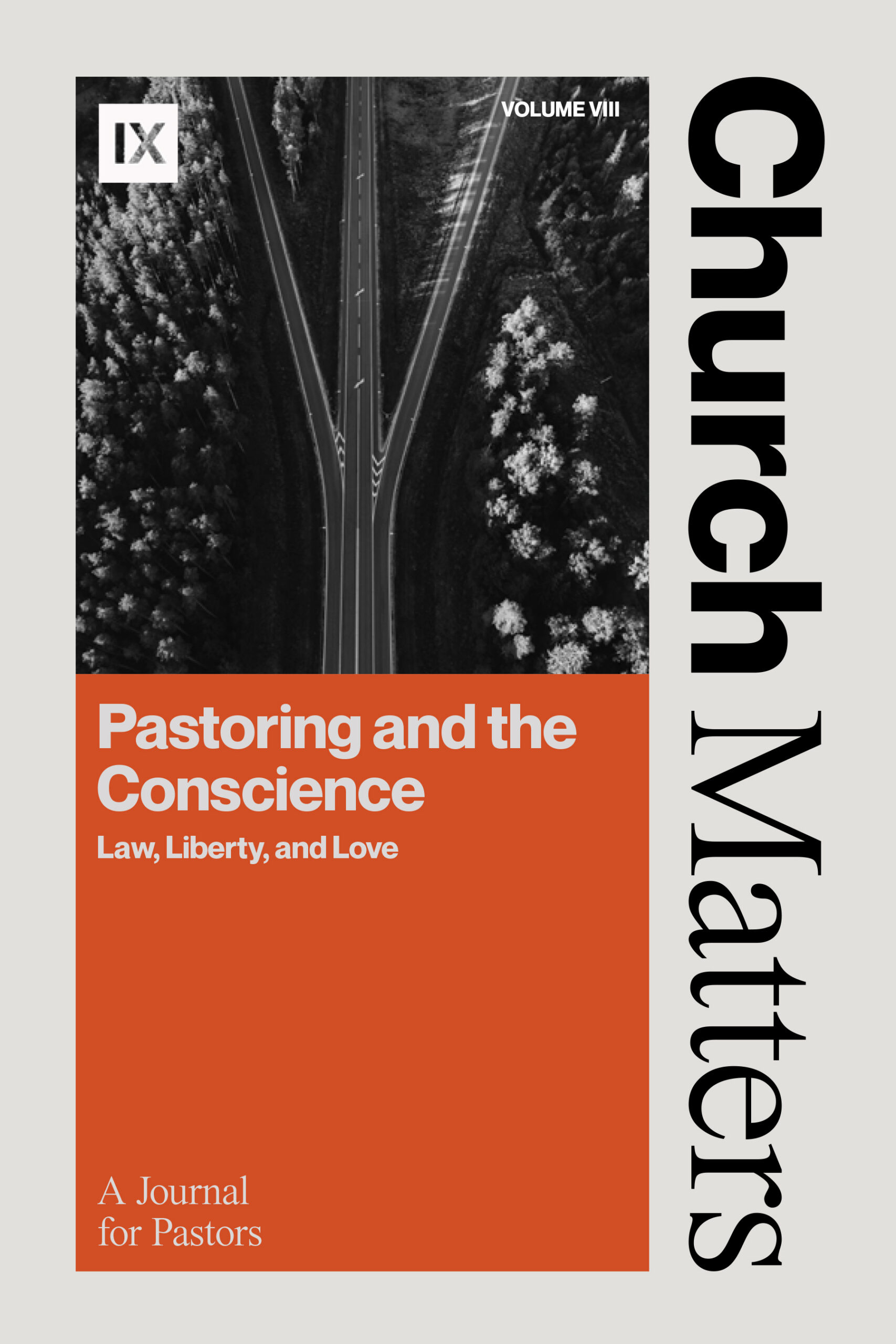
9Marks, Church Matters Volume VIII: Pastoring and the Conscience

When a Southeastern grad and a Welch grad marry each other We are truly, “Better Together”!
Kudos to my wife for her timely humor on the heels of the annual National Convention. It was a full, tiresome week, but a good one.
If you enjoy Churchatopia, would you take time to share a link to this Substack site and/or some Churchatopia that you benefited from?
No posts
Comments
Nothing yet. Say the first thing.
Sign in to join the conversation.