
Cedar Rapids Mayor Tiffany O’Donnell summarized the pinch that Americans are in when it comes to data centers:
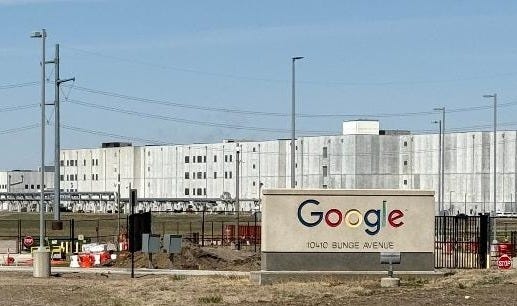
The Google data center in Council Bluffs that grows out of the distant landscape like Emerald City.
Every Google search, online bank transaction, credit card purchase, streaming media download. Amazon order, cloud photo backup, Zoom meeting, GPS route map, social media post -- and email subscription to Substack like this one -- depends on a data center somewhere.
Everything we do in our virtual daily lives now requires the processing, storage and transmission of batches of data and information made up of 0s and 1s.
Describing the “necessary infrastructure” as no longer optional but essential, O’Donnell took to her Facebook page to explain and defend her city’s openness to data centers, touching on the topline questions. She concluded: “The communities that embrace responsible innovation will shape the future. The ones that don’t will watch it happen somewhere else.”
Responsible. Ahhhh, yes. Let the definition of “responsible” be our schism.
On a recent trip through the countryside to assess storm and flood damage in Dubuque County, I drove past the farmland a developer has eyed for a potential data center client. According to the Pew Research Center, data centers covet rural locations.
Thanks for reading Iowa Dude! This post is public so feel free to share it.
To start with, the definition of data centers is squishy. Two people would have trouble agreeing on it. Iowa recently expanded public subsidies for the services they provide without mentioning the words.
The Amazons, Googles, Metas, Microsofts and Apples of the world often do not secure their own sites. The firms rely on middlemen to scout communities and sites where they may be welcome, sparing the name brands the time, expense and potential blowback, or hits to their goodwill (an actual asset on corporate balance sheets). Development costs are passed on to the end users of heavy cloud workloads, supercomputing and generative AI.
AI. Ahhhh, yes. Artificial intelligence.
The above-the-ground case made against data centers focuses on energy, water, conversion of farmland, size, noise, emissions, setbacks, information disclosure and public incentives – the usual development-related issues.
But what about the undercurrents? What explains how data centers have become such pariahs, lightning rods, the new carbon pipelines when it comes to setting the hair of Iowans on fire?
For many people, privacy is the central issue. The belief: Data centers are where personal data from our digital interactions are collected by faceless, irresponsible racketeers and peddled for profit, disrupting our lives. Meanwhile, government remains unable or unwilling to protect that privacy.
According to Pew, public opinion on data centers is trending downward. The greatest opposition comes from younger Americans.
A radio broadcast I heard on my rural windshield tour hinted at one reason for this turn in opinion. “The Daily” is a popular New York Times news analysis podcast on Iowa Public Radio. That day, host Natalie Kitroeff and her guest discussed “Young Economic Populists Reshaping the Left.”
Thesis: A generation of young people was advised by elected officials and others to borrow huge sums of money for college educations so they can qualify for the jobs of the future and be better off than their parents. Many have found the opposite to be true. Large numbers of graduates are now unemployed (in their chosen fields), underpaid and underwater on their debt, with no bailouts in sight.
Among the causes: Automation, globalization, dilution in the value of college degrees,the decline of unions. Now, add an “affordability crisis” to the cauldron, a life crisis for many that some attribute to the avarice of billionaires and faceless corporations taking advantage of wars, pandemics, climate disasters and D.C. accomplices.
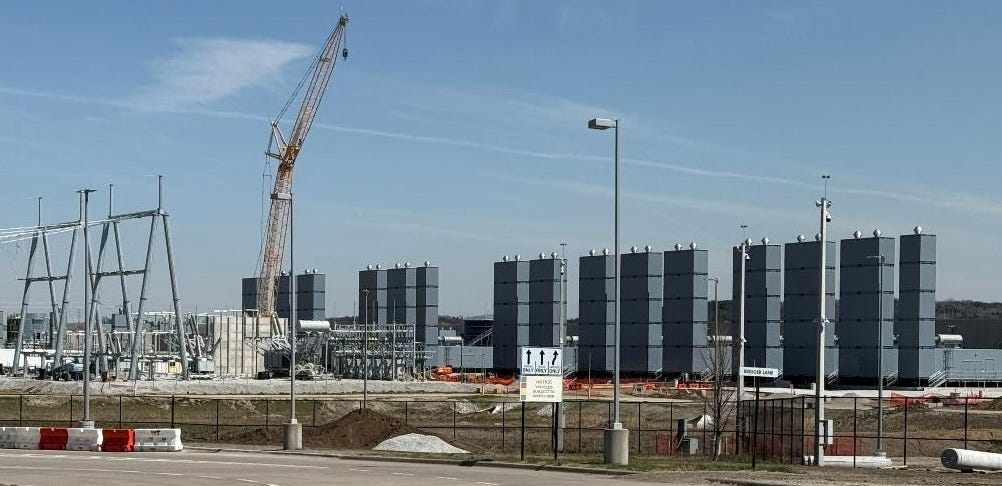
Construction at the Google data center in Council Bluffs in 2025, Data center owners tend to grow their existing facilities rather than break new ground elsewhere.
My takeaway: Data centers are an incarnation of economic insecurity. Opposition to them is a tangible manifestation of generational frustration. They hold “artificial intelligence” and its propagators responsible for a range of social maladies -- taking their jobs, tanking their future prospects, usurping the public square with deceitful social media, even gutting democracy itself.
Parents – they’d love to see their kids move out of the basement again and pay off their debts. At the macro level, the AI takeover suppresses the “economic optimism index.”
Organizing to oppose a tangible thing is easier than opposing an intangible idea. Most recent example: Public opposition to large “ICE prisons” – super-sized immigrant detention facilities (often converted warehouses) that U.S. Homeland Security is building across the country. Rabbling crowds are flooding public meetings to express their fury, using public pressure to block them where possible. Data center opponents are taking notes.
In the short term, most data center construction will go nowhere fast. Where moratoriums are in place, no projects not already on the table will be proposed. Such projects would become pinatas.
We’ve seen that movie before. In 2025, Dubuque County supervisors spent months working on a renewable energy ordinance. The county zoning commission, bent on “just saying no,” proposed regulations that would have made most projects non-viable. A solar developer working with farmers near Holy Cross withdrew. Nothing has been heard about the ordinance since.
Iowa lawmakers tried and failed to standardize local government regulation of renewable energy facilities. In 2026, the Legislature also failed to adopt modest disclosure requirements for data centers. The issue may yet emerge as a major partisan divide on the November election campaign trail.
The economic and social sky backlighting the rise of “responsible” data centers does not dismiss the fact that serious practical issues cloud their feasibility in many places.
The conversion of farmland -- whether for housing, energy or industry – eventually comes down to a private property rights debate. The closer you get to residential and other developed areas, the more that setbacks, noise, heat, air quality (from diesel generators) and other operational issues loom large.
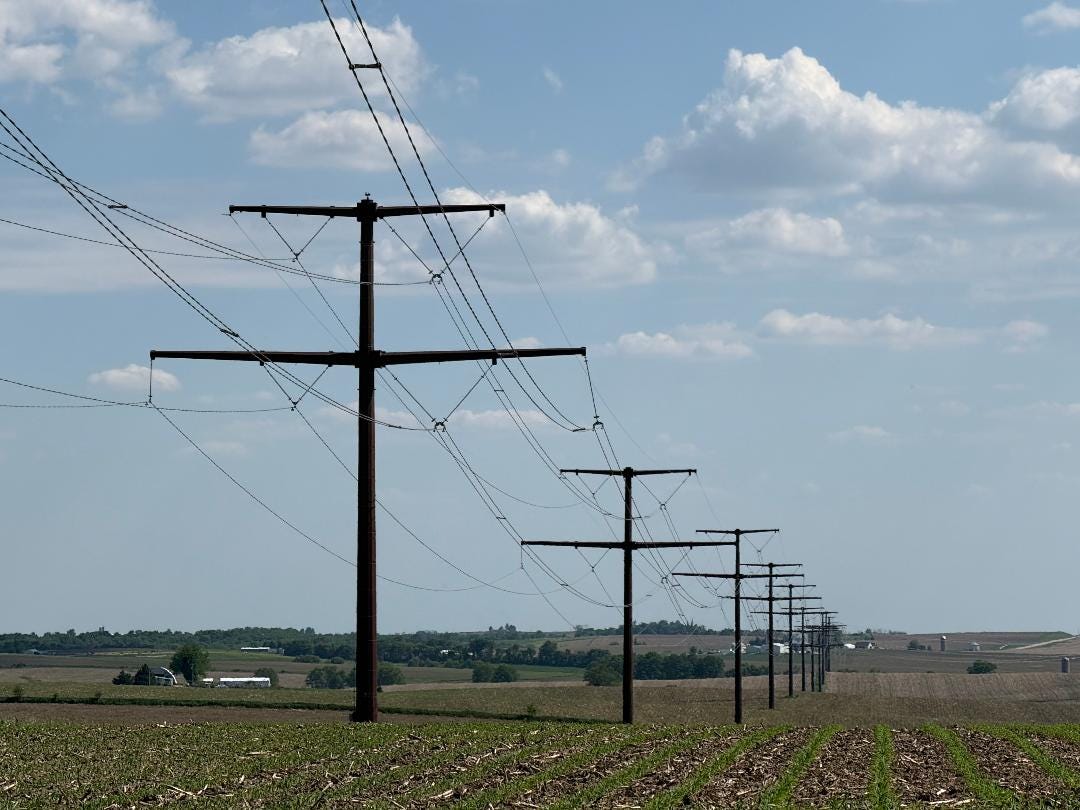
Data centers need power. They are close to electric transmission lines, like this one that crosses southern Dubuque County.
Water and energy use are the main drivers of public policy scrutiny.
Groundwater withdrawals may be addressed by new technologies that allow for re-use in “closed-loop” systems. Since water is defined as a public wealth in Iowa, state lawmakers can incentivize reuse with an excise tax similar to what other states impose on oil and gas.
In fact, anticipating that hydrogen and rare earth mineral mining may be the next extraction booms in the state, Iowa lawmakers drove a stake in the ground this session by prospectively imposing such a tax.
As I calculated for another essay, even a .0001 per gallon tax (one-hundredth of one cent) on a sand mining company would raise $400,000 a year, based on their projected use of four billion gallons. Such a fee -- spread across all private water users in the state -- could raise a pretty penny to address surface water quality and help communities provide clean drinking water and wastewater treatment for their residents.
A prospective developer approached the City of Dubuque about water. The City just extended service to the airport area. For the site in question, annexation might be required, which would be a stretch. In 2016, the City of Dubuque bought out a nearby rural water system, setting themselves up as the go-to provider for economic development south and west of the city.
Dubuque, not always a role model for public participation when crafting ordinances, mailed a survey seeking input from all its residents. County supervisors, lacking the professional staff to charge with carrying out its directives, describes itself as “going in circles.” The body is considering an outright, permanent ban.
Energy remains the biggest question mark. The company exploring Dubuque County, Karis, develops cold storage, industrial and data center sites for lease. Why did they approach farmers for the 420 acres they are looking for on land in the flight paths of the regional airport?
Simple: Because the center would be under an electric transmission line, next to a large substation and above a natural gas pipeline not far away: Everything needed to power a data center. Or fuel an on-site power plant.
As it happens, MISO -- the “Midcontinent Independent (Electrical) System Operator” – is studying a plan to extend a 340-kilovolt transmission line to the Salem substation in that area. Stated purpose: To serve a 160-megawatt natural gas electric generation facility.
A similar project in Scott County proposed by CIPCO (Central Iowa Power Cooperative) is being entertained by the Iowa Utilities Commission. CIPCO says the project is needed to serve existing rural electric customers. Alliant Energy wants to build a 720-megawatt gas-fired power plant in Linn County for data centers.
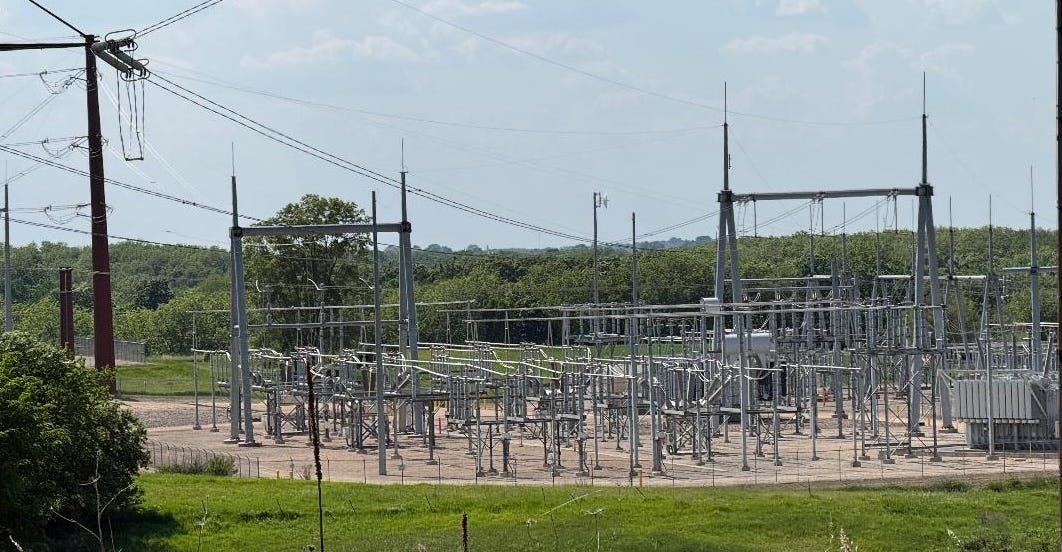
Substations like this one in southern Dubuque County take power from transmission lines owned by companies like ITC Midwest and step down the voltage so the electricity can be distributed to utility customers served by companies such as Alliant Energy and Maquoketa Valley REC.
Fossil fuels provoke climate activists. Natural gas and diesel-powered generation create carbon pollution, causing global warming. Heat waves increase data center power demands. A few states with robust climate policies (Iowa is not one of them) require new data centers to run on renewable energy such as wind and solar.
In any case, the transmission and distribution companies tell me that new customers with large electricity demands would be required to pay for the power generation and transmission grid enhancements that “load” would require. Their policies: Don’t make existing customers pay the costs to serve big new customers. ITC Midwest claims that once such high-load customers are brought on line, they can lower the transmission costs assessed to all other customers.
What remains the driving force for elected officials like Mayor O’Donnell? The construction industry likes data centers. Otherwise, data centers don’t directly employ a lot of people. States are not requiring huge job numbers in exchange for generous subsidies. Yet some communities benefit from new jobs when ancillary industries “co-locate” where data centers are being constructed. A Des Moines firm that manufactures electrical equipment for data centers and utilities has asked the state for $2 million in tax benefits to create 160 new jobs.
The pot at the end of the rainbow for local government is $$$. Tax revenue. Iowa lawmakers put cities and counties in straitjackets this year. Property tax increases that city councils and supervisors can collect to pay for higher costs of basic services are limited: two percent max.
The only way out of the pickle: Create new taxable value. Data centers result in new buildings and increased land values, generating new property taxes not subject to the cap. Catch-22: No one knows how much tax revenue a project might generate until an actual project is proposed. A moratorium prevents considering that factor.
So I close out this treatise with an indirect comparison.
John Deere Dubuque Works covers 140 acres and employs 2,800 people in Dubuque County. Assessed value of property in 2026: $15.6 million. Value exempt from taxation: $355,000 (2.3 percent). Property taxes paid: $332,218.
The Microsoft Data Center on Booneville Road in West Des Moines, built between 2021 and 2026, covers 153 acres. Microsoft employs 600 people across the community. Investment in buildings: $1.2 billion. Investment in equipment (servers, storage, networking): $1.1 billion. Assessed property value in 2026: $804 million. Value exempt from taxation: $315 million (39 percent). Property taxes paid: $4.9 million.
Do the rest of the math. Local elected officials are.
West Des Moines, Polk County and the school district use the money to do more nice things for their residents and students. They can reduce the property taxes everyone else pays.
Is that the end of the story? Hardly.
The show isn’t over until somebody sings, as the saying goes, but I have a sudden urge to hear some Judas Priest.
No posts
Comments
Nothing yet. Say the first thing.
Sign in to join the conversation.