
Was the runner safe at first? Did the wide receiver step out of bounds before reaching the goal line? Was the foul flagrant one or flagrant two?
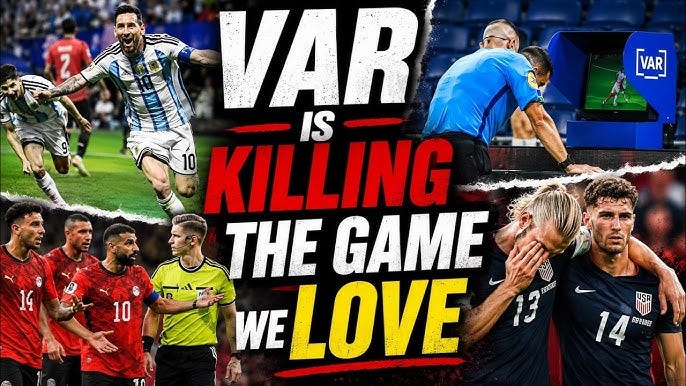
Everyone is weighing in, so I might as well, too, on what seems to have become the most talked about issue of World Cup 2026. The technology designed to eliminate controversy is creating it, instead. Hérculez Gómez, former U.S. national team player and now a sports commentator for ESPN, had this take on use of VAR.
Spectators and home viewers are accustomed to instant replay being used to correct umpires and referees.
Controversy over removing the “human element” from sports (“we all make mistakes”) reached a new level at the World Cup. The United States’ top goal-scorer was ejected from a game for (accidentally?) stepping on an opponent’s ankle.
Folarin Balogun’s automatic one-game suspension was lifted by the rules committee of soccer’s governing body, FIFA. He played in the following game against Belgium. Balogun made no impact and the U.S. lost anyhow.
The reversal set an astonished soccer world ablaze. In addition to the political interference involved in “changing the rules in the middle of the game,” the incident also focused attention on soccer’s use of a “video assistant referee” or VAR.
As a soccer referee for many years, I have my own take.
The system puts an extra official in a remote replay room to help the on-field referee in critical situations. “Clear and obvious errors” can be corrected and unseen incidents of serious misconduct addressed. That’s the story, at least.
Thanks for reading the Iowa Dude. This post is public so feel free to share it.
Off-field review in soccer started in 2014 with goal-line technology to certify if the whole ball crossed the whole line to score a goal. Such use of replay is now widely accepted in most sports, including hockey and football. In 2022, full-blown use of a VAR came to the World Cup in Qatar.
Set aside the hullabaloo over Balogun’s get-out-of jail-free card. The way video-assisted review is now being used changes the way referees work, not always for the better. The outcome of games is affected in unforeseen ways.
Chip technology inside the ball allows a computer to automatically determine if and when a ball is touched. That is being used to decide whether a player is offside.
Croatia was eliminated and Portugal advanced when Joško Gvardiol’s dramatic last-minute goal was wiped out this way. No visual replay showed that a teammate “clearly and obviously” redirected the ball on its way through to Gvardiol. No players on the field were “up-in-arms.” Many spectators including me found that outcome unjust.
Penalty kicks (usually leading to goals) and “sending-offs” (punished with game suspensions) often result from VAR reviews.
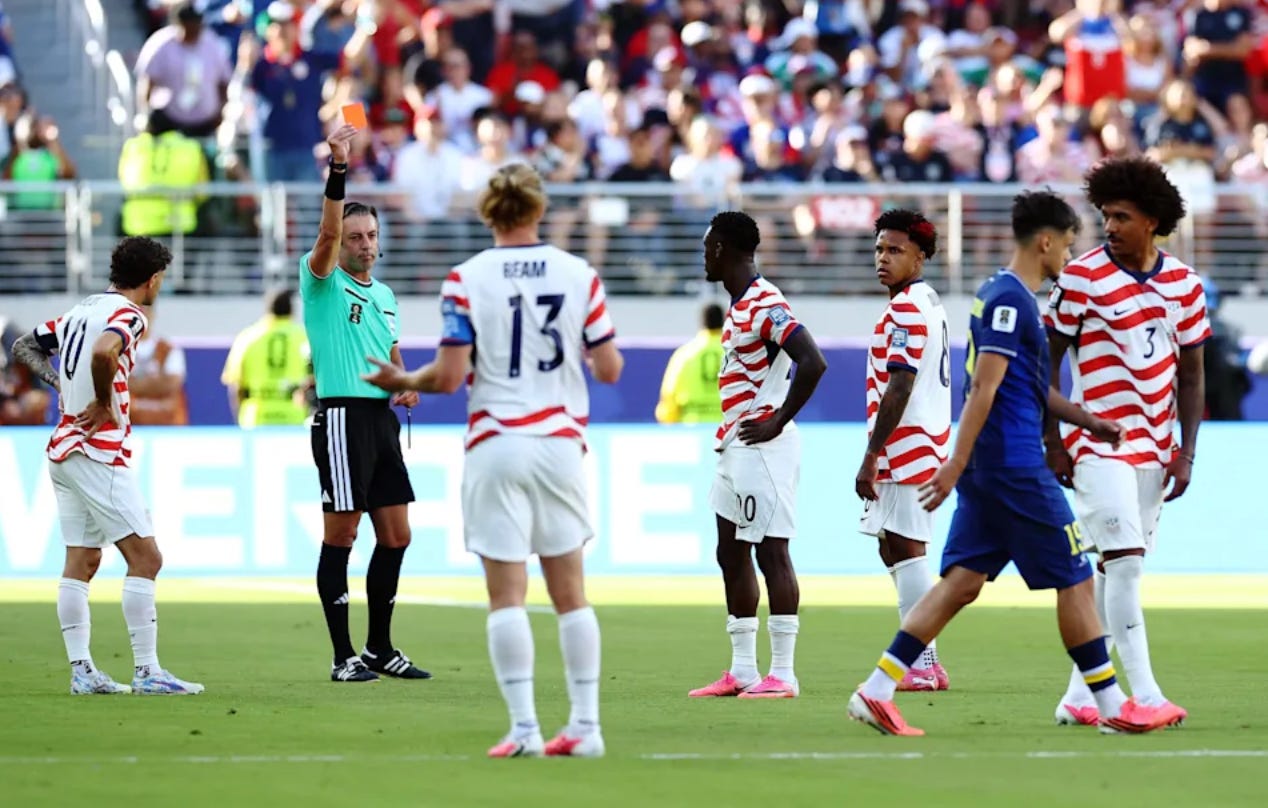
Folarin Balogun of the U.S. is shown a red card by referee Raphael Claus. Photo Credit © Phil Noble, Reuters via Imagn Images.
In many situations, the referee has not whistled at all. Case 1: The foul by Balogun. Case 2: A penalty kick for Mexico called against England’s Harry Kane in an incident the referee looked straight at in real time. Case 3: A goal denied to Egypt for a “foul” 100 yards away for contact other referees have overlooked under FIFA’s preference to “let them play.”
Both the French referee and VAR did exactly that 34 minutes later when Egypt captain Mohammed Salah was kicked in the penalty area. Argentina went the length of the field to score the deciding goal.
Some referees seem to use the VAR as a crutch, no longer trusting their own eyes, hesitant to make decisions themselves. The VAR simply “re-referees” the game from the booth, making their own judgment calls, even though using slow-motion and stop action replay is supposedly against protocol.
Nothing happens on the field in slow motion. Players, coaches and fans don’t expect to agree with referees on every judgment call. We get on with the game.
What players and coaches really prize is “consistency” within the game, knowing what to expect. The VAR makes consistency on the field hard to achieve. Plus, you never see what you often see in hockey and football – officials huddling to compare notes in efforts to get the call right. That reassures players and fans alike.
So, we get situations that will enrage debate for years. Case-in-point: The send-off of Switzerland’s Embolo in a quarterfinal game. A yellow card against an Argentina player turned into a second caution for Embolo for “diving” (referred to as simulation in the rules). Why? Because the VAR turned a simple misjudgment by the referee (who did not consult his partners) into a case of supposed “mistaken identity.”
Had the protocol allowed the Portuguese referee to use common sense, he would have rescinded the caution against the Argentina player, put his card back in his pocket and wagged his finger at Embolo. "Dude, fool me once, shame on me. Do it again and the shame will be on you.” The situation would have been quickly forgotten in the fog of World Cup history. Instead, Switzerland was forced to play the rest of their game a man down, on their heals, until Lautaro Martinez scored the winning goal for Argentina. The anti-VAR crowd erupted.
Video review in soccer is more accepted when getting it right involves factual situations such as whether a foul occurred inside or outside the penalty area. Or did the assistant referee fail to see that a goal-scorer was clearly offside by more than a toe?
Spectators aren’t interested in seeing great goals wiped out when a body part is slightly past a defender based solely on a microchip in a ball and artificial intelligence that “prove” when the ball was last played.
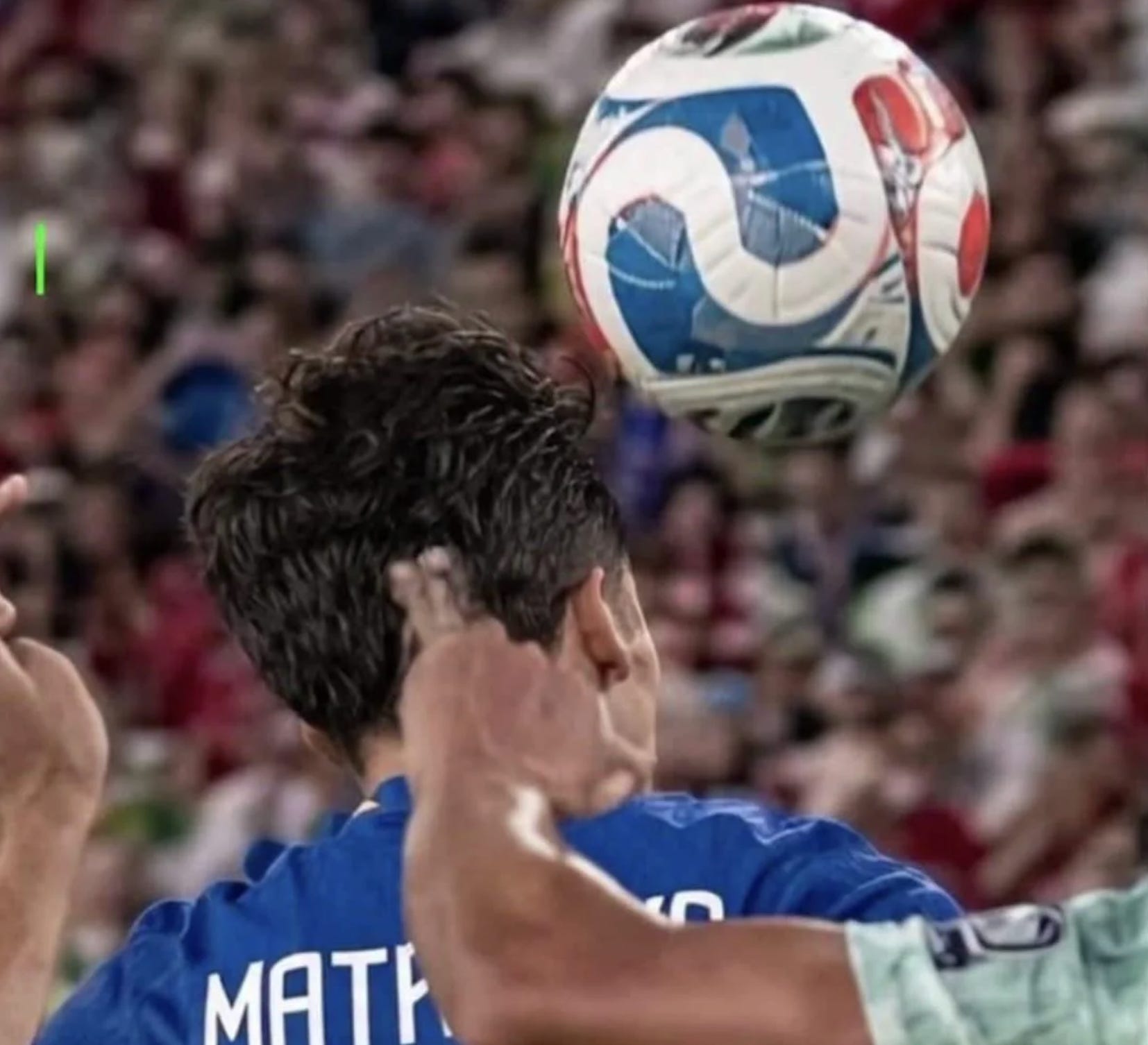
Technology in the ball and AI were used to detect contact with strands of hair on the Croatian player’s head, putting his teammate offside on the tying goal and put Croatia out of the World Cup against Portugal.
In my experience, if the referee is decisive, a VAR will not often suggest that on-field calls be reviewed. If Argentinian referee Raphael Claus had shown Balogun a yellow card (which is what the clumsy foul deserved) the VAR probably would not have intervened based on a cringy still photo. If he had, Claus could have stuck with his decision. By the time the VAR told Claus to take a look at the monitor, with no other decision made, Balogun was toast.
I attend annual training sessions to keep my soccer refereeing licenses. We are told the role of the referee is to make the game “E-S-E” (easy) – that is, enjoyable, safe and equitable, or fair, for players and spectators alike.
The VAR system, with its long delays and inconsistent use, makes the game harder for referees, squashes the enjoyment of fans, and sometimes robs the players of justice. Let’s find ways to argue more about what happens on the field and less about what happens in the VAR booth.
I foresee a day when soccer takes the route of other sports: Give the team captain two chances to request video review for limited, defined reasons, but not to question judgment calls. Use them wisely. Otherwise, “play on.”
This essay was updated from an article first published in the Dubuque Telegraph Herald on July 12, 2026.
No posts
Comments
Nothing yet. Say the first thing.
Sign in to join the conversation.