
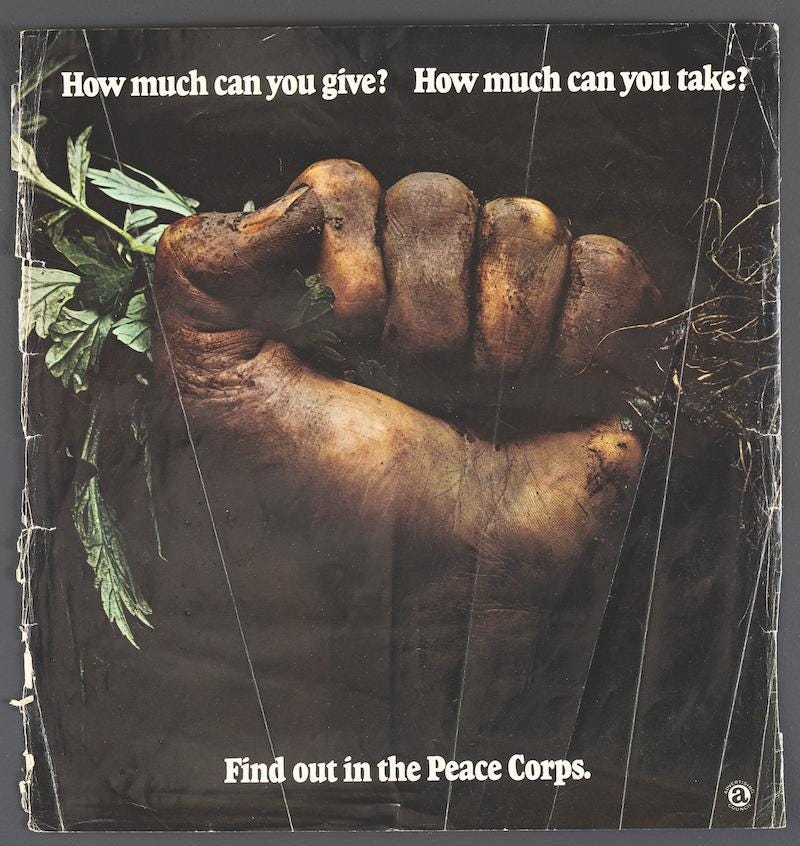
In the early hours of October 14th, 1960, the crisp autumn air blew through the streets of the University of Michigan. It was 2 o’clock in the morning, so you would not be remiss for thinking the student body was either sleeping, partying, or studying for midterms. Instead, thousands of students were crowded outside the student union listening to an impromptu campaign speech by then-Senator John F. Kennedy. Fighting through the exhaustion of the final months of a presidential run, Kennedy called on the engineers, teachers, and doctors of the crowd to do their part in projecting soft power internationally. His challenge to contribute part of their lives to their country by bettering humanity abroad struck a nerve, and Kennedy’s proposal for a Peace Corps (PC) soon became an official campaign pledge.
The Peace Corps was the culmination of decades of discussion for a “peace army” to spread American goodwill across the developing world, but JFK made it a reality in March 1961, and he tasked his brother-in-law Sargent Shriver to lead the program. First by executive order, and later given a permanent budget of $40 million by Congress, the Peace Corps garnered thousands of applications, with students around the country eager to answer Kennedy’s inaugural call to ask not what their country could do for them, but what they could do for their country. To fulfill the new president’s wishes, volunteers needed to complete an intense boot camp, with the first groups training for missions in Ghana, Tanganyika (now Tanzania), and Colombia, with Ghana 1 being the first to land on site. But how did we get to this point?

One precursor of the Peace Corps was the International Voluntary Service (IVS), which “[utilized] the services of volunteers on an organized basis to combat hunger, poverty, disease, and illiteracy in the underdeveloped areas of the world and thereby further the peace, happiness and prosperity of the peoples thereof.” IVS was an independent, non-profit organization that worked closely with the U.S. Foreign Operations Administration, borne out of the success of the Marshall Plan—America’s initiative to rebuild Europe after its decimation in the Second World War.
Fostering peace through humanitarian aid and development was crucial to the United States’ Cold War strategy, as influence in the Global South was sought after for both the Soviet Union and the U.S. The success of programs like IVS directly influenced policymakers’ conversations around a formal government program to support developing nations. A “peace army” would surely boost the image of capitalism and democracy, showing off the incredible post-war economic growth of the United States, highlighting the country’s willingness to share that wealth abroad, and providing bargaining power in the future.
The Peace Corps was founded with three fundamental principles: teaching skills that help interested countries with their needs, promoting a better understanding of Americans abroad, and promoting a better understanding of different cultures domestically. These three pillars have remained unchanged over six decades; every Peace Corps volunteer understands them implicitly. The third pillar, spreading knowledge of other cultures domestically, is highlighted again and again in the stories that returned Peace Corps volunteers share on SoftPower/FulStories—along with the fervent belief that they got more than they gave or learned more than they taught during their service
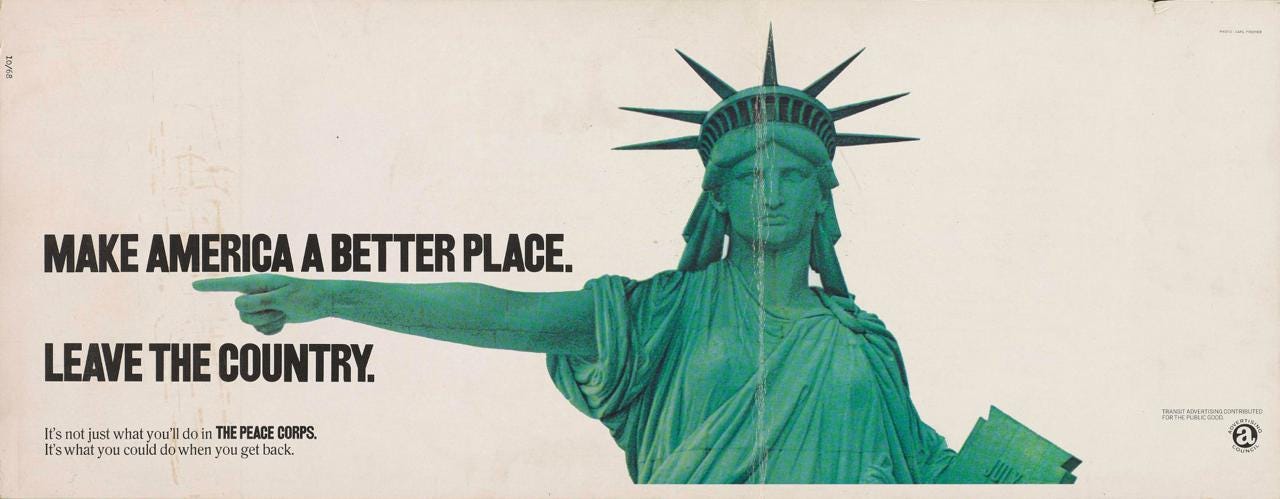
The first field deployment of Peace Corps volunteers (“Ghana 1”) arrived in Accra on August 30, 1961. To take part in that pivotal journey, volunteers were whittled down from the huge pool of applicants. In fact, eighty percent of applicants were dismissed before boot camp. Training lasted three months and included intense language lessons. These volunteers were about to be shipped across the globe to very remote areas where English was spoken by virtually no one.
One volunteer recalled the training mantra: “Here today, Ghana tomorrow.”
Volunteers in Ghana were largely assigned as teachers. Their first issue arose quickly, and is one shared by decades of Peace Corps volunteers: a lack of materials. They were able to access materials in their respective villages; however, they were inadequate to meet the students' demand. Textbooks were scarce, outdated, and unreliable. Volunteers had to use their ingenuity and adapt to the circumstances. Chalkboards were marked from corner to corner, students huddled around the few up-to-date books, and the teachers even created their own curricula from scratch.
The ability for these volunteers to adjust to their circumstances and make the most of their resources paved the way for every mission after them. 144 countries have been or are actively served by the Peace Corps, whose alumni now number a quarter of a million Americans. Each of those 250,000 people has a story of resourcefulness and ingenuity, not to mention resiliency. [At the end of the essay, we’ve linked to some of our favorite stories.]
Each of these hundreds of thousands of Peace Corps stories is vitally important, as the culture and knowledge exchanged between the U.S. and countries all over the world over the last 65 years is immeasurable. Despite this, the recent political climate and inward-looking policies of the current Administration have led to budget cuts and even calls for the dismantling of the Peace Corps. The budget of ~$400 million for FY26 might sound like a lot, but in reality it represents less than 0.01% of the United States' annual budget. The return on that investment is priceless.
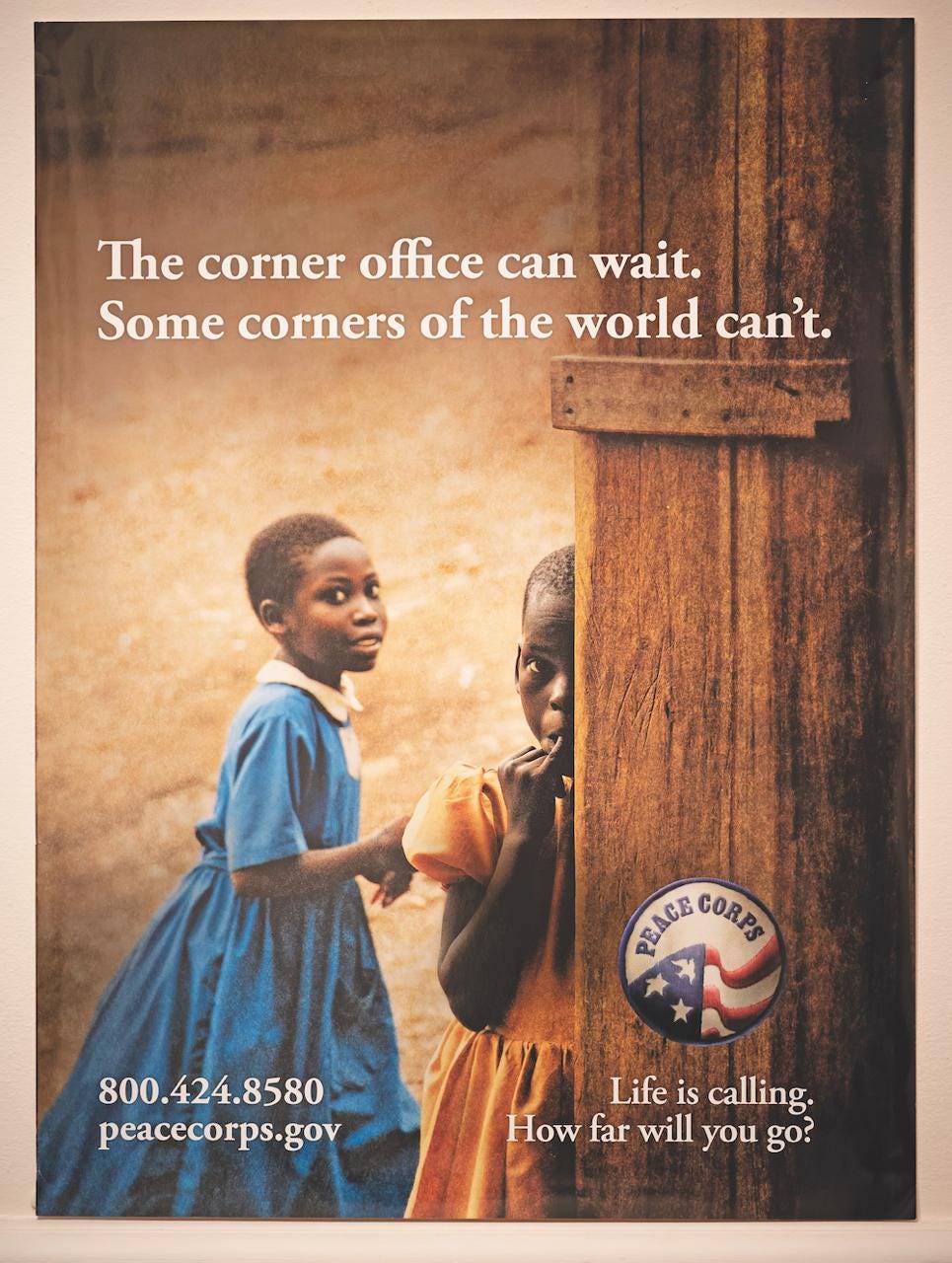
Imagine you have a family member, perhaps a “dubious aunt,” who would rather spend that $400 million in the United States. What would you say to her? Is 0.01% of the richest country’s budget going to bettering our global citizens, facilitating cultural exchange, and building goodwill worth it? As Former Peace Corps Director Aaron Williams puts it, “No matter how you look at it, we are interconnected in the world like never before.” It is incredibly important to take this reality of the 21st century with us as we consider how we approach foreign policy. No country exists in a vacuum.
If you enjoyed this story, we know you’ll love the following episodes…
LISTEN: "Peace Corps Baby" - Burton Cummings
Thanks for reading! This post is public so feel free to share it.
No posts
Comments
Nothing yet. Say the first thing.
Sign in to join the conversation.